
List of Abbreviations
DARAC Departmental Audit and Risk Assurance Committee
FTE Full-time equivalent
NIFHA Northern Ireland Federation of Housing Associations
NIHE Northern Ireland Housing Executive
PAC Public Accounts Committee
RHAs Registered Housing Associations
RSAR Regulatory Standard Annual Return
RSH Regulator for Social Housing
SHP Social Housing Policy
SHPO Social Housing Policy and Oversight
TFF Tenancy Fraud Forum
TFOG Tenancy Fraud Oversight Group
TFU Tenancy Fraud Unit
Key Facts
49,000
the number of applicants on the social housing waiting list at 31 March 2025
134,000
the total number of social homes in Northern Ireland
284
the number of social homes recovered in 2024-25 as a result of tenancy fraud and misuse
4,000
the potential number of social housing properties that could be subject to tenancy fraud and misuse in Northern Ireland
£28,450
is the estimated cost of a tenancy fraud case in Northern Ireland
£8 million
the estimated cost to the public purse in 2024-25 arising from tenancy fraud and misuse
Executive Summary
Background
1. Social housing tenancy fraud and misuse was defined in our 2013 report as ‘the use of social housing by someone who is not entitled to it.’ In the absence of an agreed definition for the purposes of this report, social housing tenancy fraud is defined as the:
- attempt to gain or acquire a social home by providing misleading, incomplete or deliberately false information; or
- misuse of a social home, including the allocated tenant not occupying the social home as their main or only home and/or by sub-letting the property.
With current unprecedented demand for social housing, tenancy fraud and misuse of social housing denies a home to vulnerable homeless households on the social housing waiting list. On 31 March 2025, 32,000 households in Northern Ireland were legally homeless, waiting for a social housing property.
2. In Northern Ireland there are a total of 134,000 social homes with 83,000 managed by the Northern Ireland Housing Executive (NIHE) and over 51,000 managed by one of eighteen Registered Housing Associations (RHAs). Within these 51,000 properties, approximately 37,500 are categorised as general need, 8,800 as sheltered and 5,000 as supported properties. The scope of this report does not include the sheltered and supported properties.
3. The Department for Communities (the Department) is responsible for housing policy in Northern Ireland. It is also the regulatory authority (the Regulator) of the RHAs, monitoring and assessing compliance with a number of financial, consumer and governance standards contained in the Regulatory Framework. RHA Boards are primarily responsible for leading and governing their organisations to ensure that regulatory standards are met.
4. The NIHE is responsible for tackling tenancy fraud and misuse within its own housing stock and reports to the Department. It is an executive member of the Tenancy Fraud Forum (TFF) UK and has its own dedicated specialist Tenancy Fraud Unit (TFU) which investigates complex cases of suspected fraud on behalf of local NIHE offices.
5. While social landlords in Northern Ireland, can take action to recover stock where there is misuse or indications of tenancy fraud through civil enforcement, pursuing tenancy fraud and misuse through the criminal law provision in the Fraud Act 2006 is exceptional. There is no dedicated tenancy fraud and misuse legislation such as the ‘Prevention of Social Housing Fraud Act 2013’ in England and Wales, which aims to deter tenants and make subletting a criminal offence.
6. In September 2013, we published our report ‘Tackling Social Housing Tenancy Fraud in Northern Ireland’ which found that, although fraudulent properties were being recovered across the sector, public bodies were not sufficiently proactive in tackling tenancy fraud and misuse. For example, the RHAs did not have tenancy fraud and misuse strategies in place, tenancy fraud and misuse data was not routinely collated, and there was no dedicated TFU within the NIHE. Subsequently, in October 2014 the Northern Ireland Assembly’s Public Accounts Committee (PAC) issued its own report. A number of the recommendations made in this report have not been fully implemented and /or remain outstanding, including:
- since 2016, the Department has not driven forward efforts to establish an evidence-based baseline figure for the level of tenancy fraud in social housing in Northern Ireland;
- the Regulator is yet to assess the adequacy of the RHAs’ tenancy fraud and misuse strategies or review performance targets in this area; and
- the first phase of legislative reform ‘The Administrative and Financial Provisions Act’ is progressing through the Northern Ireland Assembly and is currently at Committee Stage. The second phase, which includes several dedicated tenancy fraud provisions broadly based on ‘The Prevention of Social Housing Fraud Act 2013’, is planned for public consultation in 2026, with introduction anticipated in the first year of the next legislative mandate.
More than twelve years since we last reported, significant work is still required to progress these areas.
Key Findings
There is no complete picture of tenancy fraud and misuse across the social housing sector
7. There is an uncoordinated approach by the Department to the collection and recording of RHA tenancy fraud and misuse data. There are differences in the nature, type and timing of tenancy fraud and misuse data being collected within the Department by the Social Housing Policy (SHP) Team and the Regulator.
8. The Department’s SHP team collect data on suspected and actual cases of fraud and misuse, with no data sought on outcomes such as recoveries. This is used by the SHP team to inform policy and legislative work and report quarterly to the Departmental Audit and Risk Assurance Committee (DARAC). Information collected by the Regulator is retrospective in nature and includes recovery data for tenancy frauds and abandonments. The Department has acknowledged there is an opportunity for a more coordinated and streamline approach to data collection in order to remove duplication of effort and ensure complete data is captured in real time to inform performance assessment and decision making.
9. There are no formal arrangements for the Regulator to monitor tenancy fraud and misuse, with no explicit reference to such within its financial, consumer and governance standards contained in the Regulatory Framework. This is in contrast to the position of the Regulator for Social Housing in England, who includes tenancy fraud and misuse within its standards.
10. Without a joined-up approach and coordinated reporting, there is no complete picture of tenancy fraud and misuse performance, and the number of suspected tenancy frauds and recoveries in Northen Ireland. While the NIHE publishes data for its 83,000 homes, no equivalent data is published for the 37,500 homes managed by the RHAs.
There has been no improvement in the number of recoveries made due to tenancy fraud and misuse since we last reported in 2013
11. While there has been a general upward trend in the reporting of suspected tenancy frauds and misuse since the COVID-19 pandemic, the number of recoveries has not followed the same trend. The total number of recovered properties is lower than when we reported in 2013, falling from 363 properties recovered in 2011-22 to 284 properties recovered in 2024-25. In relative terms, taking account of the size of total housing stock, the number of properties recovered per 10,000 houses has fallen from 29.5 in 2011-12 to 23.7 in 2024-25. The Department indicated that this may be a consequence of the actions taken by social landlords to deter and prevent tenancy fraud and misuse, including tenancy sustainment measures which involve regular and meaningful engagement with tenants to ensure tenancies are being lawfully and appropriately occupied.
The level of tenancy fraud and misuse in Northern Ireland is unknown
12. An evidence-based baseline estimate of the level of tenancy fraud and misuse in social housing in Northern Ireland has not yet been established, despite being a recommendation of the PAC in 2014. The PAC report considered the number of social homes that could be fraudulently occupied and the extent of tenancy fraud and misuse in Northern Ireland.
13. The TFF reported in 2023 that 1 in 30 of all social homes in England (outside of London) are subject to some form of tenancy fraud or misuse. Using this ratio to illustrate only the potential scale of tenancy fraud and misuse in Northern Ireland, and in the absence of an evidence-based baseline or any other estimate of scale from the Department, up to 4,000 social housing properties could be subject to some form of tenancy fraud or misuse.
There could potentially be significant cost savings if tenancy fraud and misuse was prevented
14. The cost of a tenancy fraud case in Northern Ireland was calculated by the NIHE in 2021-22 at approximately £28,450 per property. The calculation includes estimated amounts for average temporary accommodation costs, investigation and legal costs and void costs. Increases in temporary accommodation and void costs since 2021-22 would indicate that an up-to-date estimate is higher. This calculation is under review by the NIHE, who has advised it was instrumental in establishing the methodology for the figure which is now adopted for use in England. In 2024-25, a total of 284 social houses were recovered in Northern Ireland due to tenancy fraud and misuse. Applying the estimated cost of £28,450 to the 284 recoveries in 2024-25 equates to a cost to the public purse of approximately £8 million arising from tenancy fraud and misuse.
15. Each instance of tenancy fraud and misuse reduces the availability of social housing at a time of unprecedented demand. As at 31 March 2025, the social housing waiting list had grown to more than 49,000 households, while annual expenditure by the NIHE on temporary accommodation increased to over £40 million in 2024–25. Recovering fraudulently occupied and misused properties restores control of public assets for allocation to households most in need on the social housing waiting list. This also contributes to reducing annual expenditure on temporary accommodation, given 18 per cent of allocations from the waiting list are made to households in temporary accommodation.
There is potential to improve the level of tenancy fraud and misuse detection and recoveries through focused tenancy fraud and misuse measures
16. Proactive, co-ordinated and focused measures could be better used to identify tenancy fraud and misuse, while collaboration across the sector has been high level to date. While some measures have already been put in place by the Department, NIHE and RHAs, there are a number of further measures that could be adopted by social housing providers to tackle tenancy fraud and misuse. These include establishing a central tenancy fraud strategy which formalises best practice; agreeing a common definition of tenancy fraud and misuse; and devising and undertaking a co-ordinated annual programme of risk assessed tenancy audits informed by better use of data sharing and data matching. The Tenancy Fraud Oversight Group (TFOG) which was dissolved in August 2019, was re-instated in May 2024 to drive forward sector wide progress taking a more coordinated and strategic approach to detect more tenancy fraud and misuse.
17. Almost twelve years after the PAC recommendation for legislative change was accepted, there are now two proposed changes in relation to tenancy fraud and misuse. The first, the ‘Administrative & Financial Provisions Bill’ will create a single investigatory capability for complex cases of tenancy fraud and misuse. The second is dedicated tenancy fraud legislation similar to the ‘Prevention of Social Housing Fraud Act 2013’ in England and Wales.
Conclusions and recommendations
18. Tenancy Fraud and misuse remains a significant unknown in Northern Ireland. The failure by the Department to establish an evidence-based baseline estimate coupled with the uncoordinated recording of data makes it difficult to get a complete picture. While there is evidence of active fraud prevention measures, there is scope for more to be done and it is difficult for the Department to provide assurance that tenancy fraud and misuse is being adequately addressed and is not putting avoidable stress and associated costs on the social housing sector.
19. Since our last report, there are a number of outstanding actions which are fundamental to moving forward the pace of change in tackling tenancy fraud and misuse in Northern Ireland and these cannot be overlooked. The enacting of the proposed legislative changes, especially those similar to the ‘Prevention of Social Housing Fraud Act 2013’, with the appropriate mechanisms, structures and arrangements to take action, present Northern Ireland with the best opportunity to tackle tenancy fraud and misuse going forward.
Recommendation 1
In line with the PAC’s recommendation from 2013, the Department should establish an evidence-based baseline estimate of the level of tenancy fraud and misuse across all social housing in Northern Ireland within six months of this report.
Recommendation 2
The Department should implement a consistent monitoring and reporting system for all tenancy fraud and misuse data across social houses in Northern Ireland, which is supported by robust oversight arrangements. To achieve this, agreeing a definition of tenancy fraud and misuse is an urgent action point which requires immediate attention.
Recommendation 3
The Department should undertake tenancy fraud and misuse benchmarking exercises to monitor and compare social housing providers’ performance. It should continue to promote and share where best practice and innovative solutions exist in relation to how tenancy fraud and misuse is addressed.
Recommendation 4
The Regulator, through its annual regulatory assessment programme, should ensure that RHA boards obtain assurances on the adequacy, effectiveness and performance of tenancy fraud and misuse arrangements within RHAs. This should include assurance on the adequacy and effectiveness of action taken to prevent and address tenancy fraud and misuse.
Recommendation 5
The Department should agree a single common cost figure of tenancy fraud and misuse across all social housing; and share this information as a means of assisting in the prevention and detection of tenancy fraud and misuse.
Recommendation 6
The Department should develop an overarching Tenancy Fraud and Misuse Strategy for social housing which reflects best practice. The NIHE and RHAs should develop detailed and measurable action plans aligned to the achievement of the strategy’s objectives, targets and desired outcomes.
Recommendation 7
There should be a co-ordinated annual programme of tenancy fraud and misuse audits across a targeted proportion of all social housing in line with best practice. While keeping the merits of this approach under review, the Department should make this a requirement of both the NIHE and RHAs through its housing policy and regulatory functions.
Recommendation 8
The Department should formalise arrangements between the Benefit Security Division and the NIHE’s Tenancy Fraud Unit for the reciprocal investigation of benefit frauds and tenancy frauds where applicable.
Recommendation 9
The Department should take steps now to ensure legislative tenancy fraud and misuse powers can be acted upon as soon as legislation takes effect. This should include making arrangements to carry out data matching across all social housing.
Part One:
Introduction and Background
Recommendations previously made by the NIAO and the Public Accounts Committee to address tenancy fraud and misuse have not been implemented
1.1 In September 2013, we published our report ‘Tackling Social Housing Tenancy Fraud in Northern Ireland’ which showed the number of social houses recovered across the sector as a result of tenancy fraud and misuse, as well as the associated costs of tenancy fraud and misuse to the taxpayer. The report also set out a number of best practice counter fraud measures adopted at that time by housing providers in England. We made five recommendations (see Appendix 1) which included the establishment of a single tenancy fraud team for the social housing sector, requirements for NIHE and RHAs to produce tenancy fraud strategies and for the RHAs to notify the Department of any fraud or attempted fraud or investigation.
1.2 Subsequently, in October 2014 the Northern Ireland Assembly’s Public Accounts Committee (PAC) issued its own report on the matter, noting that many of the tenancy fraud and misuse initiatives were still at an early stage. The PAC set out eight recommendations (see Appendix 2) aimed at establishing the foundations needed to continue developing a proactive and effective approach to tackling tenancy fraud and misuse.
1.3 More than twelve years later, progress against the previous reports’ recommendations has been limited. While a number of recommendations were implemented in the wake of the NIAO and the PAC reports, our RAG assessment of the current position is set out in Appendices 1 and 2. Significant work is still to be undertaken in some areas, in particular:
- The NIHE do not have a dedicated Tenancy Fraud strategy in place.
- There is no assessment of the RHA Tenancy Fraud strategies or performance targets.
- There has been limited participation of RHAs in the NFI or alternative data matching exercises since 2020. The Departments has stated that cost is the main barrier to participation.
- An evidence-based baseline figure for the level of tenancy fraud in social housing in Northern Ireland has not been established.
- Legislative reform has not been completed.
1.4 We do however, acknowledge that some progress has been made such as: establishing a specialist Tenancy Fraud Unit (TFU) within the NIHE; proposed legislative changes to enable the NIHE’s TFU to undertake investigations for other social landlords; and more recently the reestablishment of the Tenancy Fraud Oversight Group (TFOG) by the Department to encourage co-operation across the social housing sector.
What is Tenancy Fraud and Misuse?
1.5 Social housing tenancy fraud and misuse, often called tenancy fraud, was defined in our 2013 report as the use of social housing by someone who is not entitled to it. In the absence of an agreed definition, for the purposes of this report social housing tenancy fraud and misuse is defined as the:
- attempt to gain or acquire a social home by providing misleading, incomplete or deliberately false information; or
- misuse of a social home, including the allocated tenant not occupying the social home as their main or only home and/or by sub-letting the property.
1.6 It is fraud and misuse which denies a social home to someone who is in need, at a cost to the taxpayer and the local economy. Forms of tenancy fraud and misuse include:
- Abandonment – tenant permanently vacates their social housing property without notifying the landlord. This represents over 60 percent of reported cases of tenancy fraud and misuse in Northern Ireland.
- Non-occupation – tenant does not live in the social housing property as their principal home.
- Falsifying a housing application – applicant provides false information on a social housing application to increase their chances of securing a tenancy.
- Subletting – tenant rents all or part of their social housing property without the knowledge or permission of the landlord.
- Key selling – tenant sells the keys to their social housing property to another person.
- False succession – applicant falsely claims the right to succeed to the social housing tenancy of a deceased tenant.
- Unlawful assignment – tenant moves out and passes their social housing property to a friend or family member to by-pass the social housing assessment and/or waiting list.
- Right to buy fraud – tenant misrepresents their circumstances to purchase their social housing property at a discount they are not entitled to.
1.7 The Department has overall responsibility for housing policy in Northern Ireland. The Department’s Social Housing Policy and Oversight (SHPO) Division is responsible for ensuring the policies in place discharge the statutory requirements in relation to social housing for implementation by the NIHE and RHAs. Its objectives are to ensure that policy and guidance is fit for purpose, and to support the development and progression of legislation for areas within the Division’s responsibility, including social housing tenancy fraud and misuse.
1.8 Both RHAs and the NIHE are responsible for investigating reports of suspected tenancy fraud and misuse within their own housing stocks and taking action to recover properties where tenancy fraud and misuse has been confirmed however, the NIHE has its own specialist TFU which currently comprises a total of seven full time equivalent (FTE) qualified fraud investigators reporting to the Head of the Corporate Investigation Unit. This unit deals with complex cases of suspected tenancy fraud and misuse reported against NIHE properties once the local offices have exhausted all lines of enquiry and cannot progress the cases any further. The NIHE told us that without the TFU’s assistance, tenancy fraud and misuse would not be confirmed and properties recovered for the majority of complex tenancy fraud and misuse cases.
1.9 The Department also acts as the regulatory authority (the Regulator) of Registered Housing Associations (RHAs) under the Housing (NI) Order 1992. The Order gives powers to the Department to establish and maintain a register of housing associations and to exercise supervision and control over RHAs. To facilitate this, the Department has established a Regulatory Framework, which was most recently updated 1 April 2024 following an independent high-level review of its effectiveness and relevance. The Regulatory Framework aims to protect the interests of tenants, homeless people and people who use the services provided by RHAs and sets out governance, financial and consumer standards which each RHA Board must comply. There is no specific reference to tenancy fraud and misuse in any of the standards.
1.10 Unlike other regions of the United Kingdom, Northern Ireland does not currently have dedicated tenancy fraud and misuse legislation such as the ‘Prevention of Social Housing Fraud Act 2013’ in England and Wales which aims to deter tenants from committing social housing fraud by making subletting a criminal offence. The Act also allows the court to award an unlawful profit order while making provisions to allow data sharing when investigating social housing fraud. Tenancy fraud and misuse in Northern Ireland has historically been pursued through civil enforcement and general criminal law provisions such as false representation under the Fraud Act 2006. Proposed changes to legislation in Northern Ireland, are outlined within Part Four of this report.
The social housing sector in Northern Ireland
1.11 Currently there are approximately 120,500 of the total 134,000 social housing properties across Northern Ireland classified as for general need. There are 83,000 managed by the NIHE and over 37,500 managed by one of eighteen RHAs. These RHAs are independent, not-for-profit societies, bodies of trustees or companies that provide rented social homes.
1.12 As well as being Northern Ireland’s largest social landlord, the NIHE is the region’s Strategic Housing Authority. In this role the NIHE is responsible for assessing housing need of all social housing applicants and managing the social housing waiting list for Northern Ireland. The social housing waiting list is based on a points system with applicants awarded points determined by the Housing Selection Scheme which assesses eligibility and need. Applicants are added to the social housing waiting list in rank order, and available NIHE and RHA social houses are allocated to applicants with the highest points for that property type and location.
There is unprecedented demand for social housing in Northern Ireland
1.13 Allocations of social housing are not keeping pace with increasing demand in Northern Ireland, with the number of applicant and homeless households on the social housing waiting list continuing to increase and is at an all-time high. There were over 49,000 applicant households on the social housing waiting list as at 31 March 2025, of which almost 32,000 were deemed to be statutory homeless. This represented over 61,000 individuals. This has resulted in a significant demand for homelessness services within the NIHE, with over 4,700 households in temporary accommodation on any given night during 2024-25 at an annual cost of over £40 million.
1.14 To help alleviate the demand and expenditure on homelessness services within the NIHE, it is critical that every available social home is occupied by someone who is entitled to it.
Tenancy fraud and misuse denies some of the most vulnerable households in society of a home
1.15 Ongoing prevention and detection activity to continually tackle tenancy fraud and misuse should always be a priority due to the financial impact alone, with each fraudulent tenancy estimated to cost the Northern Ireland economy £28,450. This level of cost, against the backdrop of Northern Ireland’s current social housing crisis makes it even more compelling both socially and morally to identify, investigate and remove tenancy fraud and misuse from all social housing provision as each case of tenancy fraud and misuse denies some of the most vulnerable households in society of a home.
1.16 Part Three of this report details the costs of tenancy fraud and misuse in Northern Ireland, but as recently as November 2025, the Tenancy Fraud Forum (TFF) reported that ‘tenancy fraud is the second-largest cause of local government fraud losses, costing councils and taxpayers an estimated £1 billion annually in London alone.’ This further demonstrates the financial impact of tenancy fraud and misuse on public finances and why it is important for the C&AG to report on the scale of the issue in Northern Ireland and the success of counter fraud measures being implemented.
Scope and structure
1.17 In 2013, when we last reported, we concluded that while there were cases of social housing properties subject to tenancy fraud and misuse being recovered, performance could be improved by public bodies being more proactive through dedicated tenancy fraud and misuse strategies and counter fraud measures. This study considers tenancy fraud and misuse performance and its impact socially and economically since we last reported. It sets out the current approach of the Department, the NIHE and the RHAs in tackling tenancy fraud and misuse across all social housing in Northern Ireland, and includes recommendations where performance, oversight and reporting, legislative reform, and counter fraud measures can be improved.
- Part Two outlines the current levels of tenancy fraud and misuse being reported across the sector highlighting uncoordinated data collection and recording, the lack of an underlying baseline estimate and the role of the Regulator.
- Part Three considers the estimated costs to the Northern Ireland economy as a result of tenancy fraud and misuse.
- Part Four looks at the current measures being undertaken to tackle tenancy fraud and suggests possible further measures to consider including proposed legislative changes and the need for further joined up working across the sector.
1.18 Our methodology included review and analysis of tenancy fraud and misuse statistics and information held by the Department, the NIHE and the RHAs. We examined relevant reports published by the TFF and the Audit Commission as well as independent reports commissioned by the Department. We engaged with a wide range of tenancy fraud and misuse stakeholders in Northern Ireland and representatives from the UK’s TFF.
Current levels of Tenancy Fraud and Misuse
The level of tenancy fraud and misuse in Northern Ireland is unknown
2.1 The level of tenancy fraud and misuse across all social housing in Northern Ireland remains unknown as no evidence-based baseline estimate has been calculated. The establishment of an evidence-based baseline estimate was a recommendation made by the PAC in 2014, ‘to urgently drive forward efforts to establish an evidence-based baseline figure for the level of tenancy fraud in social housing in Northern Ireland.’ Alongside this, the PAC also recommended that ‘a progress report is compiled by the Department to determine the extent of tenancy fraud and to assess the success of the Department’s counter fraud measures over the next twelve months.’ The previous PAC report considered the number of social homes that could be fraudulently occupied and the extent of tenancy fraud and misuse in Northern Ireland. This recommendation was accepted in the December 2014 MoR by the Department but has yet to be completed.
2.2 The Department has on two occasions attempted to calculate a baseline estimate, but both were not without issue. The initial assessment in 2015 calculated a percentage for RHAs which could not be extrapolated due to the limited representation of the sample. The second attempt in 2016 involved a representative sample of RHA tenancies but reported a baseline percentage of zero following confirmation that all tenancies sampled were correct. The Department has confirmed that no further benchmarking exercises have been undertaken since 2016.
2.3 The absence of an evidence-based baseline estimate means it is difficult to determine the scale of tenancy fraud and misuse in Northern Ireland, the success of counter fraud measures, and the performance of both the Department and NIHE in tackling tenancy fraud and misuse. The TFF report ‘Lost Homes, Lost Hope’ stated that 1 in 30 of all social homes in England, outside of London, were subject to some form of tenancy fraud and misuse.
2.4 If the TFF ratio was used to indicate the potential scale of tenancy fraud and misuse in Northern Ireland, up to 4,000 social housing properties could be subject to some form of tenancy fraud or misuse. Significant numbers of tenancy frauds and misuse could be going undetected resulting in a gap between detected and undetected tenancy fraud and misuse.
Recommendation 1
In line with the PAC’s recommendation from 2013, the Department should establish an evidence-based baseline estimate of the level of tenancy fraud and misuse across all social housing in Northern Ireland within six months of this report.
Data collection and recording is not coordinated across the Department
2.5Without a coordinated approach to data recording within the Department, there is no complete picture of all tenancy fraud and misuse recoveries across social housing in Northern Ireland. The only data published is by the NIHE and is limited to suspected frauds, and recoveries within its own housing stock of 83,000 homes. During 2024-25 the NIHE reported in its Annual Report there were 752 new cases (2023-24: 751) of suspected tenancy, of which 169 cases (2023-24: 212) were recovered. No equivalent data is collectively reported for the more than 37,500 social homes managed by the RHAs.
2.6 Good quality data is essential; referring to the TFF report from 2023, ‘Lost Homes, Lost Hope’, it emphasised that ‘good data is critical to tackling fraud in any sector’ and that the social housing sector in England had effectively been ‘flying blind’ since 2014. It does appear that Northern Ireland is in a similar situation as we have found it difficult to obtain good quality, consistent data for the purposes of this report in relation to tenancy fraud and misuse, and recoveries across all social housing.
2.7 Data collection and reporting is not coordinated across the Department. The Department’s SHP team told us that 20 (2023-24: 19) properties were recovered across all RHAs, however the same information received from the Regulator for 2024-25 confirmed a total of 115 (2023-24: 103) recoveries were reported by all RHAs, with 105 (2023-24: 102) categorised as abandonment and 10 (2023-24: 1) as tenancy frauds. The variation in these figures is due to differences in the nature, type and timing of tenancy fraud and misuse data collected within the Department.
2.8 The SHP team collect data on suspected and actual cases of fraud and misuse, with no reporting on outcomes such as recoveries, including abandonments. The SHP team use this data to inform policy and legislative work, and report quarterly to the DARAC. In contrast, the Regulator gathers information in retrospect annually on all recoveries for a number of reasons including tenancy frauds and abandonments, from each RHA as part of their annual regulatory assessment. A more coordinated approach to capturing ongoing data on tenancy fraud and misuse across RHAs, including confirmed recoveries by fraud and misuse type each quarter, would help streamline reporting and provide complete and timely data to assess performance, support informed decisions, target measures and regulate RHAs. The Department has acknowledged there is more that can be done to improve data recording and reporting.
2.9 Having been dissolved in August 2019, the Department re-instated the TFOG in May 2024 to inform a review of tenancy fraud and misuse. The group provides a dedicated forum for key stakeholders to openly discuss ongoing issues regarding fraudulent activity in social housing and to share information, experiences, and best practice around tenancy fraud and misuse. Membership of the TFOG includes representatives from both the Departmental and NIHE Housing Policy Teams as well as the NIHE’s TFU, the Northern Ireland Federation of Housing Associations (NIFHA), the Regulator, alongside the Department’s Benefit Security Fraud and Compliance Team, and any RHAs that wish to participate.
2.10 Members of the TFOG told us it is currently working to develop a consistent and uniform approach to tenancy fraud and misuse including agreeing a single service definition of tenancy fraud and misuse for all social housing across Northern Ireland. This is a welcome development and essential to enable the Department to establish an evidence-based baseline estimate for the existing level of tenancy fraud and misuse within the social housing sector in Northern Ireland.
Recommendation 2
The Department should implement a consistent monitoring and reporting system for all tenancy fraud and misuse data across social houses in Northern Ireland, which is supported by robust oversight arrangements. To achieve this, agreeing a definition of tenancy fraud and misuse is an urgent action point which requires immediate attention.
The number of recovered properties is lower for 2024-25 than when we previously reported in 2013
2.11 As Figure 1 shows, there has been a general upward trend in the reporting of suspected tenancy frauds and misuse since the COVID-19 pandemic in Northern Ireland while the number of recoveries has not followed the same trend. The total number of recovered properties is lower than when we reported in 2013, falling from 363 properties recovered in 2011-22 to 284 properties recovered in 2024-25. In relative terms, taking account of the size of total housing stock, the number of properties recovered per 10,000 houses has fallen from 29.5 in 2011-12 to 23.7 in 2024-25. While the Department did not provide a specific reason for the lower number of recoveries, it highlighted that this may be a consequence of the actions taken by social landlords to deter and prevent tenancy fraud and misuse.
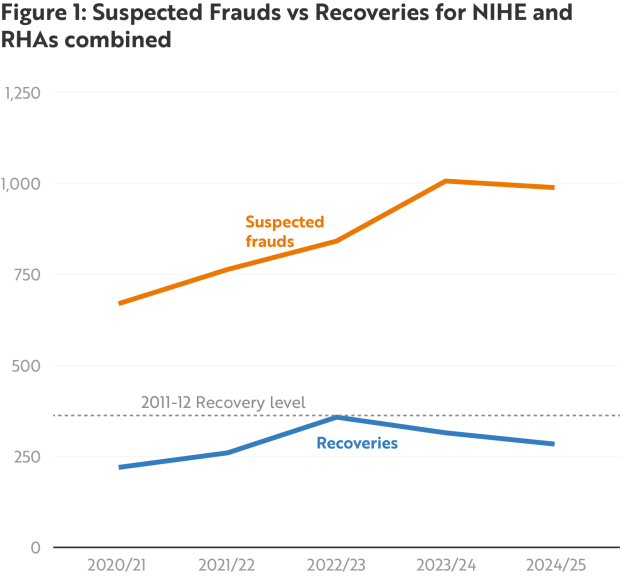
2.12This fall in the numbers of recoveries is in line to what is being experienced in other regions of the UK. Findings of a 2023-24 data collection survey published in the TFF’s ‘Tenancy Fraud London 2025’ report showed a 43 percent fall in tenancy fraud detections from 2013-14 across London boroughs that participated in the voluntary survey. This was attributed to reduced investigative capacity resulting from funding restrictions and central government policy but also that tenancy fraud and misuse detections arising from abandonment were not always included.
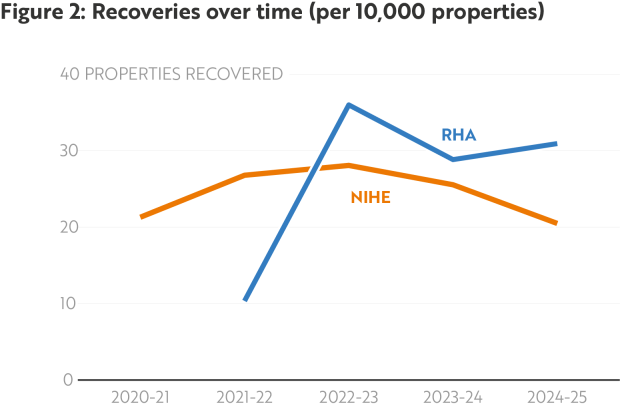
2.13The same 2025 TFF report stated that ‘in theory all social housing providers should be able to detect broadly the same level of tenancy frauds every year, proportionate to their housing stock. More housing stock would normally equate to more tenancy fraud in total being committed which in turn leads to more detection opportunities….’ To compare performance in detecting tenancy fraud and misuse across the social housing sector in Northern Ireland, we have shown both the actual and relative recoveries per 10,000 social housing stock. In 2024-25 the NIHE recovered 169 properties, which equated to 20 properties per 10,000 of housing stock. In the same year, the Regulator recorded that collectively the RHAs recovered 115 properties, which is calculated as 30.6 properties per 10,000 of housing stock indicating that collectively the RHAs had a higher rate of recovery of fraudulent properties than the NIHE.
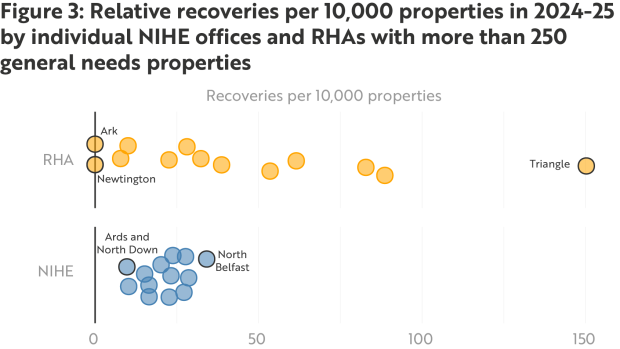
2.14 It is useful to compare the relative performance in terms of recoveries due to tenancy fraud and misuse of each individual RHA and NIHE area office. Figure 3, which is supported by detailed analysis at Appendices 3 and 4, shows there to be significant variability both between RHAs and between the NIHE area offices and potentially highlights where further measures are needed. In 2024-25, there was a wide range in the relative recoveries for the RHAs ranging from 0 properties to 151 per 10,000 housing stock, while the same analysis undertaken for the NIHE area offices in 2024-25 showed a smaller range in recoveries of between 10 and 34 per 10,000 housing stock.
Recommendation 3
The Department should undertake tenancy fraud and misuse benchmarking exercises to monitor and compare social housing providers’ performance. It should continue to promote and share where best practice and innovative solutions exist in relation to how tenancy fraud and misuse is addressed.
2.15 We recognise tenancy fraud and misuse as a complex matter, which involves ethical, societal and inherent factors personal to individuals, and so the following factors may contribute to the levels of identification:
- Capacity and capability to investigate – resources and expertise dedicated to tenancy fraud and misuse investigations varies significantly across the social housing sector, with only the NIHE having a dedicated TFU made up of trained investigators. This is considered further at Part Four.
- Financial cost of tenancy fraud and misuse – every instance of tenancy fraud and misuse denies a household on the social housing waiting list access to a home. This increases pressure on homelessness services at a time when social housing demand exceeds supply and contributes to more homeless households requiring temporary accommodation. Given the financial cost of providing temporary accommodation is borne by the NIHE, there is a notable financial incentive for it to tackle tenancy fraud and misuse and ensure social housing is occupied only by tenants who are entitled to it. The financial cost of tenancy fraud and misuse is considered further at Part Three.
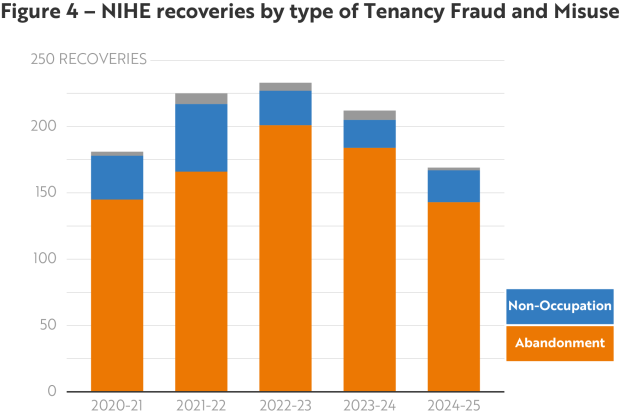
- Effectiveness of counter fraud measures – as set out at Figure 4 below (NIHE data), abandonment accounts for the majority of suspected tenancy frauds and misuse. These frauds and misuse are more visible and easier to confirm. It is possible that more extensive counter fraud measures are needed to identify tenancy frauds and misuse which are more sophisticated and harder to confirm. This is considered further at Part Four.
The Regulator is uniquely placed to influence through its annual assessments
2.16 The Regulator is the Regulatory Authority for RHAs in Northern Ireland. On behalf of the Department, the Regulator performs regulation activity to ‘monitor, assess and report on the performance of RHAs in relation to housing activities’ and ‘monitor their financial well-being and standards of governance’. Our engagement with the Regulator found there is limited monitoring activity of tenancy fraud and misuse data being undertaken.
2.17 In order to protect the interests of tenants, homeless people and people who use the services provided by RHAs, the Regulator assesses each RHA annually against the following three standards of the ‘Regulatory Framework’: financial, consumer and governance. However, as previously noted in this report, there is no explicit reference to tenancy fraud or misuse within this framework or in any of the standards.
2.18 In contrast, the TFF’s 2023 report ‘Lost Homes, Lost Hope’ suggested the English Regulator for Social Housing (RSH) ‘could encourage housing associations to play their full part in the fight against tenancy fraud simply by enforcing existing governance requirements more vigorously and consistently’. In response the RSH has made reference to tenancy fraud within their tenancy standard, stating ‘registered providers must take action to prevent and tackle tenancy fraud’. While acknowledging that the governance context is different in England due to the ‘Prevention of Social Housing Fraud Act 2013’, it is important to recognise the pivotal role the Regulator could play due to its unique remit.
2.19 To demonstrate compliance with the Framework, each RHA in Northern Ireland is required to complete a Regulatory Standard Annual Return (RSAR) questionnaire as evidence to the Regulator. This results in each RHA being awarded a rating between 1 and 4 as outlined below. These annual regulatory ratings are published and could have a significant impact to the RHA in terms of their borrowing capacity. The Regulator is therefore uniquely placed and could use the annual assessment to influence and drive improvements in tackling tenancy fraud and misuse within the RHAs.
| Regulatory Rating | Compliant? | Definition |
|---|---|---|
| 1 | Compliant | Meets regulatory standards. |
| 2 | Compliant | Largely meets regulatory standards but needs to improve in some areas to ensure continued compliance. |
| 3 | Non-compliant | Does not meet the regulatory standards but is working with the Regulator to improve its position. |
| 4 | Non-compliant | Does not meet regulatory standards due to issues of serious concern and is subject to significant engagement with the Regulator. |
2.20 Up to 2023-24 there was one question on the RSAR relating to tenancy fraud:
‘Is there a Tenancy Fraud Strategy/Policy in place?’
This question is output focused, and no additional assessment is undertaken by the Regulator of the adequacy, effectiveness nor performance of the strategy. This is despite the PAC previously recommending in 2014 that an ‘assessment of the adequacy of tenancy fraud strategies and review of performance targets in this area should be included in the Regulator’s inspection regime for housing associations.’ We note, however, that in 2014 MoR, the Department stated it did not consider that including this in its inspection regime for RHAs was necessary. This is something we would strongly suggest the Department to now reconsider.
2.21The following two additional questions have been included in the RSAR for 2024-25, however at the time of our engagement all responses had not been received by the Regulator:
‘How regularly are the Board provided with information on tenancy fraud?’
‘How does the Board receive assurance that tenancy fraud is being addressed?’
These questions are again output focused, and the sample answers provided to us by the Regulator did not indicate that an evaluation of the adequacy and robustness of tenancy fraud and misuse arrangements and performance was planned. Further to this, the Regulator told us it would only become involved with an individual RHA if there was a systemic issue in relation to tenancy fraud and misuse to address, as this would be indicative of a governance failure and a wider issue for the RHA.
2.22 In our discussion with the Regulator there was an emphasis on the co-regulation of each RHA jointly between the Regulator and the RHA’s Board. There is scope for the Regulator to make more use of the co-regulation arrangements, placing an onus on RHA Boards to obtain assurances on the adequacy, effectiveness and performance of tenancy fraud and misuse arrangements in place in the RHAs. This would represent a shift to outcomes-based assessment, where the impact and performance of tenancy fraud and misuse arrangements is considered, rather than narrower outputs assessment, such as the existence of a strategy or the frequency of information reporting.
Recommendation 4
The Regulator, through its annual regulatory assessment programme, should ensure that RHA boards obtain assurances on the adequacy, effectiveness and performance of tenancy fraud and misuse arrangements within RHAs. This should include assurance on the adequacy and effectiveness of action taken to prevent and address tenancy fraud and misuse.
The cost of Tenancy Fraud and Misuse
Tenancy fraud and misuse could potentially represent a significant cost to the Northern Ireland economy
3.1 Prior to the COVID-19 pandemic, the NIHE started to develop a cost per tenancy fraud and misuse case. The estimated cost is based on legal, void and temporary accommodation costs incurred over the average duration of a tenancy fraud and misuse case. Approved by the National Fraud Initiative and adopted by the TFF, the cost per tenancy fraud and misuse case in Northern Ireland was estimated to be £28,450 in 2021-22. The Department agreed in November 2023 to adopt the methodology used by NIHE. It has been a number of years since these calculations were performed, during which time temporary accommodation and void costs have increased. It is therefore the case that the estimated cost is potentially understated and in need of revision.
3.2 To further show the financial impact of tenancy fraud and misuse; applying the NIHE’s estimated £28,450 figure to the 284 recoveries made during 2024-25 equates to a cost of approximately £8 million to the public purse arising from tenancy fraud and misuse. These are costs which without tenancy fraud and misuse would not have been incurred by the Northern Ireland economy. In Part Two of this report we set out that 1 in 30 or up to 4,000 social housing properties in Northern Ireland could be potentially impacted by some sort of tenancy fraud or misuse. Clearly estimated costs for levels of tenancy fraud and misuse of this magnitude would be significant using the £28,450 cost per case figure.
3.3 As part of an ongoing review of tenancy fraud by the Department, the development of a cost per tenancy fraud and misuse case across all RHAs is being considered. NIFHA has suggested that an estimated cost could help demonstrate to local communities both the financial cost of tenancy fraud and misuse and the benefits of reporting suspected cases.
Recommendation 5
The Department should agree a single common cost figure of tenancy fraud and misuse across all social housing; and share this information as a means of assisting in the prevention and detection of tenancy fraud and misuse
3.4 Properties which are held fraudulently are no longer available for social housing. Our 2013 report considered the cost of tenancy fraud and misuse as:
- the cost to the NIHE of providing temporary accommodation to those denied a social housing tenancy due to tenancy fraud and misuse; and
- the replacement building cost for properties that are no longer available for social housing due to tenancy fraud and misuse.
These are considered further below in the context of current circumstances.
Tackling tenancy fraud and misuse will make more social housing available and help to alleviate temporary accommodation expenditure
3.5 Each instance of tenancy fraud and misuse reduces the availability of a social home at a time when demand for social housing significantly exceeds supply. Preventing, detecting and removing tenancy fraud and misuse makes more social housing available for allocation to households most in need on the social housing waiting list.
3.6 The cost of providing temporary accommodation is a principal component in estimating the financial impact of tenancy fraud and misuse. On any given night in 2024-25, over 4,700 homeless households were placed in temporary accommodation at an annual cost to the NIHE of over £40 million. Around 18 per cent of allocations from the social housing waiting list are to households in temporary accommodation. Based a high-level illustrative estimate in Part Two that up to 4,000 social housing properties in Northern Ireland could potentially be impacted by tenancy fraud and misuse, eliminating such fraud would increase the number of allocations from the social housing waiting list and help reduce annual expenditure on temporary accommodation.
Social housing capacity lost to tenancy fraud and misuse has a significant replacement cost
3.7 The number of homeless households on the social housing waiting list continues to rise. As at 31 March 2025, there were almost 32,000 homeless households on the social housing waiting list, an increase of almost 11,000, or 53%, since 2019-20. A key contributing factor is that housing supply is not keeping pace with demand. For example, in 2024-25, the number of homeless households on the waiting list grew by over 2,300, despite 1,400 new-build social houses.
3.8 Each fraudulent and misused tenancy not only reduces the availability of social housing but is the loss of control of a public asset. Our 2013 report estimated the cost of replacing social housing capacity lost due to tenancy fraud and misuse to be in the region of £200 million. The new build cost of a two bed, two storey social house in Northern Ireland is currently £206,000. Applying the high-level illustrative estimate that 4,000 social houses could be subject to some form of tenancy fraud and misuse to this new build cost demonstrates there would be a substantial cost to replace social housing capacity lost due to tenancy fraud and misuse. Given that housing supply is already failing to meet demand and the number of homeless households continues to increase, it is neither financially nor practically feasible to replace this lost capacity. The only viable cost effective and operational option is to apply robust measures to identify and remove tenancy fraud and misuse across all social housing properties and regain control of a vital public asset.
There is a social cost to not tackling tenancy fraud and misuse
3.9 The social value of tackling tenancy fraud and misuse can sometimes be overlooked. As far back as 2009 the Audit Commission concluded in its report ‘Protecting the public Purse’ that ‘well targeted spending on housing stock can yield financial benefits including health and crime cost savings and the value of recoveries should therefore also recognise the long term social and financial benefits to those in need.’
3.10 RHAs understand the need to tackle tenancy fraud and misuse because of the associated social and personal costs to the local communities in which they operate as a result of the current reliance on temporary accommodation. Our recent report ‘Homelessness in Northern Ireland’, March 2025 included findings of a study by the homeless charity Crisis which estimated that, on average, preventing homelessness for one year would result in savings to the public purse of £9,266 per person from reduced spending on NHS services, drug and alcohol services and mental health services which are higher among homeless people. Fraudulent and misused tenancies deny some of the most vulnerable households in society of a home.
Measures to Tackle Tenancy Fraud and Misuse in Northern Ireland
Measures employed to tackle tenancy fraud and misuse have developed since our previous report
4.1 Since our 2013 report, the NIHE and RHAs have implemented several measures which will have impacted the incidence of tenancy fraud and misuse, including:
- Photographing new tenants – The NIHE take a photograph of a new tenant at sign up stage. This allows NIHE staff to view the tenant’s photograph when there is any further contact for verification purposes, including during an initial verification visit to confirm the identity of the resident matches that of the legal tenant. Several RHAs also require new tenants to have photographic ID on file and use standard visits as an opportunity to take photographs and update records for existing tenants.
- Dedicated reporting channels – The NIHE has a fraud portal through which the public can report any concerns in relation to tenancy fraud and misuse and can remain anonymous if they wish. Around half of RHAs also have a dedicated section within their website which directs the public on how to report suspicions of tenancy fraud and misuse to them. This has been a positive introduction which has simplified the reporting process making it easily accessible for anyone with a media device and the internet.
- Tenancy Fraud Unit (TFU) in the NIHE – This is a dedicated unit of seven FTE staff reporting to the Head of the Corporate Investigations Unit within the NIHE, to which more complex or difficult to substantiate NIHE tenancy fraud and misuse cases are escalated. Referrals to the unit are considered and either recommendations are made to NIHE area managers on next steps, or a request made for third party information from other sources. All staff within the unit have specialist qualifications. The NIHE told us that without the TFU’s assistance, tenancy fraud and misuse would not be confirmed and properties recovered for the majority of complex tenancy fraud and misuse cases.
The NIHE’s current approach to address tenancy fraud and misuse centres around customer contact
4.2 The NIHE explained that opportunities to detect tenancy fraud and misuse arise at every point of customer interaction with its staff. The primary methods used by the NIHE to identify potential tenancy fraud and misuse include:
- Fraud prevention checks at sign-up – Local office staff carry out identity verification checks on new tenants, collating information during the sign-up procedure. All new tenants must have their photograph taken for uploading to a housing management system. This is a mandatory condition of offer acceptance of the tenancy.
- New tenancy checks – Staff are required to carry out unannounced visits within the first two months of a tenancy to ensure the correct tenant is in occupation. The photograph taken at sign up is used during the verification visit to confirm the identity of the resident matches that of the legal tenant.
- Standard tenant verification for existing tenants – Staff are required to undertake verification checks on any contact via telephone or at the public counter to confirm they are the legal tenant. Any concerns would trigger further investigation.
- Annual gas service – Under the Gas Safety (Installation and Use) Regulations 1998 there is a mandatory duty for landlords to carry out an annual safety check on all gas systems. This can be a way to identify properties that may have been abandoned as the property’s gas supply has been disconnected or repeated attempts to contact the tenant or gain access to the property have failed.
- Dedicated fraud portal – This is a webpage for reporting tenancy related fraud suspicions which are triaged by the Tenancy Fraud Unit for investigation by local area teams.
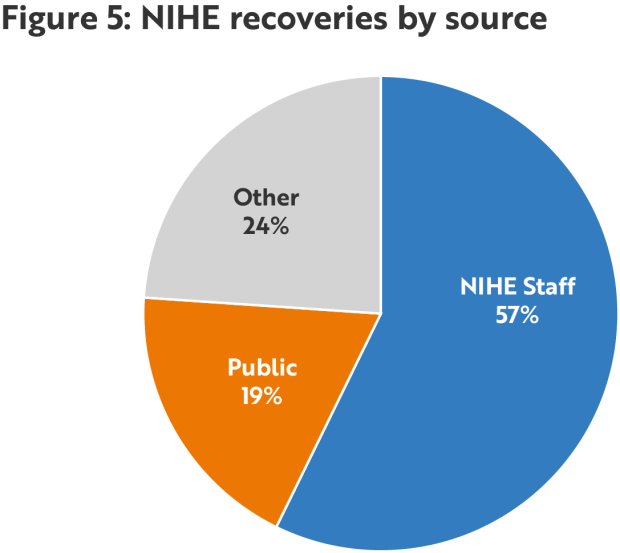
4.3 The most common source of discovering tenancy fraud and misuse is from reports made by NIHE staff (Figure 5), as they are best placed to identify the most common types of tenancy fraud and misuse, which are abandonment and non-occupation. The average patch size for an NIHE manager is 353 properties. While the NIHE believes combatting tenancy fraud and misuse is a core element of the role of these managers, they often have many competing priorities to balance when onsite, of which potential tenancy fraud and misuse is just one. NIHE area staff investigate any suspicions of tenancy fraud and misuse which they have and refer any more complex cases to the TFU for assistance in resolving the case and confirming tenancy fraud and misuse has been committed.
4.4 The second most common source is reporting of suspicions by members of the public. The public can make such reports to their local office, housing officer or through the dedicated portal. It is then investigated by the local area team with support from the TFU. NIHE has reported a cultural shift in recent times where members of the public are more willing to report suspected cases of tenancy fraud and misuse. In part, they consider this has been brought about by working from home, increased homelessness and housing pressure.
Registered Housing Associations (RHAs) differ in their approach to tenancy fraud and misuse
4.5 Only nine RHA websites have clear tenancy fraud and misuse statements, policies and public reporting mechanisms available publicly on their websites. Although currently not a requirement, this could indicate fundamental differences in the way tenancy fraud and misuse is prioritised and managed by RHAs.
4.6 Engagement with NIFHA and three representative RHAs identified that tenancy fraud and misuse measures within these RHAs include:
- dedicated email for members of the public to report any suspicions.
- tenancy fraud and misuse statement on RHA website.
- observations of housing managers and onsite community assistants. This includes observation at events hosted by RHA staff for tenants and their families.
- collection of photographic ID and completion of new tenancy visits.
The Department has stated it is working towards a common preventative and investigatory approach for RHAs, which is hoped to bring more consistency across the sector in terms of checking of tenants, reporting of suspected fraud, and the NIHE assistance in complex cases.
There is scope to improve tenancy fraud and misuse detection and recover more social housing properties
4.7 Our engagement found limited evidence of proactive, co-ordinated and focused measures and arrangements to tackle tenancy fraud and misuse. Below we have outlined areas where tenancy fraud and misuse measures and arrangements could be improved to detect and remove tenancy fraud and misuse from social housing.
Capacity and capability to investigate tenancy fraud and misuse
4.8 While RHAs vary in size so does their capability and capacity to tackle tenancy fraud and misuse internally. RHAs have restricted information compared to the NIHE, do not partake in data matching or sharing, and they do not always have staff with expertise in undertaking complex investigations, although many now have Tenancy Fraud Officers.
4.9 To demonstrate this, one RHA told us that it had to close most of its suspected tenancy fraud and misuse cases in 2024-25 as it did not have the resources and expertise to gather the required evidence. The TFF report ‘Lost Homes, Lost Hope’ puts emphasis on the importance of the use of specialist investigators or housing officers trained in fraud awareness. Planned proposed legislative changes will mean that RHAs can pass such complex tenancy fraud and misuse cases to the specialist TFU in NIHE for further investigation. The impact of the legislative changes is considered further at the end of this chapter.
Co-ordinated and strategic approach
4.10 There is not an encompassing strategic approach to tacking tenancy fraud and misuse across social housing in Northern Ireland. Neither the Department or the NIHE have in place a formal strategy to tackle social housing tenancy fraud and misuse. While it is positive development that the NIHE recently devised a Tenancy Fraud Action Plan in November 2024, this is focused on outputs and requires an overarching Tenancy Fraud and Misuse Strategy to join actions to strategic priorities, impacts and the achievement of outcomes. We acknowledge the Department reinstated the TFOG in May 2024 to inform its review of tenancy fraud, which has encouraged more co-operation across the social housing sector.
Recommendation 6
The Department should develop an overarching Tenancy Fraud and Misuse Strategy for social housing which reflects best practice. The NIHE and RHAs should develop detailed and measurable action plans aligned to the achievement of the strategy’s objectives, targets and desired outcomes.
Tenancy fraud and misuse audits
4.11 At the recent Departmental conference ‘Tackling Social Housing Tenancy Fraud’ on 20 November 2025, the TFF spoke on the value of tenancy fraud and misuse audits and persevering with unannounced visits as an effective measure to tackle tenancy fraud and misuse. However, we found the use of tenancy fraud misuse audits to be limited, with no evidence of proactive and widespread programmes of unannounced visits and ongoing tenancy fraud and misuse audits across the NIHE and RHAs. The Department has stated that a statutory definition and statutory powers to tackle tenancy fraud and misuse are required before moving ahead with a sector-wide approach for measures.
4.12 Beyond the requirement to confirm tenant verification in the first two months of a new tenancy, the NIHE does not perform further unannounced visits or tenancy fraud and misuse audits. Subsequent unannounced visits are reactive and only take place once there is suspicion of tenancy fraud or misuse. The NIHE has told us that the ‘quiet enjoyment’ clause in Tenancy agreements makes blanket tenancy checks inappropriate without reasonable suspicion of fraud or misuse.
4.13 Our engagement has not identified evidence of comprehensive and coordinated programmes of tenancy fraud and misuse audits across all RHAs. There are a number of housing associations completing an annual programme of tenancy fraud and misuse audits, however for many it is a targeted exercise to those already under suspicion of tenancy fraud and misuse rather than attempting to identify undetected fraud. The table below provides examples of some good practice we noted during our fieldwork.
| Tenancy Fraud and Misuse Audits performed by RHAs during 2024-25 |
|---|
| Woven performed tenancy audits across 27% of its housing stock during 2024-25. It made 729 random tenancy audit visits, with seven tenancy frauds and misuse identified as a result. In addition, they recovered a further 8 properties under other actions on tenancy fraud and misuse. |
| Radius Housing aims to perform annual tenancy audits across 20% of its housing stock. During 2024-25, it made 1,275 random tenancy audit visits, with 3 tenancy frauds and misuse identified as a result. In addition, they recovered 27 properties under other actions on tenancy fraud and misuse. |
| North Belfast Housing’s strategy is to perform annual tenancy audits across 1% of its housing stock. During 2024-25, it made 25 tenancy audit visits (2.15% of stock) to those properties under suspicion for tenancy fraud and misuse, with 4 tenancy frauds and misuse identified as a result. |
4.14 The importance of adherence to best practice when conducting tenancy fraud and misuse audits is demonstrated in the report ‘Lost Homes, Lost Hope’, which states that ‘housing providers following good practice in tenancy audits were nine times more likely to identify tenancy fraud.’ It is therefore important that best practice is followed when undertaking tenancy fraud and misuse audits to ensure allocated resources are achieving maximum return. Best practice includes tenancy fraud and misuse audits being unannounced and conducted by specialist staff onsite with the purpose of identifying tenancy fraud and misuse. Selection could be based on a risk assessment, taking into account a variety of applicable factors and using data matching, with audits aimed at those properties with highest risk of tenancy fraud and misuse. This could potentially lead to increased recoveries.
Recommendation 7
There should be a co-ordinated annual programme of tenancy fraud and misuse audits across a targeted proportion of all social housing in line with best practice. While keeping the merits of this approach under review, the Department should make this a requirement of both the NIHE and RHAs through its housing policy and regulatory functions.
Better use of data sharing and matching
4.15 The social housing sector should be making more effective use of data sharing and matching were possible, using advances in technology to implement sophisticated measures to tackle tenancy fraud and misuse. As an example of what is possible, the NIHE is exploring the possibility of using digital document verification with data held by a third-party organisation to identify application fraud.
4.16 At a recent housing conference, the NIHE stated that tenant forums, such as the Housing Community Network, have been very useful in understanding that tenants would welcome any such measures which aid in preventing and detecting tenancy fraud and misuse, including the increased use of tenant data with appropriate consent.
4.17 The NIHE undertakes limited data sharing, only engaging with utilities and credit reference agencies once suspected fraud or misuse has been identified. The NIHE told us that more proactive data sharing is not possible as there is currently no legislative requirement in Northern Ireland to prevent or detect tenancy fraud and misuse. The absence of this legislative basis means the NIHE cannot proactively match data held for all social housing tenancies with data held by benefit teams within the Department or data held by credit reference agencies to flag potential tenancy frauds and misuse and/or risk profile tenants for subsequent tenancy fraud and misuse audits. This has been considered further later in this chapter, as part of legislative reform.
Further progress could be achieved by formalising collaborative arrangements across the sector
4.18 The Department reinstated the TFOG in May 2024 to provide a dedicated forum for key stakeholders to discuss ongoing issues regarding fraudulent activity in social housing, and to share information, experiences, and best practice around tenancy fraud and misuse. The TFOG has the aim of a single, coordinated approach to tenancy fraud and misuse across social housing in Northern Ireland.
4.19 Since its reinstatement, the TFOG has commenced work on a common definition of tenancy fraud, a tenancy fraud review, proposed legislative reform, data collection and reporting, and data sharing practices. The Department told us that RHAs are actively engaging in the TFOG to share best practice, learn from experts and introduce greater consistency in data sharing. It is important that these collaborative arrangements continue to be strengthened, and that the TFOG progresses its work with urgency to deliver meaningful and measurable improvements in tenancy fraud and misuse arrangements and actions.
4.20 The Department has told us that there is now a more joined up approach between its Benefit Security Division and the NIHE’s TFU to investigate benefit fraud and tenancy fraud.
- Where tenancy fraud or misuse is suspected as part of a benefits fraud investigation, the Department has told us that the Benefit Security Division may make a referral to the NIHE’s TFU for further investigation. At the moment this is undertaken on a case-by-case basis by informal arrangements established through the TFOG. The NIHE’s TFU told us it has four investigations ongoing under this approach.
- Where a tenancy fraud investigation confirms housing benefit and other benefits are in payment, the NIHE’s TFU told us that these cases are referred to the NIHE’s Housing Benefit Fraud Liaison Team for onward referral to the Department’s Benefit Security Division. Data on the number of such cases referred to the Department’s Benefit Security Division, and the outcome of subsequent investigations, was not available.
4.21 At present, there are no arrangements to permit the sharing of benefits information with RHAs. However, the proposed Administrative and Financial Provisions Bill may provide a lawful basis for the NIHE’s TFU to investigate complex cases of tenancy fraud and misuse on behalf of RHAs, effectively removing this barrier to joined up working. The Audit Commission Report ‘Protecting the Public Purse 2012’ states that tenancy frauds and misuse are not isolated incidents, with evidence of other types of fraud, such as housing benefit, in nearly half of tenancy fraud and misuse cases. There is therefore value in the Department pursuing more formalised joined up working and associated reporting with the NIHE’s TFU to investigate benefit frauds and tenancy frauds.
Recommendation 8
The Department should formalise arrangements between the Benefit Security Division and the NIHE’s Tenancy Fraud Unit for the reciprocal investigation of benefit frauds and tenancy frauds where applicable.
4.22 The Departmental Tenancy Fraud Conference held as part of National Fraud Awareness Week in December 2025 was a positive step toward greater collaboration and partnership working within the sector. The conference highlighted the need to promote what tenancy fraud and misuse is, its cost and effects to raise awareness of the issue within Northern Ireland and this is something that could be co-ordinated between the Department, NIHE, NIFHA and RHAs.
Case Study
Woven RHA
The following examples demonstrate how tackling tenancy fraud and misuse directly benefits families in need and ensures fair use of housing stock.
While onsite for other reasons, a housing officer identified a property as being vacant. Through persistent door knocking and communication with other tenants, they were able to establish the tenant was living elsewhere.
• Throughout a period of investigation, various tenancy audits were conducted. The tenant only allowed access to on a planned basis, with housing officers noting a pattern of the property being cold and the tenant leaving shortly after each visit. No repairs had been reported for over two years, and no one was in the property on repeated unannounced visits.
• The housing officer’s persistence paid off and they were able to use local information to confirm where the tenant was residing. When challenged with the findings, a Termination of Tenancy was signed, and the keys returned within a week.
• As a result of Woven’s actions, a couple were able to be allocated a mobility bungalow after it was recovered from a tenant who was living elsewhere.
A tenancy audit was conducted on a property after no gas access. Various visits were undertaken by different housing officers with no response. CCTV discovered the tenant had stopped living in the property two months earlier and had moved to England. This property was reallocated to an individual who was homeless and had been on the waiting list for 18 months.
• Woven used information obtained from previous tenancy audit visits and local residents to prove the applicant of a succession tenancy claim had not lived in the property.
• Woven re-allocate a recovered tenancy fraud and misuse property to a family who had been homeless for two years.
Case Study
A local council in England introduced the following measures from 2009 onwards when local authorities in England where not yet dealing effectively with tenancy fraud and misuse. As a result, tenancy fraud and misuse became the highest reported fraud type in the council leading to the recovery of 263 properties between 2010-2013, 12 Prosecutions and 10 other sanctions.
• Introduced tenancy fraud and misuse as part of council-wide Fraud Awareness training for all employees, elected Members and stakeholders.
• Used the data already held by focussing on properties such as those where there had been no tenant contact, difficulty gaining access, rent accounts in credit, rent paid by someone else and benefit fraud referrals received for non-occupancy.
• Unannounced visits checking ID, proof of residency and conducting a tenancy audit.
• Used dedicated fraud investigation officers who deal solely with tenancy fraud and misuse making best use of legislation and working closely with Housing staff.
• Launched a public fraud awareness campaign including press releases and publicised outcomes.
• Revised all the application, nomination and succession forms including the addition of photos for all tenants.
• Included Housing Officers on the IUC’s so they could manage recovery/NTQ processes.
Evidence from England suggests that the introduction of the proposed new legislation could transform the fight against tenancy fraud and misuse
4.23 Twelve years after our last report, Northern Ireland still does not have statutory provisions equivalent to the ‘Prevention of Social Housing Fraud Act 2013’ (‘the Tenancy Fraud Act’). Such equivalent legislative changes could have the potential to help identify undetected tenancy fraud and misuse in the system, build more robust investigations and may act as a deterrent.
4.24 In Northern Ireland there are two proposed legislative changes. The first is the ‘Administrative & Financial Provisions Bill’ which will create a single investigatory capability within the NIHE for all social housing. RHAs will be able to escalate more complex tenancy fraud and misuse cases to this unit for investigation, with the NIHE charging RHAs for the provision of this service.
4.25 The second change, which is not anticipated to complete before the end of the current mandate in May 2027, is dedicated tenancy fraud and misuse legislation. The Department has indicated that it will consult this year on the proposed legislation, which aims to ensure that social landlords have the powers to investigate suspected fraud, recover properties where appropriate, and pursue consequences through the criminal justice system for the most serious cases of tenancy fraud. The consultation will also propose definitions for the various types of tenancy fraud and misuse. This is a welcome development, with legislative tenancy fraud and misuse provisions capturing instances where the personal circumstances of individuals do not support the need to retain a social housing tenancy.
4.26 The legislation to be introduced is only as good as the mechanisms, structures and arrangements established to support and facilitate its implementation. It is important the legislative changes have maximum impact and cover all key areas.
Recommendation 9
The Department should take steps now to ensure legislative tenancy fraud and misuse powers can be acted upon as soon as legislation takes effect. This should include making arrangements to carry out data matching across all social housing.
Appendices
Appendix 1
NIAO 2013 Tenancy Fraud Report Recommendations Update
| NIAO Report Recommendations | NIAO current position assessment | NIAO RAG status assessment | Department’s assessment of recommendation implementation at April 2026 |
|---|---|---|---|
| 1. The Department should formally recognise the importance of actively tackling tenancy fraud in both the Housing Association Guide and NIHE’s Financial Memorandum and should require NIHE and Housing Associations to produce dedicated tenancy fraud strategies. | As the regulatory authority of Registered Housing Associations (The Regulator), the Department seeks assurance that Housing Associations have tenancy fraud strategies in place. Although the NIHE devised a Tenancy Fraud Action Plan in November 2024, it does not have a dedicated tenancy fraud strategy in place. This will be superseded by Recommendation 6 in Part Four of this report. The Department should develop an overarching Tenancy Fraud and Misuse Strategy for social housing which reflects best practice. | AMBER | The Department recognised the importance of actively tackling tenancy fraud in the Housing Association Guide. Housing Associations do have dedicated tenancy fraud strategies, which was confirmed by the Department following the initial NIAO report. The Strategies were viewed again by the Department in 2025 as part of the review of tenancy fraud. The NIHE also has a Tenancy Fraud Action Plan. |
2. Tenancy fraud strategies should draw on the best practice established in England and may include the following: • publicity to develop awareness of the problem amongst tenants and housing staff; • establish and publicise a confidential hotline to report suspected cases of fraud; • photographing tenants; • employment of dedicated tenancy fraud staff with investigative expertise; • awareness training for housing staff; • targeted data matching such as credit checks to identify potential frauds; • targeted tenancy audits; • reporting of frauds detected in local media; • consider the use of the Fraud Act to prosecute fraudsters; and • establishment of more formal protocols with utilities around the sharing of information. | The Department reviewed tenancy fraud strategies developed by RHAs following the 2013 recommendation and again in 2025. The Department’s review has confirmed that on the whole, RHA tenancy fraud strategies include: • tenancy fraud definitions • prevention measures • detection methods • fraud response action • public reporting mechanisms While the Department has identified some areas for improvement across RHA tenancy fraud strategies, this will be superseded by Recommendation 4 in Part Two of this report. The Regulator, through its annual regulatory assessment programme, should ensure that RHA boards obtain assurances on the adequacy, effectiveness and performance of tenancy fraud and misuse arrangements within RHAs. | GREEN | Tenancy Fraud Strategies do draw on best practice. The Department, via the Tenancy Fraud Oversight Group (TFOG), reviewed the Strategies following the initial report and again in 2025. The Strategies have been reviewed for definitions, prevention measures, detection methods, actions and public reporting methods. There is evidence of sharing best practice across the sector via the TFOG. The Department also hosted a 2025 Conference highlighting best practice, including speakers from England, with free attendance for all Housing Associations. |
| 3.Given the disparate nature of social housing provision in Northern Ireland, it is unlikely to be cost effective to provide separate investigative resources for NIHE and the Housing Association sector. We recommend that consideration is given to establishing a single tenancy fraud team to provide investigative services to both sectors. As an alternative, given the link between tenancy fraud and social security benefit fraud, there may be merit in expanding the remit of the Social Security Agency’s Benefit Investigation Service to provide this service. In either case the Department should explore the potential to fund this through the Northern Ireland Executive’s Invest to Save Fund14. | A single tenancy fraud team for both sectors has not been established. Legislative reform is being progressed to facilitate this. The remit of the Department’s Benefit Security Division has not been expanded to provide investigation services to the NIHE and RHAs. | AMBER | The Administrative and Financial Provisions Bill is progressing through the Assembly (Consideration Stage 20/4/26). This will enable a single investigation team for complex tenancy fraud cases, and an associated sharing of information. |
| 4.At present Housing Associations report abandonments annually as part their regulatory returns to the Department. NIHE does not routinely collate or report tenancy fraud statistics. Good management information and intelligence is key in order to target limited investigative resources. In order to improve both management information and accountability, we recommend that NIHE and Housing Associations compile more comprehensive statistics and report them regularly to the Department. Returns should include statistics on the numbers of suspected frauds; investigations carried out; the nature of the frauds uncovered; and the number of properties recovered. | The NIHE and RHAs report statistics to the Department. Issues with RHA data collection and reporting not being coordinated across the Department have been noted in this report. | AMBER | The NIHE and RHAs regularly report statistics to the Department. This recommendation was implemented and is ongoing. |
| 5.We recommend that the Department, NIHE and local Housing Associations (perhaps through a NIFHA representative) should be represented at the Tenancy Fraud Forum which is a national forum, bringing social landlords together to combat tenancy fraud. There may also be merit in establishing a local oversight group, chaired by the Department including representatives from Housing Associations and the NIHE to coordinate efforts, share information and disseminate best practice. | The NIHE is an executive member of the Tenancy Fraud Forum. The Department re-instated the Tenancy Fraud Oversight Group (TFOG) in May 2024 to inform a review of tenancy fraud having previously dissolved it in August 2019. | GREEN |
Appendix 2
Update on PAC Recommendations (2013 Tenancy Fraud Report)
| PAC recommendations – Sept 2014 | MOR Response – Dec 2014 | NIAO current position assessment | NIAO RAG status assessment | Department’s assessment of recommendation implementation at April 2026 |
|---|---|---|---|---|
| 1. The Committee expects the Department to urgently drive forward efforts to establish an evidence-based baseline figure for the level of tenancy fraud in social housing in Northern Ireland. The Committee recommends that a progress report is compiled by the Department to determine the extent of tenancy fraud and to assess the success of the Department’s counter fraud measures over the next twelve months. This report should be forwarded to the Committee. | The Department accepted this recommendation. | The Department attempted to calculate baselines in 2015 and 2016 but was unsuccessful. The Department has not made any further efforts to establish an evidence-based baseline figure for the level of tenancy fraud in Social Housing in Northern Ireland. | RED | |
| 2. The Committee recommends that the Department, as a matter of urgency, should update the Housing Association Guide, to ensure that dedicated tenancy fraud strategies become part of the Department’s regulatory requirement. The Committee also recommends that the need for a dedicated tenancy fraud strategy should be reflected in NIHE’s Financial Memorandum. | The Department accepted this recommendation. | As the regulatory authority of Registered Housing Associations (The Regulator), the Department seeks assurance that RHAs have tenancy fraud strategies in place. The NIHE do not have a dedicated tenancy fraud strategy in place. This will be superseded by Recommendation 6 in Part Four of this report. The Department should develop an overarching tenancy fraud and misuse strategy for social housing which reflects best practice. The NIHE and RHAs should develop detailed and measurable action plans aligned to the achievement of the strategy’s objectives, targets and desired outcomes. | AMBER | The Housing Association Guide was updated to set out the requirement for all RHAs to have tenancy fraud strategies, guidance on tenancy fraud and the requirements of reporting to the Department. The NIHE has a Tenancy Fraud Action Plan. |
| 3. The Committee recommends that the assessment of the adequacy of tenancy fraud strategies and review of performance targets in this area, should be included in the Regulator’s inspection regime for housing associations. | The Department partially accepted this recommendation and agreed that the adequacy of tenancy fraud strategies and performance targets in this area should be monitored. The Department did not consider that including this in its inspection regime for Housing Associations was necessary. | The Regulator does not assess the adequacy of the RHAs’ tenancy fraud strategies or review performance targets in this area. | RED | As part of the annual regulatory return, RHAs must state that they have a tenancy fraud strategy/policy and how often they provide information to their Board on tenancy fraud. The return provides a summary of how the Board receives assurance that tenancy fraud is being addressed.” |
| 4. The Committee recommends that the Department, in conjunction with social housing providers, should carefully consider whether additional funding would enable social landlords to organise more effective prevention, detection and investigation activities. In the Committee’s opinion, a strong case for seeking funds under the “Invest to Save” Initiative could be made. | The Department accepted this recommendation. | There is no funding available under Invest to Save or the Change Fund Scheme at present. Best practice activities are being identified on an ongoing basis through membership of the UK Tenancy Fraud Forum and shared through the Tenancy Fraud Oversight Group. | NA | |
| 5. The Committee strongly supports the National Fraud Initiative. Given that housing associations have received around £1 billion of Northern Ireland public funding over the past 10 years, in the form of a Housing Association Grant, the Committee expects all housing associations to participate. | The Northern Ireland Federation of Housing Associations (NIFHA) partially accepted this recommendation. | There has been no participation of Housing Associations in the National Fraud Initiative since 2020. Prior to that only a maximum of three Housing Associations participated. | RED | This recommendation was implemented and RHA representatives participated in the NFI. One RHA has confirmed participation in Phase 2 of the NFI housing tenancy pilot. Participation of all Housing Associations has not proven value for money investment to date. The Department keeps the position under active review.” |
| 6. The Committee considers that formal protocols with utility companies open up a valuable source of evidence in the investigation of suspected tenancy fraud and the Committee strongly recommends that the present impetus is maintained leading to the introduction of formal protocols with all social landlords. | The Department, NIHE and NIFHA are in the process of implementing this recommendation. | This has not been progressed due to no legislative reform. | RED | |
| 7. The Committee considers that progress on tenancy fraud will best be achieved through cooperation across the social housing sector in Northern Ireland. It welcomes consideration of innovative approaches, such as the introduction of a single investigative team to combat tenancy fraud and the establishment of an inter-agency dedicated tenancy fraud hotline. It recommends that these issues are pursued and enhanced measures to counter tenancy fraud are established as a matter of urgency. | The Department, NIHE and NIFHA are in the process of implementing this recommendation. | The NIHE established a Tenancy Fraud Unit in August 2014. It tackles more complex tenancy fraud cases where local NIHE offices have exhausted their lines of enquiry. The Unit is fully accredited and investigates to civil and criminal standards. The NIHE has a dedicated fraud portal for suspected tenancy frauds. Housing Associations have dedicated email addresses and phone numbers for suspected tenancy frauds. A single tenancy fraud team for both sectors has not been established. Legislative reform is being progressed to facilitate this. | AMBER | |
| 8. The Committee notes the local Tenancy Fraud Forum’s review of the legislative position in Northern Ireland. The Committee recommends strengthening local legislation, particularly in relation to data sharing. | The Department accepted this recommendation. | Legislative reform is being progressed to facilitate this. The Administrative and Financial Provisions Bill will deliver some improvements in respect of data sharing before May 2027. Further data sharing provisions are anticipated in legislation progressed in the next mandate. | AMBER |
Appendix 3
NIHE recoveries by Area 2024-25
| NIHE Area Office | Housing Stock | Recoveries | Recoveries per 10,000 stock |
|---|---|---|---|
| Ards & North Down | 6,131 | 6 | 9.8 |
| Causeway | 6,409 | 13 | 20.3 |
| Lisburn & Castlereagh | 5,254 | 8 | 15.2 |
| Mid & East Antrim | 5,563 | 16 | 28.8 |
| Mid Ulster | 3,765 | 9 | 23.9 |
| N Belfast | 5,831 | 20 | 34.3 |
| S & E Belfast | 9,431 | 22 | 23.3 |
| South Antrim | 6,114 | 17 | 27.8 |
| South Area | 7,230 | 12 | 16.6 |
| South Down | 5,125 | 14 | 27.3 |
| South West | 3,510 | 8 | 22.8 |
| West | 8,458 | 14 | 16.6 |
| West Belfast | 9,679 | 10 | 10.3 |
| Total | 82,500 | 169 | 20.5 |
Appendix 4
RHA recoveries (General Needs Properties) by individual organisations 2024-25
| Housing Association | Total General Needs Housing Stock | Recoveries | Recoveries per 10,000 stock |
|---|---|---|---|
| Abbeyfield & Wesley | 9 | 0 | 0.0 |
| Alpha | 102 | 0 | 0.0 |
| Apex | 5,919 | 6 | 10.1 |
| Arbour | 1,488 | 8 | 53.8 |
| Ark | 712 | 0 | 0.0 |
| Choice | 8,148 | 23 | 28.2 |
| Clanmil | 3,814 | 3 | 7.9 |
| Connswater | 1,320 | 3 | 22.7 |
| Craigowen | 0 | 0 | 0.0 |
| Covenanter | 0 | 0 | 0.0 |
| Grove | 215 | 0 | 0.0 |
| Newington | 630 | 0 | 0.0 |
| North Belfast | 1,029 | 4 | 38.9 |
| Radius | 9,228 | 30 | 32.5 |
| Rural | 601 | 5 | 83.2 |
| St Matthews | 210 | 0 | 0.0 |
| Triangle | 994 | 15 | 150.9 |
| Woodvale & Shankhill (W & S) | 337 | 3 | 89.0 |
| Woven | 2,427 | 15 | 61.8 |
| Total | 37,183 | 115 | 30.9 |
Appendix 5
Recoveries over time (General Needs Properties)
| Organisation | Year | Housing Stock held in year | Recoveries | Total Properties recovered per 10,000 held |
|---|---|---|---|---|
| NIHE | 2024-25 | 82,500 | 169 | 20.5 |
| NIHE | 2023-24 | 83,000 | 212 | 25.5 |
| NIHE | 2022-23 | 83,000 | 233 | 28.1 |
| NIHE | 2021-22 | 84,000 | 225 | 26.8 |
| NIHE | 2020-21 | 85,000 | 181 | 21.3 |
| RHA | 2024-25 | 37,183 | 115 | 30.9 |
| RHA | 2023-24 | 35,723 | 103 | 28.8 |
| RHA | 2022-23 | 34,732 | 125 | 36.0 |
| RHA | 2021-22 | 33,816 | 35 | 10.4 |