
List of Abbreviations
AFBI Agri-Food and Biosciences Institute
CSO Combined Sewer Overflow
DAERA Department of Agriculture, Environment and Rural Affairs
DfI Department for Infrastructure
DOE Department of the Environment
DWI Drinking Water Inspectorate
EA Environment Agency
EDM Event Duration Monitor
EPA Environmental Protection Agency
EU European Union
GoCo Government owned Company
ISO International Organisation for Standardisation
LMA Local Management Area
mg/l milligrams per litre
NAP Nutrient Action Programme (2019-2022)
NI Northern Ireland
NiD Nitrates Directive
NIEA Northern Ireland Environment Agency
NIW Northern Ireland Water
NO3/l Nitrate per litre
NRW Natural Resources Wales
ODP Outcomes Delivery Plan
OEP Office for Environmental Protection
PC Price Control period (NI Water)
PfG Programme for Government
PIMS Pollution Incident Management System
R&D Research and Development
RBD River Basin District
RBMP River Basin Management Plan
RoI Republic of Ireland
SCaMP NI Sustainable Catchment Area Management Practice Northern Ireland
SEPA Scottish Environmental Protection Agency
SRP Soluble Reactive Phosphorus
SWELL Shared Waters Enhancement and Loughs Legacy
TP Total Phosphorus
UK United Kingdom
UKAS UK Accreditation Services (for ISO standards)
UKTAG UK Technical Advisory Group on the Water Framework Directive
WFD Water Framework Directive
WMU Water Management Unit
WwTW Wastewater Treatment Works
Glossary of Terms
| Term | Definition |
|---|---|
| Catchment area | The area of land from which water flows into a river, lake or reservoir. |
| Combined Sewer Overflow (CSO) | By carrying away rainwater and wastewater in a single sewer pipe, a Combined Sewer Overflow is intended to act as an overflow valve to reduce the sewage backing up during heavy rainfall, thereby avoiding the flooding of premises. |
| Consent to discharge | Under The Water (Northern Ireland) Order 1999 (as amended), the granting of a ‘consent to discharge’ makes provision for the release of substances into a watercourse or to a soakaway, under controlled conditions. The nature of the discharge governs the application, such as a discharge into a waterway from a domestic setting, or a daily discharge (within prescribed limits) from non-domestic premises. |
| Cross-compliance | The requirement for farmers to comply with a set of Statutory Management Requirements and also ensure that the land is in Good Agricultural and Environmental Condition, in order to qualify for the maximum agricultural support payment available to the farm business. |
| Derogation | A provision in a European Union legislative measure allowing all or part of it to be applied differently, or not at all, to an individual, group or organisation. Rather than providing for the exclusion of the application of the legal measures, it is a choice given to allow for greater flexibility in the application of the law, by enabling a Member State to take account of special circumstances. In the context of this report, in certain circumstances, farms can be permitted to operate under a derogation. |
| Environmental Protection Agency (EPA) | An independent state body with responsibility for protecting and improving the environment in the Republic of Ireland, providing research and advisory services, alongside the promotion of education on agriculture, horticulture, food and rural development matters. |
EU cross-border water improvement projects: - ‘Source to Tap’ - ‘CatchmentCARE’ - ‘SWELL’ | Source to Tap aims to improve water quality in cross-border catchments through three projects, and ensure compliance with the EU’s Drinking Water Directive. CatchmentCARE is based around Catchment-focussed Community Actions for Resilient Ecosystems. The SWELL project represents Shared Waters Enhancement and Loughs Legacy. |
| Measurement of Soluble Reactive Phosphorus (SRP) | When present at elevated concentrations in a river, the plant nutrient Soluble Reactive Phosphorus can result in the accelerated growth of algae and other plants and reduced oxygen levels, leading to an imbalance within the overall ecosystem. |
| Northern Ireland Water (NIW) | As a Government owned Company, NIW is a statutory trading body owned by central government, but operating under companies legislation. The management of NIW’s operations and its interaction with the environment is governed by legislation, including: The Water and Sewerage Services (NI) Order 2006; The Water Framework Directive; The Habitats Directive; The Conservation (Natural Habitats, etc) (NI) Regulations 1995; The Water (NI) Order 1999; Fisheries Act (NI) 1966; Water Abstraction and Impoundment (Licensing) Regulations (NI) 2006 and the Urban Wastewater Treatment Regulations (NI) 2007. |
| Pollution incidents severity rating | A rating of ‘High/Medium/Low’ is the result of an assessment undertaken against a set of formalised incident severity criteria. |
| River Basin District (RBD) | Areas of land and sea comprising a catchment or neighbouring catchments, which may include rivers, lakes, associated groundwater and marine waters. |
| SCaMP NI | NIW’s approach to managing water catchments on a sustainable basis. |
| Sewerage | A system/process for carrying away rainwater and sewage. |
| Soil Nutrient Health Scheme | Rollout of DAERA’s May 2022 Soil Nutrient Health Scheme is planned to take place across four zones until 2026, with a total estimated cost of £45m. The current scheme was preceded by a DAERA-funded, Agri-Food and Biosciences Institute-led pilot project between 2018 and 2022. |
| The Rivers Trust | An umbrella organisation for member Rivers Trusts in the UK and RoI, with river and catchment conservation expertise, working with farmers, organisations, individuals and communities to provide relevant advice and resources. |
| UK Technical Advisory Group (UKTAG) | A technical advisory group on the Water Framework Directive, established as a partnership of the United Kingdom’s environment and conservation agencies. |
| Water abstraction | The process of taking or extracting water from a natural source (such as a river, a lake or groundwater) for various uses from drinking to industrial application. |
| Water quality-related legislation | Applicable compliance-based legislation enacted through European Directives by EU Member States remains operational following the withdrawal of the UK from the EU on 1 January 2021 (Brexit). This includes The Water Framework Directive [2000/60/EC of 23 October 2000] and the Nitrates Directive [Council Directive 91/676/EEC of 12 December 1991]. Regulatory requirements which have been transposed into UK legislation include Water Environment (Water Framework Directive) Regulations (Northern Ireland) 2017 and The Water (Amendment) (Northern Ireland) (EU Exit) Regulations 2019. |
| Water-reliant economic sectors | These sectors include commercial and industrial (such as heavy industry), agriculture and fisheries, food and drink manufacturing, public bodies and electricity and renewable energy providers. |
Key Facts
2027 – The year by which all surface water bodies across Northern Ireland should achieve ‘Good’ or ‘High’ ecological status
31% – The percentage of river water bodies that achieved ‘Good’ or ‘High’ ecological status in 2021
1 in 4 – Pollution incidents in Northern Ireland linked to the agriculture sector during 2022
1 in 8 – Pollution incidents linked to Northern Ireland Water’s operations during 2022
70% – The interim target percentage of Northern Ireland’s surface water bodies to achieve ‘Good’ or ‘High’ ecological status by 2021
14% – The percentage of lake water bodies that achieved ‘Good’ or ‘High’ ecological status in 2021
373 – Agriculture-related pollution incidents assessed as ‘High’ or ‘Medium’ in severity between 2017 and 2021
68 – Northern Ireland Water-related pollution incidents assessed as ‘High’ or ‘Medium’ in severity from 2017 to 2021
Executive Summary
Background
1. Northern Ireland’s (NI) water resources are an important natural asset which contributes to economic, social and environmental wellbeing. As they also support ecological habitats and species of national and international importance, protecting these resources from damage is important for our health, economy and environment.
2. The causes of poor water quality can be numerous and improving water quality takes time, with the actions needed to bring it back in line with regulatory standards often requiring long-term, sustained and targeted action. Given that climate change is likely to increase the pressures on NI’s water bodies, those with low levels of pollutants are likely to be more resilient in the face of such change.
3. There are regulatory standards which must be met in relation to the quality of NI’s water bodies. The term ‘water bodies’ incorporates rivers, lakes, marine waters and groundwater. This study assessed the extent to which these regulatory standards are being met.
4. Our study examined the work of the Department of Agriculture, Environment and Rural Affairs (the Department) and its Northern Ireland Environment Agency (NIEA) in addressing issues with the quality of water in NI’s rivers and lakes, and is focused around:
- meeting the regulatory requirements in place (by examining published water quality data);
- managing the impact of agricultural practices, which are linked with an increased level of environmental risk; and
- the oversight of Northern Ireland Water (NIW), as it seeks to address particular risks associated with its ongoing operations.
Findings
The target for 100 per cent of surface water bodies in Northern Ireland to attain ‘Good’ or ‘High’ ecological status by 2027 will not be met
5. The monitoring of water quality is governed by standards, which are linked to the European Union (EU) Water Framework Directive (WFD). Under this Directive, it was intended that all surface water bodies would achieve ‘Good’ ecological status and ‘Good’ chemical status across all EU Member States by 2027 (although the regulations provide for extended deadlines in respect of selected chemical substances). Overall, the intended objective is recognised as a long-term one. Although the methodology used to assess water quality allows for certain, potentially toxic, substances to be detected, the tolerance threshold in place is low.
The published outcomes show that both river and lake (surface) water bodies have been falling short of the ecological status target.
Since 2015, the ecological status of Northern Ireland’s rivers has not improved and it has deteriorated for lakes
6. Our study focussed particularly on status targets for rivers and lakes, which are reported on separately by water body type, using the results of ecological and chemical monitoring. There are 450 river and 21 lake water bodies in NI.
7. In 2015, 33 per cent of NI’s river water bodies (147) achieved ‘Good’ or ‘High’ ecological status, while in 2021, the published outcome was 31 per cent (140).
8. In 2015, 5 of the 21 lake water bodies in NI (24 per cent) achieved ‘Good’ or ‘High’ ecological status. However, by 2021, this had reduced to 3 of the 21 lake water bodies (14 per cent).
9. NIEA told us that measures of ‘overall water body status’ are no longer meaningful, and that the focus should instead be around the individual reporting of ecological and chemical status outcomes. However, for completeness, Part Two of our report includes NIEA’s published outcomes under WFD reporting for rivers (Figure 4) and lakes (Figure 5) detailing ecological status, chemical status and ‘overall status’ for each of these surface water body types. ‘Overall status’ takes account both of ecological status and chemical status outcomes, through the application of an accepted ‘one-out-all-out’ principle (see paragraph 2.9 and Appendix 1).
As a consequence, Figures 4 and 5 also show that, in 2021, with the inclusion of new ‘priority substances’, no rivers or lakes achieved ‘Good’ or ‘High’ overall water body status in Northern Ireland
Excess nutrient levels have contributed to the lack of improvement seen in Northern Ireland’s rivers and lakes since 2015
10. When excess quantities of substances such as phosphorus and nitrate, are allowed to accumulate in rivers and lakes, the combination of reduced oxygen levels and increased algae growth is detrimental to the long-term health of the water environment.
11. Reporting carried out against the Nitrates Directive shows that the number of rivers assessed as ‘Poor’ (already nutrient enriched) due to the presence of excessive levels of phosphorus increased by almost 40 per cent between the reporting periods 2012-2015 and 2019 (5.6 to 7.8 per cent). Many of those rivers rated as ‘Poor’ or ‘Moderate’ (at risk) were located in catchments with high numbers of derogated farms. Derogation is a provision in the EU legislation that allows for greater flexibility in the application of the law to take account of special circumstances. Whilst correlation is observed in areas with high numbers of derogated farms and these may be a proxy for agricultural intensity, based on the available evidence, it is not possible to conclude that derogation arrangements have been the direct cause of the deterioration in water quality noted.
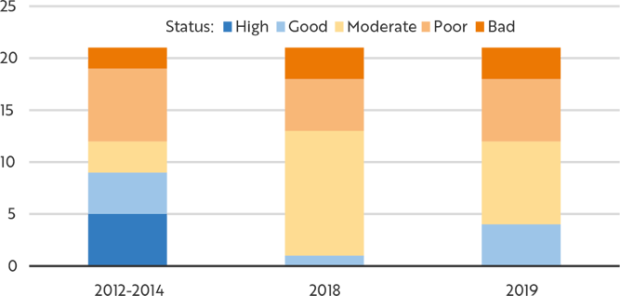
12. The percentage of lakes assessed with ‘Good’ or ‘High’ status for a Total Phosphorus measure also decreased significantly, from 42.9 per cent in 2014 to 19.0 per cent in 2019.
Current approaches to improve the management of agricultural practices are not effectively addressing long-standing issues around water quality
13. It is generally accepted that the nature of some practices within the agriculture sector exerts particular pressures on water quality. Current approaches should be enhanced through an increased focus on developing strong partnerships, both within and across the agriculture sector, in order to further reduce (and prevent) damage to water resources.
14. There is a need for a substantive change around significant land management issues associated with diffuse pollution (from excess nutrient releases), livestock and sediment deposits. However, NIEA’s one per cent regulatory sample means that the deterrent effect of any ‘potential’ inspection is minimal in practice. In the five years to 2021, less than £0.5m in cross-compliance penalties and prosecution fines was levied as a result of agriculture-related pollution.
15. Our analysis of NIEA data on the severity and causes of agricultural pollution incidents (2017-2021), across NI’s three River Basin Districts (RBDs), showed that:
- pollution was most prevalent (53 per cent of total incidents) within the Neagh Bann RBD, with 27 per cent assessed as High or Medium in severity;
- within the Neagh Bann RBD, incident frequency was three times worse in the River Blackwater Local Management Area (LMA) than in any of its other LMAs; and
- the three pollutants most frequently detected in this LMA were ‘farm effluent mixture’, ‘silage’ and ‘cattle waste’, with the main contributory causes linked to these being ‘poor working practices’ and ‘negligence’ (44 and 25 per cent of incidents respectively).
Given that this RBD already includes ‘priority water bodies’, having been assessed as needing particular attention, and that an EU-funded project linked to water quality improvement is ongoing, these outcomes provide cause for concern.
A number of water quality issues have arisen as a result of Northern Ireland Water’s activities
16. Historically, funding deficits are likely to have impacted water quality. For the 2021-2027 Price Control period (which informs NIW strategy), the determination reached has set out a requirement for £2.1 billion in capital investment in order to maintain and enhance the existing water and wastewater treatment infrastructure.
17. Partly as a result of the Crown Immunity status granted to the predecessor of NIW, and now some 16 years after the Government-owned Company’s (GoCo) formation, the schedule of compliance assessment sampling agreed with NIEA and undertaken by NIW at Wastewater Treatment Works (WwTW) continues to be pre-announced – this approach is inconsistent with that in other regions of the UK.
In addition, a key element of an NIEA reform initiative introduced in 2016, which was intended to bring about a change to unannounced sampling, will not formally take effect until 2027, at the earliest.
18. From the Department’s regular environmental reporting, we established that there have been 572 substantiated water pollution incidents from 2017 to 2021 linked to NIW operations. We note that NIW-related pollution incidents have declined by 43 per cent since 2014. Our detailed analysis of NIEA’s 2017-2021 dataset showed that:
- almost half (46 per cent) of the 572 incidents occurred in the North Eastern RBD; and
- of these, 73 per cent of incidents occurred in four of its eight LMAs, with pollution frequency in the River Lagan LMA being between 25 and 46 per cent higher than in the three remaining LMAs.
19. Alongside DAERA’s oversight of NIW operations, we identified the main forms of partnership working in place to be liaison with the Scottish Environmental Protection Agency (SEPA), the Environment Agency (EA) and Natural Resources Wales (NRW), particularly around the sharing of operational procedures and compliance assessment arrangements. In addition, the Department’s Agri-Food and Biosciences Institute (AFBI) has a contributory role in two ongoing EU cross-border projects around water quality improvement.
High-level benchmarking with other regional water providers and public sector regulators has identified alternative initiatives with the potential to contribute to improved water quality for Northern Ireland
20. Given limited benchmarking with other United Kingdom (UK) regions and the Republic of Ireland (RoI) around water quality issues, we undertook some high-level analysis to identify other initiatives with the potential for use within NI in the short-term. In particular, this identified:
- structured plans to tackle rural diffuse pollution (Scotland and Wales) and a risk-based approach being used in RoI;
- the expansion of monitoring and reporting around Combined Sewer Overflows (CSOs), involving both water providers and regulators, across the other regions; and
- a need for further expansion around the contribution of Rivers Trusts operating within RoI, by increasing their numbers.
Conclusions
21. There have been long-standing concerns around water quality in NI. While some positive impacts have been achieved, especially around reducing the number of pollution incidents, further work is needed to ensure that NI’s rivers and lakes are protected from damage.
22. Agriculture sector practices and the regulation of NIW’s operations continue to challenge the achievement of improved ecological status of NI’s rivers and lakes. Overall, making further improvements will require the Department to better utilise the opportunities available for all forms of partnership working.
23. The introductory sections of our report highlight the importance of attaching asset status to water as a resource, given the need for its constant availability for human consumption, the breadth of economic sector activities reliant on consistency of supply and the long-term environmental effects linked to water pollution. However, our findings show that water is not currently being treated as an asset of value and remedial action across a range of areas is required to address this.
Recommendations
Recommendation 1
In order to address the long-term prevalence of pollution linked to agricultural practices, we recommend that the Department:
- utilises all available data sources to focus its inspection efforts by incorporating, as far as possible, the results of analysis pinpointing key incident causes and associated locations into sampling methodologies; and
- draws on these enhanced data outcomes for benchmarking purposes, particularly where outcomes in other regions around similar issues are better.
Recommendation 2
We recommend that NIEA considers ways in which the effectiveness of its regulatory, inspection and preventative work can be enhanced.
- In relation to NI Water, this should include effective management of the oversight arrangements in place leading up to the planned introduction of water reforms from 2027, which will enable NIEA’s regulation of NIW to be strengthened.
- A key output of the revised arrangements should be the development and implementation of a joint, long-term strategy around the operation of Combined Sewer Overflows in NI.
- Detailed operational procedures which address the extent and forms of monitoring and assessment to be undertaken by NIW and NIEA (as regulator) should also be drawn up and agreed, with a view to meeting the applicable regulatory standards across the water network.
Recommendation 3
We recommend that the Department formalises its approaches to managing and influencing environmental stakeholders to address all sources of diffuse pollution, through the development and publication of a structured plan with time-bound targets.
This should include actively promoting the development of wider stakeholder partnerships and participation by the agriculture sector in water quality improvement initiatives, both internal and external to DAERA, (such as the Soil Nutrient Health Scheme), as part of its joint working with stakeholders.
Recommendation 4
We recommend that the Department develops and publishes an overarching water quality improvement strategy, incorporating any enhancements to be introduced as a result of the recommendations in this report. This will provide a roadmap for tackling key priority areas over the next five years through partnership working, structured in terms of the (funded) initiatives required to address these and linked through to clear delivery milestones.
Part One: Introduction and Background
Introduction and Background
1.1 The Department of Agriculture, Environment and Rural Affairs’ (DAERA or the Department) stated purpose, as set out in Sustainability for the Future – DAERA’s Plan to 2050, is to have ‘sustainability at the heart of a living, working, active landscape valued by everyone’. The Department also had lead responsibility for Outcome 2 within the Northern Ireland Executive’s plans for a 2016-21 Programme for Government (PfG) – ‘We live and work sustainably – protecting the environment’. The absence of a PfG agreed by locally elected ministers led to the development of an Outcomes Delivery Plan (ODP) to progress these. Although subsequent plans for a PfG Outcomes Framework, which includes this same Outcome, were consulted on during 2021, this has remained in draft form.
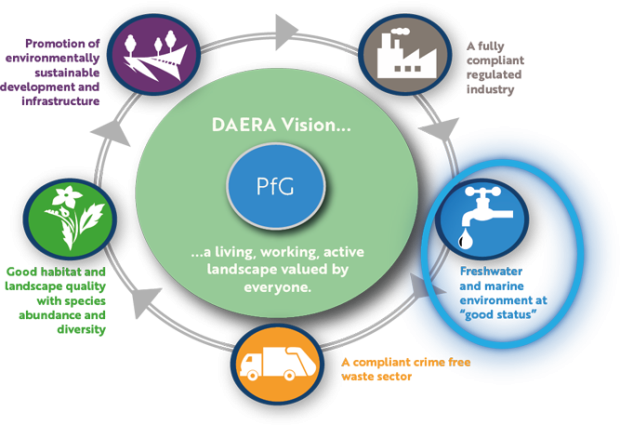
1.2 Figure 1 shows the areas of strategic focus set by the Department to progress its vision, which includes NI’s freshwater and marine environment. The ODP included two targets (PfG Indicators) around levels of phosphorus and nitrate in the environment – in excess quantities, both are detrimental to environmental health.
Figure 1. Areas of strategic focus for DAERA in the draft 2016-21 Programme for Government
Source: Northern Ireland Environment Agency (NIEA) Annual Report and Accounts 2020-21
Why is maximising the quality of Northern Ireland’s water resources important?
1.3 As an asset of value, water may be quantified in terms of the need for its constant availability for human consumption, the breadth of the economic sector activities which rely on consistency of supply and long-term environmental effects linked to water pollution. In financial terms, an Office for National Statistics publication valued UK water abstraction costs at £3,442m in 2020.
1.4 Given the reliance placed on water and its quality, regulatory controls set out in secondary and other compliance-based legislation have been in operation for several years. These have come about, in part, through the introduction of European Directives aimed at managing specific areas of concern, such as waste water treatment in urban areas and levels of chemical build-up including phosphorus.
Why was this study undertaken?
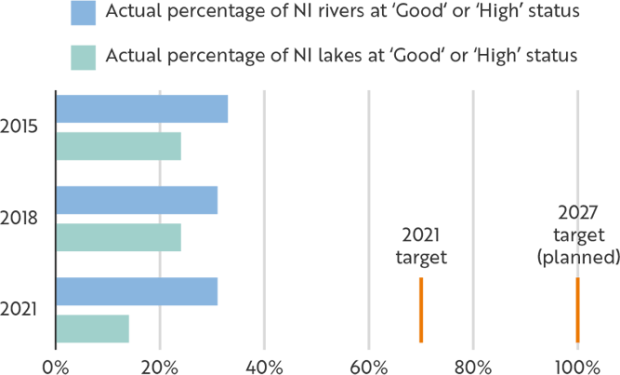
1.5 In response to deteriorating water quality across Europe, the European Water Framework Directive (WFD) (2000/60/EC) came into force in 2000. Its provisions, applicable in all EU Member States were transposed into NI Regulations in 2003, with a view to surface water bodies achieving ‘Good’ or ‘High’ ecological status by 2027. By the end of the second cycle (2015-2021), the attainment rate against this measure was 31 per cent for rivers and 14 per cent for lakes. This means that ‘Good’ or ‘High’ ecological status for NI’s rivers and lakes by 2027 will not be achieved.
The Northern Ireland Environment Agency is responsible for the conservation, protection and improvement of the aquatic environment in NI and contributes to ongoing policy development
1.6 While the Department has overall responsibility for matters relating to agriculture, the environment and rural affairs in NI, day-to-day operations in relation to water and water quality are managed by NIEA, an Executive Agency of the Department, in its role of protecting and enhancing the environment. Conservation, protection and improvement activities are undertaken using a combination of regulatory, monitoring and enforcement approaches.
Scope of the study
1.7 Our study examines how the Department has planned and managed its resources to address long-standing issues around water quality and to meet the regulatory requirements in place. In its River Basin Management Plans, the Department has previously identified sources of watercourse nutrient enrichment to include wastewater and septic tanks, with the most significant cause being the run-off of organic chemical fertilisers. As a result, we have focused on the influence of external factors on NI’s rivers and lakes, in assessing:
- the extent to which regulatory measures targeted at water quality improvement have been achieved (Part Two);
- the impact of land management activities within the agriculture sector on reported outcomes, given an increased level of known risk (Part Three); and
- the departmental oversight of NIW in its management of environmental risks associated with its day-to-day operations (Part Four).
Audit methodology
1.8 This study has been undertaken using the following audit methodologies:
- review of DAERA and NIEA documentation;
- review and analysis of performance data published by DAERA, NIEA, comparative data sources and other published outcomes;
- generation of additional outputs from DAERA and NIEA management information systems to further inform aspects of our report;
- benchmarking against organisations with similar water-related responsibilities in the other UK regions and RoI;
- discussions with staff in DAERA and NIEA; and
- engagement with a broad range of external stakeholders, including the Ulster Farmers’ Union, Northern Ireland Environment Link, Ulster Angling Federation, Friends of the Earth, The Rivers Trust and Loughs Agency.
Part Two: Water Quality Outcomes in Northern Ireland's Rivers and Lakes
Introduction
2.1 This Part of our report considers how NI’s water quality has changed over time and then examines the reported outcomes for rivers and lakes in more detail. Many of the existing water quality targets have their origins in European Directives, with outcomes being reported to the European Commission when the UK was an EU Member State. Following the Brexit transition, these regulatory requirements have been transposed into UK legislation - revised reporting arrangements have not yet been finalised.
Water quality status is determined using the results of monitoring activity
2.2 Water quality status is assessed by analysing data generated from water monitoring activity which is carried out at selected locations. Under the WFD established in 2000, it was intended that all surface water bodies (river, lakes and marine waters) would achieve ‘Good’ ecological status and ‘Good’ chemical status across all EU Member States by 2027 (although the regulations provide for extended deadlines in respect of selected chemical substances). Overall, the intended objective is recognised as a long-term one. Although the methodology used to assess water quality allows for certain, potentially toxic, substances to be detected, the tolerance threshold in place is low. Groundwater bodies are required to achieve ‘Good’ chemical status and ‘Good’ quantitative status.
The target for 100 per cent of surface water bodies in Northern Ireland to attain ‘Good’ or ‘High’ ecological status by 2027 will not be met
2.3 Improving water quality takes time. Under WFD, the strategies and activities planned to achieve this have been set out in a series of River Basin Management Plans (RBMPs) covering six-year cycles (2009-2015; 2015-2021 and 2021-2027). They have also required input from key stakeholders, both internal and external to the Department, with a view to achieving incremental progress over successive cycles. The targets set and reported outcomes are shown overleaf.
Figure 2. Northern Ireland river and lake water body ecological status outcomes, 2015 to 2021
Source: DAERA
2.4 As Figure 2 shows, NI’s surface water bodies have been falling short of this ecological status target since 2015. This is of concern, as an economic assessment shared with an NI Assembly Committee, linked to the (then) DOE noted that £105m would be required for water quality-related activities to meet a 70 per cent interim target set for 2021. This funding was to come from European, NIW and cross-departmental sources.
Northern Ireland’s water resources are managed using a catchment-based approach
2.5 Responsibility for water quality now falls within the remit of DAERA in NI. Although the day-to-day management of this is undertaken by NIEA, an Executive Agency of the Department, decision-making around environmental policy development and delivery remains with DAERA. We consider some of the broad implications of this later in our report.
Figure 3. Northern Ireland’s River Basin Districts and Local Management Areas

Source: NIEA
2.6 As Figure 3 shows, NIEA’s water-related activities are managed through a catchment-based approach. There are three catchments in NI – the North Eastern, Neagh Bann and North Western River Basin Districts (RBDs). The first is within NI only, while the others extend into RoI and are International RBDs. Each catchment is sub-divided into Local Management Areas (LMAs), with activities targeted to improve water quality overseen by Catchment Officers.
Cyclical RBMPs are progressed through programmes of water quality-focussed activities
2.7 During each RBMP cycle, wide-ranging activities with a water quality focus are undertaken, with the dual aims of halting deterioration and improving water body status. While some of these fall wholly within NIEA’s remit, it also has a degree of oversight of external activities involving other key stakeholders (such as NIW and the Department), where progress is linked to the delivery of strategies and initiatives which are intended to positively impact the water environment.
2.8 Alongside the requirements under WFD, other European Directives which feature in RBMPs include the long-standing Nitrates Directive (91/676/EEC) and the Urban Waste Water Treatment Directive (91/271/EEC).
Assessments of water body status for rivers and lakes take account of both chemical and ecological components
2.9 Assessing the status of rivers and lakes requires both chemical and ecological status to be considered. Chemical status is derived from the levels of specific substances identified in each environment. Ecological status is a broader assessment, taking account of a range of elements present – chemical, biological (living organisms) and hydromorphological (related to a water body’s physical character and water content). The final reported outcome is then based on the lowest result from each stage of the assessment process, known as the ‘one-out-all-out’ principle, using a scale of ‘High-Good-Moderate-Poor-Bad’. Appendix 1 provides more detail on the methodology used.
2.10 Under WFD, the standards which govern the presence of chemical substances in the environment are periodically revisited. Surveillance monitoring for possible chemicals which can impact water quality is undertaken. Any that are deemed to present a significant environmental risk must then be formally monitored and reported on as priority substances. Two categories were added in 2015, a commercial agricultural insecticide, and a group of ‘forever chemicals’ which have become widespread and persist in the environment (and depending on dose and duration, potentially toxic) – these were first reported on in 2021.
Since 2015, the ecological status of Northern Ireland’s rivers has not improved
2.11 A river is defined as a flowing stream of (normally fresh) water that leads to the sea, a lake or another river. For the purposes of WFD reporting, 450 of NI’s rivers have been designated as ‘river water bodies’ and are currently monitored (in the remainder of this Part, use of the term ‘rivers’ collectively refers to these 450 ‘river water bodies’). The first RBMP cycle outcomes were reported in 2015, and Figure 4 shows that the ecological status of NI’s rivers has not improved since then. With the addition of the priority substances, none achieved ‘Good’ or ‘High’ overall status in 2021 and, even with remedial action, this position is unlikely to change for several years.
Figure 4. The ecological status of Northern Ireland’s rivers has not improved since 2015
| Reporting year | % of Rivers achieving ‘Good’ or ‘High’ ecological status (and river numbers) | % of Rivers achieving ‘Good’ chemical status (and river numbers) | % of Rivers achieving ‘Good’ or ‘High’ overall water body status |
|---|---|---|---|
| 2015 | 33 (147) | 51.7^1 (233) ^no chemical data available for 206 rivers | 33 |
| 2018 | 31 (141) | 91.11 (410) | 31 |
| 2021 | 31 (140) | 92.81 (418) | not reported |
| 2021 RESTATED | 31 (140) | 0.0*2 (*extended to all rivers) | 0 |
1 chemical classification excluding new ‘priority substances’ – a commercial agricultural insecticide and a group of ‘forever chemicals’
2 chemical classification including new ‘priority substances’ – a commercial agricultural insecticide and a group of ‘forever chemicals’
Source: NI WFD Statistics, DAERA/NIEA
Since 2015, the ecological status of Northern Ireland’s lakes has deteriorated
2.12The general definition of a lake is a body of water surrounded by land. For WFD reporting purposes, 21 of NI’s lakes have been designated as ‘lake water bodies’ and are currently monitored (in the remainder of this Part, use of the term ‘lakes’ collectively refers to these 21 ‘lake water bodies’). The results of status monitoring for lakes is summarised in Figure 5.
Figure 5. Since 2018 there has been a reduction in the number of Northern Ireland’s lakes achieving ‘Good’ or ‘High’ ecological status
| Reporting year | % of Lakes achieving ‘Good’ or ‘High’ ecological status (and lake numbers) | % of Lakes achieving ‘Good’ chemical status (and lake numbers) | % of Lakes achieving ‘Good’ or ‘High’ overall water body status |
|---|---|---|---|
| 2015 | 24 (5) | 1001 (21) | 24 |
| 2018 | 24 (5) | 1001 (21) | 24 |
| 2021 | 14 (3) | 1001 (21) | not reported |
| 2021 RESTATED | 14 (3) | 02 | 0 |
1 chemical classification excluding new ‘priority substances’ – a commercial agricultural insecticide and a group of ‘forever chemicals’
2 chemical classification including new ‘priority substances’ – a commercial agricultural insecticide and a group of ‘forever chemicals’
Source: NI WFD Statistics, DAERA/NIEA
Excess levels of nutrient-rich substances have contributed to the lack of improvement seen in Northern Ireland’s rivers and lakes since 2015
2.13 The environment can benefit from the presence of nutrient-rich substances such as phosphorus and nitrate, whether these occur naturally or are introduced as part of land management techniques. However, where excess quantities of these accumulate and enter rivers and lakes, they cause ecological changes. Where this persists, it has a detrimental effect on the long-term health of the water environment, due to increased algae growth and reduced oxygen levels. The reported outcomes of phosphorus and nitrate monitoring activity show that deterioration in water quality from excessive phosphorus continues to be a particular issue in NI.
Phosphorus levels in rivers have increased over the last decade
2.14 The level of phosphorus present in a river is a key component in the assessment of its ecological status. The draft 2016-2021 PfG included an Indicator based on the levels of average Soluble Reactive Phosphorus (SRP) in rivers which were detected at 93 surveillance sites across NI. In the last decade, the average level of SRP detected has increased from 0.053 milligrams per litre (mg/l) to 0.073 mg/l in 2022, as Figure 6 shows.
Figure 6. Average phosphorus levels in Northern Ireland’s rivers have increased over the last decade

Source: NI Environmental Statistics Report, May 2023, DAERA
Note: Due to restrictions imposed as a result of the Covid-19 pandemic, river monitoring was affected with samples not taken in April and May and limited numbers taken in March and December of 2020.
2.15 The Phosphorus (Use in Agriculture) Regulations (Northern Ireland) 2006 introduced several years ago, were aimed at preventing water pollution by limiting the amount of phosphorus applied to the land using chemical fertiliser. The Department’s commentary around average SRP outcomes in its NI Environmental Statistics Report 2023 notes that ‘the introduction of [these regulations] has contributed to a reduction in phosphorus from agricultural activities, in conjunction with ongoing improvements in domestic wastewater treatment through investment by Northern Ireland Water’. NIEA’s delivery of Outcome Action Plans for 20 high priority river water bodies across NI has included the monitoring of progress through SRP testing.
2.16 NIEA also carries out SRP monitoring at additional locations across NI under the provisions of the 1991 Nitrates Directive (NiD). This was undertaken at 391 sites from 2012 to 2015, 501 in 2018 and 471 in 2019. Outcomes reported to the European Commission showed an 18 per cent increase on the average 2015 figure (0.065mg/l) in 2018, to 0.077 mg/l. By 2019, although the 0.075 mg/l outcome was a slight improvement, this was still 15 per cent more than in 2015.
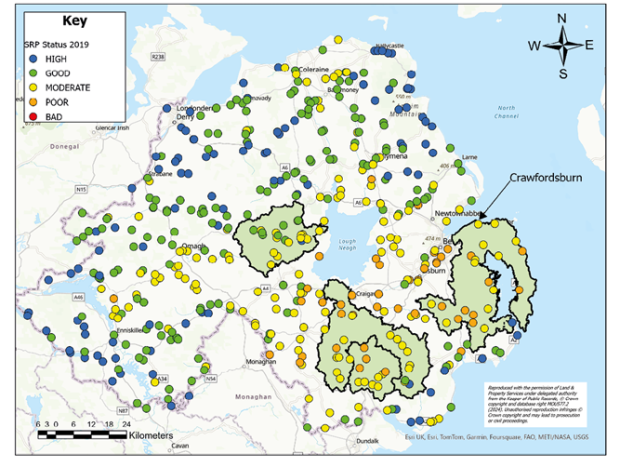
2.17 The NiD includes a provision or ‘derogation’ which, in certain circumstances, allows elements of the legislation to be applied differently, or not at all. Applying the WFD methodology assessment scale of ‘High-Good-Moderate-Poor-Bad’, for phosphorus over the 2012-2015 period, river sites were classified as ‘High/Good’ for 66.3 per cent of sites; ‘Moderate’ (at risk from (damaging) nutrient enrichment) for 28.1 per cent; and ‘Poor’ (already nutrient enriched) for 5.6 per cent (based on three-year averages). In 2018, the equivalent outcomes, from a one-year dataset, were 60.7 per cent; 28.3 per cent; and 11 per cent respectively. In 2019, 56.1 per cent of sites were classified as ‘High/Good’, 36.1 per cent were ‘Moderate’ and 7.8 per cent were ‘Poor’, (a further one-year dataset), with the individual results plotted in Figure 7.
Figure 7. Many of the rivers in Northern Ireland classified as ‘Moderate’ or ‘Poor’ for phosphorus in 2019 were located in catchments with high numbers of derogated farms
Source: NIEA
2.18 Overall, the reported outcomes for the presence of phosphorus in NI’s rivers demonstrate a link to deteriorating water quality, and correlation is observed in areas with high numbers of derogated farms (highlighted in green in Figure 7). Whilst correlation is observed in areas with high numbers of derogated farms, and these may be a proxy for agricultural intensity, based on the available evidence, it is not possible to conclude that derogation arrangements have been the direct cause of the deterioration in water quality noted.
By 2019, only four of Northern Ireland’s lakes monitored under WFD achieved a ‘Good’ status outcome for phosphorus
2.19 As well as the NI lakes monitored under the WFD, a Total Phosphorus (TP) measure was first included within derogation reporting in 2012. Figure 8 shows that the 2019 outcome, four lakes with ‘Good’ status for this measure, represented a reduction in status of 23.9 per cent when compared with 2014 (42.9 per cent).
Figure 8. Since 2014, the proportion of Northern Ireland’s monitored lakes assessed with ‘High’ or ‘Good’ status for Total Phosphorus has reduced by more than 55 per cent
Source: Nitrates Directive Derogation Reports
2.20 Further reported outcomes for levels of average TP in 2018 were 0.087 mg/l, an increase of almost 34 per cent on the 2012-2014 figure (0.065 mg/l). In 2019, an equivalent outcome of 0.083mg/l, while indicating some improvement, was still almost 28 per cent more than in 2012-2014.
The average concentration of nitrate measured in Northern Ireland’s rivers is relatively low and has remained stable over time
2.21 Monitoring for nitrate pollution under the NiD has been undertaken since 2000 at selected sites across NI, with the results used to calculate annual mean (average) nitrate concentrations. Alongside a ‘mandatory standard’ of 50 mg of nitrate per litre (NO3/l), there is a more rigorous ‘guide standard’ with a requirement for 90 per cent of samples to be less than 25 mg NO3/l. Although the results of long-term monitoring set out in Figure 9 indicate the presence of stable and relatively low average nitrate concentrations, derogation reporting has also shown that, where measurable increases have occurred, high numbers of derogated farms have also been present.
Figure 9. Nitrate concentrations in Northern Ireland’s rivers have remained relatively low, on average, since sample monitoring began in 2000
| Reporting period | Percentage of sites achieving nitrate outcomes against the ‘guide standard’ (90 per cent of samples less than 25 mg NO3/l) | Annual average nitrate concentrations for all sites in mg NO3/l |
|---|---|---|
| 2000-2011 | 99.0 | 5.1 (622 sites monitored between 2008 and 2011) |
| 2012-2016 | 100 | 5.2 (337 sites monitored between 2012 and 2015) |
| 2018 | 99.6 | 5.8 (501 sites monitored) |
| 2019 | 99.8 | 6.3 (505 sites monitored) |
| 2020 | 100.0 | not known |
| 2021 | 100.0 | not known |
Source: NI Environmental Statistics and Nitrates Directive Derogation Reports
Reported outcomes show that water quality in Northern Ireland’s rivers and lakes is significantly worse than in the Republic of Ireland
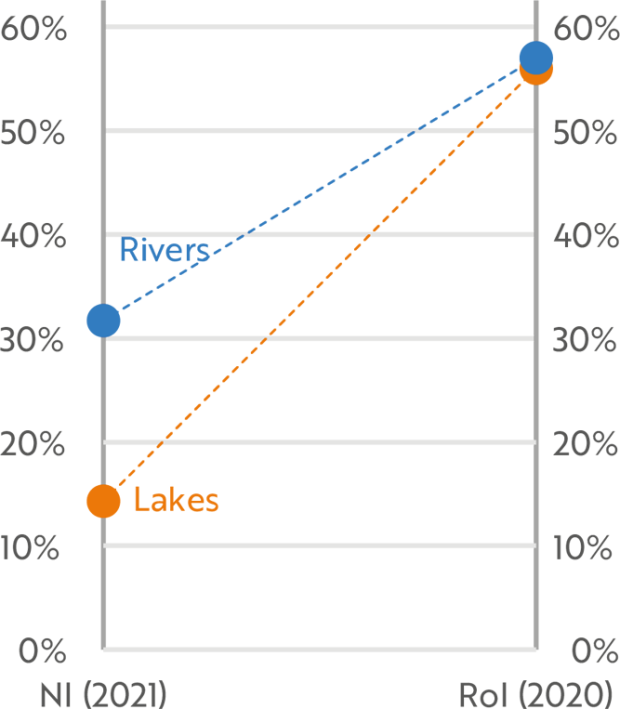
2.22 In RoI, water quality monitoring is undertaken by the Environmental Protection Agency (EPA). In its 2021 publication, ‘Good’ or ‘High’ ecological status outcomes across the 1,836 rivers and 224 lakes which were assessed in 2020 were significantly better than the equivalent status measures reported for NI, as shown in Figure 10.
Figure 10. On average, more than twice as many rivers and lakes in the Republic of Ireland achieved ‘Good’ or ‘High’ ecological status in 2020, compared to Northern Ireland
Source: EPA and NI WFD Statistics, DAERA/NIEA
2.23 Similarly, recent status outcomes reported for phosphorus and nitrate, as set out in Figures 11a and 11b, have been more favourable for rivers and lakes in RoI.
Figure 11a. The percentage of rivers and lakes assessed with ‘High’ or ‘Good’ status for phosphorus measurements in Northern Ireland is much lower than in the Republic of Ireland
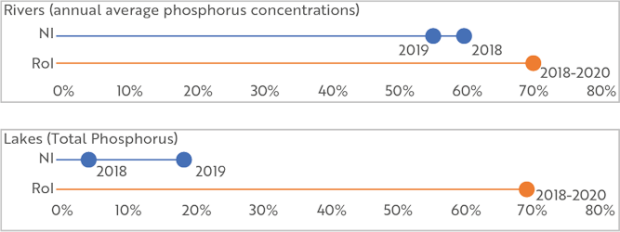
Figure 11b. Reported outcomes have shown that, compared to the Republic of Ireland, excess levels of nitrate are proportionately higher in Northern Ireland’s rivers and lakes
| Republic of Ireland | Northern Ireland |
|---|---|
| Average nitrate concentrations for all sites (mg NO3/l) | |
(2018-2020) 477 sites less than 4.0 mg 226 less than 8.0 mg 623 more than 8.0 mg (in the absence of current environmental standards for nitrate, EPA assessed 1,326 river sites only) | (2018) 5.8 mg (501 sites) (2019) 6.3 mg (505 sites) |
Source: EPA and Nitrates Directive Derogation Reports
Note: Figures 11a and 11b provide multi-year outcomes for RoI and single-year outcomes for NI, as reported.
2.24 We have examined NI’s water quality by considering reported outcomes for ecological, chemical and overall status, as well as levels of phosphorus and nitrate concentrations, in respect of rivers and lakes. The results show that excessive phosphorus, in particular, has had an adverse impact on water quality within the last decade. Given the known increased risks to the environment associated with agricultural practices and NIW’s operational activities, we examine how each area has contributed to NI’s water quality status in Parts Three and Four, and consider what improvements could be made.
Part Three: The Impact of Agricultural Practices in Northern Ireland on Water Quality
Introduction
3.1 In Part Two we established that, over time, there has been a deterioration in the water quality of NI’s rivers and lakes, with a key element being the presence of phosphorus at excess levels. As activities in the agriculture sector are known to exert particular pressures on water quality, this Part considers the nature of water pollution incidents linked to farms over the last decade in more detail, and the outcomes of the Department’s actions in this area.
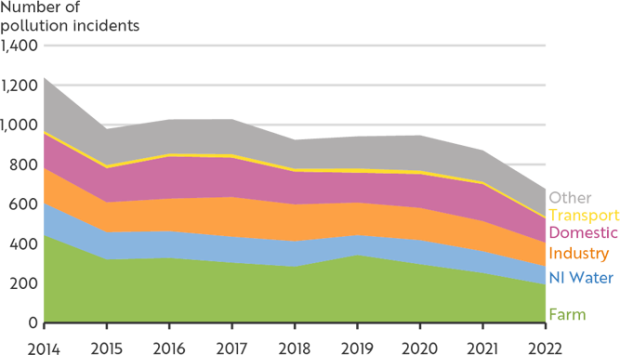
Figure 12. Between 2014 and 2022, the largest proportion of substantiated water pollution incidents in Northern Ireland were linked to farms
Source: NI Environmental Statistics Report, May 2023, DAERA
3.2 Figure 12 provides a breakdown of substantiated water pollution incidents for a range of sectors, within the last 10 years. Overall, this shows that, between 2014 and 2022, the largest proportion of these incidents was linked to farms.
3.3 In order to examine the agriculture-related incidents further by quantifying the magnitude of their main causes, we asked NIEA to generate datasets for us from its Pollution Incident Management System (PIMS). In later sections, we set out the results of our data analysis and use these to consider the extent to which the causes identified reflect the current focus of NIEA and, more widely, the Department, in addressing the impact of agricultural practices on water quality.
Within the agriculture sector, NIEA undertakes regulatory inspection activity and adverse incident investigations, while proactively seeking to improve quality standards in water catchments
NIEA’s Water Management Unit operations
3.4 At 31 March 2022, NIEA’s Water Management Unit (WMU or the Unit) comprised some 167 staff, with a complement of 129 supplemented by 38 ‘field’ staff. The field staff attached to the Unit undertake certain aspects of its work, but are employed by one of four NI Councils, or under a separate contractual arrangement. Total in-year costs for the Unit of £8.6m included around £1.6m in respect of these 38 staff.
3.5 NIEA operations include a three-fold focus in terms of agricultural land management activity which is based around: regulatory aspects (on-farm inspections), reactive work due to catchment operations, particularly pollution-related investigations and also proactive preventative work, including larger-scale approaches to the management of water catchments (for example, in ‘priority areas’). We consider some of the main outcomes from these activities in the following sections.
Around one per cent of farms in Northern Ireland are inspected each year, in line with regulatory requirements
3.6 The Unit’s regulatory inspection activity in the agriculture sector is governed by a statutory risk assessment and outcomes-based framework. The approach to inspections is set down within the regulations which govern the current Nutrients Action Programme (NAP) 2019-2022 and is aligned with the Statutory Management Requirement for the Protection of Water against Nitrates Pollution. Compliance with NAP Regulations, which replaced an earlier Nitrates Action Programme linked to the Nitrates Directive and Phosphorus Regulations, is applicable to all agricultural land, as is a cross-compliance requirement.
3.7 The agriculture sector accounts for 77 per cent of NI’s total land area of 1.043 million hectares, with around 26,000 farms. Given that the required one per cent inspection sample, which incorporates both risk and random aspects, is around 270 annually, the deterrent effect of any ‘potential’ inspection will be minimal. There is some additional work undertaken, as a result of internal referrals from departmental colleagues and the concerned public.
3.8 Data extracted from the Department’s 2021 publication Agricultural Nutrients and Water Quality and further supplemented by NIEA-compiled figures showed that, over the period from 2012 to 2021, ‘pollution to a waterway’ and ‘livestock manure storage requirements’ were the areas consistently associated with the two highest rates of non-compliance.
NIEA is tasked with investigating pollution incidents which occur during catchment operations
3.9 In preparing for the 2021-2027 WFD cycle, NIEA identified diffuse agricultural pollution as a significant water management issue, caused by ‘the release of the nutrients phosphorus and nitrogen from agricultural sources; sediment entering waters due to damage to river banks….livestock trampling; ploughing and overgrazing’. SRP concentrations measured at impacted river sites assessed between 2015 and 2018 also indicated that this was the primary cause.
3.10 The sources of nutrient releases associated with normal land management activities are well-established. Issues with slurry and fertiliser application can occur where these substances are inappropriately applied close to rivers and lakes. Examples include slurry spreading which may be excessive and poorly controlled or leakage from overladen storage facilities, as well as the over-application of fertiliser on poorly-drained land or during unsuitable weather conditions. Each of these, by altering the physical, chemical or biological conditions of a river or lake, can affect water quality.
3.11 During the 2015-2021 cycle, many of the actions within NIEA’s remit related to the agriculture sector and were linked to the Nitrates Action Programme, in order to influence appropriate levels of nutrient applications. Addressing pollution caused by sewage was also included. In 2015, these factors were reported to have affected 65 per cent of rivers in the North Eastern River Basin District (RBD) (see Figure 3). By 2021, nutrients released from agricultural sources represented the most significant pressure on rivers and lakes across NI. RoI reported similar findings in 2020.
Over the five years to 2021, more than half of all incidents involving agricultural pollution have occurred in the Neagh Bann River Basin District
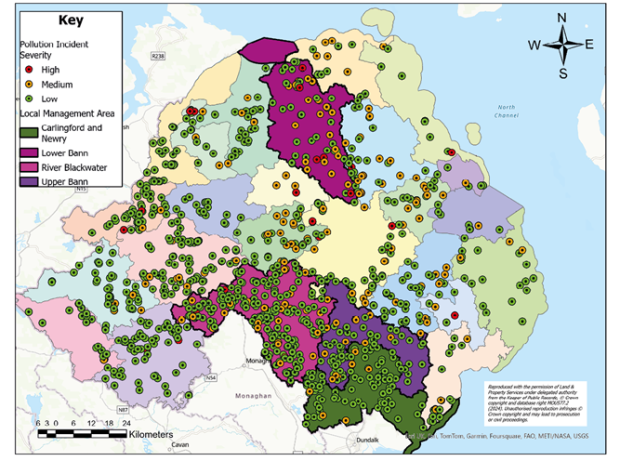
3.12We analysed the datasets generated for us by NIEA, covering the period January 2017 to September 2021, to establish and examine recent trends from agricultural pollution-related incidents. In addition, the outcomes from these datasets were mapped by NIEA, by LMA and incident severity (High, Medium or Low), as shown in Figure 13. We utilised another dataset which was sourced through the Department’s Agricultural Payments Branch and detailed associated enforcement action, along with the value of any cross-compliance penalties levied against farm businesses in receipt of agricultural support funding. We understand that NIEA does not routinely produce these data types as part of ongoing monitoring activities.
Figure 13. Substantiated agricultural pollution incident severity by Local Management Area, 2017 to 2021
Source: NIEA
3.13 Figure 14 summarises our analysis of NIEA’s 2017-2021 dataset. This shows that more than half (53 per cent) of all substantiated agriculture-related pollution incidents in the last five years occurred in the Neagh Bann RBD. Some 247 (27 per cent) of these were assessed as High or Medium severity.
Figure 14. Substantiated agricultural pollution incidents during the period 2017-2021 were most prevalent in the Neagh Bann River Basin District
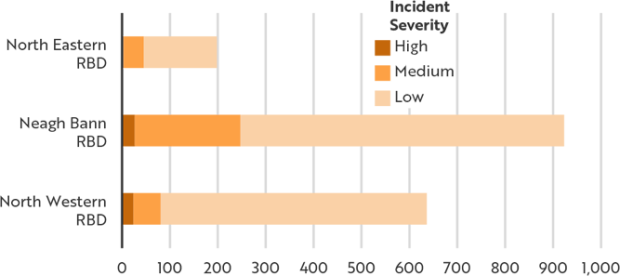
Source: NIEA and NIAO
3.14 Within the Neagh Bann RBD, more than 72 per cent (666) of incidents occurred in four of its nine LMAs (River Blackwater, Carlingford & Newry, Upper Bann and Lower Bann). Of these, the frequency of substantiated pollution incidents (310) was three times worse in the River Blackwater LMA, with 23 per cent assessed as High or Medium in severity. Given the fact that there are ‘priority water bodies’ in need of particular attention here, and that an EU-funded project linked to water quality improvement is ongoing, this is particularly concerning.
Recommendation
In order to address the long-term prevalence of pollution linked to agricultural practices, we recommend that the Department:
- utilises all available data sources to focus its inspection efforts by incorporating, as far as possible, the results of analysis pinpointing key incident causes and associated locations into sampling methodologies; and
- draws on these enhanced data outcomes for benchmarking purposes, particularly where outcomes in other regions around similar issues are better.
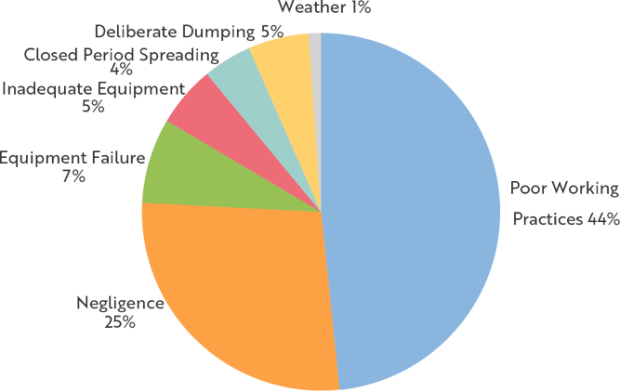
3.15 Given the frequency of pollution in the River Blackwater LMA, our further analysis of the 310 incidents recorded between 2017 and 2021 was used to identify the most frequently occurring pollutants detected and the associated principal contributory causes (as summarised in Figures 15a and 15b).
Detailed breakdowns of the results, which are set out in Appendices 2a and 2b, reflect one of the additional sources of data analysis referenced in our recommendations.
3.16 As Figures 15a and 15b show, overall we found that the three pollutants most frequently detected, ‘farm effluent mixture’, ‘silage’ and ‘cattle waste’, accounted for 86 per cent (266) of all incidents. When cross-referenced against the principal contributory cause recorded in PIMS, the seven causes shown could be linked to 91 per cent of these 262 incidents, with the most frequent being ‘poor working practices’.
Figure 15a. River Blackwater LMA - most frequently detected pollutants, 2017-2021
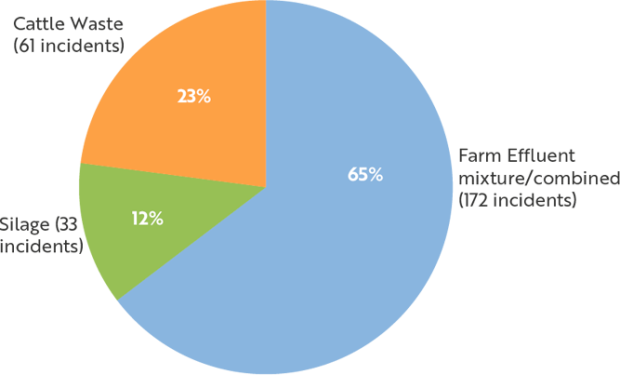
Figure 15b. River Blackwater LMA - principal contributory causes, 2017-2021
Source: NIEA and NIAO
Since 2017, the average cross-compliance penalty levied for agricultural pollution in Northern Ireland has been around £1,600
3.17 NIEA’s operations may ultimately result in cross-compliance penalties. DAERA’s Agricultural Payments Branch uses NIEA inspection results to determine where financial sanctions will be levied. NIEA told us that it has no requirement to see this type of information or any use for it.
3.18 Of 1,480 agriculture-related water pollution incidents recorded between January 2017 and September 2021, in line with NIEA enforcement policy, polluters were subject to, or considered for, enforcement action in 343 cases (23.2 per cent). There was no action taken in the majority of incidents recorded over this period, where the incident was assessed as low severity and the polluter was not in receipt of an agricultural support payment which could be penalised or the polluter was not identifiable.
3.19 Over the five-year period, the total levied in cross-compliance penalties was £446,000 over 273 cases, an average of £1,634 per case. In addition to this, £25,000 of prosecution fines were levied across 51 incidents.
3.20 This Part of our report has considered the consistency with which the issues identified in the agriculture sector have persisted, the implications of this for improved water quality metrics, the outcomes from the additional data generated for this report by NIEA and DAERA and the limited deterrent effect that financial and other sanctions appear to exert. An enhanced programme of work, appropriately targeted and resourced, would provide the opportunity to focus on a discrete issue(s) within an RBD or a single LMA, utilising existing datasets and accumulated knowledge to pinpoint hotspots for follow-up which is impactful. Alongside this is the importance of ongoing stakeholder involvement, both internal and external to NIEA, as a key contributor to achieving incremental and sustained improvement.
Recommendation
We recommend that NIEA considers ways in which the effectiveness of its regulatory, inspection and preventative work in the agriculture sector can be enhanced through wider stakeholder partnerships, and formalises this as one strand within an overarching water quality improvement strategy.
NIEA has a role in proactively seeking to influence water quality standards through improved catchment management
3.21 NIEA’s catchment management work is based around on-the-ground identification of pressures using more in-depth approaches, which includes additional biological sampling. Its activities in this area also include the provision of advice and guidance to users of water resources, and overseeing small-scale project funding delivered through a water-quality strand of The Environment Fund, which is designed to provide small community-based groups with project funding related to water quality improvement. More widely, the Department has stakeholder involvement through AFBI in three EU-funded, multi-year projects with a water quality focus. These aspects are considered further in Part Four.
3.22 In RoI, the EPA operates as an independent body, with responsibility for protecting and improving the environment through regulation, knowledge and advocacy. Across the UK, the status of Natural Resources Wales (NRW), the Scottish Environmental Protection Agency (SEPA) and England’s Environment Agency (EA) is similar to EPA, however, this is not the case with NIEA.
3.23 Following the publication of the NIAO report on Control of River Pollution in Northern Ireland (HC 693, Session 1997-98), the NI Assembly Public Accounts Committee’s subsequent report in 2000 included a recommendation around the formation of an independent environmental protection agency. We note that the January 2020 New Decade, New Approach document also included the same undertaking. Since then, NI has taken Non-Executive membership of the recently constituted UK-based Office for Environmental Protection (OEP), which is tasked with providing independent scrutiny and advice on environmental law and policy, investigating environmental complaints and, if necessary, taking enforcement action against public authorities in breach of environmental law.
3.24 As part of our work, we engaged with a range of stakeholders around their involvement in activities relevant to catchment operations. We discussed the opportunities available to contribute to the maintenance and improvement of water as a valued resource, and approaches in use within neighbouring geographic regions to tackle similar water quality-related issues. The overall message from stakeholders is that a need exists for more strategic, partnership-based working to address the themes which emerged from these discussions.
3.25 Given the extent of water pollution associated with agriculture practices, the need for key stakeholders to work together is clear, while focussing on their particular interests and areas of influence. While we found some examples of co-operative working on the ground and involving community groups, stakeholders also highlighted some of the difficulties which have restricted their ability to do more.
3.26 Stakeholders also told us that, while scope exists to expand opportunities which would build accumulated knowledge across economic sectors in NI and with RoI, this needs to be progressed as part of a wider, planned strategy.
The availability and timely release of funding are essential to progress water quality improvement
3.27 Although small project grants of £5,000 to £30,000 are available to voluntary groups through the Environment Fund Water Quality Improvement Strand, part of DAERA’s Environmental Challenge Fund Competition, stakeholders told us that the reduction in funding levels from 100 to 85 per cent over time is an additional hurdle to participation. In other geographic regions, such as RoI, there is a strong community-based focus to securing funds for similar project work while, in England, funding released through the Department for Environment, Food and Rural Affairs is utilised by the Catchment Based Approach initiative and environmental trusts.
3.28 Particular challenges arise with the management of multi-year water quality improvement projects, when funding cycles are restricted to 12 months. With environmentally-based projects in particular, the timing of available funds has a strong influence on successful completion. There is evidence of planned river restoration work unable to be progressed during the winter season, in order to avoid riverbed damage or the effect on fish movements, leading to project funding being returned.
3.29 The Department told us that involvement by farm businesses in water quality measures under the Environmental Farming Scheme has led to more than 2,500 kilometres of riparian (watercourse) buffer strips (such as fencing and tree planting), which reduce the risk of nutrients from manure and other run-off contaminating watercourses, and prevent livestock access.
Individually and collectively, farm businesses need to be supportive of initiatives which can contribute to resolving long-standing water quality issues
3.30 Opportunities exist for farm businesses to play a role in driving water quality improvement. One example is through voluntary participation in advisory visits such as those facilitated by The Rivers Trust, which can help with targeting areas for action such as input efficiencies, including fertiliser usage. In addition, the focus of DAERA’s Soil Nutrient Health Scheme, launched during 2022, is around contributing to increased sustainability in agriculture. With both approaches using issue identification and knowledge-sharing as a first step towards long-term improvement, the Department’s role in promoting participation is key. In RoI, advisory visits are a feature of its Agricultural Sustainability Support and Advisory Programme, with early results reported to be ‘encouraging’.
3.31 Two major sources of pollution identified within catchments in England, agricultural and raw sewage spills, accounted for around 250,000 incidents in 2019 and 400,000 in 2020. Action areas identified here have included additional investment for better catchment management, higher agricultural standards and improved slurry management.
3.32 In Scotland, a Rural Diffuse Pollution Plan covering the period 2015-2021 formed an integral part of its second cycle RBMPs. With delivery under the management of the Diffuse Pollution Management Advisory Group, this had been established during the first RBMP cycle, in line with a decision-making and governance framework. Fourteen catchments were prioritised on the basis of pollution impact, with SEPA’s co-ordinated rollout aligned to the controlled activities legislation in place. Awareness-raising work was also undertaken around diffuse pollution issues combined with initial site visits and follow-ups for persistent non-compliance. The legislative context has been considered as key to achieving the required levels of stakeholder engagement and buy-in.
Recommendation
We recommend that the Department actively promotes participation by the agriculture sector in water quality improvement initiatives, both internal and external to DAERA, (such as the Soil Nutrient Health Scheme), as part of its joint working with stakeholders.
Part Four: The Impact of Northern Ireland Water Operations on Water Quality
Introduction
4.1 Part Two of our report set out the background to the limited improvement achieved in the overall quality of water in NI’s rivers and lakes. This Part considers some of the operational activities of Northern Ireland Water (NIW), given the need to manage associated environmental risks, particularly those associated with water quality maintenance. We have also included the results of a high-level review of water sector activities in neighbouring geographic regions, which considered inputs and outcomes.
4.2 NIW, a Government-owned Company (GoCo) was established in 2007, with a remit to provide water and sewerage services in NI. As an entity with Non-Departmental Public Body status, it is sponsored by the Department for Infrastructure (DfI), its sole Shareholder, with the Minister for Infrastructure appointing NIW’s Board. A Partnership Agreement in place with DfI and the Department of Finance in NI collectively sets out the framework under which NIW can operate.
4.3 NIW is a monopoly supplier and, as such, is subject to regulation by the Northern Ireland Authority for Utility Regulation (Utility Regulator). The Utility Regulator’s role includes the publication of regulatory Price Control (PC) determinations every six years, which is based on a Business Plan submitted by NIW and indicative funding allocations from DfI. For the current PC period (2021-2027), price limits have been set which NIW can charge non-domestic customers, along with expected outputs which will be delivered and a recommended level of capital investment. In line with current policy arrangements, rather than levying a charge on domestic customers, DfI instead makes subsidy payments to NIW.
4.4 NIW provides 605 million litres of clean water and treats 362 million litres of wastewater from domestic properties, business/industrial premises and accumulated rainwater, on a daily basis.
Historic funding deficits in NIW are likely to have impacted water quality
4.5 Over time, and largely as a result of funding shortfalls, issues linked to operational capacity are likely to have affected NIW’s ability to respond fully to the pace of water and wastewater treatment infrastructure development - this has affected both urban and rural parts of NI. The reported value of DfI subsidy payments to NIW in 2021-2022 was £318.6m. DfI has told us that it is the constraints of public expenditure (that is, the spending of the subsidy) which will impact the delivery of the investment needed in the required infrastructure to avoid the risk of adverse outcomes, including pollution, to occur where environmental protection standards have not been maintained. For the 2021-2027 PC period, the determination reached sets out a requirement for £2.1 billion in capital investment to maintain and enhance the present infrastructure. In addition, DfI has told us that the current areas for strategic focus, as set by the Utility Regulator, relate to development constraints, increasing capital investment and long-term tariff stability, and it is these which will define the development of water and sewerage services in the medium to long-term. NIW’s view for the long-term is that the value of current investment will need to be maintained for a further two to three PC periods (that is, 2039 to 2045), in order to alleviate the issues associated with the ageing water and sewerage systems which have arisen as a consequence of these historic funding deficits.
There are a number of risk areas associated with NIW’s operational activities
4.6 NIW operations include the abstraction or drawing out of ‘raw’ water from 34 designated points for processing at 24 water treatment works across NI. This clean water is then piped into homes and businesses for a variety of uses. As the raw water sourced from rivers, reservoirs and loughs is used to provide drinking-quality water, the Drinking Water Inspectorate (DWI) within NIEA has a role in regulating and enforcing the quality of the drinking water received at the tap. Staff working on water regulation matters have responsibilities around licensing and regulating the quantity of raw water abstracted to meet the level of drinking water supply needs. Known issues associated with abstraction activities include the erosion of riverbanks and areas of peatland. We note from the NIW website that, on occasion, pesticide-related pollution has been detected in the raw water abstracted. Along with DAERA, NIEA and others, NIW has been involved in the Water Catchment Partnership, which was formed in 2013, with a view to addressing pesticide-related issues affecting raw water quality.
4.7 NIW’s approach to catchment management, known as SCaMP NI, aims to improve the quality and reliability of water using sustainable catchment-based solutions, while protecting the environment. There is a particular focus around the management of polluted raw water at source, prior to its abstraction for processing at water treatment works, in order to minimise the cost of removing contaminants.
4.8 NIW operations also include the treatment of wastewater collected through the sewerage system. Sewers, pipes and pumps convey wastewater from homes and commercial properties, along with rainwater from roads, foothpaths and roofs to Wastewater Treatment Works (WwTW), for cleaning and safe disposal into a river, a lake or the sea. In some locations, two sewers will separately carry sewage away for treatment and rainwater for release into a water body, while elsewhere, combined sewers carry rain and wastewater away via a single pipe. Combined sewers have overflow points, known as Combined Sewer Overflows (CSOs), which are designed to spill excess storm water in the event that the capacity of the sewer network (either before or at the WwTW) becomes overwhelmed during heavy rainfall. DfI has told us that storm overflows, by releasing excess water build-up, operate as designed to prevent the occurrence of flooding. NIW has told us that the operation of storm overflows is integral to the existing sewage system, in reducing the likelihood of flooding of properties, businesses and roads with wastewater. However, given that it is not possible to eliminate all risk of flooding taking place, pollution incidents may still occur.
4.9 In line with the provisions of the Water (Northern Ireland) Order 1999 (as amended) water regulation staff also have a role in the granting of ‘consents to discharge’. These provide for the release of substances into a watercourse or to a soakaway, under controlled conditions. The nature of the discharge governs the form of consent required, such as a direct discharge into a waterway from a domestic setting where a connection to the NIW sewage collection and treatment system is not available, or a daily discharge (within prescribed limits) from business premises. Discharges by NIW from water treatment works, WwTW and other wastewater collection systems are also regulated in line with this Order. If a discharge is assessed as ‘acceptable’, the granting of a ‘consent to discharge’ will also specify the regulatory standards in force, in order to protect water quality in the environment. If an application could potentially impact, for example, a protected site, DAERA’s Natural Environment Division can provide input to the assessment process. New Environmental Permitting Regulations have been proposed, although it remains unclear what effect these could have on the current arrangements in place.
From our stakeholder discussions, a number of water quality issues linked to NIW’s operations were routinely highlighted
4.10 As indicated in Part 3, we met with a range of stakeholders involved in water-related activities. They provided observations on the causes of reduced water quality linked to the NIW day-to-day operations already described, the influence exerted by external factors outside NIW’s control and some of the perceived shortcomings in the existing approaches to regulation and enforcement in this area.
The inadequacy of Northern Ireland’s existing water infrastructure
4.11 A lack of investment in NIW infrastructure, over a prolonged period, is reflected in ongoing leakages from water pipes (for drinking water) and flooding incidents (in relation to sewerage). In addition, the limited capacity of the wastewater infrastructure network in dealing with increased drainage requirements is reducing the capability to manage clean rainwater and wastewater as intended, as a result of additional discharges from CSOs. Furthermore, where pollution of sewage itself has occurred prior to a treatment process, such as from the presence of fats, oils and grease, wet wipes, cotton buds and microplastics, this will present an additional hazard.
4.12 While any infrastructure investment is to be welcomed, increased funding is required to address inflationary pressures, accelerate progress in the areas identified and maximise the potential benefits, including improved water quality outcomes.
Pollution of the water network is a significant issue
4.13 Stakeholders made reference to a seeming reluctance to investigate and take enforcement action against polluters of the water network, particularly where repeat offenders were involved. Issues were also raised around unregulated industrial discharge, particularly with incidents where the original source was considered, in their view, to have been traceable.
Further and improved engagement around partnership-based working is required
4.14 Stakeholders considered that existing opportunities, with the potential to improve water quality, could be more actively promoted through joined-up working, and that this might also be used to constructively influence and contribute to a more structured water strategy.
NIEA’s approach to maintaining quality standards for drinking water and wastewater includes regulatory activity and investigative work following pollution incidents
The role of NIEA in water regulation
4.15 Matters relating to water regulation are managed separately from the activities of WMU. At 31 March 2022, this involved 43 staff, with associated salary and running costs of £1.6m and £2.36m respectively. Income valued at around £0.85m annually is also generated from regulatory activities, including the assessment of ‘consent to discharge’ applications.
4.16 The structure of NI’s catchment system (in the form of RBDs) and LMAs was set out in Part 2 (Figure 3). The operational coverage of Senior Water Quality Inspectors for pollution control is shown in Figure 16.
Figure 16. The management of NIEA’s environmental health-related activities is split across nine administrative areas of Northern Ireland

Source: NIEA
NIEA’s regulatory oversight of NIW is outdated and the implementation of planned reforms will not become effective until 2027, at the earliest
4.17 An operator self-monitoring programme is in place to assess the compliance of the treated effluent discharged at WwTWs serving over 250 population equivalent. In its regulatory role, and in line with applicable guidance, NIEA agrees a sampling schedule annually for those qualifying WwTWs. NIW collects the samples through a contracted third party and analyses these at its laboratory. The majority of the analytical work required is undertaken at NIW’s laboratory, alongside a sub-contract with a UK-accredited facility in respect of some specific pollutants. Both sampling and analytical work is accredited to UK Accreditation Services (UKAS) ISO 17025 standards, and is subject to annual audit processes by UKAS, with NIEA externally auditing NIW’s processes and procedures. Under the operator self-monitoring programme, NIW submits the data from the sample collection and laboratory analysis for those qualifying WwTW monthly. NIEA then assesses the submitted data against the standards set within the discharge consent for the individual WwTW, in order to determine the level of compliance. This is carried out using the NIEA’s Water Quality Archive (an internal database management system), where an algorithm is applied which assesses individual site compliance. NIEA has told us that where a site does not reach the parameters established for a particular compliance standard, the Department’s enforcement policy is then applied.
4.18 NIEA also implements a site inspection programme to assess the environmental performance of those small WwTW serving less than a 250 population equivalent, reporting the inspection findings to NIW for remedial action. Sites requiring improvement are identified as non-compliant until NIW has delivered the required improvements.
4.19 Prior to NIW’s formation, the entity in existence was NI Water Service, a central government Executive Agency which had been granted Crown Immunity status. With the creation of NIW as a GoCo in 2007, immunity from prosecution was removed and, as referenced in the relevant Statement of Regulatory Principle and Intent prepared at that time, the agreed approach to enforcement action as regards wastewater placed emphasis on management failure, whilst issues related to the history of under-investment…will be dealt with through a thorough and proportionate enforcement regime, linked to the NIW capital works programme. NIEA staff have told us that, in their view, this was an appropriate regulatory regime in 2007.
4.20 Since then, and in recognition of the need for greater consistency around regulatory alignment with other UK regions, NIEA instigated the reform of these early compliance arrangements in 2016, which would include:
- advising NIW of the necessity to move from announced to unannounced sampling within its operator self-monitoring programme (which would require a separation of the operational/maintenance teams from the delivery of the compliance sampling programme in place); and
- progressing an intention to apply additional parameters to the assessment of wastewater inflows and treated discharge outflows at WwTWs, as a means of assessing the efficacy of treatment processes.
Another element of this reform initiative was the review of all relevant Statements of Regulatory Principle and Intent from 2007 – this began in 2022 and involved both NIW and DfI. We understand that the outcomes from this review are currently under consideration, in the context of NIEA’s future regulation of NIW operations.
4.21 NIW continues to work with NIEA in seeking to develop what it refers to as ‘wastewater regulation compliance reform’, which would align with other regions of the UK. However, some eight years after the start of a major reform initiative, the intended rollout of new and revised wastewater compliance assessment arrangements remains outstanding. NIEA has told us that the introduction of unannounced sampling would, in its view, result in a significant change to the operating model of NIW, driving improvements in the operation of WwTW and water quality.
4.22 NIEA also told us that, following on from NIW’s Business Plan for the 2015-2021 PC period, the current 2021-2027 PC period had been designed with a view to preparing NIW to change its operational model and allowing the implementation of these planned reforms. However, this continues to remain a work-in-progress (for example, with plans to conduct unannounced sampling pilots and procurement of the appropriate monitoring equipment), given that the agreements put in place with NIW are not due to take effect until 2027, at the earliest, and are subject to NIW funding allocations.
Recommendation
We recommend that control of the oversight arrangements put in place by the Department around the introduction of planned reforms to strengthen its regulation of NIW is managed effectively, in order to ensure that no drift is permitted beyond 2027.
4.23 Figure 17 sets out the compliance outcomes for NIW WwTW as assessed against consent to discharge standards and wastewater treatment regulations between 2013 and 2022.
Figure 17. Compliance assessment outcomes at NIW WwTW against consent to discharge standards and wastewater treatment regulations, 2013 to 2022
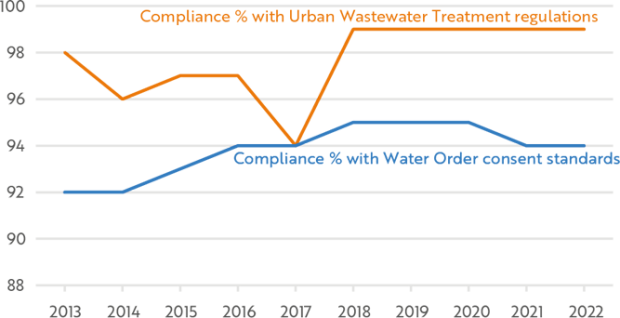
Source: NI Environmental Statistics Report, May 2023, DAERA
Pollution incidents linked to NIW operations have declined by 43 per cent since 2014
4.24 DAERA’s regular environmental statistics reporting records the number of substantiated water pollution incidents linked to NIW. Analysis of this data shows that, on average, these have accounted for 12.9 per cent of the total since 2014 – see Figure 18.
Figure 18. In 2022, around 1 in 8 of Northern Ireland’s water pollution incidents could be linked directly to NIW

Source: NI Environmental Statistics Report, May 2023, DAERA
4.25 We used a more detailed dataset of NIW-related pollution incidents, again provided by NIEA for the period January 2017 to September 2021, in order to gain a better understanding of the nature and extent of these. Figure 19 shows the outcomes, categorised according to incident severity rating High, Medium or Low, by LMA.
Figure 19. Substantiated NIW-related pollution incident severity by Local Management Area, 2017 to 2021
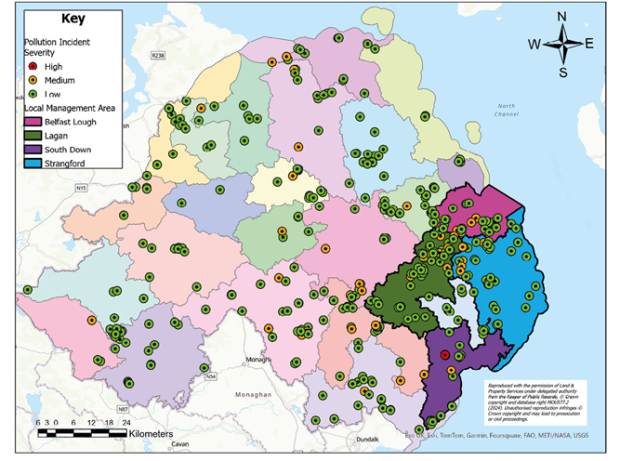
Source: NIEA
4.26 Figure 20 summarises our analysis of the 2017-2021 dataset. It shows that almost half (46 per cent) of all substantiated NIW-related pollution incidents during that period occurred in the North Eastern RBD. Some 38 (15 per cent) of these were assessed as High or Medium severity.
Figure 20. There were 68 substantiated High or Medium severity NIW-related pollution incidents during the period 2017 to 2021
| Incident severity | North Western RBD | Neagh Bann RBD | North Eastern RBD | Total | |||
|---|---|---|---|---|---|---|---|
| No. | % | No. | % | No. | % | ||
| High | - | - | - | - | 1 | 1 | 1 |
| Medium | 5 | 5 | 25 | 12 | 37 | 14 | 67 |
| Low | 97 | 95 | 180 | 88 | 227 | 85 | 504 |
| Total | 102 | 18 | 205 | 36 | 265 | 46 | 572 |
Source: NIEA and NIAO
4.27 Within the North Eastern RBD, more than 73 per cent or 211 incidents occurred in four of its eight LMAs (River Lagan, Strangford Lough, Belfast Lough and South Down). We also found that the frequency of pollution incidents in the River Lagan (72) was between 25 and 46 per cent higher than in these other three LMAs. In relation to this, a DfI-led, long-term strategy-driven initiative, the Living With Water Programme, is using an integrated approach to bring key infrastructure providers together with a view to enhancing and protecting the environment, providing flood protection and generating economic growth – within the Greater Belfast area, for example, NIW has a key role in contributing to the achievement of these outcomes.
We identified some examples of current partnership working linked to Northern Ireland’s water and sewerage services, including cross-border projects
4.28 At a strategic level, we understand that NIEA liaises with SEPA, EA and NRW particularly around the sharing of operational procedures and compliance assessment arrangements.
4.29 As referenced in Part 2, two of NI’s three RBDs extend into RoI. The Neagh Bann and North Western International River Basin Districts have been part of three EU cross-border projects, linked to water quality improvement, since 2017-18 (see Appendix 3). AFBI is involved in the delivery of ‘Source to Tap’, ‘CatchmentCARE’ and ‘SWELL’ projects, on behalf of the Department, while NIW participates in both ‘Source to Tap’ and ‘SWELL’. In financial terms, funding of £23.3m has been paid over through the Special EU Programmes Body during the five year-year period to 2021-22. Given the nature of the stated ‘actions to be delivered’ through these projects, we note that the outputs are intended to inform the development of further discrete pieces of sector-based work, including aspects relevant to agriculture and water.
Benchmarking with other regional water providers and public sector regulators has identified alternative initiatives with the potential to contribute to improved water quality for Northern Ireland
4.30 When we considered the extent to which NIW-related operations are benchmarked against water providers in other UK regions and in RoI, we found that direct comparators were limited. As a result, we undertook some high-level analysis to assess the degree of similarity elsewhere with NI’s water sector issues, including forms of remedial action introduced.
4.31 The arrangements which govern water provision and available capital investment options vary by region:
- England’s regional privatised water companies deliver water/water and wastewater services, with investment funded using capital markets;
- Scottish Water is a public corporation operating on a commercial basis, generating over half of its income from fees, charges and borrowings from the Scottish Government, which is the main source for capital investment monies;
- Welsh Water operates as a not-for-profit organisation, reinvesting surplus funds and financing further investment through market bonds; and
- Irish Water is a publicly owned and regulated commercial State body, with access to financial investment through capital markets and related institutions.
Scotland
4.32 Scottish Water’s latest strategic planning document highlights the extent and increasing concentrations of organic matter found at abstraction points. Related to this, additional treatments requiring more chemicals at water treatment works have, at times, become necessary to maintain compliance with drinking water standards. Its recent regulatory strategy, One Planet Prosperity, refers to SEPA’s current focus, the reduction of environmental non-compliance, alongside the management of water resources through partnership working.
4.33 One outcome of this managed co-operative effort has been the rollout of a seven-year Rural Diffuse Pollution Plan for Scotland to 2022, aligned with a decision-making and governance framework, and with a focus around priority catchments. Although SEPA’s approach has been to raise awareness around diffuse pollution issues, alongside on-the- ground visits, it has also utilised the provisions of controlled activities legislation, in force since 2011.
4.34 In the urban water environment, and in light of the required actions within RBMPs and SEPA’s regulatory strategy, Scottish Water has been developing its understanding of the impact of its sewer network operations, with a view to making improvements. While this has led to increased monitoring and reporting of all CSOs discharging into the highest priority waters, and work to reduce spills from the sewer network, the extent of these issues and the potential impact of non-compliance has been acknowledged as ‘concerning’.
4.35 A 2021 Scottish Water publication was supportive of SEPA’s intention to maintain engagement with stakeholders around future plans for the urban water environment. In addition, an overarching Investment Planning and Prioritisation Group for the water sector, which is chaired by the Scottish Government, has brought together representatives including SEPA, the Water Industry Commission and Drinking Water Quality Regulators and Scottish Water to ensure that arrangements in place to review the development of the rolling investment programme, and around progress reporting, operate as intended.
Wales
4.36 Issues in Wales identified in the first and second cycle RBMPs included rural diffuse pollution, sewage and wastewater treatment and traceable pollution from wastewater systems. In common with other regions, ongoing significant investment by Welsh Water is required in order to address these areas. Although NRW (as regulator) has a Diffuse Pollution Plan in place and this, along with the Welsh Government’s Water Strategy for Wales 2015-2035, features in the Programme of Measures intended to address WFD requirements, the necessary improvement plans remain under development. We also note that The Water Resources (Control of Agricultural Pollution) (Wales) Regulations 2021 now in operation to reduce losses of pollutants from agriculture into the environment.
4.37 In its business planning processes, Welsh Water has noted wide engagement with its key stakeholders – the Consumer Council for Water, NRW and DWI. These groupings also contribute to its Customer Challenge Group alongside service users, for example, its 2015-2020 Plan was informed through wide engagement and there had been ‘discrete exercises on different facets of the plan such as…..specific environmental issues’. Highlighted in the third cycle RBMP are other partnerships such as the Wales Land Management Forum, established to protect and improve water quality. A sub-group of this Forum undertook an in-depth analysis exercise to improve understanding around agricultural pollution, with the results feeding into a number of ongoing NRW partnership projects.
4.38 Investment to improve flow compliance and an increased level of monitoring at WwTW is also being progressed by Welsh Water, while CSOs have been targeted with a view to substantially reducing the incidence of pollution through significant spills. In addition, there has been a focus around sustainable development schemes in priority areas, as a means of managing flooding risks and reducing river and lake pollution, as well as early involvement of relevant stakeholders, including local authorities, around aspects of development and water-related planning.
4.39 In relation to drinking water, investment in water treatment works has been necessary to manage its quality, while operator self-monitoring samples drawn by Welsh Water are tested at its own laboratories.
England
4.40 Diffuse pollution (rural and urban) and wastewater have both been identified as significant water management issues. With rural pollution, as in other regions, the same sources have been identified – nutrients, contaminants, chemicals and sediment deposits from land management activities. For wastewater, existing treatment technologies are under consideration, with a view to reducing the impact of any chemicals remaining where treated sewage is discharged, whether into rivers, lakes or the sea. As regards smaller-scale pollution, leakages from privately-owned septic tanks continue to have an adverse impact in some locations. Significant investment is also required to address pollution which can be traced back to WwTW operations, as well as where storm overflows are insufficient to cope with the increasing frequency of heavy rainfall events.
4.41 Although a regional privatised water company model is used in England, the EA, as regulator, has a role in monitoring the outcomes from current company operations. A significant level of planned investment has also been identified to address the water management issues already noted. In addition, the regulator is tasked with ensuring that actions which might adversely affect the water environment are proactively managed, and that plans around flood risk management, other government-funded catchment level improvements and measures to promote sustainable water resources can contribute to building water system resilience in urban and rural locations.
4.42 The regions of England are covered by a series of RBMPs and there are instances where alternative, less stringent objectives have been set for improvement in the ecological status of rivers and lakes, due to technical infeasibility or the disproportionate expense involved. In this context, the results of some preliminary research referenced in a 2015 Humber River Basin RBMP update are noteworthy, with the launch of a new four-year Countryside Stewardship Scheme aimed at improving water quality and flooding resilience. This research work concluded that, if targeted advice on tackling nutrients and sediment build-up was provided alongside standard scheme support, the level of additional benefit achievable could be in the range of 2 to 10 per cent. This demonstrates the merit of considering the potential of using non-technical, low-cost methods to increase impact.
4.43 These RBMPs also reference the importance of catchment partnerships, with representatives from the public, private and voluntary sectors working together, with funding, to respond to particular short and longer-term needs. Engagement with communities can also lead to ownership being taken of local water environments.
Republic of Ireland
4.44 The EPA’s National River Monitoring Programme has reported similar sources of rural diffuse pollution in RoI, as elsewhere – nutrient losses from agriculture, sediment losses and traceable farmyard pollution – along with urban wastewater and septic tank discharges. The intention is that, by using a risk-based approach to identify critical source areas of diffuse pollution, this will assist in focussing the Agricultural Sustainability Support and Advisory Programme’s management measures in ‘priority areas’ to maximum effect. There are 30 Sustainability Advisors in place to promote agricultural best practice in areas where water-related pressures currently exist, which is regarded as complementary to an ongoing Local Authorities’ Water Programme.
4.45 Given the significant improvements in water quality required, the need for communities and individuals to take ownership of environmental issues is recognised. One example is by encouraging participation in catchment-based projects which seek to address local issues using targeted solutions. To assist in this work, the need to expand the number of Rivers Trusts, currently operating within RoI, has also been identified.
4.46 RoI’s 2018-2021 RBMP referenced Irish Water investment of €1.7 billion on wastewater projects, programmes and asset maintenance. By late 2022, however, no clear plans or timeframes had been put in place to address wastewater discharges in 27 of the 37 priority areas, as highlighted by EPA.
4.47 Water governance arrangements were also revised within the second cycle RBMP to provide for a Water Policy Advisory Committee and Water Forum, sources of technical support (including EPA) and the involvement of local authorities in implementation at the local level, to include ‘meaningful stakeholder and public engagement’.
4.48 Linked to the planned development of new standards for CSOs (as part of the Urban Waste Water Treatment Directive), a current EPA-funded project aims to identify emerging technologies in wastewater overflow monitoring and treatment. Over the seven years to 2021, more than 120 water-related research projects had committed funding from EPA of €13.5m, while EPA Research 2030, a 10-year high-level research programming framework, is also in place.
Other emerging issues
4.49 In the preceding sections we have outlined the publication and rollout of structured plans by other regional regulators, to tackle a range of water quality issues, including those linked to diffuse pollution. However, whilst the issues in Northern Ireland are comparable, to date, there has been nothing similar put in place.
Recommendation
We recommend that the Department formalises its approach to managing and influencing environmental stakeholders to address all sources of diffuse pollution, through the development of a structured plan with time-bound targets.
This key output will also make a valuable contribution to the development of an overarching strategy around water quality improvement in Northern Ireland.
4.50 NIW has been undertaking ecosystem modelling in conjunction with AFBI, as a means to identify key sources of pollution and to generate evidence around the actions required to address them. NIEA has told us that a working group has been established to link NIW with the appropriate DAERA staff teams, as well as to guide the setting of environmental drivers for these models and to agree the data for use.
4.51 We have identified significant investment in monitoring equipment for CSOs by water companies in other regions of the UK and, in some cases, the introduction of regulations governing flow compliance. In Scotland, increased data on CSO discharges in its highest priority waters has highlighted where remedial action is required, which aligns with SEPA’s attention to environmental non-compliance within its regulatory strategy. Similarly, a focus on better rates of flow compliance and more WwTW monitoring by Welsh Water ties in with NRW’s forward plans under the WFD, as regards additional monitoring of CSOs and improved flow compliance. In RoI, EPA is engaged in forward planning to harness emerging technologies in this area through funded research.
4.52 DfI has told us that NIW carries out manual inspections of storm overflows as part of its maintenance and monitoring activities, in order to assess their condition and performance, by checking for signs of blockages or malfunction. In order to monitor and record spills (by occurrence and duration), Event Duration Monitors (EDMs) are being installed across NIW’s wastewater network as part of a multi-year investment programme. As agreed with NIEA, the focus of the initial deployment phase has been around discharges to bathing waters and shell fisheries, with the intention that, by mid-2024, many of these EDMs will be relaying reliable data back to an established Alarm Management Centre. By the close of the 2021-2027 PC period, the aim is for more than 700 EDMs to be operational (at a cost of £20m, subject to funding). There is also an intention that a case for further funding will form part of NIW’s 2027-2033 Business Plan preparations for the following PC period to allow for the installation of EDMs at all storm overflows, subject to the necessary approvals being given.
4.53 We are aware that, while there has been investment by NIW around the operation of several hundred CSOs, much more work is required to gain a full understanding of their current regulatory status throughout the NI network - this forms part of NIW’s 2021-2027 Business Plan. In terms of the extent to which this area is currently being addressed, through the review process for collection system discharge consents, NIEA sets the environmental need for each asset operating within a collection system. NIEA has told us that, while work on the implementation of CSO monitoring has been extensive, a gap in policy means that there is currently no legislative requirement in place for NIEA to seek the submission of storm overflow monitoring data. It also told us that the focus of NIW’s work is around data collection, in order to inform the prioritisation of capital investment and design solutions which meet the environmental need set by NIEA going forward. While NIW’s work in this area, in particular, is acknowledged and it is clear that partnership working with NIEA is underway, issues around CSO overflows were raised as a significant cause for concern during our stakeholder discussions, as a known source of polluted raw water - a clear strategic direction to deal with all aspects of current CSO operations, with a view to minimising environmental damage, is lacking.
Recommendation
We recommend that the Department’s current partnership working arrangements with NIW are enhanced. One of the key outputs should be the development and implementation of a joint, long-term strategy around the operation of Combined Sewer Overflows in Northern Ireland.
Detailed operational procedures which address the extent and forms of monitoring and assessment to be undertaken by NIW and NIEA (as regulator) respectively should also be drawn up and agreed, with a view to meeting the applicable regulatory standards across the water network.
These outputs will feed into an overarching water quality improvement strategy.
Overall Conclusion
4.54 Our report has considered the main regulatory and other activities undertaken by Departmental staff in relation to the operation of NI’s water network. It has also highlighted some of the wide-ranging initiatives established in response to the significant and persistent issues around water quality. While acknowledging the work undertaken, including the contribution made by many stakeholder groups, the piecemeal nature of individual initiatives is likely to have reduced the overall deliverable benefits.
4.55 In its May 2022 publication of the DAERA Research and Development (R&D) Strategy (2022-2026), the Department made reference to the need for more coherence across its responsibilities for R&D purposes, as the basis for the strategy’s development. We take the view that this thinking could be usefully extended to the range of water quality issues covered in our report, in light of the level of improvement which is currently required. Taking the form of a single, overarching strategy, this would set out all aspects of water-related activities in which the Department is involved, and also provide strategic direction as to how these will collectively contribute to maximising improvements in NI’s water quality, through the prioritisation of inputs and strategic target-setting.
Recommendation
We recommend that the Department develops and publishes an overarching water quality improvement strategy. This will provide a roadmap for tackling key priority areas over the next five years through partnership working, structured in terms of the (funded) initiatives required to address these and linked through to clear delivery milestones.
Appendix 1: Recommended assessment methodology* to determine water quality status classifications for Surface Water Bodies
IMAGE PLACEHOLDER Appendix_1
* This methodology was originally sourced from ‘Recommendations on Surface Water Classification Schemes for the purposes of the Water Framework Directive UKTAG, 2007’. Its subsequent revision was undertaken on a devolved basis, with each UK region taking an individual approach to factoring in the new ‘priority substances’ introduced in 2018. The current applicable methodology for NI is as shown above.
Appendix 2a: Substantiated agricultural pollution incidents in the River Blackwater LMA, 2017 to 2021, by severity and frequently detected pollutants
| Incident severity category | Incident numbers by severity | Frequently detected pollutants | Incident numbers analysed by pollutant | Total |
|---|---|---|---|---|
| High | farm effluent mixture/combined | 4 | ||
| other | 2 | |||
| 6 | 6 | |||
| Medium | farm effluent mixture/combined | 48 | ||
| silage | 12 | |||
| cattle waste | 3 | |||
| other | 5 | |||
| 68 | 68 | |||
| Low | farm effluent mixture/combined | 120 | ||
| cattle waste | 58 | |||
| silage | 21 | |||
| other | 37 | |||
| 236 | 236 | |||
| Total incidents | 310 | 310 |
‘other’ - includes dirty water, other animal waste, fallen animals and suspended solids.
Appendix 2b: Substantiated agricultural pollution incidents in the River Blackwater LMA, 2017 to 2021, by severity, pollutant and principal contributory cause
| Incident severity category | Frequently detected pollutants | Incident numbers analysed by pollutant | Sub total | Principal contributory cause identified | Total | ||||||||
|---|---|---|---|---|---|---|---|---|---|---|---|---|---|
| Poor Working Practices | Negligence | Equipment Failure | Unknown | Inadequate Equipment | Closed Period Spreading | Deliberate Dumping | Weather | Other | |||||
| High | farm effluent mixture/combined | 4 | 1 | 1 | 1 | 1 | 4 | ||||||
| 4 | 1 | 1 | 1 | 1 | 4 | ||||||||
| Medium | farm effluent mixture/combined | 48 | 21 | 17 | 1 | 2 | 7 | 48 | |||||
| silage | 12 | 5 | 3 | 2 | 1 | 1 | 12 | ||||||
| cattle waste | 3 | 1 | 1 | 1 | 3 | ||||||||
| 63 | 27 | 21 | 3 | 1 | 3 | 1 | 7 | 63 | |||||
| Low | farm effluent mixture/combined | 120 | 57 | 23 | 9 | 4 | 3 | 9 | 8 | 2 | 5 | 120 | |
| cattle waste | 58 | 27 | 13 | 2 | 3 | 5 | 5 | 2 | 1 | 58 | |||
| silage | 21 | 6 | 8 | 3 | 2 | 2 | 21 | ||||||
| 199 | 90 | 44 | 14 | 7 | 10 | 9 | 13 | 4 | 8 | 199 | |||
| Total incidents | 266 | 118 | 66 | 18 | 9 | 13 | 10 | 13 | 4 | 15 | 266 | ||
% of incidents represented by principal contributory cause identified | 44% | 25% | 7% | 3% | 5% | 4% | 5% | 1% | 6% | 100% |
Appendix 3: EU cross-border water quality improvement projects since 2017
IMAGE PLACEHOLDER Apppendix_3
Source: NIEA