
List of Abbreviations
ARIG Agency Reduction Implementation Group
CNO Chief Nursing Officer
HSC Health and Social Care
NDNA New Decade, New Approach
NMC Nursing and Midwifery Council
UK United Kingdom
WTE Whole time equivalent
Key Facts
£1.1 billion
Nursing and midwifery group permanent staff costs in 2024-25
17,024
The number of whole time equivalent registered nurses in the HSC system
1,178
The number of reported registered nurse vacancies
2,195
The estimated number of additional nurses required to ensure safe and effective staffing levels
8 million
The number of temporary nursing and midwifery hours commissioned in 2024-25
The nursing and midwifery group includes registered nurses, midwives, and support staff. The vast majority of temporary staffing and spend relates to nursing and support staff, not midwifery.
£258 million
Amount spent on temporary nursing and midwifery staffing in 2024-25
£162 million
Amount spent on agency nursing staff in 2024-25 (tripled since 2018-19 from £52 million)
£277 million
Spend on temporary nursing and midwifery reached a record high in 2022-23
£36.86 per hour
Band 5 agency nurse average hourly rate for standard day shifts in Northern Ireland
£28.87 per hour
The maximum hourly rate paid for Band 5 agency nurses for standard day shifts in London
£24.06 per hour
The maximum hourly rate paid for Band 5 agency nurses for standard day shifts in the rest of England
£36.7 million
The estimated saving in 2024-25 if agency nursing staff cost the same as HSC internal bank staff
Executive Summary
1. Nurses have a crucial role in the delivery of health and social care (HSC) services. As of March 2025, there were 18,050 whole time equivalent (WTE) registered nursing and midwifery staff in the HSC sector in Northern Ireland, of which 17,024 were nurses – representing about one quarter of the system’s workforce. There were also 4,219 WTE support staff. As well as being the largest HSC staffing group, nursing staff have the most contact and interaction with patients and provide the widest range of patient-centred care and services.
2. In July 2020, we published our report on Workforce Planning for Nurses and Midwives which highlighted issues around nursing workforce pressures and workforce planning. Inadequate workforce planning, including prolonged cuts to the undergraduate nursing training budget between 2011-12 and 2016-17, had contributed to rising vacancy levels and increased reliance on more expensive temporary staff, who were also less likely to deliver strong patient outcomes.
3. Following the publication of our previous report, the permanent HSC registered nursing workforce has increased, and staff vacancies have been reduced. However, major issues and challenges persist. Temporary nursing staff continue to be heavily relied upon for a variety of reasons including staff absences, unfilled vacancies, shortfalls in funded staffing positions, high population demand, and inadequate workforce planning. This report considers the ongoing reliance and expenditure on temporary nursing staff, particularly agency staff, and progress to develop a more sustainable and cost-effective permanent nursing workforce to better meet patient needs. It should be noted that whilst the data in this report covers the entire nursing and midwifery workforce group, the vast majority of temporary staffing and spend relates to nursing, including support staff, not midwifery.
Key Findings
The registered nursing workforce has grown and reported vacancy levels have reduced, but the extent of spend on temporary nursing solutions shows that significant workforce gaps remain
4. The HSC system’s permanent registered nursing workforce has grown, and the number of registered nursing vacant posts has decreased. From March 2019 to March 2025, the number of registered WTE nursing vacancies dropped from 2,161 to 1,178. Trends for support staff have been less positive, with the number of WTE vacancies increasing from 445 to 562 over the same period. There remains a significant dependency on temporary nursing staff to address gaps in the nursing workforce. In 2024-25, Trusts commissioned more than eight million temporary nursing hours and spent £258 million on temporary nursing staff. Spend on temporary nursing staff reached a record high of £277 million in 2022-23.
A new agency nursing framework has resulted in a substantial reduction in off-contract agency usage
5. In May 2023 a new agency nursing framework was rolled out. The main objective was to end the use of very expensive off-contract nursing agencies (agencies which Trusts had no contractual agreements with and who had high autonomy in setting their own rates) which had become highly prevalent within Trusts. Spend on off-contract nursing staff had risen alarmingly, increasing by almost 400 per cent from £27 million in 2018-19 to £134 million in 2022-23.
6. The new framework has succeeded in ending the use of off-contract agencies, except in a small number of complex cases. It has brought greater and longer-term price certainty for Trusts using agency nursing staff as the rates payable are contractually fixed, compared to the previous situation where off-contract suppliers had significant autonomy in setting rates. However, agencies had developed a strong market hold and significant engagement was required to establish terms that would attract agencies to come onto the new framework, thereby limiting the financial savings that could be achieved.
7. The Department told us that when developing the agency nursing framework, it did not undertake any benchmarking exercise to compare previous or current reliance and expenditure on agency nurses with the rest of United Kingdom (UK). The current framework was extended for two years in May 2025 with no change. We consider this was a missed opportunity to more fully review and clarify the outcomes achieved through the framework. The Department told us that work to develop a new framework, to run from May 2027, is ongoing.
Rates paid for agency registered nurses under the new framework are much higher than comparable rates in England
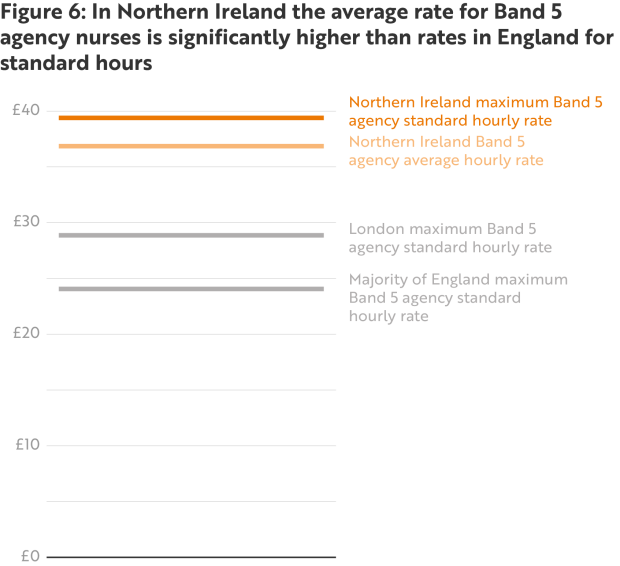
8. Band 5 nurses represent the majority of registered agency nurses used by Trusts in Northern Ireland. We found that comparable agency rates are much higher than in England. In Northern Ireland, Band 5 nurses’ average hourly rate for standard day shifts is £36.86 per hour under the new framework, up to a maximum of £39.39. In most of England, this rate is capped at £24.06 per hour while in inner London, which has the highest rates for agency nurses in England, the maximum rate for Band 5 agency nurses for standard hours is £28.87 per hour.
9. The maximum rates paid for Band 5 agency nurses in Northern Ireland are at least 35 per cent higher than in the majority of England. In some cases, the maximum rate paid can be up to 64 per cent higher. If the rates paid in Northern Ireland were capped at the same rates paid throughout England, it would result in substantial savings.
10. The fees paid to agencies in Northern Ireland have ranged significantly from £2 to £15 per hour. The total hourly rate paid for agency nurses includes the fee paid to agencies. Comparable available data for England shows that the maximum amount which agencies receive as part of total costs is £4.87 per hour. The fees charged by some agencies in Northern Ireland could therefore be viewed as excessive.
Agency nursing staff costs in Wales and Scotland are significantly lower than in Northern Ireland
11. Wales and Scotland also continue to face nursing workforce challenges and supplement the permanent workforce through the use of temporary and agency nursing staff. In 2024-25 in Wales, which has almost double the population size of Northern Ireland, agency nursing staff costs were £79 million. Scotland, which has an even larger population size than Wales, had costs of £57 million. In comparison, agency nursing staff costs in Northern Ireland were £161.6 million in 2024-25, having more than tripled from £52.1 million in 2018-19, and continue to add pressure to an already strained budget.
Using the bank system to provide temporary nursing staff provides much better value for money than utilising agencies
12. The use of temporary nursing staff to fill workforce gaps is inevitable to some degree. When staffing gaps arise the optimal option for Trusts in terms of cost and patient outcomes is to utilise the internal HSC nursing staff bank. Bank usage has increased from 3.3 million hours in 2021-22 to 3.5 million hours in 2024-25. As this is the Department’s preferred temporary staffing option, the increased usage of bank staff is to be welcomed. Work is ongoing within the Department to consider how to further incentivise agency nursing staff into the bank and maximise its usage.
13. On average, over the four years to 2024-25, agency nursing staff were more than £11 per hour more expensive than nursing bank staff. Hypothetically, if those agency nursing staff cost the same amount per head as bank staff, the HSC system would have saved up to £186 million over four years.
14. The average hourly agency cost has reduced, since the introduction of the framework. Based on 2024-25 (the first full year the framework was in operation) the average hourly agency cost incurred was £35.67. The comparable average bank hourly cost for the same year was £27.57. Therefore, if the agency staff cost the same amount per head as bank staff, the HSC system would have saved up to £36.7 million in 2024-25.
The Department has not set strategic targets to reduce agency usage
15. The Department’s main objective through the new framework was to end off-contract agency use. The Department sees the framework as the first step in reducing overall agency usage. However, six years after the Agency Reduction Implementation Group was established, agency usage remains extremely high, and the Department has still not set strategic targets for reducing agency usage and associated expenditure. This is in stark contrast to England, which has in place a directive, from the UK Government, to end agency nursing usage by 2029. This includes a target to ensure there has been a 30 per cent reduction in agency expenditure from 2024-25 to 2025-26. The Department told us that work is now ongoing to significantly reduce agency usage in 2026-27.
Reported vacancies do not give a complete picture of workforce need
16. Despite overall growth in staffing levels and the reported figures showing that registered nursing vacancies have substantially reduced, there are limitations with this data. Reported vacancy figures only reflect funded posts which Trusts are actively recruiting. The figures are a measure of recruitment activity at a point in time and exclude vacant posts which are not being recruited, therefore do not provide an assessment of overall workforce need.
17. In addition to the reported figure of 1,178 registered nursing vacancies at March 2025, work completed by the Department as at April 2025 indicated that a further 2,195 nurses are required to ensure safe and effective staffing levels. The Department told us that the figure of 2,195 does not include all areas of practice therefore the full extent of the potential shortfall is not known.
18. In 2024-25, including salary and all additional employer-related costs, the average cost of the most experienced Band 5 nurses to the HSC sector was almost £62,000 per year. The £161.6 million spent on nursing agency costs in 2024-25 would equate to paying the full-time employment costs of more than 2,600 experienced Band 5 nurses and go a long way towards delivering a cost-effective permanent nursing workforce.
Effective workforce planning is crucial to enable Trusts to reduce their heavy reliance on agency staff
19. Responsibility for strategic, long-term workforce planning in the HSC sector rests with the Department while HSC Trusts retain responsibility for operational, day-to-day workforce planning. We found that progress against the Workforce Plan for Nursing and Midwifery in Northern Ireland (2015-25), which was published in 2016, and set out the proposed number of training places required as well as considering wider workforce challenges, was not monitored or tracked. The Department told us it became quickly outdated. A revised workforce plan for nursing was not put in place. The Department has however, ensured an increased number of pre-registration training places as recommended in the 2015-2025 workforce plan.
20. In 2018, the Department published the Health and Social Care Workforce Strategy 2026 which aimed to address key workforce challenges and pressures across the entire health and social care workforce by 2026. The Department told us that the COVID-19 pandemic impacted on delivery of the strategy, and it intends to extend the strategy for a further two years. One of the themes within the 2026 Strategy is “Effective Workforce Planning”. The continuing high reliance and expenditure on agency nursing staff strongly indicates that significant work remains to be done to establish a sustainable and cost-effective workforce.
21. There is no detailed evidence or model behind the number of pre-registration nurse training places commissioned by the Department in recent years. It commissions what it can afford based on the assumption that there is a need for a greater supply of nurses to meet increased demand as a result of an ageing population and people living longer with multiple morbidities. More must be done to adequately project future workforce needs and ensure a sufficient pipeline of appropriately skilled nursing staff.
Conclusion
22. The new nursing agency framework has brought greater and longer-term price certainty for Trusts using agency staff and the Department has been successful in reducing the use of very expensive off-contract nursing agencies which had become highly prevalent across Trusts. However, whilst total agency costs have fallen since the introduction of the framework they have more than tripled since 2018-19, from £52 million to £162 million in 2024-25 and are well in excess of the comparable costs incurred in other jurisdictions.
23. The Department was slow to develop the agency nursing framework and did not benchmark against other jurisdictions when setting rates. We found that the hourly rates paid for agency registered nurses in Northern Ireland are much higher than the comparable rates paid in England. This includes a significant variation in agency fees. Better value for money could have been achieved.
24. There remains a very significant dependency on temporary nursing staff in Northern Ireland. In 2024-25, £258 million was spent in total on temporary nursing staff, including agency staff and HSC bank staff. Without more progressive operational workforce planning solutions assessing day-to-day workforce requirements and availability, HSC Trusts will remain highly reliant on agency nursing staff. Equally, comprehensive action is required to ensure longer-term strategic workforce planning solutions are in place to build a sustainable permanent nursing workforce. Robust workforce planning has the potential to yield significant long-term benefits and financial savings through reduced agency dependence.
Recommendation 1
Within the next 12 months, the Department of Health must work with Trusts to develop and implement phased action plans to achieve its objective of improving staff utilisation, including reforming the HSC bank, and reducing agency spend. This must involve setting sustained targets to reduce agency usage.
Recommendation 2
The Department of Health should consider actions taken in other jurisdictions in the UK to reduce reliance and spend on agency nursing staff and ensure learning is built into future strategies.
Recommendation 3
The Department of Health needs to review and clarify the outcomes achieved through the nursing agency framework. This must include benchmarking costs and rates of pay against other jurisdictions to ensure that any new framework achieves the best value for money for Northern Ireland.
Recommendation 4
Nursing vacancy levels, both funded and unfunded, must be more accurately recorded and reported by HSC Trusts and the Department of Health to provide a complete overview of current HSC workforce needs. This should be implemented within the next 12 months and used to inform workforce planning.
Recommendation 5
The Department of Health, in collaboration with the HSC Trusts, must significantly improve its workforce planning for nursing. This should include:
- Evidence-based projections of future population demand and the nursing workforce needed to meet that demand.
- Clear evidence to support the number of pre-registration training places commissioned.
- Scenario planning to reflect the impact of initiatives such as safe staffing legislation and changes in future service models, such as the Neighbourhood Model of Care.
- Regular review points to track progress, revise assumptions and refresh the workforce plan as necessary.
Recommendation 6
The Department of Health must obtain HSC nursing staff retention data on an annual basis. This should include the demographic profile of staff leavers and the area(s) of nursing in which they had been working. Trends across Trusts should be analysed to identify issues or best practice and be factored into workforce plans.
Part One:
Introduction
Background
1.1 The Northern Ireland public sector’s Health and Social Care (HSC) system aims to provide comprehensive care, which is free at the point of use, to all people in this jurisdiction. However, there are pressures at every level of this system. These include the rising costs of delivering care, an ageing population, challenging budgets and insufficient workforces in many areas. This results in significant delays to patients accessing quality care. The roll-out of the large-scale digital IT project, Encompass, has also at times placed additional staffing demands on HSC Trusts.
1.2 The HSC nursing and midwifery group includes registered nurses, midwives, and support staff. Nurses, by a significant margin, reflect the highest proportion of any staffing group working within the HSC sector. As of March 2025, there were 18,050 whole time equivalent (WTE) registered nursing and midwifery staff in the HSC sector in Northern Ireland, of which 17,024 were nurses – representing about one quarter of the system’s workforce. In addition, there were 4,219 WTE support staff.
1.3 The registered nursing workforce predominantly consists of Band 5 nurses, who are the core qualified nursing grade. It also includes Band 6 and Band 7 nurses, who are more senior staff and often hold management and supervisory roles. Registered nursing roles can also extend beyond Band 7 for example, advanced and consultant nurse roles.
1.4 Nursing support staff, also known as healthcare assistants, include Band 2 and Band 3 staff who mainly perform non-clinical patient support roles. Band 3 staff may also undertake some delegated clinical duties. There are also some Band 4 nursing assistant roles.
1.5 All HSC staff are key to ensuring the successful delivery of HSC services, but the nursing workforce has a particularly crucial role. As well as being the largest HSC staffing group, nursing staff have the most contact and interaction with patients and provide the widest range of patient-centred care and services. The importance of a suitably resourced nursing workforce is underlined by the ongoing need to cope with a changing environment and significant pressures brought about by an ageing population and a growing demand for HSC care. Some nursing staff are required to work unsocial hours and, in some HSC Trusts, there are additional workforce challenges brought by rurality.
1.6 Where the HSC nursing workforce does not have the capacity to meet demand, temporary nursing staff have to be sourced from either the Trusts’ own nursing bank system or, failing that, private sector agencies. This approach can be costly, so agencies should be utilised in a limited and structured way. In recent times, however, without significant usage of agency nursing staff, Northern Ireland’s HSC system would have been left without the ability to provide requisite levels of care.
We previously reported on the HSC sector’s significant reliance on temporary nursing staff
1.7 In July 2020 we published our report on Workforce planning for nurses and midwives.
The report highlighted issues around nursing workforce pressures and workforce planning which had led to poor value for money. We found that inadequate workforce planning, and prolonged cuts to the undergraduate nursing training budget between 2011-12 and 2016-17, had contributed to rising vacancy levels and increased reliance on more expensive temporary staff, who were also less likely to deliver strong patient outcomes.
1.8 Our 2020 report concluded that the various staffing challenges which had developed meant that the Department of Health (the Department) faced an uphill battle in developing a more sustainable nursing workforce. Collectively, our recommendations reflected a clear need to improve nursing and midwifery workforce planning and address the HSC sector’s growing and significant dependence on temporary nursing staff.
Scope and structure of this report
1.9 Following on from our 2020 report, this report has considered:
- whether the Department and the Trusts have taken effective action to substantially reduce the high reliance and expenditure on temporary nursing staff, particularly agency staff; and
- if further action is still needed to build a more sustainable and cost-effective permanent HSC nursing workforce to better meet patients’ needs and further reduce longer-term reliance and spend on agency staff.
1.10 The Department advised that it is normal practice when reporting that the professions are classed collectively as nursing and midwifery. The expenditure data provided to us, and included in this report, represents the entire nursing and midwifery group (including support staff). However, it should be noted that the vast majority of temporary staffing and spend, and main focus of this report, is on nursing and support staff, not midwifery.
1.11 The structure of this report is as follows:
- Part Two includes details of temporary nursing staff expenditure trends in recent years. It also considers work done by the Agency Reduction Implementation Group (ARIG), which was established in late 2019, and assesses how both on-contract and off-contract agency cost trends have changed as a result.
- Part Three assesses the effectiveness of workforce planning and strategic actions taken by the Department to ensure the health service’s complement of nursing staff meets the needs of the people of Northern Ireland. This includes the use of the pre-registration nursing training programme and international recruitment of nurses to strengthen the HSC nursing workforce.
1.12 Our methodology is set out in Appendix 1.
Part Two:
Usage and expenditure on temporary nursing
HSC Trusts are heavily reliant on agency nursing staff to address gaps in the nursing workforce
2.1 There are many factors which contribute to Trusts in Northern Ireland deploying temporary nursing staff solutions. These include maternity absences, unfilled vacancies, shortfalls in funded staffing positions, inadequate workforce planning and high population demand, resulting in additional beds being staffed above the funded bed numbers each day (known as escalation beds). Temporary staff are also required to cover staff sickness. In 2022-23 the percentage of hours lost due to registered staff sick absence was 8.53 per cent and 14.35 per cent for support staff. This has decreased to 7.84 per cent and 12.31 per cent respectively in 2024-25.
2.2 There are two main options for Trusts when these staffing gaps arise. In the first instance, Trusts should attempt to utilise their internal HSC staff bank. The bank enables nursing staff employed directly by the public sector to work flexible, casual or additional hours. Each Trust in Northern Ireland has their own bank system. If Trusts are unable to fill staffing gaps through the bank system, they can then engage nursing staff from external private sector agencies.
2.3 Extensive reliance on agencies is far from satisfactory. Evidence suggests that heavy use of temporary staff to provide cover can result in poorer outcomes for patients. For example, research shows a connection between a high usage of agency nurses with increased patient mortality rates, less work being completed by nursing staff, reduced patient safety levels and lower patient satisfaction.
2.4 Agency staff usage also brings substantial additional costs. The hourly rate paid to agencies is more expensive than permanent HSC nurses or utilising the HSC bank. Despite these clear disadvantages, our 2020 report highlighted how, between 2011-12 and 2018-19, total HSC spend on temporary nursing and midwifery staff had grown by 150 per cent from £45.2 million to £115 million. Over that period, agency costs alone increased by over 500 per cent from £8.6 million to £52.1 million.
Spend on temporary nursing staff peaked at £277 million in 2022-23
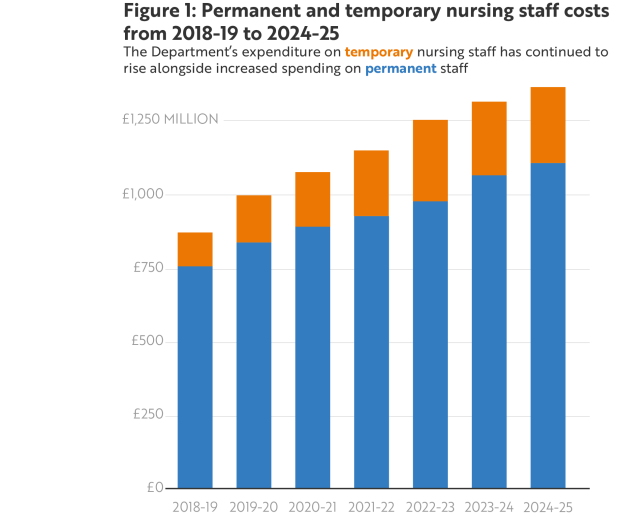
2.5 Figure 1 shows the permanent and temporary nursing and midwifery costs between 2018-19 and 2024-25. Permanent HSC staff costs have risen each year from £755 million in 2018-19 to over £1.1 billion in 2024-25, an increase of 38 per cent while also representing a substantial proportion (13 per cent) of the Department’s total budget of £8.5 billion that year. At the same time, the Department’s expenditure on temporary nursing staff has continued to rise, peaking at £277 million in 2022-23.
Source: NIAO analysis of data provided by the Department.
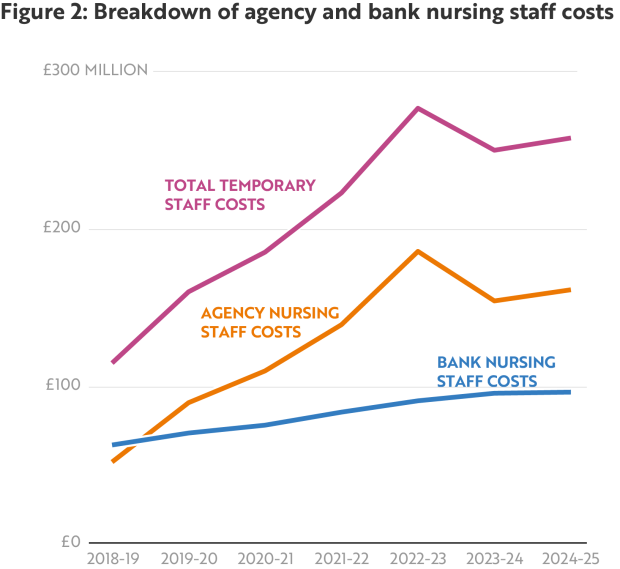
2.6 Figure 2 shows that the majority of temporary nursing staff costs continue to be agency costs as opposed to HSC internal staff bank costs. Agency nursing costs increased sharply, from £52.1 million in 2018-19 to £186 million in 2022-23. Agency costs then dropped to £154.5 million before increasing again in 2024-25 to £161.6 million.
Source: NIAO analysis of data provided by the Department.
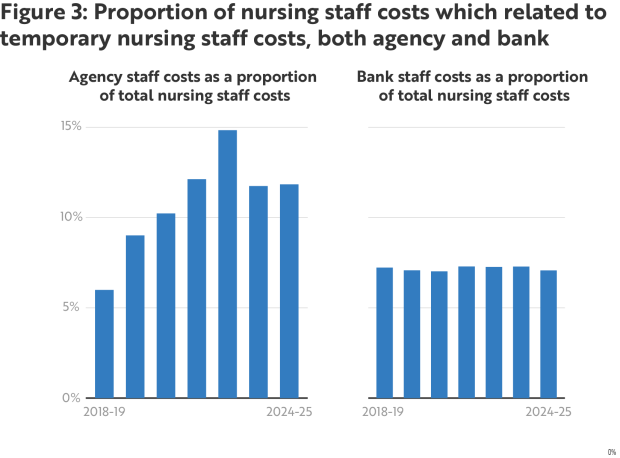
2.7 Agency costs made up 6 per cent of total nursing staff expenditure in 2018-19. By 2021-22 this had doubled. When agency costs reached a high of £186 million in 2022-23, they accounted for 15 per cent of total nursing costs. Contrastingly, HSC nursing bank staff costs as a proportion of total nursing costs have remained steady at 7 per cent (see Figure 3).
Source: NIAO analysis of data provided by the Department.
At the end of 2019 the Department established the Agency Reduction Implementation Group, however in the years that followed agency costs rose significantly
2.8 As noted in paragraph 2.4 temporary nursing costs had been spiraling since 2011-12. However, it wasn’t until late 2019 that strategic action was initiated by the Department in an effort to control expenditure in this area. This occurred with the establishment of the Agency Reduction Implementation Group (ARIG) in December 2019. ARIG’s purpose is “to co-ordinate the improvement of staff utilisation, with the aim of reducing unsustainable agency/locum spend”. Membership includes senior Department of Health officials, representatives from the Trusts and the Royal College of Nursing. ARIG has six workstreams, three of which relate to nursing:
- nursing agency framework;
- reform of the HSC nursing and midwifery bank system; and
- guidance and monitoring of the use of agency nurses by Trusts.
2.9 Paragraphs 2.5 to 2.7, show how expenditure on temporary nursing staff – particularly in relation to agency staff – continued to increase significantly in the years which followed ARIG’s creation. We note that ARIG was established shortly before the COVID-19 pandemic and the Department told us that its work to reduce agency use was therefore put on hold until October 2022.
Spend on off-contract nursing staff rose alarmingly between 2018-19 and 2022-23
2.10 When staffing gaps arise the optimal option for Trusts, in cost and patient outcome terms, is to utilise the internal HSC staff bank system. The next preference is to use nursing staff from contracted agencies (i.e. agencies with which fixed rates have been agreed). The use of off-contract agencies is the least favourable and most expensive solution as those agencies have significant autonomy in setting rates. However, when ARIG’s work recommenced in late 2022, the use of off-contract agencies by HSC Trusts throughout Northern Ireland had grown considerably. This situation resulted in a large disparity between both on-contract and off-contract pay rates, and HSC permanent nursing staff.
2.11 The higher rates of pay offered by the off-contract agencies attracted increasing numbers of nurses from contracted agencies and also encouraged many nurses to leave their direct employment with Trusts. This caused core staff shortages and an increased dependency on more costly agency staffing. It also led to agencies who were on-contract to end this arrangement and instead operate in an off-contract capacity. Off-contract agency expenditure rose each year from 2018-19 until 2022-23, increasing by almost 400 per cent, from £27 million to £134 million. As well as placing a major strain on the Health budget, this clearly represented very poor value for money.
2.12 There was a lack of effective departmental control over the ever-increasing costs associated with growing off-contract agency usage by Trusts. This developed into a culture of dependency on off-contract agency nursing staff. The Department cited various reasons for this situation developing, including rising patient needs, and exceptional workforce demands arising from pandemic pressures. However, overall agency costs and reliance had already grown sharply before COVID-19, from £8.6 million in 2011-12 to £90 million in 2019-20.
2.13 In October 2022, the Minister for Health recognised that off-contract expenditure was not a cost-effective use of taxpayers’ money, and could lead to a lack of workforce continuity, with the potential to undermine patient safety. ARIG’s focus therefore was to significantly reduce off-contract agency usage and expenditure.
A new agency nursing framework was introduced in May 2023 which resulted in a substantial reduction in off-contract agency usage
2.14 ARIG identified the need to implement a new agency nursing framework which included revised contractual arrangements. The Department and the HSC Trusts saw this as a first step towards eventually incentivising more nursing staff, both permanent and temporary, to work for the HSC sector. Following a procurement process, a new agency framework was rolled out in May 2023.
2.15 The framework is split into two lots. Lot 1 includes 25 agencies which supply registered nurses. Lot 2 includes 20 agencies which supply nursing support staff. Within both lots, suppliers were ranked into two tiers to try to ensure value from the new framework. Tier 1 agencies are less costly than Tier 2 agencies. Trusts are required to attempt to procure from Tier 1 agencies before using the more costly Tier 2 suppliers.
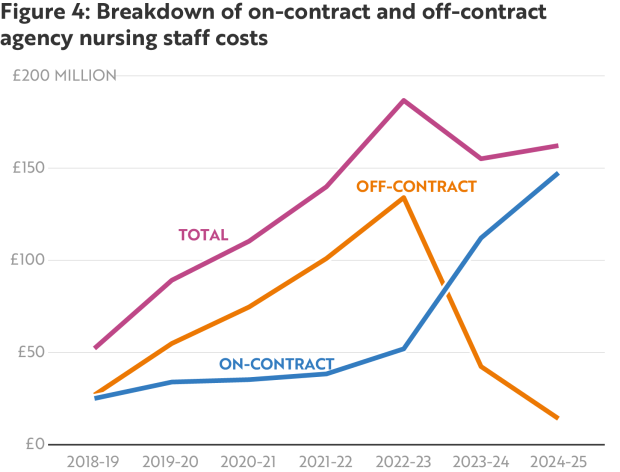
2.16 Following a period of transition, all HSC organisations worked towards a 14 August 2023 deadline date for the cessation of off-framework (i.e. off-contract) nursing and midwifery agency usage. The roll out of the framework led to a substantial drop in off-contract agency expenditure from £134 million in 2022-23 to £42.4 million in 2023-24 and £14.2 million in 2024-25. Therefore, the framework has been successful in significantly reducing off-contract agency nursing costs. Some off-contract expenditure continues to be incurred in relation to Muckamore Abbey and a small number of other complex cases.
2.17 However, as shown in Figure 4, these substantial off-contract cost reductions occurred concurrently with major increases in on-contract expenditure. There remains a very heavy reliance on agency nursing staff with total agency nursing costs for the HSC sector increasing by 210 per cent from £52.1 million in 2018-19 to £161.6 million in 2024-25.
Source: NIAO analysis of data provided by the Department.
Average on-contract pay rates are significantly higher since the roll out of the framework
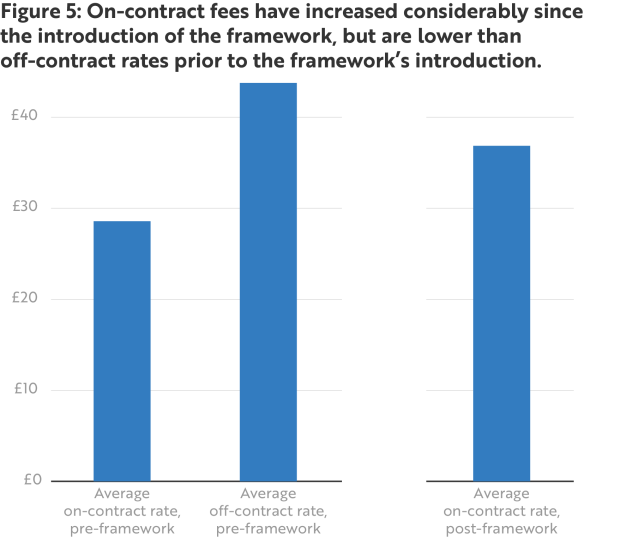
2.18 The heavy reliance on agency nursing staff placed private sector agencies in a strong bidding position. This, combined with off-contract pay rates becoming so high, meant the Department had to offer relatively lucrative rates to encourage agencies on to the new framework. Band 5 nurses represent the vast majority of registered agency nurses used by Trusts in Northern Ireland. The average rate paid for on-contract Band 5 nurses for standard hours was £28.57 per hour pre-framework. Following the introduction of the framework, this increased by 29 per cent to £36.86 per hour. Whilst this is lower than the comparative off-contract standard hourly rate of £43.77, it demonstrates that there are limitations to the savings that can be achieved (see Figure 5).
Source: NIAO analysis of data provided by the Department.
2.19 Consequently, even with eliminating off-contract arrangements, the scope for financial savings under this framework will be limited if the heavy reliance on agency nurses continues. Greater strategic intervention, supported by more effective workforce planning, was needed at a much earlier stage to secure more sustainable and significant savings.
2.20 Provision exists for an escalation process to allow client organisations to secure supply on the framework at an increased rate, on exceptional patient safety grounds only, should the need arise. The Department told us that any use of this process would be reported through ARIG, and to date it has not occurred.
Agency rates in Northern Ireland are a lot higher than in England
2.21 As previously noted, Band 5 nurses represent the vast majority of registered agency nurses used by Trusts in Northern Ireland. We found that comparable framework pay rates for Band 5 agency nurses in England are significantly lower, as shown in Figures 6 and 7. In Northern Ireland, the average rate paid for Band 5 nurses for standard hours is £36.86 per hour (within the range £31.20-£39.39) under the new framework. In most of England, this rate is capped at £24.06 per hour while in inner London, which pays the highest rates for agency nurses in England, the comparable rate is capped at £28.87 per hour. The highest rate paid for agency nurses for night, and Saturday shifts is £36.10 per hour in inner London which is still lower than the £36.86 average hourly rate for Band 5 nurses working standard day shifts in Northern Ireland. In both Northern Ireland and England the rates include fees to the agencies supplying the nurses as well as the pay to the nurses themselves.
Source: NIAO analysis of data provided by the Department and NHS England’s agency price card.
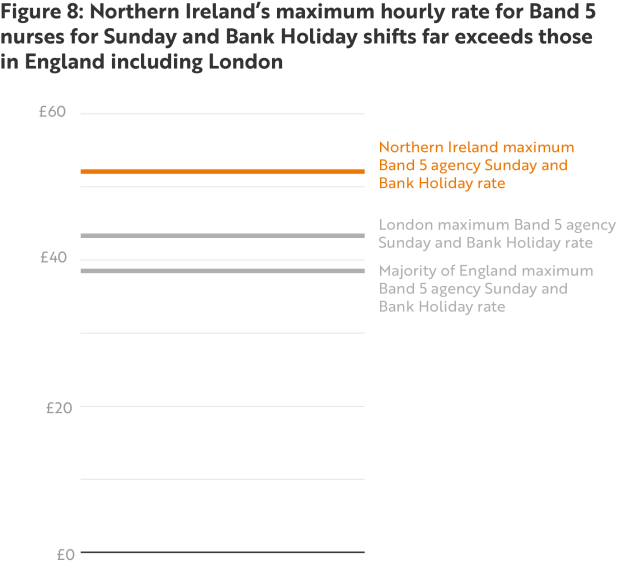
2.22 As shown in Figures 7 and 8, the highest rate paid in Northern Ireland for Band 5 agency nurses is £52.10 per hour (lowest £43.82), for Sunday and Bank Holiday shifts. In most of England, the highest hourly rate is £38.51 (£43.32 per hour in inner London) for comparable shifts. Across the range of shifts, the maximum rates paid for Band 5 agency nurses in Northern Ireland are at least 35 per cent higher than in the majority of England. In some cases, the maximum rate paid can be up to 64 per cent higher. If the rates paid in Northern Ireland were capped at the same rates as those paid throughout England, it would result in substantial savings.
Figure 7: Hourly rate ranges for Band 5 agency nurses in Northern Ireland, the majority of England and inner London
| Hourly contracted rate range for Band 5 agency nurses following the introduction of framework in Northern Ireland | Hourly contracted rate range for Band 5 agency nurses in most of England | Hourly contracted rate range for Band 5 agency nurses in inner London | |
|---|---|---|---|
| Standard day shift | £31.20-£39.39 | £19.60-£24.06 | £23.62-£28.87 |
| Monday-Friday 8pm to 6am and Saturday | £38.46-£45.30 | £25.47-£31.29 | £29.53-£36.10 |
| Sunday and Bank Holiday | £43.82-£52.10 | £31.35-£38.51 | £35.55-£43.32 |
Source: NIAO analysis of data provided by the Department and NHS England’s agency price card.
Source: NIAO analysis of data provided by the Department and NHS England’s agency price card.
Fees paid to the framework agencies vary considerably in Northern Ireland
2.23 For the 25 suppliers currently supplying Band 5 and above registered nurses to Trusts in Northern Ireland as part of the framework, the fees paid to agencies – as part of the overall costs to provide nurses – vary significantly across different agencies and, in some cases, could be viewed as excessive. These fees have ranged from £2 per hour to £15 per hour. As of May 2025, we note that the highest fee paid reduced to £10 per hour. The Department could not provide an explanation of why the variance is so significant and advised that the agency fees are absorbed into the total hourly rates paid. There is therefore variation in the pay rate being received by agency nurses. Comparable available data for England shows that the maximum amount which agencies receive as part of total costs is £4.87 per hour.
Agency nursing costs in Wales and Scotland are significantly lower than in Northern Ireland
2.24 Scotland and Wales also continue to face challenges in delivering a sustainable workforce and supplement the permanent workforce with temporary nursing staff. In 2024-25 in Wales, agency nursing and midwifery (including support staff) costs were £79 million – less than half of the £162 million spent in Northern Ireland. This is despite Wales having almost double the population size of Northern Ireland. Scotland, which has an even larger population than Wales, had costs of £57 million. The Department told us that when developing the agency nursing framework, it did not undertake any benchmarking exercise to compare previous or current reliance and expenditure on agency nursing staff with the rest of UK.
Using the bank system to provide temporary nursing staff provides much better value for money than utilising agencies
2.25 From 2021-22 to 2024-25, nursing bank staff delivered over 13 million hours of work for the HSC system in Northern Ireland at a cost of £367 million. Agency nursing staff, delivered almost 16.5 million hours of work, costing over £641 million. In addition to demonstrating the scale of reliance on temporary nursing staff, this also demonstrates the cost differential between bank and agency nursing staff (see Figure 9).
Figure 9: The costs of hours worked by nursing bank and agency nursing staff
| Year | Nursing bank staff hours delivered (million) | Nursing bank staff costs (£ million) | Agency nursing staff hours delivered (million) | Agency nursing staff costs (£ million) |
|---|---|---|---|---|
| 2021-22 | 3.3 | 83.8 | 3.5 | 139.4 |
| 2022-23 | 3.20 | 91.0 | 4.21 | 186.0 |
| 2023-24 | 3.28 | 95.8 | 4.24 | 154.5 |
| 2024-25 | 3.50 | 96.5 | 4.53 | 161.6 |
| Total | 13.28 | 367.1 (Average hourly cost: £27.64) | 16.48 | 641.5 (Average hourly cost: £38.93) |
Source: NIAO analysis of data provided by the Department.
2.26 Based on the costs shown in Figure 9, on average over the four years to 2024-25, agency nursing staff were more than £11 per hour more expensive than nursing bank staff. Hypothetically, if those agency nursing staff cost the same amount per head as bank staff, the HSC system would have saved up to £186 million over four years.
2.27 The average hourly agency cost has reduced since the introduction of the framework. Based on 2024-25 (the first full year the framework was in operation) the average hourly agency cost is £35.67. The comparable average bank hourly cost for the same year was £27.57. Therefore, if the agency staff cost the same amount per head as bank staff, the HSC system would have saved up to £36.7 million in 2024-25.
2.28 Some Trusts emphasised work they have done individually to recruit temporary staff from agencies onto the bank. For instance, we were told how they have put significant resources into social media campaigns to highlight the benefits of working flexibly, as a contracted nurse through the bank system. They have also made substantial efforts to try to ensure a higher proportion of available shifts are being filled by nursing bank staff rather than by agency staff. Further work in this area will be key to reducing agency costs throughout Northern Ireland.
2.29 ARIG has a workstream aimed at making the bank system more attractive. Work on nursing bank reform did not start until September 2024 once dedicated project resources had been identified and secured. The key purpose of this project is to modernise and harmonise current bank arrangements and increase the supply and retention of bank staff to meet demand. Updates on progress are reported to ARIG every two months. A number of enablers are under consideration including pay and non-pay-related incentivisation.
2.30 Whilst the Department expects bank activity to increase as a result of the bank reform project, this may still be some way off as significant concerns have been raised within the Department that there is a lack of resources to effectively progress the work.
The Department has processes in place to monitor compliance with the framework
2.31 The May 2023 framework was for an initial period of two years. The option to extend for a further two years was exercised. Trusts feel processes implemented since the framework’s introduction have been positive and that the framework has brought about more consistent approaches to using agencies throughout Northern Ireland. The Department and Trusts hold regular reviews of framework performance, with a focus on agency activity to ensure that the need for a full complement of suppliers actively supplying on the framework is met. Seven agencies in total have been removed, or withdrawn, from the framework. All have been replaced by new suppliers. Agencies are required to submit monthly management information for scrutiny, including data relating to complaints, critical incidents and shift fill rates.
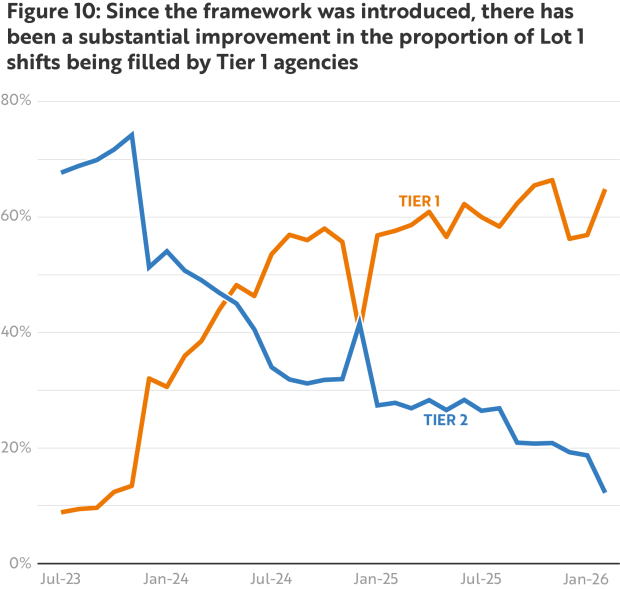
2.32 As noted in paragraph 2.15, the HSC sector tried to ensure value from the new framework by ranking suppliers into two tiers. Trusts are required to attempt to procure from Tier 1 agencies (the less expensive tier) before using the more costly Tier 2 suppliers. Activity relating to Tier 1 and Tier 2 usage is collected and monitored on a monthly basis by ARIG. The data shows that there has been a substantial improvement relating to the proportion of Lot 1 shifts (which relate to registered nurses) being filled by Tier 1 agencies (see Figure 10).
2.33 There has been little change in the proportion of Lot 2 shifts (which relate to nursing support staff) being filled by Tier 1 and Tier 2 agencies. It continues to be a relatively even split.
Source: NIAO analysis of data provided by the Department.
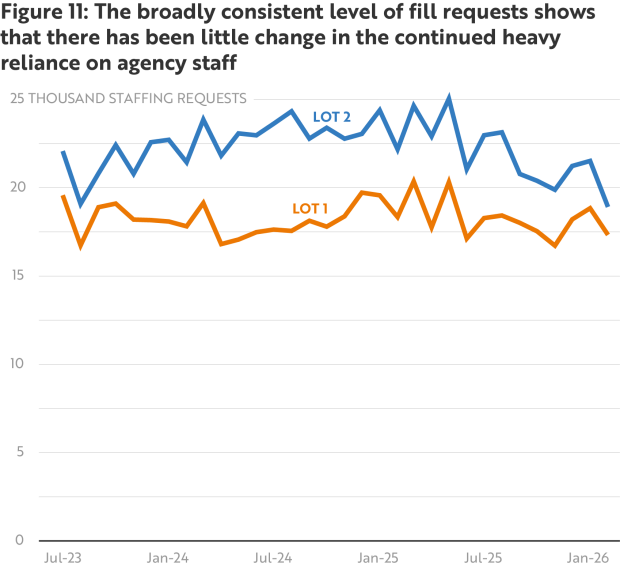
2.34 We found there has been a broadly consistent number of both Lot 1 and Lot 2 shifts being requested by Trusts on a monthly basis since the framework’s introduction. This illustrates that there has been little change in the continued heavy reliance on agency staff and that ARIG has not yet been effective in reducing reliance on agency nursing staff (see Figure 11).
Source: NIAO analysis of data provided by the Department.
Much better value for money could have been achieved
2.35 The new framework has brought greater price certainty for Trusts using agency nurses. However, to encourage agencies to join the framework, contracted rates are much higher than both pre-framework rates, and comparable rates in England. Whilst off-contract agency use has very significantly reduced, overall agency costs remain extremely high and are well in excess of the comparable costs incurred in other jurisdictions. Total agency costs have tripled since 2018-19, despite ARIG being established in late 2019, with the aim of reducing agency expenditure. Earlier decisive action to tackle off-contract agency usage could have stopped costs rising so dramatically. This would almost certainly have resulted in the framework rates of pay being lower than the agreed current levels, thereby ensuring that much better value for money would have been achieved.
2.36 The Department’s main objective through the new framework was to eradicate off-contract agency use. The Department sees the framework as the first step in reducing agency usage. However, it did not, and still has not, established strategic targets for reducing agency usage and associated expenditure. This is in stark contrast to England which has in place a directive, coming from the UK Government, to end agency nursing usage by 2029. This involves, for instance, a target to ensure there has been a 30 per cent reduction in agency expenditure from 2024-25 to 2025-26. The Department told us that work is now ongoing to significantly reduce agency usage in 2026-27.
2.37 The current framework was extended for two years in May 2025 with rates held static. We consider this was a missed opportunity to more fully review and clarify the outcomes achieved through the framework. The Department told us that work to develop a new agreed framework, to run from May 2027, is ongoing.
Recommendation 1
Within the next 12 months, the Department of Health must work with Trusts to develop and implement phased action plans to achieve its objective of improving staff utilisation, including reforming the HSC bank, and reducing agency spend. This must involve setting sustained targets to reduce agency usage.
Recommendation 2
The Department of Health should consider actions taken in other jurisdictions in the UK to reduce reliance and spend on agency nursing staff and ensure learning is built into future strategies.
Recommendation 3
The Department of Health needs to review and clarify the outcomes achieved through the nursing agency framework. This must include benchmarking costs and rates of pay against other jurisdictions to ensure that any new framework achieves the best value for money for Northern Ireland.
Part Three:
Nursing workforce planning
The Department has overall responsibility for strategic workforce planning in the HSC sector
3.1 In our 2020 report we concluded that the scale of the staffing challenges which had developed meant that the Department faced an uphill task in developing a workforce capable of meeting the rising demand for care and that major efforts were required. At that time, we referred to two key documents which had been published by the Department:
- A Workforce Plan for Nursing and Midwifery 2015-2025, published by the Department in May 2016. It set out the proposed number of pre-registration nursing and midwifery training places required until 2025 as well as considering wider workforce challenges.
- The Health and Social Care Workforce Strategy 2026: Delivering for our People, published by the Department in May 2018. It outlines the approach to the development of the HSC workforce including training, recruitment and retention. The strategy relates to the entire HSC workforce.
3.2 We sought updates on progress made on both the workforce plan and the workforce strategy referred to in paragraph 3.1. We found no evidence that the Department has continued to action, monitor or report progress against the Workforce Plan for Nursing and Midwifery 2015-25. The Department told us that it became quickly outdated. A revised workforce plan was not put in place. We do however note that, the Department has ensured an increased number of pre-registration training places as recommended in the 2015-2025 workforce plan (see paragraph 3.12 and Figure 12).
3.3 The Department told us that the COVID-19 pandemic caused delay in implementation and delivery of the HSC Workforce Strategy 2026 and as such the life of the strategy will be extended by two years, to March 2028, accompanied by a third action plan covering the period 2025-26 to 2027-28. The strategy sets the direction for workforce planning across HSC professions. It does not include detailed actions for workforce planning in individual professions or services. As such, there is limited specific reference to nursing and midwifery throughout either the strategy or the associated action plans.
3.4 According to the Department, strategic actions taken in recent years to strengthen the nursing and midwifery workforce have included the increased commissioning of training places, updated recruitment processes for recent graduates, the international nurse recruitment programme, the work of ARIG and the development of a nursing and midwifery retention framework. It emphasised that Trusts are responsible for operational planning and need to ensure the most effective and efficient use of the workforce and identify gaps in workforce availability.
The registered nursing workforce has grown, and vacancy levels have reduced, but the extent of agency spend shows significant workforce gaps remain
3.5 Since we reported in 2020, the HSC registered nursing workforce has grown in both headcount and WTE terms, while the number of registered nursing vacant posts has decreased. From March 2019 to March 2025, the number of registered WTE nursing vacancies has dropped from almost 2,200 to close to 1,200. This represents a percentage decrease of 45 per cent. Trends for nursing support staff have been less positive, with workforce numbers reducing by almost 5 per cent since March 2019 and the number of WTE vacancies increasing from 445 to just over 560.
3.6 Although the reported figures show that registered nursing vacancies have substantially reduced, there are limitations with this data. The vacancy figures only reflect funded posts which are being actively recruited by HSC Trusts. The figures are a measure of recruitment at a point in time and exclude vacant posts which are not being recruited, therefore do not provide an assessment of overall workforce need. In addition, the continuing high reliance and expenditure on agency nursing staff, strongly indicates that considerable work remains to be done to establish a sustainable and cost-effective workforce.
Work to progress Delivering Care indicates a substantial shortfall in the nursing staff needed to provide safe and effective staffing levels
3.7 Delivering Care is the agreed local policy for formulating the development of safe staffing approaches for nursing and midwifery. It was originally launched in March 2014. Our 2020 report highlighted how Delivering Care identified a nursing and midwifery staffing shortfall of almost 1,600 in the HSC system. In the four years between April 2021 and March 2025, the Department has spent over £817,000 to identify and model safe staffing needs. As of April 2025, work to progress Delivering Care had identified a shortfall of 2,195 WTE nurses to provide safe staffing levels. It should be noted that the figure of 2,195 is an estimate and does not include all areas of practice therefore the total shortfall could be different.
3.8 The Department told us that since Delivering Care was launched over a decade ago, there have been significant changes in service delivery models and population health needs. As a result, and in preparation for prospective safe staffing legislation, the Delivering Care policy has been refreshed and published in March 2026.
3.9 The shortfall of 2,195 WTE relates to jobs which the HSC system has not commissioned and does not have funding to recruit for. They are separate from funded vacant posts, previously referred to in paragraph 3.5. Therefore, a more complete estimate of the HSC system’s registered nursing workforce need could be calculated by combining this safe staffing shortfall (2,195) with the number of funded posts being actively recruited (1,178) i.e. the total number of posts could be in the region of 3,400 WTE. It is important to note that this figure is an indicative estimate of the potential workforce gap and more needs to be done across the HSC to establish a complete and accurate figure.
3.10 As of 2024-25, including salary and all additional employer-related costs, the average cost of the most experienced Band 5 nurses to the HSC sector was almost £62,000 per year. The £161.6 million spent on agency nursing staff costs in 2024-25 would equate to paying the full-time employment costs of more than 2,600 of the most experienced Band 5 nurses. That would go a long way towards building a more sustainable workforce and delivering better outcomes for patients.
3.11 We recognise there are challenges in attracting nursing staff as permanent staff members and that there can be a multitude of factors outside the Department’s control in relation to why they may prefer to work for an agency on a temporary basis. For example, Trusts have highlighted that a higher proportion of recently qualified nurses want more flexible working now than in the past. However, more needs to be done to determine the optimum workforce needed and develop a clear plan to fund staffing shortfalls more efficiently, with a view to achieving much better value for money, improved patient outcomes and reducing workforce pressures on HSC staff.
Recommendation 4
Nursing vacancy levels, both funded and unfunded, must be more accurately recorded and reported by HSC Trusts and the Department of Health to provide a complete overview of current HSC workforce needs. This should be implemented within the next 12 months and used to inform workforce planning.
The local pre-registration nursing training programme is a key means to help ensure that the HSC nursing workforce is sufficiently resourced
3.12 The Department is responsible for overseeing the annual commissioning of pre-registration training places for nurses and midwives in Northern Ireland. Funding allocated from New Decade, New Approach (NDNA) aimed to create a further 900 additional nursing and midwifery student places over three years from 2020-21. The target was achieved, with approximately 300 additional training places being established in each of the three years following the signing of the NDNA deal. The first cohort of the additional pre-registration nursing and midwifery training places entered the workforce in July 2023. Figure 12 shows that commissioned training places subsequently decreased.
Figure 12: Pre-registration nursing and midwifery training places in Northern Ireland from 2019-20 to 2025-26
| Year | Number of nursing training places | Number of midwifery training places | Total number of nursing and midwifery training places |
|---|---|---|---|
| 2019-20 | 935 | 90 | 1,025 |
| 2020-21 | 1,216 | 115 | 1,331 |
| 2021-22 | 1,210 | 115 | 1,325 |
| 2022-23 | 1,220 | 115 | 1,335 |
| 2023-24 | 940 | 85 | 1,025 |
| 2024-25 | 915 | 120 | 1,035 |
| 2025-26 | 945 | 120 | 1,065 |
Source: Data provided by the Department.
3.13 The Department cited severe financial constraints as preventing the sustained increase in training places. Of the £60 million committed to safe nursing and midwifery staffing in the NDNA deal, just £25 million has been invested in this staffing group. The Department advised that the remainder has been reallocated due to ongoing financial pressures within the health service.
3.14 Since 2023-24, the number of commissioned training places for nurses and midwives has been considered each year between the Chief Nursing Officer’s (CNO) Group and the Department’s Workforce Development Unit. A number of commissioning options have been presented to the Minister in an annual submission relating to training places.
3.15 However, we found that the Department does not use any detailed, evidence-based metrics to determine the right number of training places. Instead, training places are commissioned based on what the Department can afford, set within the context that there is a need to ensure an adequate supply of nurses to meet the demands of an ageing population, with multiple morbidities and widening health inequalities. The case put forward to increase the number of places also reflects a recognition of workforce supply need beyond HSC Trusts, including the expectation that more nurses will be required within the wider primary care setting to help support the population to stay healthy for longer in their homes rather than attending/or being admitted to HSC Trust hospital settings. The Department highlighted how the Cancer Strategy, the Mental Health Strategy and other clinician-led reports cite the importance and requirement of nurses at both specialist and advanced practice level.
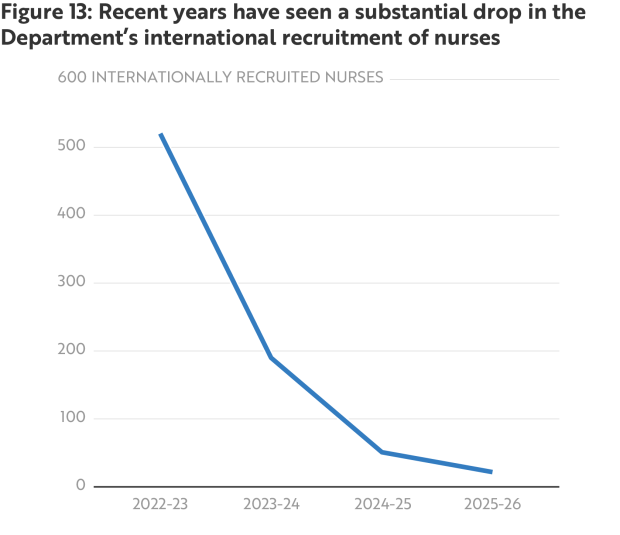
In recent years there has been a substantial drop in the Department’s international recruitment of nurses
3.16 Since 2016, a recruitment campaign to attract international nurses to work in Northern Ireland has been one of the main initiatives used to try and strengthen the HSC workforce. The campaign’s objective was to ensure that 622 overseas nurses commenced HSC employment by March 2020. The campaign resulted in 503 nurses joining the workforce in Northern Ireland by March 2020, 119 fewer nurses than the target. An additional 595 international nurses were recruited in the two-year period from April 2020 to March 2022. There was no evidence of targets being set during this time.
3.17 Subsequently, a target for recruiting 3,000 new international nurses was set for the following five years (2022-23 to 2026-27). This target was supported by a business case, which outlined nurse vacancies across the HSC system and the identified needs to meet rising demand. The target is set to be comprehensively missed, with only recruitment of adult and some mental health nurses taking place. Figures show that from 2022-23 to 2024-25, 761 international nurses have been recruited, with a further 22 joining in 2025-26 (see Figure 13). The Department told us the business case was never fully funded. Funding available for recruiting international nurses has dropped every year since 2022-23, from £7.8 million to £0.9 million in 2025-26.
Source: NIAO analysis of data provided by the Department.
3.18 The Department explained that the initial objective of recruiting 3,000 international nurses slowed because HSC Trusts had reached capacity in terms of the provision of on-the-ground support they could provide for both international recruits and the increased number of locally commissioned trainees following NDNA (see paragraph 3.12). The Department added that in 2023-24 HSC Trusts revised their collective need for international recruitment of nurses due to increased local supply and bespoke international recruitment carried out individually by some of the HSC Trusts. The Department told us that the numbers recruited reflected their revised ask. However, no evidence of revised targets was provided to us. Furthermore, NDNA was agreed in January 2020, more than two years before the plan to recruit 3,000 new international nurses over the five years up to March 2027 was established. If the increased number of locally commissioned trainees entering the workforce were to render this international recruitment target obsolete, officials should have known this long before the target was set.
3.19 Whilst there have been some challenges with the international recruitment campaign, including the need for bespoke induction and preceptorship training, there have also been several clear benefits achieved. These included relatively low recruitment costs and a high retention rate with 91 per cent of those recruited since 2016 still in post in 2025. The Business Services Organisation, an arm’s length body of the Department, plans to consult with the Department and the Trusts to establish if there is a need for a further phase of the international recruitment programme for nurses. It is crucial that future commissioning of training, local or international, is linked to evidence-based need.
Recommendation 5
The Department of Health, in collaboration with the HSC Trusts, must significantly improve its workforce planning for nursing. This should include:
- Evidence-based projections of future population demand and the nursing workforce needed to meet that demand.
- Clear evidence to support the number of pre-registration training places commissioned.
- Scenario planning to reflect the impact of initiatives such as safe staffing legislation and changes in future service models, such as the Neighbourhood Model of Care.
- Regular review points to track progress, revise assumptions and refresh the workforce plan as necessary.
Issues with nursing staff retention have persisted for many years
3.20 In March 2022 the CNO launched the Nursing and Midwifery Retention report. It drew on findings from a retention survey issued to nursing and midwifery staff employed across the Trusts. The survey found the top three factors contributing to staff considering leaving the HSC workforce were the pressures of work, not feeling valued and wanting more pay. Of those who were considering leaving, 25 per cent were planning to work for an agency. The top five factors that would encourage staff to remain in post were identified as improved staffing levels, better pay, more support to deal with workforce pressure, feeling more valued in their work and improved work-life balance.
3.21 The Department launched an implementation framework to act on the findings of the report, including 14 recommendations and detail on how these issues would be actioned. However, we were told no funding was provided to support implementation and the Department has not formally tracked progress against these actions since September 2023. Problems were identified with implementing the actions associated with 13 of the 14 recommendations.
3.22 Annual surveys run by the registration body, the Nursing and Midwifery Council (NMC), provide some insight into the reasons why individuals have left their roles in the profession throughout the UK. The 2024-25 survey highlights that in Northern Ireland, the main reason why people left the NMC that year was due to retirement (46 per cent). 24 per cent of those surveyed left their roles in the profession due to physical and mental health combined with burnout and exhaustion. Just 28 per cent of leavers would promote the profession – with 51 per cent considering themselves active detractors of the profession. It is important that the Department uses this data to inform workforce planning, including succession planning and work to deliver well-being strategies.
3.23 In December 2025, the Department launched a new Career and Development Model for Nursing and Midwifery which aims to support workforce retention and personal development.
Recommendation 6
The Department of Health must obtain HSC nursing staff retention data on an annual basis. This should include the demographic profile of staff leavers and the area(s) of nursing in which they had been working. Trends across Trusts should be analysed to identify issues or best practice and be factored into workforce plans.
Appendix 1 (paragraph 1.12)
Study Methodology
The main elements of our review methodology were as follows:
- We reviewed findings and outcomes from our 2020 report, titled Workforce planning for nurses and midwives and engaged with stakeholders to understand developments in relation to agency nursing staff costs, the HSC nursing workforce and issues facing the HSC system.
- We interviewed key stakeholders including the Department of Health, Health and Social Care Trusts and the Royal College of Nursing.
- We collated and analysed key data and information from the Department of Health and the Health and Social Care Trusts. This included looking at trends in terms of nursing staff numbers, temporary nursing staff usage and agency expenditure.
- We benchmarked data against available statistics from elsewhere in the UK.
- We reviewed published and unpublished documents from a range of bodies.