
List of Abbreviations
ALB Arms length body
DAERA Department of Agriculture, Environment and Rural Affairs
DfC Department for Communities
DfE Department for Economy
DE Department of Education
DoF Department of Finance
DoH Department of Health
DfI Department for Infrastructure
DoJ Department of Justice
NI Northern Ireland
NIAO Northern Ireland Audit Office
NICS Northern Ireland Civil Service
PIDO Public Interest Disclosure Order
PPS Public Prosecution Service
PSNI Police Service of Northern Ireland
TEO The Executive Office
Key Facts
500 - More than 500 concerns have been raised with the NI Departments in the last five years
69 - The number of concerns raised that were classified as alleged fraud or maladministration
230 - Around 230 concerns have been raised with local councils in the last five years
10% - The percentage of complaints raised over the last five years that were upheld
70% - The percentage of respondents to the NICS People Survey who were confident that if they raised a concern, it would be investigated properly
64% - The percentage of respondents to the NICS People Survey who felt it was safe to challenge inappropriate behaviour in the workplace
Executive Summary
Raising concerns has a vital part to play in ensuring transparency, accountability and integrity within the Northern Ireland public sector
1. Raising concerns – often referred to as whistleblowing – is a vital organisational protection. It provides a way for organisations to hear concerns about serious issues that may not otherwise be discovered. It also empowers workers to report misconduct, malpractice or risks to the public interest without fear of reprisal. In Northern Ireland, raising concerns is protected by legislation through the Public Interest Disclosure (NI) Order 1998 (PIDO).
2. The key benefits of strong raising concerns arrangements for organisations include:
- Protection for individuals who raise concerns
- Effective reporting channels
- Early detection of issues
- Timely investigation
- Improved organisational culture
There have been a number of high-profile cases associated with raising concerns
3. Raising concern’s critical role is highlighted by a number of recent cases across the UK. The Post Office scandal saw hundreds of innocent sub-postmasters wrongly prosecuted due to faulty IT systems in instances which might have been mitigated had concerns been acted upon earlier. A number of cases related to healthcare have also been prominent. In the Lucy Letby case, whistleblowers raised alarms about patient safety but were ignored. Ongoing reviews into maternity services across the UK reveal systemic failures that persisted despite repeated warnings from frontline professionals.
4. Similarly, there are a number of local cases in Northern Ireland which highlight the importance of listening to and acting upon concerns raised with public bodies. Dr Bronckaers, a vet within DAERA, raised concerns about animal welfare and the impact of deleted cattle moves on traceability. An independent report noted that these concerns were not treated appropriately. Dr Bronckaers has since received a £1.25m settlement from DAERA, along with an “unreserved” apology. Similarly, the Muckamore Abbey Hospital inquiry uncovered abuse of vulnerable patients, with staff whistleblowers playing a key role in bringing these issues to light.
Progress has been made in some areas
5. To address concerns, including those identified by the Bronckaers case, the Northern Ireland Civil Service issued the Northern Ireland Departments’ Raising A Concern, Policy Framework (the Framework) in January 2023 which was subsequently updated in March 2025. The Framework outlines how departments should handle any concerns raised with them and aims to encourage and provide reassurance to members of the public and staff who want to raise concerns.
6. As the Framework is now implemented, all departments have updated their raising concerns policies and all now have a Designated Officer to act as the point of contact for concerns within each organisation and to appropriately triage those concerns.
7. Despite the improvements brought about by the Framework, our review of raising concerns across the public sector has noted that there are still some areas in which improvements could be made.
There is a need for greater clarity of roles and responsibilities for those involved in dealing with raising concerns
8. The roles and responsibilities of the NI Departments are set out in the Raising a Concern Policy Framework. Local government do not follow a policy framework. However, it is best practice to ensure that the appropriate roles and responsibilities are in place to ensure effective processes for raising concerns.
9. As part of our engagement, we noted that on some occasions, organisational structures were not always appropriate for adequately dealing with raising concerns. In the weakest cases, we noted:
- a raising concern team that lacked specific skills that are necessary for adequately dealing with raising concerns;
- some raising concerns teams were isolated or lacked significant organisational support, especially from senior management;
- raising concerns teams did not learn from best practice in other organisations;
- lessons from concerns or investigations in one area of the business were not shared across the organisation.
There is additional scope to improve culture around raising concerns
10. The NI Departments’ Raising a Concern Policy Framework states that each department will have a Speak Up Champion. This is an important role in promoting and developing a positive culture around raising concerns. Champions are responsible for raising awareness about raising concerns and encouraging “a culture of curiosity and challenge within their department…consideration of how improvements made as a result of concerns raised can be publicised to ensure staff see the positive value of raising concerns.”
11. However, during our engagement with departments, it was apparent that this did not exist in all organisations. The Speak Up Champion role is not operating as intended and given this, there is additional scope to improve the culture around raising concerns and provide support to both those who want to raise a concern and those dealing with concerns raised.
There is a lack of training in raising concerns
12. The provision of appropriate training in raising concerns is essential, especially awareness training for new starts. Our work has found that there is a need for greater training in this area. Few organisations had provided recent, dedicated training for all staff. This was especially concerning in the case of new starts, where mandatory training should be provided as part of an induction process.
13. We also found that even those staff who were Designated Officers – in charge of dealing with raising concerns in some of the largest public bodies in Northern Ireland – had received little training. Whilst some told us that they had received basic training when their role commenced, others had not been trained. None had reported specific recent training in relation to this role. Many organisations told us that they had difficulty sourcing specific and appropriate training.
14. We encourage all organisations to refer to our updated Good Practice Guide on Raising Concerns in the first instance as a source of guidance and good practice.
Few organisations have appropriately trained investigative staff
15. A further important area where we noted there was often insufficient training was in relation to staff who undertook investigations. In some cases, we noted that the initial investigations when concerns are received are undertaken by the individual who receives the concern. These individuals are not always trained in investigative techniques.
16. Whilst this may be occasionally an appropriate method of obtaining further information, there are significant potential risks associated with untrained individuals undertaking investigations, including alerting anyone involved, producing an investigation that did not meet standards or even putting the organisation at risk of legal challenge.
Stronger governance could improve how organisations deal with concerns
17. Given the breadth and variety of bodies in the public sector, some degree of variance is inevitable when considering raising concerns across the whole public sector. However, we noted a number of areas where consistency would improve analysis and the sharing of best practice.
18. In many of these instances, enhanced central oversight and ownership of raising concerns could ensure that concerns are treated in a timely manner and follow up action is taken. Oversight would also ensure the timeliness of investigations and ensure engagement, where possible, with individuals raising concerns.
19. Whilst variation in treatment of ALBs can be appropriate, in some cases we found that relationships between departments and ALBs around raising concerns were not always being guided by the level of assessed risk or an assessment of appropriate autonomy. At a minimum, engagement with ALBs should be guided by open and honest communication including a mutual sharing of experience around raising concerns. A department’s approach to its ALB around raising concerns should be outlined in an agreed partnership arrangement.
20. Audit and Risk Assurance Committees have a key role to play in the governance of raising concerns. Whilst it is not the Audit and Risk Assurance Committee’s job to investigate concerns, Committees should ensure that they are aware of significant cases, are aware of trends in concerns that have been received; and have evidence that concerns are being processed and treated in the correct manner.
Whilst many administrative arrangements are now more effective, the culture around raising concerns needs to be improved
21. The introduction of the Framework has helped improve many administrative arrangements associated with raising concerns across the civil service. However, the Framework has not focused on culture and there remains room for many organisations to focus on actions to improve the culture around raising concerns.
22. During our engagement, none of those responsible for raising concerns in public bodies highlighted any significant barriers that they felt were preventing people speaking up. However, we noted that a number of public bodies had received very few concerns over the five-year period that we analysed. Whilst there is no benchmark for the number of concerns an organisation should expect, such low figures may indicate that barriers exist. It is therefore essential that organisations consider and address barriers – real and perceived – that might be preventing people from raising concerns.
23. The recent NICS people survey (June 2025) identified that 70 per cent of respondents knew how to raise a concern under the Raising Concerns Policy. This has decreased from around 73 per cent in the last survey. There is significant scope to focus on raising awareness with staff and promoting the policy.
A number of bodies are implementing innovative best practice that could be adapted and learnt from
24. During our engagement for this report, we identified a number of bodies who had implemented best practice. These approaches include a clear demonstration of a positive tone from the top; ensuring all staff are included in awareness of the raising concerns policy; taking a person-centred approach to how raising concerns work in practice and measuring staff engagement with the raising concerns policy. All demonstrate a positive and open culture towards raising concerns.
Recommendations
Recommendation 1
Organisations should look critically at the number and type of concerns raised with them, consider implications and take action. Audit and Risk Assurance Committees should:
- Discuss raising concerns as a regular agenda item;
- Engage with the organisation’s Designated Officer or equivalent;
- Be satisfied that organisations have the appropriate capacity and capability to investigate and manage concerns; and
- Seek assurance that raising concerns are treated in line with the policy.
Recommendation 2
Organisations should undertake a review of their raising concerns team structures to ensure they have sufficient resources and skills available to manage raising concerns and promote awareness. This should consider both their capacity for considering concerns and conducting investigations and the capability of the raising concerns teams.
Recommendation 3
The Speak Up Champion role is not operating effectively. Departments should ensure this important role is working as intended, as detailed within the Framework. Other public sector organisations should also consider appointing a ‘Speak Up Champion’ as an important role in promoting and developing a positive culture around raising concerns.
Recommendation 4
Organisations should review the training available for all staff to improve awareness around raising concerns. Specific training for Designated Officers and those responsible for managing and handling concerns should be put in place.
Recommendation 5
Organisations should ensure they have mechanisms and procedures in place to regularly measure staff awareness of raising concerns such as staff surveys and act on the results.
Recommendation 6
Organisations should review their procedures to ensure that the raising concerns team are appropriately sighted on all concerns raised and to enable effective central oversight and governance of how concerns are being investigated.
Recommendation 7
Organisations should create and nurture a positive raising concern culture led by senior leadership who have an important role in promoting and fostering this culture throughout the organisation. Organisations should review their strategies for promoting a positive raising concern culture, ensuring they provide a clear focus on all staff groups. This should include those geographically dispersed and those in insecure employment. This includes ensuring that all employees have a clear understanding of the relevant policy and procedures and ensuring that any potential barriers that may discourage individuals from speaking up – whether that be cultural, procedural or interpersonal – are removed.
Recommendation 8
We have updated our Good Practice Guide on Raising Concerns. We recommend that all organisations should review the good practice guide and ensure that all elements appropriate to their organisation are considered. Actions should be taken to strengthen raising concerns where necessary.
Part One: Introduction and Background
Raising concerns has a vital part to play in ensuring transparency, accountability and integrity within the Northern Ireland public sector
1.1 Raising concerns – often referred to as whistleblowing – is a vital organisational protection. It provides a way for organisations to hear concerns about serious issues that may not otherwise be discovered. It also empowers workers to report misconduct, malpractice or risks to the public interest without fear of reprisal.
1.2 The key benefits of strong raising concerns arrangements include:
- Protection for workers who raise concerns
- Effective reporting channels
- Early detection of issues
- Timely investigation
- Improved organisational culture
1.3 Effective raising concerns arrangements include not only the necessary systems and administrative processes but also require a strong and positive culture that supports safe and effective reporting.
1.4 As such, to effectively manage and address concerns raised, organisations must foster an environment that encourages and celebrates concerns being raised. This requires open communication, with clear policies and procedures in place for reporting and addressing concerns. Crucial in this is leadership. Leaders within organisations are responsible for cultivating this culture and must be approachable and set the right ‘tone from the top’.
A broad range of concerns can be disclosed
1.5 A broad range of concerns can be disclosed to public sector organisations. Concerns can be raised about mistakes, errors and unintended consequences, both in respect of the interests of the department and its staff. One type of concern is known as a qualifying disclosure.
1.6 Qualifying disclosures are disclosures of information which the worker reasonably believes are made in the public interest. The Public Interest Disclosure (Northern Ireland) Order 1998 (‘the Order’), protects workers who raise concerns about wrongdoing. The Order makes provision about the kinds of disclosures which may be protected; the circumstances in which such disclosures are protected; and the persons who may be protected.
1.7 Concerns can also be raised about any issue relating to suspected malpractice, risk, abuse or wrongdoing that is in the public interest. The person raising the concern does not need to have evidence or proof of wrongdoing. As long as they have an honest belief, it does not matter if they are mistaken. Individuals should be encouraged to raise the concern as early as possible, even if it is only a suspicion, to allow the matter to be looked into promptly.
1.8 The types of issues which may be considered a protected disclosure include:
- any unlawful act (e.g. theft or fraud);
- health and safety risks to employees, service users or the public;
- the abuse of children or vulnerable adults in care;
- damage to the environment (e.g. pollution);
- failing to safeguard personal and/or sensitive information (data protection);
- abuse of position; or
- any deliberate concealment of information tending to show any of the above.
Employees who raise concerns are protected under the legislation
1.9 The Public Interest Disclosure legislation allows an employee to take their employer to an employment tribunal if they suffer detriment in any way as a result of raising a concern (referred to in the legislation as making a disclosure in the public interest). Members of the public who have no employment relationship with an organisation about which they raise a concern are not protected by the legislation.
1.10 The legislation was introduced to give retrospective protection to workers who raise a concern in their workplace and suffer detriment as a result. Such a situation may arise if an employer does not have an open and honest culture and a clear policy which welcomes the raising of concerns. Detriment may include bullying, marginalisation or being passed over for promotion.
1.11 Therefore, the greatest protection is provided by employers proactively adopting good practice, so that concerns are properly and appropriately dealt with, detriment does not occur and recourse to a tribunal is not required. Implementing good practice saves on the time and cost of formal tribunal proceedings. It helps to reduce sickness absence due to stress, prevents poor staff morale and avoids deterioration of working relationships.
Concerns are not always treated appropriately
1.12 However, it is apparent that not all concerns are treated seriously or investigated thoroughly. In their 2025 Impact Report, PROTECT, state that:
- Almost 2 in 5 callers (38 per cent) said their whistleblowing concern had been ignored by their employer;
- More than two-thirds (71 per cent) said they faced victimisation or felt forced to resign.
1.13 High-profile cases in recent years, such as the Bronckaers case have highlighted this. Dr Bronckaers, a vet within DAERA, raised concerns about animal welfare and the impact of deleted cattle moves on traceability. She has since received a £1.25m settlement from DAERA, along with an “unreserved” apology. This case illustrated that without the right culture and practices in place, individuals raising concerns may be overlooked, victimised or face consequences for speaking up.
1.14 In 2022, following the criticism of the Bronckaers case, the Head of the Civil Service and the Permanent Secretaries for the Department of Agriculture, Environment and Rural Affairs (DAERA) and the Department of Finance (DoF), jointly commissioned an Independent External Review into the handling of concerns and matters in this case.
1.15 The report was published in January 2023, along with an action plan in response to the findings of the review. The action plan included the completion and publication of the Raising a Concern Policy Framework for the NI Departments. This Framework was published in January 2023. The purpose of this Framework is to enhance raising concern practices, through encouraging reporting, protecting whistleblowers and ensuring accountability.
There have been a number of recent legislative developments
1.16 Recent legislative developments, such as the proposed Organisational Duty of Candour Bill, reflect a growing commitment to embedding transparency across the health and social care sector. This bill would legally obligate organisations to act honestly and inform affected parties when things go wrong.
1.17 Additionally, the Public Office (Accountability) Bill, “A bill to impose a duty on public authorities and public officials to act with candour, transparency and frankness”, currently going through the House of Commons, seeks to extend these principles across all public officials, reinforcing the expectation of candour, frankness, and public interest-driven conduct. These changes could help break down barriers to speaking up by making honesty and ethical behaviour a legal requirement, which in turn could help build public trust. In practice every hospital, school, police force, government department, local authority and further education provider will have to publish their code of ethical conduct.
1.18 The NI Executive has agreed that the relevant provisions of the Bill should extend to NI.
Our scope and methodology
1.19 Effective raising concern mechanisms contribute to better governance, early detection of issues, and improved service delivery and proper handling can avoid costly mistakes being made. However, despite the existence of formal policies and legal protections, various barriers continue to hinder individuals from speaking up. These barriers must be addressed to help foster a culture where concerns are welcomed, acted upon, and those raising concerns are supported.
1.20 As part of analysing the mechanisms in place, we met with all central government departments and all local councils. We collected and analysed data around the number of concerns that had been raised with each body. We also reviewed how the NI Departments’ Raising a Concern: Policy Framework has been implemented, through data collection, reporting practices and evidence of an implemented policy. We have also considered the extent to which policies in local government have incorporated best practice guidance.
Part Two: The current landscape of raising concerns in the Northern Ireland public sector
A new framework was introduced in 2023 to improve the handling of concerns
2.1 The NI Departments’ Raising a Concern Policy Framework (the Framework) was issued in January 2023 and subsequently updated in March 2025. The Framework outlines how departments should handle any concerns raised with them, and to encourage and provide reassurance to members of the public and staff who want to raise concerns.
2.2 This provided an overarching framework within which departments would operate, however each department was required to also have its own raising a concern policy and operational arrangements. These should be consistent with the approach set out in the Framework but will be tailored to reflect the circumstances of each department where required.
More than 700 concerns have been raised with public sector organisations in the last five years
2.3 As part of our audit, we have collated data from all government departments and local councils; these datasets have limitations. There may be differences between organisations in the decisions they take when defining something as a concern or in the approach they take to including concerns received from external sources or about concerns raised with them about their arm’s length bodies.
2.4 Departments and local councils in Northern Ireland recorded details of more than 700 concerns that they received in the five years from 2020-21 to 2024-25. The number of concerns reported varies between these organisations, with central government departments receiving the majority of concerns over this period. The numbers of concerns received also fluctuates from year to year.
2.5 This section considers:
- The numbers of concerns raised with public sector bodies;
- What these concerns were about;
- How concerns were raised; and
- The outcome of public bodies’ investigations into those concerns.
Since the introduction of the Framework, the number of concerns raised in central government have increased
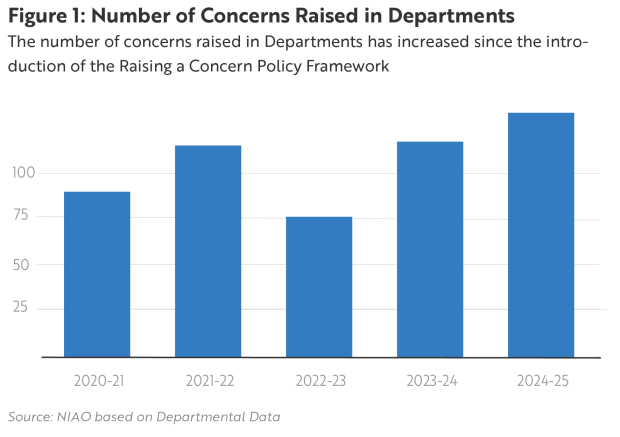
2.6 Across the last five years, central government departments have received more than 500 concerns. Importantly, since the introduction of the NI Departments’ Raising a Concern Policy Framework in January 2023, there has been a noticeable increase in concerns raised within central government (Figure 1). This upward trend is a positive and a potentially encouraging sign which suggests growing awareness, a confidence in the policy and that individuals feel able to voice issues. This has the potential to contribute to a more transparent, accountable, and responsive environment.
Figure 1: Number of Concerns Raised in Departments
The number of concerns raised in Departments has increased since the introduction of the Raising Concerns Framework
Note: This figure may include cases of fraud which are counted separately in some departments.
Source: NIAO based on Departmental Data
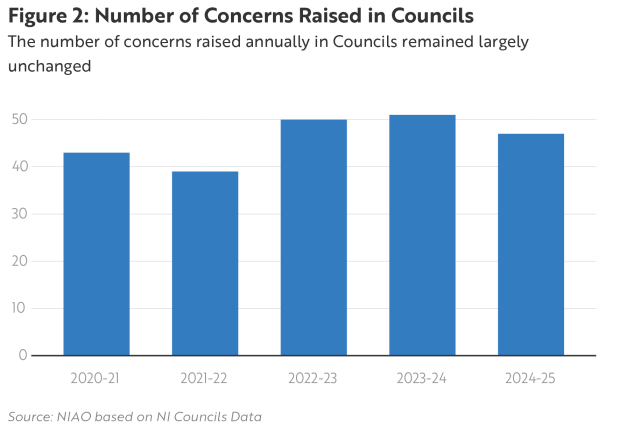
2.7 In local government, around 230 concerns have been raised with councils in the last five years. In contrast to central government, the numbers of concerns raised annually within local government have remained largely unchanged over the past five years (Figure 2).
Figure 2: Number of Concerns Raised in Councils
The number of concerns raised annually in Councils remained largely unchanged
Source: NIAO based on NI Councils Data
2.8 Without a clear and consistent way for people to speak up, issues may go unnoticed or unaddressed. This can make it harder for councils to learn from mistakes or improve how they work. Councils could consider introducing a simple, well-communicated raising concern framework across local government to help staff feel more confident about reporting problems and lead to better accountability and service delivery.
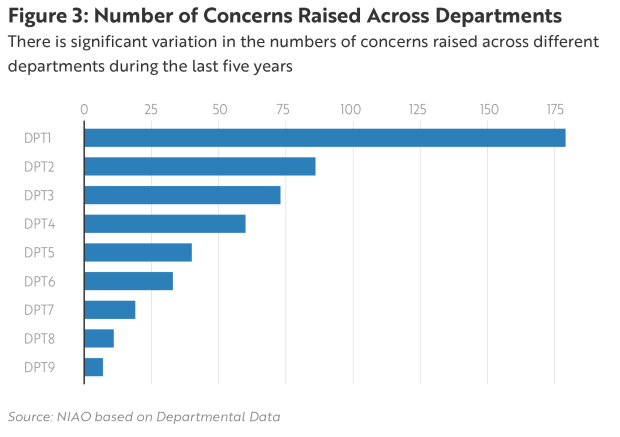
2.9 All central government departments have received concerns during the period we analysed. However, the number of concerns received by each department varies significantly (Figure 3).
Figure 3: Number of Concerns Raised Across Departments
There is significant variation in the number of concerns raised across different departments during the last five years
Source: NIAO based on Departmental Data
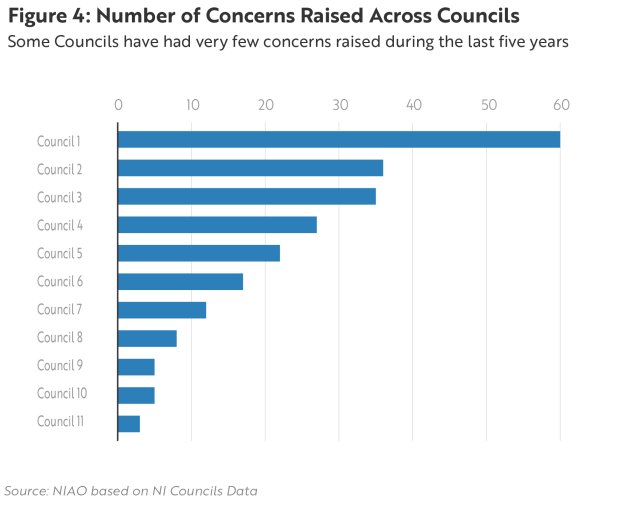
2.10 Local councils have received 230 concerns during this five-year period. However, these are not distributed evenly across councils.
Figure 4: Number of Concerns Raised Across Councils
Some Councils have had very few concerns raised during the last five years
Source: NIAO based on NI Councils Data
2.11 This variation in the number of concerns raised may be reflective of practices in some councils where raising concerns do not appear to be an area of focus. We noted that in one council at the time of our fieldwork, there was no accessible raising concerns policy. This Council recorded 3 concerns over the 5-year period. Whilst a high number of concerns can indicate areas of significant concern for an organisation, a consistently low number may also indicate a culture that is closed or flaws in the process for raising concerns.
Recommendation 1
Organisations should look critically at the number and type of concerns raised with them, consider implications and take action. Audit and Risk Assurance Committees should:
- Discuss raising concerns as a regular agenda item;
- Engage with the organisation’s Designated Officer or equivalent;
- Be satisfied that organisations have the appropriate capacity and capability to investigate and manage concerns; and
- Seek assurance that raising concerns are treated in line with the policy.
Alleged fraud is the largest category of concerns raised with public sector bodies
2.12 All public bodies we engaged with told us that often concerns raised with them could be difficult to categorise. This could be because of a lack of clarity on issues raised, or a number of issues raised within one concern. In addition, there is substantial variation in categorisation and recording methods across organisations. Some public sector bodies do not categorise concerns raised with them.
2.13 Despite these challenges, we analysed the concerns that had been raised across the public sector in the last five years. All public bodies had not analysed all concerns received into categories. Where they had, the single largest category of concerns raised within the public sector related to alleged fraud or maladministration (Figure 5).
Figure 5: Category of Concerns Across The Public Sector
Fraud is the largest category of concerns raised over the last five years
| Category of concern | Total |
|---|---|
| Fraud and/or maladministration | 69 |
| Breach of conduct/procedures | 53 |
| Grants | 37 |
| Abuse of position | 35 |
| Unlawful act/criminal activity | 33 |
| Bullying/harassment and/or employee mistreatment | 27 |
| Employee misconduct (including contractors) | 21 |
| Ethics | 14 |
| Health and safety | 14 |
| Complaint | 11 |
| Conflict of interest | 10 |
| Safeguarding | 8 |
| Breach of confidentiality | 7 |
| Resource misuse | 7 |
| Financial malpractice | 2 |
| Unfair hiring practices | 2 |
| Planning concern | 1 |
| Other | 54 |
| Total | 405 |
Source: NIAO based on Departmental and NI Councils Data
2.14 The next largest category related to concerns about breaches of procedures and conduct. Alongside alleged fraud, these two categories comprise more than one in four of all classified concerns.
2.15 Concerns related to grants have decreased significantly in recent years. Whilst 19 and 16 were received respectively in 2020 and 2021, only two concerns were received in total over the last three years. Whilst this may relate to the ending of grants paid during the pandemic, public bodies with significant grant schemes should consider why such concerns are now not being received.
Most concerns are received by email
2.16 Email is the preferred method of communication when raising a concern. Among those bodies who record the method of communication, almost 80 per cent of concerns were received via email during the period 2020-2025.
Figure 6: Type of Contact Method Across The Public Sector
The majority of concerns are received via email
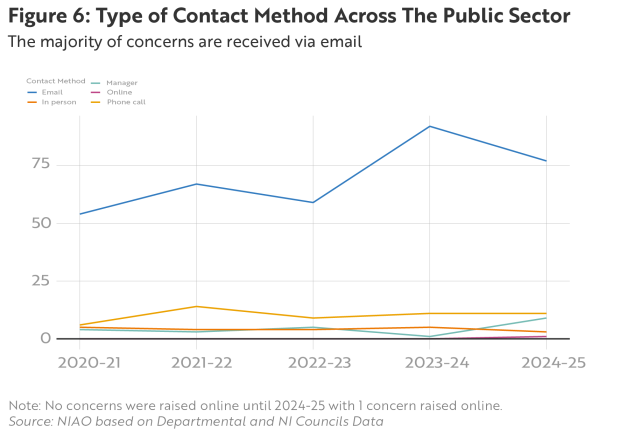
Note: No concerns were raised online until 2024-25 with 1 concern raised online
Source: NIAO based on Departmental and NI Councils Data
The majority of concerns raised with public sector bodies are not upheld
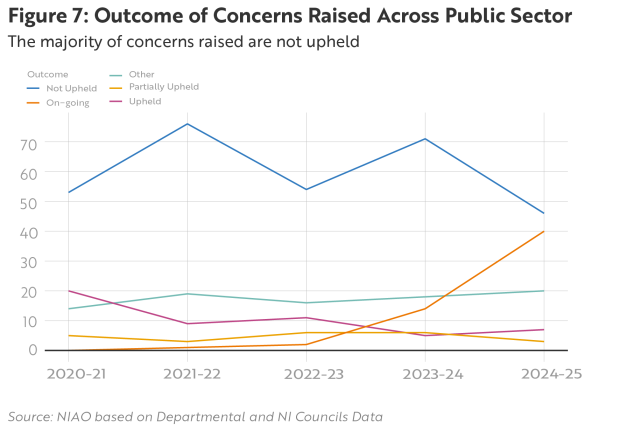
2.17 Over the last five years, in the case of investigations that have been completed, 300 of 519 (58 per cent) of the concerns raised, were not upheld (Figure 7). Over the period, only 10 per cent of concerns were upheld. In local government specifically, 11 per cent of concerns were upheld and 54 per cent were not upheld. In central government 9 per cent of concerns were upheld and 60 per cent were not upheld. Other concerns were referred to another department, reclassified or deemed to be outside the bodies’ remit.
Figure 7: Outcome of Concerns Raised Across The Public Sector
The majority of concerns raised are not upheld
Source: NIAO based on Departmental and NI Councils Data
The majority of concerns received are external to the organisation
2.18 Raising concerns policies should enable both staff who work in public bodies and those external to the body to highlight areas of concern. To achieve this, the raising concern policy should be clearly available on both the intranet and the public facing internet. We found that not all organisations complied with this best practice.
2.19 Concerns can be raised anonymously. As a result, it will not always be possible to identify if the person who raised the concern was internal or external to the organisation. In cases where the individual has identified themselves, organisations should record whether the concern was raised internally or externally.
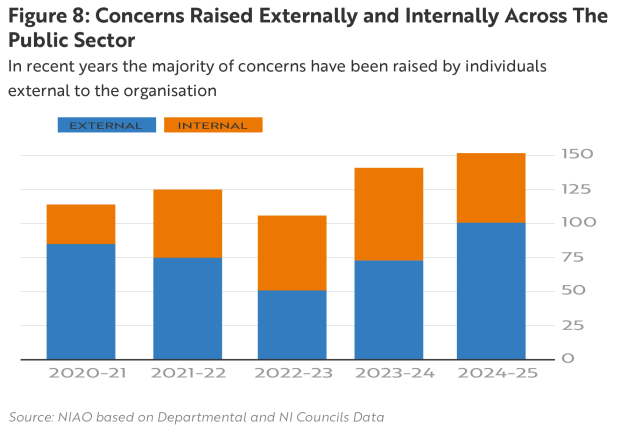
2.20 Where this information was recorded, the majority of concerns were received from external individuals in four out of the past five years (Figure 8). There was only one year in the past five when the majority of concerns came from individuals internal to the organisation. That year coincided with the publication of the NI Departments’ Raising a Concern Policy Framework.
Figure 8: Concerns Raised Externally and Internally Across The Public Sector
In recent years the majority of concerns have been raised by individuals external to the organisation
Source: NIAO based on Departmental Data and NI Councils Data
2.21 Bodies should consider the origin of the concerns they receive. Where there are a limited number of concerns received internally, this may be a reflection of organisational culture and a potential indication that staff are uncomfortable raising issues.
Part Three: The effectiveness of arrangements for raising concerns in the public sector
3.1 As part of our work, we engaged with all central government departments and local councils in Northern Ireland. Central government departments told us that the introduction of the Raising a Concern Policy Framework had improved how concerns were handled.
3.2 Through this engagement, however, we also identified a number of areas in which improvements could be made in how concerns are being treated across the public sector. These broad areas include:
- The governance around raising concerns;
- The clarity of roles and responsibilities for those involved in dealing with raising concerns;
- How to effectively promote awareness of raising concerns; and
- Providing training and support to those who require it.
There could be greater clarity of roles and responsibilities for those involved in dealing with raising concerns
3.3 Public sector organisations in Northern Ireland, including the NI Departments, have a duty to foster a culture of openness and accountability. They must ensure that effective arrangements are in place for individuals to raise concerns about things going wrong. These arrangements should protect the person raising the concern and ensure that issues are addressed promptly and appropriately.
There are a range of roles and responsibilities in relation to raising concerns
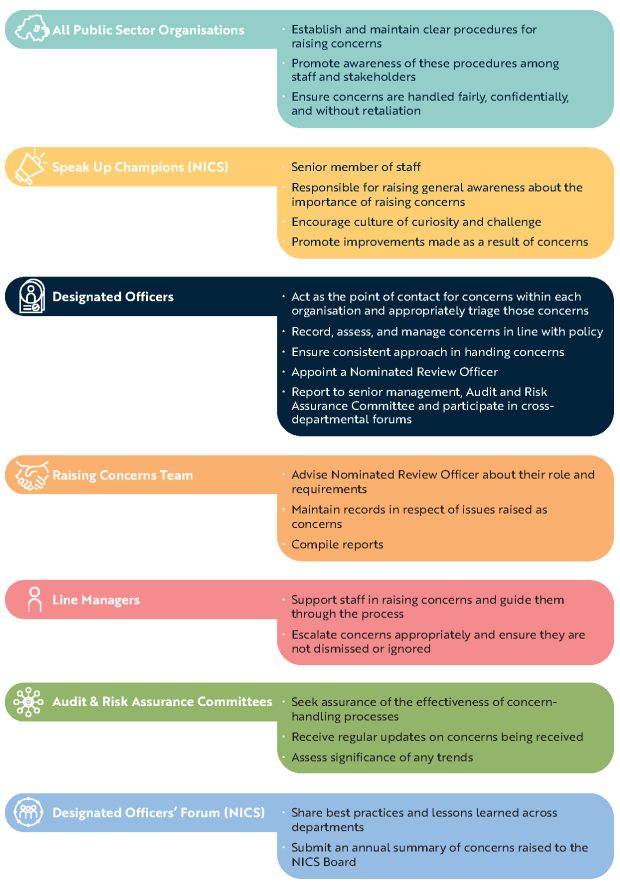
3.4 The roles and responsibilities for central government departments are set out in the NI Departments’ Raising a Concern Policy Framework. Departments are responsible for following the ‘Raising a Concern Policy Framework’ and responding appropriately to concerns, correcting failures and learning lessons. This Policy Framework sets out the roles and responsibilities for Designated Officers, Accounting Officers, Nominated Review Officers and the Departmental Audit and Risk Assurance Committee.
3.5 Local government do not follow a raising concerns policy framework. However, it is best practice to ensure that the appropriate roles and responsibilities are in place to ensure effective processes for raising concerns.
Figure 9: Summary of Raising Concerns roles and responsibilities across the Public Sector
Source: NIAO based on NI Departments’ Raising a Concern: Policy Framework; Departmental raising concerns guidance; NIAO Good Practice Guide.
3.6 We noted that on some occasions, organisational structures were not always appropriate for adequately dealing with raising concerns. In the weakest cases, we noted:
- a team that lacked specific skills that are necessary for adequately dealing with raising concerns;
- a team that were isolated or lacked significant organisational support, especially from senior management;
- a team that did not learn from best practice in other organisations;
- concerns raised directly with managers or in business areas were not being readily shared across the organisation;
- lessons from concerns or investigations in one area of the business were not shared across the organisation.
Recommendation 2
Organisations should undertake a review of their raising concerns team structures to ensure they have sufficient resources and skills available to manage raising concerns and promote awareness. This should consider both their capacity for considering concerns and conducting investigations and the capability of the raising concerns teams.
It is important to ensure that information on concerns is shared internally within an organisation
3.7 Many organisations told us that it was often challenging to differentiate whether issues raised with them were a concern, a grievance or a complaint. Whilst there will inevitably be professional judgement involved in making that decision, guidance on these distinctions is available including the NIAO updated Good Practice Guide on Raising Concerns.
3.8 Perhaps more importantly, organisations should ensure that the issues raised through each of these channels are considered holistically. Intelligence sharing through these key channels – raising concerns, grievances and complaints – has the potential to identify trends and specific areas of concern in organisations which may otherwise not be pinpointed. It also has the benefit of reducing misdirection and minimising delays in handling concerns.
Speak Up Champions are not operating in many departments
3.9 The NI Departments’ Raising a Concern Policy Framework states that each department will have a Speak Up Champion. This role is an important role in ensuring bodies have a positive culture around raising concerns. They are to be responsible for raising awareness about raising concerns and “encourage a culture of curiosity and challenge within their department… consideration of how improvements made as a result of concerns raised can be publicised to ensure staff see the positive value of raising concerns.”
3.10 During our engagement with departments, it was apparent that this did not exist in all departments. The majority of departmental policies did not refer to a Speak Up Champion. Those that did, simply stated that the role would be fulfilled by the Designated Officer.
3.11 The Speak Up Champion role is not operating as intended. There is additional scope to improve the culture around raising concerns and provide support to both those who want to raise a concern and those dealing with concerns raised.
Recommendation 3
The Speak Up Champion role is not operating effectively. Departments should ensure this important role is working as intended as detailed within the Framework. Other public sector organisations should also consider appointing a ‘Speak Up Champion’ as an important role in promoting and developing a positive culture around raising concerns.
There is a lack of training in issues associated with raising concerns
3.12 Clarity over roles and responsibilities is important in ensuring concerns are appropriately treated. However, for many of those involved in raising concerns, ensuring appropriate training is provided is essential.
3.13 Our work has found that there is a need for greater training around raising concerns. Few organisations had provided recent, dedicated training. This was especially concerning in the case of new starts, where mandatory training should be provided as part of an induction process.
3.14 We also found that even those staff who were Designated Officers – in charge of dealing with raising concerns in some of the largest public bodies in Northern Ireland – had received little training. Whilst some told us that they had received [basic] training when their role commenced, others had not been trained. None had reported specific recent training in relation to this role. Many organisations told us that they had difficulty sourcing specific and appropriate training.
Recommendation 4
Organisations should review the training available for all staff to improve awareness around raising concerns. Specific training for Designated Officers and those responsible for managing and handling concerns should be put in place.
Few organisations have appropriately trained investigative staff
3.15 A further important area where we noted there was often insufficient training was in relation to staff who undertook investigations. In some cases, we noted that the initial investigations when concerns are received are undertaken by the individual who receives the concern. These individuals are not always trained in investigative techniques.
3.16 Whilst this may be occasionally an appropriate method of obtaining further information, in our view there are significant potential risks associated with untrained individuals undertaking investigations. A number of organisations noted that they considered there were risks in alerting anyone involved, producing an investigation that did not meet standards or even putting the organisation at risk of legal challenge.
Awareness of how to raise concerns is essential for staff
3.17 It is essential that organisations prioritise an open culture where raising valid concerns is promoted and welcomed. It is also important for organisations to provide clear avenues to employees and the public to allow them to raise concerns. Many organisations felt they had provided routes to raise concerns – but not all had measured the extent to which employees were aware of how to raise concerns.
3.18 One organisation held ‘awareness sessions’ and ‘inform you’ sessions with their staff. These sessions highlight the raising concern policy and its practices.
3.19 Within the Civil Service, the NICS People Survey is a biennial staff survey conducted across the Northern Ireland Civil Service to gather insights into employee experiences, attitudes, and perceptions of their working environment. It covers a range of topics including leadership, wellbeing, inclusion, and organisational culture. Also included in the survey are questions around raising concerns.
3.20 Recent results have shown some encouraging trends around raising concerns. In 2025, 70 per cent of respondents stated that they know how to raise a concern under the policy. This however was a decrease from 73 per cent in 2023. In contrast, 70 per cent of respondents expressed confidence that their concern would be properly investigated – up from 64 per cent in 2023.
3.21 Outside of NICS, however, few organisations had considered attempting to measure staff awareness of raising concern policies or staff confidence in raising concerns practices. In our view, measurement of this type can provide management with valuable insight into the effectiveness of their raising concerns policies and practices.
Figure 11: Excerpt from 2025 NICS people survey
| B56. In my department, people are encouraged to speak up when they identify a serious policy or delivery risk | |||||||||||||
| NICS 2025 | DAERA | DFC | DfE | DE | DoF | DoH | DfI | DoJ | TEO | HSENI | PPS | NICS 2023 | 2023- 2025 |
| 61% | 59% | 62% | 65% | 47% | 65% | 54% | 58% | 63% | 62% | 52% | 65% | 59% | +2 |
| B57. I feel able to challenge inappropriate behaviour in the workplace | |||||||||||||
| NICS 2025 | DAERA | DFC | DfE | DE | DoF | DoH | DfI | DoJ | TEO | HSENI | PPS | NICS 2023 | 2023- 2025 |
| 64% | 62% | 65% | 66% | 59% | 68% | 58% | 62% | 62% | 62% | 47% | 64% | 61% | +3 |
| The NICS Code of Ethics and Raising Concerns (Whistleblowing) Policy | |||||||||||||
| D01. I fully understand the NICS Code of Ethics and what it means for my conduct % strongly agree / agree | |||||||||||||
| NICS 2025 | DAERA | DFC | DfE | DE | DoF | DoH | DfI | DoJ | TEO | HSENI | PPS | NICS 2023 | 2023- 2025 |
| 89% | 90% | 88% | 94% | 89% | 91% | 91% | 83% | 89% | 92% | 90% | 87% | 88% | +1 |
| D02. Are you aware with how to raise a concern under the Raising Concerns (Whistleblowing) Policy? % Yes, excluding ‘Prefer not to say’ responses | |||||||||||||
| NICS 2025 | DAERA | DFC | DfE | DE | DoF | DoH | DfI | DoJ | TEO | HSENI | PPS | NICS 2023 | 2023- 2025 |
| 70% | 76% | 64% | 78% | 77% | 76% | 75% | 71% | 72% | 81% | 69% | 64% | 73% | -3 |
| D03. Are you confident that if you raised a concern under the Raising Concerns (Whistleblowing) Policy in your department, it would be investigated properly? % Yes, excluding ‘Prefer not to say’ responses | |||||||||||||
| NICS 2025 | DAERA | DFC | DfE | DE | DoF | DoH | DfI | DoJ | TEO | HSENI | PPS | NICS 2023 | 2023- 2025 |
| 70% | 67% | 68% | 76% | 63% | 77% | 67% | 67% | 69% | 68% | 68% | 74% | 64% | +6 |
Recommendation 5
Organisations should ensure they have mechanisms and procedures in place to regularly measure staff awareness of raising concerns such as staff surveys and act on the results.
Stronger governance could improve how organisations deal with concerns
3.22 Our analysis identified a number of areas where stronger governance arrangements could improve the handling of concerns and potentially result in better outcomes for both organisations and those who raise concerns.
3.23 Given the breadth and variety of bodies in the public sector, some degree of variance is inevitable when considering raising concerns across the whole public sector. However, our review has noted a number of areas where consistency would improve analysis and the sharing of best practice.
3.24 In many of these instances, we believe that enhanced central oversight and ownership of raising concerns could ensure that concerns are treated in a timely manner and appropriate follow up action is taken.
3.25 Oversight of all concerns raised – even at a high level – will provide a department with useful information. At a minimum level, we expect departments to ensure that ALBs have the necessary capabilities to deal with the concerns raised and to act as a source of advice if needed.
Recommendation 6
Organisations should review their procedures to ensure that the raising concerns team are appropriately sighted on all concerns raised and to enable effective central oversight and governance of how concerns are being investigated.
Audit and Risk Assurance Committees have an important role to play
3.26 Audit and Risk Assurance Committees have a key role to play in the governance of public bodies in Northern Ireland. Raising concerns is one important element of this. Our discussions with Designated Officers across the public sector have confirmed that in all cases, reports outlining concerns raised are taken to Audit and Risk Assurance Committee quarterly.
3.27 However, in some cases the role of the Audit and Risk Assurance Committee could be strengthened. Our analysis has found that the level of challenge and engagement provided by Audit and Risk Assurance Committees varied. We also found that the level of information provided to Audit and Risk Assurance Committees varied.
3.28 Whilst it is not the Audit and Risk Assurance Committee’s job to investigate concerns, Committees should ensure that they are aware of significant cases, are aware of trends in concerns that have been received; and have evidence that concerns are being processed and treated in the correct manner. This should include ensuring that Committees are content that their organisations have the capacity and capability to investigate concerns received. In the best cases that we reviewed, Audit and Risk Assurance Committees had a non-executive member that took a special responsibility for issues around raising concerns. This was a clear signal that an organisation was open to challenge and prioritised an open and transparent approach to raising concerns.
Recommendation 1
Audit and Risk Assurance Committees should:
- Discuss raising concerns as a regular agenda item;
- Engage with the organisation’s Designated Officer or equivalent;
- Be satisfied that organisations have the appropriate capacity and capability to investigate and manage concerns; and
- Seek assurance that raising concerns are treated in line with the policy.
Some cases resulting from concerns have been open for a significant period of time
3.29 Given concerns can be raised anonymously, it is not always possible to provide a response to those who have raised concerns. However, where possible, timely feedback to those who raise concerns is important in ensuring they feel listened to and in demonstrating there is a culture where concerns are taken seriously and investigated promptly.
3.30 Despite this, no organisations we spoke to have a timescale for response times. Whilst we recognise that this can be challenging to predict given the nature of investigations, organisations should ensure that there is regular communication between those who raise concerns and the body who receive them. As a minimum, bodies should establish a short timescale for acknowledgement of concerns.
3.31 Our review noted that there are a number of cases that have remained ‘open’ for a significant length of time. Bodies told us that this can be the case when investigations become complex and especially when cases are referred onwards to PSNI or PPS. However, in these instances it is essential that there are sufficient oversight mechanisms to provide a robust challenge on the progress of a case and the length of time it has taken.
Inconsistencies in recording concerns hamper comparability
3.32 Across both departments and councils there are significant variations in the level of information held. This includes the categories and classification of concerns received, which are not always recorded by the organisation and where they are, are not done consistently across organisations.
3.33 We also noted that the inclusion of ALB data varies across departments, our engagement highlighted one department is quite heavily involved with their ALBs and includes all ALB cases on their register whereas in other departments they have no involvement in the ALB cases. The Framework currently states “concerns about an ALB ought to be dealt with by the ALB; ALBs are required to comply with the Public Interest Disclosure legislation and have corresponding procedures in place. If someone raises a concern about an ALB with the department, the Designated Officer, together with the business area responsible for the sponsorship of the ALB, will decide if it is appropriate for this to be dealt with by the department.”
3.34 Although it is up to the Designated Officer to decide the appropriate course of action, a consistent treatment or recording of concerns raised with ALBs would be one step to improve comparability.
3.35 Alongside data, we noted variation in how departments and ALBs engaged around raising concerns. Whilst variation in treatment of ALBs can be appropriate, in some cases we found that the relationships between departments and ALBs around raising concerns were not being determined by the level of assessed risk or an assessment of appropriate autonomy. At a minimum, engagement with ALBs should be guided by open and honest communication including a mutual sharing of experience around raising concerns. A department’s approach to its ALB around raising concerns should be outlined in an agreed partnership arrangement.
Part Four: The barriers to raising concerns in the public sector
4.1 Encouraging individuals to raise concerns has a number of organisational benefits, including a more engaged workforce and management finding out about serious issues at an early stage. As a result, it is vital that all barriers to raising concerns are tackled to ensure that staff or the public are comfortable in highlighting issues.
4.2 Whilst policies and procedures, and the correct implementation of them, are a vital element of preventing barriers, policies in themselves are not enough. People have to feel confident in raising concerns and feel like it is worthwhile to do so. They should be confident that they will not be disadvantaged and also that action will be taken. To create this, organisations must focus on promoting a positive culture around raising concerns.
No public bodies thought there were significant barriers in place to raising concerns
4.3 During our engagement, none of those responsible for raising concerns in public bodies highlighted any significant barriers that they felt were preventing people speaking up. However, a number of public bodies had received very few concerns over the five-year period that we analysed. It is essential that organisations consider barriers – real and perceived – that might be preventing people from raising concerns.
4.4 Organisations might consider potential barriers, identified as four broad categories that can hinder raising concerns. This framework can allow organisations to consider different types of barriers which will assist in identifying potential areas for focus and improvement.
Figure 12
Cultural and Systemic Barriers
Workplace Barriers
Personal Barriers
Process Barriers
Source: General Dental Council
Cultural and Systemic barriers to raising concerns
4.5 There is a crucial relationship between raising concerns and culture. Having an open and honest culture is key to enabling staff and others to feel comfortable in raising concerns. However, the outcome of prominent cases has demonstrated that this does not exist in all public sector organisations and for many there is still stigma attached to raising concerns.
4.6 Culture is about how people behave on a daily basis. Behaviour is based on attitudes, values and beliefs, and can often be difficult to change these with ‘light touch’ initiatives.
4.7 A strong raising concerns culture requires:
- Raising awareness of wrongdoing, fraud and fraud risks on a regular basis. There needs to be regular communication and messaging across the organisation.
- The alignment of policy, values and behaviour. Organisations should not say one thing and then do another. A raising concerns policy may state that the organisation has a zero tolerance of wrongdoing or fraud, yet unacceptable behaviour within the organisation may be permitted to persist or not effectively addressed. This undermines the stated values as set out in the policy.
- Effective arrangements for raising concerns. Staff need to know that if they speak up, the information they provide will be listened to and acted on appropriately. Effective arrangements will encourage staff to raise concerns and reflect an open healthy culture.
- Sharing of ‘good news stories’. Organisations should publicise examples (via their intranet) of concerns which have been raised and which have resulted in an issue being addressed or averted. Examples should be anonymised and maintain the confidentiality of the person who raised the issue.
4.8 Where there is no open or honest culture, organisations typically may have:
- Management who do not engage with and listen to staff;
- No designated speak up champion;
- No effective training provided on raising concerns;
- A fear of repercussions for raising a concern;
- Cultural norms where poor practice can be normalised;
- A fear that confidentiality won’t be kept; and
- A culture driven by fear or moral conflict.
4.9 Addressing these cultural and systemic barriers is challenging and often requires long term organisational change aimed at promoting an open and positive culture around raising concerns. Crucially, much of this can come from senior leadership (see Figure 12).
Raising Concerns – Best Practice Example
Example One: Strong and visible leadership is required to create a positive culture around raising concerns
We noted the level of ‘buy in’ from senior leadership varied between organisations.
In the best practice examples we saw, senior leadership had a high level of buy in and were committed to promoting a positive culture around raising concerns. In one organisation the Chief Executive was themselves a visible promotor of raising concerns, actively engaging with staff of all levels and attending different geographical premises and offices in the organisation’s estate. During these engagements, the Chief Executive clearly outlined that they themselves were willing to receive concerns raised directly to them. In contrast, in other organisations, it was noted that the Chief Executives had never actively engaged with staff around raising concerns or even used group communication to raise awareness. In instances, there was no widespread buy-in and support from senior staff.
4.10 There are a number of enablers of positive and productive cultures. In the strongest organisations, they clearly demonstrate:
- Visible leadership and trust, ensuring a culture of openness in the organisation and in teams;
- Open, sharing and supportive teams with no fear of retribution;
- Promoting a ‘no blame’ culture;
- Staff who feel valued by their employer;
- Sharing stories on what action was taken when a concern is raised can create confidence in senior management and demonstrate that things do change when concerns are raised; and
- Managers who can create and facilitate trust amongst groups and teams.
4.11 Tone from the top is crucial in ensuring buy in from staff and a culture where people feel safe enough to raise concerns. In promoting this, leaders must actively engage and show their commitment to raising concerns and listening to staff. This will contribute to creating a feeling of psychological safety and the ‘freedom to speak up’. Learning should be embedded in day-to-day culture with speaking up becoming the norm.
Recommendation 7
Organisations create and nurture a positive raising concern culture. This should be led by senior leadership who have an important role in promoting and fostering a positive raising concern culture throughout the organisation. Organisations should review their strategies for promoting a positive raising concern culture, ensuring they provide a clear focus on all staff groups. This should include those geographically dispersed and those in insecure employment. This includes ensuring that all employees have a clear understanding of the relevant policy and procedures and ensuring that any potential barriers that may discourage individuals from speaking up – whether that be cultural, procedural or interpersonal – are removed.
Workplace barriers to raising concerns
4.12 Research completed by the General Dental Council suggests that individuals act differently, in terms of raising concerns, in different settings or where the culture and professional relationships are different. Much of this can be driven by the structure of individual organisations.
4.13 In small organisations, individuals can be less likely to raise concerns as there is often less perceived scope for the individual to remain anonymous, there are fewer peers with whom to discuss issues and there is less likely to be a management structure providing an internal route for raising concerns.
4.14 In larger organisations, senior managers may be less approachable, and there is a feeling that the organisation is too big and powerful to challenge. In hierarchical structures with a lack of open and transparent processes individuals can be less likely to raise concerns than those working within flatter management structures.
4.15 A number of workplace barriers can arise in organisations, including:
- An ‘Us vs Them’ mentality can exist amongst the workforce, potentially creating divisions between staff groups.
- Personality traits of management or other staff groups are not always conducive to creating workplace cultures with the required openness and transparency.
- Those groups in insecure employment, such as seasonal, part time or agency workers, can face additional challenges in raising concerns. Often these staff do not feel as much ‘a part of the team’ or may have less of a vested interest in making sure things are done correctly. Conversely an agency worker may feel more freedom to raise concerns as they are less attached to the employer.
- There can be a lack of continuous professional development and encouragement for staff to maintain CPD and ensure they are staying up to date with proper working practices.
- Limited awareness and training – employees may not be aware of their rights under raising concern legislation or may lack training on how to raise concerns appropriately.
4.16 There are a number of enablers which can help in overcoming workplace barriers. These largely focus on promoting a positive culture of awareness and ensuring staff see value in raising concerns. They include:
- Removing hierarchal structures within organisations;
- Ensuring that staff at all levels have access to mandatory training on raising concerns;
- Making raising concerns and speaking up part of the day-to-day conversation within organisations to remove stigma and ensure staff are regularly reminded of guidance;
- Emphasise a learning culture where concerns are seen as an opportunity to develop; and
- Ensuring staff feel valued and that they know their contribution is important.
Raising Concerns – Best Practice Example
Example Two: Organisations ensure that all staff groups are included in awareness around raising concerns
In the best practice examples we saw, organisations were mindful of the fact that those workers in outstations (eg waste depots, road workers) potentially faced barriers when raising concerns and admitted that the culture could be different in these environments. Staff with limited access to laptop or desktop computers are at risk of not having easy access to the policy or always knowing where to find it. One organisation countered these challenges by having an app on staff phones which gave all staff access to the intranet and therefore all policies and procedures. In other organisations, specific awareness sessions and roadshows were held by senior management to ensure all staff were aware of the policy. These organisations told us that they felt there was no variance in the number of concerns received from different areas of the workforce.
Personal barriers to raising concerns
4.17 In the past, some of those who have raised concerns have outlined the personal toll that this has taken on them. This can include mental stress; career and financial consequences; and fear of victimisation. As such, raising concerns can be difficult and challenging for individuals. These personal barriers include:
- A lack of trust in the organisations’ arrangements;
- A lack of belief that anything will be done with the concerns that are raised;
- Fears of the personal impact – retaliation from employers, a lack of future career progression, the burden of emotional stress;
- Being unsure what to do or say;
- A lack of confidence or a lack of experience in the area;
- Personal doubts over the validity of the concern to be raised; and
- A feeling of loyalty to colleagues who may be the subject of concerns.
4.18 It is also important to consider that personal barriers will impact different staff groups in different ways. Even in instances where organisations appear to have high overall levels of awareness and engagement, this may hide issues within particular staff groupings.
4.19 Recent research completed by PROTECT has highlighted the potential impact on differing age groups (Figure 13). This suggests that those early in their careers, who are less established, are less likely to raise concerns than those later on in their careers. The research also showed there was a variation on how individuals felt raising concern would impact their job security or career progression depending on the age group they are in.
Figure 13: Barriers that impact particular age groups – PROTECT
Barriers that impacted particular age groups
The survey data and the focus group research highlighted barriers which were particular to different generations.
- For Millennials (35-44 year-olds), damage to mental health was a key concern (37%), more than any other age group.
- The youngest age group (18-24 year-olds) were much more concerned about risking other peoples’ jobs than the other age groups – 34% of 18-24 year olds compared to 17% of the oldest age group (55+).
- The youngest age group also had the highest proportion of those who would not report a concern, “thinking that someone else should be the one reporting it instead” – 16% compared to 7% of all age groups combined (and significantly higher than the 3% of the 45 to 54 year-olds).
Source: PROTECT Attitudes to Whistleblowing report 25-06 Report – Attitudes to Whistleblowing
4.20 The research concluded that:
“Unsurprisingly job security and treatment at work were the dominant factors for most people: when the age groups were combined, 44 per cent identified fear of job loss as the biggest barrier to raising concerns. But we saw a decline in concern over damage to career as people got older – with 40% of 18-24s selecting this compared to 20% of the 55+ group.” (PROTECT Attitudes to Whistleblowing report 25-06 Report – Attitudes to Whistleblowing)
4.21 To counter personal barriers to raising concerns, certain enablers can be introduced or strengthened. These enablers should focus on creating a supportive environment and empowering individuals to speak up confidently and safely. Key enablers to counter personal barriers include:
- Organisations and managers cultivating a feeling of psychological safety in teams and within an organisation;
- Organisations creating an open and honest culture that values the contribution of all individuals;
- Individuals focusing on their ethical and professional duty;
- A clear policy and procedure that it accessible and open to all;
- Clear evidence that concerns are taken seriously and given due consideration;
- A zero-tolerance approach to any reprisals or detriment; and
- Unambiguous assurances on confidentiality.
Raising Concerns – Best Practice Example
Example Three: Organisations consider the experience of those who have used the system
Strong policies and processes are essential to create a strong culture around raising concerns. However, it is equally important to ensure that the operation of these policies meets best practice. In the best cases, organisations sought feedback from those who had used the system about potential areas for improvement. Whilst this can be challenging given the nature of raising concerns, feedback can provide valuable insight from those who have lived and breathed the system.
An alternative means of considering the personal challenges for those who might raise concerns is to take a ‘mystery shopper’ approach. This involved submitting a concern through the system and noting the experience of raising a concern, alongside the level of engagement and feedback received.
Process barriers to raising concerns
4.22 These relate to the barrier of not being aware of or understanding the organisation’s process. If internal procedures are perceived as ineffective, biased, or lacking confidentiality, individuals may avoid using them. Likewise, if policies are overly complex, poorly communicated, or not easily accessible, it will discourage people from raising concerns. Poor policies can also lead to confusion about what constitutes a valid concern, how to report it, and what protections are in place. A lack of transparency in how concerns are handled can further erode trust.
4.23 Typical process barriers can include:
- Staff who are unaware of the raising concern policies or where to find them;
- A lack of knowledge or understanding around who to raise concerns with and what will happen once they are raised;
- A lack of access to impartial advice;
- A lack of trust in the system or processes; and
- An unnecessarily complex or bureaucratic process.
4.24 We identified a number of process barriers. These included organisations who either did not have a clear policy or who had a policy that was not easily accessible by those who needed it — some were only available on internal intranet sites, while others were not available on websites at all. In one organisation the policy was only available externally on request from the raising concern champion.
4.25 Another barrier was the significant gap in staff training related to raising concerns. This impacts on the understanding of the relevant policies and even recognising what might constitute a concern. In many instances, training was not provided to all Designated Officers nor was it mandatory for all staff. Some Designated Officers have not received any training related to raising concerns at all.
4.26 Many organisations highlighted to us a lack of clarity around the distinction between a grievance and a concern. To address this, all concerns should be actively encouraged and then triaged by a Designated Officer. Consistency in the triaging of raising concerns across the public sector is essential to ensure fairness and transparency.
4.27 There are a number of potential enablers which can be used to help break down process barriers. These include;
- Regular communication on speaking up for all staff;
- Targeted and regular training, specific to the organisation;
- A clear statement on the desired culture around raising concerns which is communicated to staff; and
- Policies, procedures and regulation which build a robust process that encourages raising concerns and are regularly reviewed.
Raising Concerns – Best Practice Example
Example Four: Monitoring staff engagement with a new policy
A best practice example we noted was one organisation that published their updated raising concern policy. This organisation required all staff members to ‘accept’ the policy and they actively monitored who had taken the time to read the policy. In another example of good practice, one organisation had mandatory e-learning that all staff must complete. The training was monitored for completion.
Conclusion
4.28 Raising concerns is a vital part of maintaining integrity, safety, and accountability within any organisation. However, as noted above individuals often face a range of barriers that inhibit this behaviour. Personal barriers, such as fear of retaliation or lack of confidence, are compounded by workplace dynamics like unsupportive leadership or unclear hierarchies. Process-related barriers, including complex or inaccessible reporting mechanisms, further discourage speaking up. Additionally, cultural barriers, whether rooted in societal norms or organisational values, can normalise silence and discourage dissent.
4.29 To overcome these barriers, organisations must actively foster psychological safety, implement clear and trusted processes, promote inclusive and ethical cultures, and empower individuals through training and support. By addressing these barriers, workplaces can create an environment where raising concerns is not only accepted but encouraged – leading to stronger governance, better decision-making, and a positive organisational culture.