
List of Abbreviations
AO Administrative Officer
C&AG Comptroller and Auditor General for Northern Ireland
COVID-19 Coronavirus
CPD Continuous Professional Development
DAERA Department of Agriculture, Environment and Rural Affairs
DE Department of Education
DfC Department for Communities
DfE Department for the Economy
DfI Department for Infrastructure
DoF Department of Finance
DoH Department of Health
DoJ Department of Justice
DP Deputy Principal
DWP Department for Work and Pensions
EO Executive Officer
ESS Enterprise Shared Services
EU European Union
FTE Full Time Equivalent
GB Great Britain
G3 Grade 3
G5 Grade 5
G6 Grade 6
G7 Grade 7
HoCS Head of the Civil Service
HoP Head of Profession
HR Human Resources
HR Connect HR Connect is the recruitment service provider to the NICS
ICT Information and Communication Technology
Intergr8 Integr8 is the program responsible for designing and implementing a new, integrated operating model for Finance and HR supported by a new, cloud-based technology solution
L&D Learning and Development
MI Management Information
MOU Memorandum of Understanding
NI Northern Ireland
NIAO Northern Ireland Audit Office
NICS Northern Ireland Civil Service
NICSHR NICS Human Resources function
NIPSA Northern Ireland Public Service Alliance
NISRA Northern Ireland Statistics and Research Agency
OHS Occupational Health Service
PAC Public Accounts Committee
People and OD People and Organisational Development
PfG Programme for Government
PPA Personal Performance Agreement
PPS Public Prosecution Service
SCS Senior Civil Service
SIB Strategic Investment Board
SLNA Strategic Learning Needs Analysis
SO Staff Officer
SWP Strategic Workforce Planning
TEO The Executive Office
TOM Target Operating Model
UK United Kingdom
VES Voluntary Exit Scheme
Key Facts
Scale and remit
24,521 - Staff (22,909 FTE) supporting the Executive and delivery of public services – the third-largest NI public sector workforce after health and education
£1.27 billion - Annual pay bill (pre-2024/25 awards) – agency costs are recorded by departments and are not centrally consolidated
Workforce mix and flexibility
4,939 - Agency workers (of which 2,624 agency workers support the long-standing contract with the UK Department for Work and Pensions)
3,192 - Temporary promotions (13% of total headcount)
Previous capacity and capability recommendations
NIAO 2020 report
5 – achieved 13 – partially achieved 5 – not achieved
PAC 2021 report
5 – achieved 5 – partially achieved 2 – not achieved
Sickness absence
13.4 Average working days lost per staff year due to sickness absence
57.6% Proportion of staff who recorded zero sickness absence in-year
£48.8 million Estimated salary cost as a result of sickness absence
81.7% Proportion of days lost as a result of long-term absence
Recruitment and vacancies
3,373 Appointments made in 2024–25
5,486 Vacant posts declared (departments confirm affordability on a case-by-case basis)
Approximately
7 months Average timeframe for recruitment from initiation to first appointment (based on sample analysis)
Executive Summary
1. The Northern Ireland Civil Service (the NICS) supports the Northern Ireland Assembly, the Executive and the institutions of government. Getting the right capacity (having the ‘right-size’ workforce) and capability (the workforce having the requisite skills, knowledge and expertise) in the NICS is therefore essential in delivering public services that provide value for money.
2. In 2020 we published a report on capacity and capability in the Northern Ireland Civil Service (NICS). The report concluded that the NICS needed to transform how it plans, recruits, manages and develops its workforce if it is to successfully address current and future challenges and deliver value for money. It contained 23 recommendations for improvement covering areas including;
- Leadership, governance and transformation;
- Workforce planning;
- Review of resourcing;
- Vacancy management process;
- Skills;
- Performance management; and
- Talent management, learning and development.
3. The Public Accounts Committee (PAC) subsequently undertook its own investigation into capacity and capability in the NICS and published a report in April 2021. The PAC report stated that it was;
“deeply concerned about the lack of planning and foresight by the NICS which transcends the C&AG’s report. There has been insufficient workforce planning, succession planning, planning to address vacancies, planning for efficient and effective recruitment and more. The NICS has inadequate numbers in post, lacks skills and experience in key functional areas, has an overdependence on the use of temporary measures to fill vacancies, and allocates staff to grades rather than to roles”.
4. It made a further 12 recommendations to address the issues and stressed that it had not sought to replicate the recommendations made by NIAO, but confirmed that it agreed with them and stated that it was important, therefore, that all recommendations were addressed. All of the PAC’s recommendations were accepted by the NICS.
5. As Northern Ireland’s third-largest public sector employer, after health (75,000) and education (44,800), with a workforce of over 24,500 and an annual pay bill exceeding £1.27 billion (before the 2024 and 2025 pay awards are applied), the scale of the organisation demands a focused approach to workforce planning, leadership development and resource optimisation. It is essential that the NICS workforce has the right skills and capacity to deliver critical public services and meet the strategic priorities set out in the 2024–2027 Programme for Government.
6. This report provides a follow-up review of the progress made in addressing the recommendations made by NIAO in 2020 and subsequently by PAC in 2021. It also specifically examines: progress in establishing robust and effective leadership; measures for workforce planning at a strategic level; and, the current resourcing of the NICS.
Key findings
7. There have been some recent developments; the NICS Board has been reconstituted to include three independent Non-Executive members: a People sub-committee has been establishment to advise and make recommendations to the Board on strategic people issues; and the People Strategy for 2025-2030 has been developed and introduced.
8. Tangible progress in addressing the issues raised in the 2020 Capacity and Capability report has been limited to strengthening HR governance at a strategic level, defining senior accountability, reviewing HR functions, updating some key HR policies, new initiatives for apprenticeship and traineeship schemes, employability programmes, and a Graduate Management Programme. Of the 23 recommendations made by NIAO five years ago, only five have been fully achieved, 13 are partially achieved, and five remain unachieved. Similarly, of the 12 PAC recommendations, just five have been fully delivered. The lack of progress in Strategic Workforce Planning and improvements to operational resourcing and vacancy management reflects an inability to deliver the scale and pace of workforce reform required across the NICS.
9. High turnover among Permanent Secretary posts in departments and temporary appointments have disrupted leadership continuity across the NICS. Despite a 19 per cent (19 per cent, FTE) growth in senior staff and improved governance structure, progress in key People Strategy areas, such as workforce planning and recruitment, remains limited. With the median age of the Senior Civil Service maintaining at 53, action is needed on succession planning and leadership development to protect capability and institutional knowledge.
10. Since the 2020 Report, workforce challenges in the NICS have escalated, marked by significantly higher vacancy rates, greater reliance on agency workers, and rising sickness absence. While key frameworks, such as Job Families, Professions and Strategic Workforce Planning are under development, it is critical that the NICS fully delivers the commitments outlined in the People Strategy, within the timeframes set, to stabilise staffing, reduce vacancies, and ease persistent workforce pressures.
11. Equally concerning is the rise in sickness absence, and whilst the effectiveness of attendance management has not been assessed, the trend highlights a broader need to strengthen line manager capability, improve accountability, and ensure consistent implementation of attendance policies across the NICS.
12. Workforce productivity is not formally measured across the NICS, limiting the ability to assess performance and measure the impact of new or revised policies, such as hybrid working. Productivity is a measure of how efficiently resources are used to create desired outcomes and is more difficult to measure in the public sector. A structured approach to measuring workforce productivity integrated with workforce planning and absence management is required to inform decision-making and improve organisational performance.
13. The new People Strategy places clear emphasis on recognising high performance and addressing underperformance in its workforce. A revised framework for Permanent Secretary Performance Management was in place during 2024 to inform performance assessments for 2024–25 and objective setting for 2025–26. As recommended in the 2020 Report, capacity and capability objectives have been included in Permanent Secretaries performance objectives. However, the Performance Management policy for the rest of the Civil Service is under review as part of broader HR reforms, and the NICS needs to ensure this will foster a culture of high performance and continuous improvement across the organisation.
14. Although the NICS has expanded job role-specific recruitment, it continues to rely predominantly on general service recruitment. Its recruitment and selection processes have not been sufficiently modernised to effectively target role-specific skills, thereby constraining its capacity to develop a workforce aligned with its strategic priorities. In the absence of the NICSHR metrics on the duration from initiating recruitment to appointment, our review of a random sample of 20 competitions indicates an average timeframe of approximately seven months, highlighting serious inefficiencies in the process. To address this, the NICS must modernise and streamline recruitment processes, making optimal use of technology available through initiatives like the Integr8 Programme.
15. The 5,486 vacant posts reported by departments constitute a significant shortfall in staffing, representing thousands of unfilled positions that could markedly expand the workforce beyond its current level of 24,521 permanent and temporary staff and 4,939 agency workers. This report raises concerns about the accuracy of workforce data and the affordability of filling these posts. In the absence of a robust data-driven Workforce Plan that aligns business priorities with required roles, skills and existing talent, the NICS cannot reliably identify genuine skill surpluses or deficits across the organisation.
16. The People and Organisational Development (OD) Directorate in the Department of Finance (the DoF) is currently progressing a two-year HR policy renewal programme (2024–2026). A department that we engaged with expressed concerns that applying existing HR operational processes are limiting flexibility and hindering timely, risk-based decision-making. There is a clear need to ensure that new or revised policies are well understood across departments and underpinned by streamlined operational processes that support agile workforce management and deliver the intended outcomes.
Conclusion and recommendations
17. The NICS has not delivered the scale and pace of reform necessary to achieve value for money in its workforce and people management. The progress on implementing NIAO and PAC recommendations falls short of expectations, with many actions yet to be completed. However, the governance changes and development of the NICS People Strategy (2025–2030), alongside the potential technological capability offered by the Integr8 programme, provide the NICS with an opportunity to accelerate delivery. The focus must shift decisively from planning to implementation: Integr8 timelines must be met, delivery capacity optimised, and a disciplined, collective approach applied consistently across all departments. Measurable improvements are required in recruitment efficiency, workforce data integrity, and modernising HR practices, with strengthened succession planning and leadership pipelines. Time-bound milestones, transparent reporting and quantifiable outcomes—such as reduced time to hire, improved data quality and consistent policy application—must be set and published. Without urgent and sustained NICS-wide collective leadership and delivery, the NICS risks continued failure to demonstrate value for money and to meet public service accountability expectations.
Recommendations
Recommendation 1
The outstanding recommendations from the 2020 NIAO report and the 2021 PAC report have been integrated into the People Strategy 2025-2030. The NICS leadership must deliver all nine key initiatives by 2030, with the roadmap of actions planned within the next two years delivered on schedule.
Senior leaders must work collectively, with clearly defined accountability lines, to establish robust action plans supported by comprehensive monitoring and performance measurement mechanisms. A transition from planning to implementation is underway; however, it is critical that this shift is embedded consistently and sustained across the NICS to achieve the scale of transformation required.
Recommendation 2
The NICS has a unique opportunity, with the introduction of new technology, to support the reform of its workforce management as set out in its People Strategy. The NICS must ensure that it can demonstrate how it has optimised this significant investment to transform how it manages the capacity and capability of its workforce, delivering value for money across all NICS departments.
Recommendation 3
The people policy renewal programme, being delivered as part of the NICS People Strategy is focused on ensuring that policies are legally compliant, fair and transparent and articulated in clear, accessible language. However, the NICS must give equal priority to effectively communicating and building an understanding of these policies across the NICS to ensure there is consistent, effective and efficient implementation of them in all departments. Line managers should be trained and supported to enable agile and consistent decision-making.
In addition, the operational HR processes delivered by DoF’s shared service must be streamlined and efficient, reduce unnecessary bureaucracy, foster innovation, enhance workforce performance, minimise complexity and make effective use of technologies. Relevant performance indicators should be developed to monitor and continuously improve effectiveness.
Recommendation 4
To effectively develop a NICS-wide Strategic Workforce Plan, each department must commit sufficient resources and expertise and deliver the required outputs in time to meet the Integr8 detailed design timeframe. In establishing workforce baselines, departments must take this opportunity to improve efficiency and effectiveness by identifying cost inefficiencies, removing redundant activities, and redirecting resources towards improving outcomes and fostering innovation.
Each department must produce its workforce plan by 31 March 2028 to enable a NICS-wide plan to be developed thereafter. The NICS must ensure the delivery of all commitments within the timeframes specified in the People Strategy 2025-30.
Recommendation 5
In developing Strategic Workforce Plans over the next two years, departments must place a strong emphasis on identifying critical posts and succession planning by taking proactive measures to maintain continuity in key leadership roles. This is essential for maintaining strategic focus and accountability in delivering organisational objectives. Prolonged vacancies or frequent leadership changes risk destabilising operations and undermining progress toward desired outcomes.
Recommendation 6
DoF’s HR shared service has not yet fully developed sufficient management information for effective oversight of its recruitment operations. It is recommended that further recruitment metrics are developed in the next two years, to analyse performance, measure costs and report them in line with financial reporting periods. These metrics should also be used to drive continuous improvement, demonstrate value for money, and be aligned to strategic workforce planning.
Recommendation 7
Considering the size and cost of the NICS workforce, combined with increasingly constrained budgets, it is critical that the NICS can measure the efficiency and effectiveness of its workforce. To maintain public confidence and deliver on government priorities, a highly skilled workforce must be able to demonstrate value for money in its implementation of policies and statutory services.
Following the development of a Strategic Workforce Plan, we recommend that the NICS establishes data-driven metrics to evaluate performance and outcomes in alignment with its strategic objectives. These measures should include clear key performance indicators, benchmarking against best practice, and regular reporting to senior leadership. This monitoring and reporting mechanism should enable the NICS to identify underutilised capacity, optimise resource allocation, and ensure that staff are skilled and performing to maximum strategic effect.
Part One: Introduction and Background
Introduction
1.1 The 2020 report identified a number of significant issues regarding the Capacity and Capability of the NICS workforce. It is disappointing, therefore, that five years later, limited progress has been made on the recommendations that were accepted by the NICS at that time.
1.2 The Report contained 23 recommendations and found that:
- Workforce planning was inadequate, and rapid progress was needed to address significant vacancies and reduce reliance on temporary staffing solutions.
- Despite its importance to workforce capacity and capability, the NICS recruitment approach did not support the placement of ‘the right people in the right posts at the right time’.
- A stronger focus was required on developing functional skills within the NICS workforce.
- We had significant concerns about the effectiveness of performance management in the NICS.
- Leadership and talent management needed to be strengthened across the NICS.
- Further work was vital to deliver an effective NICS Human Resources (HR) operating model and the implementation of its People Strategy to improve capacity and capability.
It concluded that workforce planning, organisational development and people management were not adequately prioritised and directed by the NICS.
1.3 This resulted in:
- An alarming rise in the NICS staffing vacancy levels and increased reliance on temporary staffing solutions.
- Workforce planning across the NICS which was not sufficiently developed to effectively manage a complex organisation with staff in a wide variety of roles across the different government departments and their executive agencies and to address capacity and capability gaps.
- Recruitment processes which were cumbersome and protracted, and had not been recalibrated to target and secure the necessary skills required to support a modern-day civil service operating in a rapidly changing environment.
- Inadequate progress in formally identifying and planning for the key functional skills required to meet current and future demands across the NICS.
- Performance management arrangements which required a radical overhaul.
1.4 It said that value for money was not being achieved in this crucially important area and that collaboration across the NICS was critical to realise the benefits which are achievable through much more joined-up working and collective leadership.
1.5 The subsequent Public Accounts Committee - Report on Capacity and Capability in the Northern Ireland Civil Service made 12 recommendations aimed at addressing the issues set out in the report. It was the Committee’s view that,
“the report by the C&AG on “Capacity and Capability in the Northern Ireland Civil Service” (NICS) is damning and stark.”
1.6 This report reviews the progress made to date in implementing the recommendations made. It is concerning that, despite the NICS having accepted the PAC recommendations, progress over the last five years has been limied. This report identifies a number of significant issues which still need to be addressed including:
- Strategic workforce planning which is only now being actively pursued;
- Vacancy levels are rising rapidly, and without a clear workforce strategy, it is unclear whether these roles align with business priorities;
- Recruitment services are stretched and struggling to meet demand or attract key skill sets; and
- Staff absence remains high.
1.7 There have been some notable improvements. The NICS Board has established a People Committee, and a new People Strategy for 2025–2030 has been introduced. The Strategy clearly identifies all the key areas for development and sets out an ambitious agenda for change. Other developments include the establishment and progression of a policy renewal programme, the launch of new apprenticeships, student and work placement programmes, a Graduate Management Programme, and Civil Service Skills Academies.
Background
1.8 The Northern Ireland Civil Service (NICS) supports the Assembly, the Executive and the institutions of government. At 1 April 2025, the NICS workforce consisted of 24,521 members of staff, and 4,939 Agency workers, employed across various government departments to develop and implement government policies and help deliver services to the public of Northern Ireland. The NICS is the third largest public sector workforce in Northern Ireland, with only health (75,000) and education (44,800) having more employees. Therefore, getting the right capacity (having the ‘right-size’ workforce) and capability (the workforce having the requisite skills, knowledge and expertise) in the NICS to deliver the Programme for Government 2024-2027 is of vital importance.
1.9 Approximately 97 per cent of the NICS workforce are non-industrial staff who administer services, projects and programmes linked to their departments’ statutory obligations and the strategic priorities outlined in the 2024- 2027 Programme for Government (PfG). Around two-thirds of these roles are categorised as general service, with staff working in a wide range of roles including operational delivery, policy, and project or programme management. The other third of workers make up occupational and professional staff, which are more specialist roles.
1.10 The NICS has encountered several significant challenges in recent years, including the response to the COVID-19 pandemic, extended periods without an Executive to lead departments, and ongoing financial pressures.
What improvements have been made in the last five years
1.11 The NICS leadership has made some progress since the original report including strengthening of the governance arrangements and the launch of an ambitious five-year People Strategy. In the last year there has been a notable shift in pace in the work to progress outstanding actions, coinciding with the establishing of the People Committee and the Core Design and Implementation Phases of the Integr8 Programme. However, it is disappointing that of the 23 recommendations made in 2020, 18 have yet to be achieved and they are detailed in Appendix 1.
Strengthening of Governance Arrangements
1.12 In 2020, the NICS Board was made up of Permanent Sectaries and the Head of the Civil Service (HoCS). In February 2023, it was reconstituted through the appointment of three independent Non-Executive Members, enabling the establishment of two sub-committees: one focused on the Investment Strategy for Northern Ireland (ISNI), and the other on People. The terms of reference for the People Committee were formally endorsed by the NICS Board in January 2024, coinciding with its inaugural meeting.
1.13 The People Committee’s primary responsibility is to oversee the development of the People Strategy and coordinate associated actions for its delivery. Its aims are to foster collective ownership and provide strategic direction for the significant transformation necessary within the NICS workforce.
1.14 The Minister of Finance and Head of the Civil Service launched the NICS People Strategy for 2025–2030 in April 2025, which details nine principal initiatives. Responsibility for each initiative has been allocated to a Permanent Secretary and delivery is integrated into their individual performance objectives. As the strategy was only introduced in 2025, it is too early to assess whether it will drive the level of leadership engagement needed to ensure successful implementation.
NICS People Strategy for 2025-30
1.15 The People Strategy ambition is,
“to serve the public and fulfil our purpose, we will have a workforce which is skilled and collaborative and values their careers with us.”
1.16 It is a comprehensive and aspirational strategy. It includes fundamental aspects that were not achieved in the previous People Strategy covering 2018-2021, such as having a strategic workforce plan, a rolling three-year NICS-wide workforce plan, streamlined HR policies and processes to ensure they are fit for purpose, improved performance management, directing resources to priorities quickly and flexibly. It also incorporates many of the outstanding recommendations made in the 2020 NIAO Report and 2021 PAC Report on Capacity and Capability in the NICS.
1.17 The 2025-30 Strategy has nine key initiatives under three key People Priorities: NICS People Strategy 2025-2030.
People Priority: Skills and Capacity
Initiatives:
1 Simplify and streamline the recruitment process: to ensure we continue to recruit the best people and capability gaps are addressed ensuring a continued supply of talent in the Civil Service.
2 Introduce a new corporate approach to strategic workforce planning: with the development of Civil Service workforce planning toolkits and modelling proposals.
3 Complete a review of Civil Service professions: to ensure a workforce empowered to deliver.
People Priority: Experience and Environment
Initiatives:
4 Improve digital skills: supporting the workforce to best utilise the tools and platforms available to them as well as emerging technologies.
5 Complete a HR policy renewal programme: to modernise people policies to ensure they are user-centric and have a positive impact on employee experience.
6 Improve the workforce’s health and wellbeing: through the implementation of the Civil Service Health and Wellbeing Strategy building a positive health and wellbeing culture for all Civil Servants as well as focused support for mental health and stress related issues.
People Priority: Leadership & Inclusion
Initiatives:
7 Set out a fair total reward approach in a new Pay and Reward Strategy: that sets out a fair total reward approach for the Civil Service as an employer.
8 Equip and support managers: by implementing a refreshed learning and development provision for management and leadership as well as implementing updated and refreshed toolkits and support for line managers in respect of people matters.
9 Build capability with a focus on collective leadership: developing leaders across our whole workforce, encouraging the values and behaviours that inspire teams and foster a sense of collective purpose.
1.18 The NICS leadership believes that the successful delivery of these initiatives will depend on the achievement of wider business proprieties which they have described in six enablers that require collaboration across the NICS. These enablers also have NICS Board members assigned to lead them and are as follows:
1 Strategic Leadership Alignment and Ownership
2 Effective Communications and Engagement
3 Supportive and Empowering Digital Environment
4 Capacity and availability of resources
5 Strategic HR Function
6 Delivery of the Integr8 Programme
1.19 Strong collective leadership is needed to translate the Strategy into real transformation and cultural change for the NICS workforce. Accountability arrangements have been established by the NICS Board with each initiative and enabler being led by a NICS Board member and supported by a Senior Responsible Officer at Grade 3 level. The successful delivery of the 2025–2030 People Strategy will rely heavily on strong, consistent leadership across the NICS. It is hoped this renewed approach will achieve the outcomes that the 2018–2021 Strategy was unable to realise.
NICS Workforce Transformation Shows Little Progress Since 2020
1.20 The NICS leadership did not deliver key elements of the 2018–2021 People Strategy and, while these have been carried forward into the new strategy, a number of concerns remain:
- Despite commitments made following the 2020 Report, the NICS leadership has not demonstrated the necessary skills or effectiveness to transform the workforce in line with evolving capacity and capability needs. Current metrics in Table 1 suggest the situation has not yet improved.
- The NICS launched a project to redesign its Workforce Model in July 2025 (called ‘Job Families Framework’), which is essential for developing a comprehensive, NICS-wide Strategic Workforce Plan. Significant work is required now for departments to define role-specific skills, assess existing staff capabilities, and align these with the Job Families Framework and business objectives. Without this, it is difficult to optimise workforce planning, align it with budgets and identify areas where resources are not being utilised efficiently or effectively.
- Resourcing within the NICS continues to present significant challenges due to various factors. The huge increase in demand for recruitment competitions to fill a growing number of vacancies has affected NICSHR service delivery, issues in applying recruitment policies and procedures have resulted in delays appointing candidates and staff sickness absence remains high.
- Despite previous NIAO reports identifying specialist skills gaps within the NICS, large-scale recruitment continues to focus on generalist roles. For example, 500 EO2 posts were advertised in August 2025, following a similar competition for 500 AO posts initiated in August 2024. While these roles may be justified, in the absence of a strategic workforce plan outlining required skills and staffing levels, it is difficult to determine whether such recruitment represents value for money.
Scope and Approach
1.21 This report is a follow up to the position statement given in the 2020 Report on capacity and capability within the NICS workforce. The original report made 23 recommendations, and this review provides an update on the progress made.
1.22 The previous report assessed capacity in terms of workforce planning, vacancy management and staff recruitment as well as temporary measures to address staffing gaps. It considered capability in terms of the NICS skills base and sought to identify potential gaps and the necessary steps needed to acquire the requisite and specialist skills. It looked at the NICS profession’s structure, arrangements for managing staff performance and addressing training and development needs.
1.23 Strong leadership is essential to the success of any organisation, particularly the NICS, given the size of its workforce and the importance of its work in servicing the devolved administration. The 2020 Report highlighted the need for strong collective leadership to drive forward the transformation planned in the 2018-21 People Strategy. The Strategy’s vision was to create a, “well-led, high performing, outcome-focused …. NICS….” The NICS leadership did not fulfil the commitments outlined in the 2018–21 People Strategy (subsequently extended to 2023). While the 2025–30 People Strategy now sets out a renewed vision to address these gaps, leadership remains a critical area requiring focused attention. As such, this report will place particular emphasis on leadership as a key driver of strategic delivery.
Report Structure
1.24 This report is strategically focused and has the following structure:
- Part Two: Progress since the 2020 Report
- Part Three: Leadership and its Capacity and Capability to deliver transformation
- Part Four: Resourcing the NICS
- Appendix 1: Follow-up on recommendations
- Appendix 2: Workforce Metrics Analysis
- Appendix 3: List of Professions
- Appendix 4: NICS Current Job Architecture – Occupational Groups at 31 January 2025
- Appendix 5: Methodology
Part Two: Progress since the 2020 Report
2.1 The 2020 report made 23 recommendations. The DoF was asked to provide an update on progress made in implementing each of them, see Appendix 1: Follow-up on recommendations details the recommendations made. The Appendix also includes our assessment of whether we consider that the recommendations have been achieved, partially achieved or not achieved.
2.2 Overall, although the NICS has made progress since the original report including the strengthening of governance arrangements, the launch of a new five-year People Strategy and a new Workforce Model, there remains a lot of work to do in implementing the remaining recommendations from the NIAO and PAC Reports.
2.3 Although the NICS has faced many challenges in addressing the recommendations since the publication of the 2020 Report, in our assessment, the overall situation has not improved and this continues to have a detrimental impact on the capacity and capability of the NICS. The 2020 Report stated that, “urgency, pace and investment is now needed” for the NICS to make the transformation and cultural changes required. However, a review of workforce metrics highlights that the NICS is struggling to manage its human resources. A snapshot of these figures is contained in Table 1.
Table 1: Summary of the headline metrics since the 2020 Report
| 1 April 2019 | 1 April 2025 | Movement | |
|---|---|---|---|
| Headcount | 22,894 | 24,521 | 1,627 |
| Full-time Equivalent | 21,262 | 22,909 | 1,647 |
| Staff pay bill | £0.87 billion | £1.27 billion | £0.40 billion |
Agency workers of which: DWP funded NICS funded | 2,099 961 1,138 | 4,939 2,624 2,315 | 2,840 1,663 1,177 |
Vacancies DWP contract vacancies (31 March 2025) | 1,420 Not known | 5,486 1,568 | 4,066 n/a |
| Temporary Promoted staff | 1,844 | 3,192 | 1,348 |
| Temporary promotions longer than 12 months | 571 | 1,484 | 913 |
| Number of recruitment exercises (calendar year to December 2019, 2024) | 110 | 141 | 31 |
| Number of current competitions | Not known | 253 | n/a |
| Median Age | 47 | 47 | No change |
| Working days lost per staff year | 12.6 2018-19 | 13.4 2024-25 | 0.8 |
| Total working days lost per staff year for 2018-19 and 2024-25 | 268,300 | 303,500 | 35,200 |
| Absence – cost (not adjusted for inflation or in-year pay increases) | £32.9 million 2018-19 | £48.8 million 2024-25 | £15.9 million |
| Unsatisfactory performance assessments – 2017-18 and 2024-25 | 19 | 32 | 13 |
| Number of staff with no performance assessment | 2,437 | Not known | n/a |
Notes to the table
Headcount and Full Time Equivalent figures are taken from the NISRA website: Employment Statistics | Northern Ireland Statistics and Research Agency. Figures include permanent staff and temporary appointments but exclude agency workers.
The pay bill figures are based upon NISRA’s statistical analysis of the NICS databases. The figure for 1 April 2025 is taken before the 2024 and 2025 pay awards have been applied, which is estimated to add at least 10 per cent to the cost.
Number of recruitment exercises refer to recruitment competitions closed to applications during the 2019 and 2024 calendar years as noted in the 2019 and 2024 Recruitment into the NICS Annual Reports.
The number of competitions figures relates to the current caseload i.e. the number of live competitions from design to first round allocation stage.
The number of staff with no performance assessment at 1 April 2025 could not be provided by the DoF.
Some of these figures are explored in more detail in Appendix 2: Workforce Metrics Analysis.
The trend in workforce indicators is disappointing and calls for a renewed focus on making improvements
2.4 The size of the NICS continues to grow yet the number of vacant posts declared and use of agency workers are also increasing rapidly.
2.5 Temporary promotions have also increased by 73 per cent and in 2025 there were 1,484 members of staff temporary promoted for longer than one year.
2.6 The number of vacancies is almost four times higher since the 2020 Report, despite more recruitment activity taking place with 141 competitions being held in 2024 and 253 competitions in progress as of 31 March 2025. Recruitment activity has also not assisted in lowering the median age of the workforce which remains high at 47.
2.7 DoF said the reason for the high number of vacancies was due to pauses and reprioritisation of staff following budget constraints in the last three years. Additional factors, such as Brexit, the Windsor Framework, and Covid, also influenced the number of vacancies in certain areas where the focus was on filling professional and technical roles.
2.8 NICSHR confirmed that vacancy figures reflect posts departments have deemed affordable through submitted Funding and Headcount forms. It said that departments reassess affordability regularly, and vacancy levels fluctuate due to factors such as promotions, staff exits and new work demands.
2.9 The use of agency workers has more than doubled since 2019. NICSHR advised that, aside from the contractual work delivered by the Department for Communities (the DfC) for the Department for Work and Pensions (the DWP), temporary recruitment is typically driven by factors such as vacant posts, leave, sickness absence, special exercises, maternity cover, or temporary promotion chains. However, when the reason for using an agency worker is categorised as a “vacant post” in the HR system, it may not correspond to a formally raised vacancy with NICSHR Resourcing i.e. one supported by funding that instructs a recruitment procedure. As a result, these vacancies may not be reflected in the official vacancy count, making it impossible to accurately quantify the overlap between vacancy figures and vacant positions filled by agency workers. As of the end of July 2025, there were 2,116 agency worker assignments attributed to “vacant post.”
Without a comprehensive Strategic Workforce Plan, the NICS lacks the necessary framework to determine whether the rising demand for agency workers and the increase in identified vacancies are genuinely required to meet the organisation’s capacity and capability needs
2.10 Sickness absence in 2024-25 was 13.4 days per staff year, a rise of 0.8 days from 2018-19. This resulted in 303,500 working days lost at an estimated cost of £48.8 million, up from 268,000 days lost and a cost of £32.9 million in 2018-19. Long-term absences in 2024-25 accounted for 81.7 per cent of all working days lost, equivalent to approximately 1,132 full-time staff for an entire year. The highest instances of long-term absenteeism are in industrial and prison grade roles. For non-industrial grades the instances of long-term absence are lower, especially at the higher grades. Figures are explained further on the NISRA website - Sickness Absence in the Northern Ireland Civil Service 2024/25 | Northern Ireland Statistics and Research Agency.
2.11 Encouragingly, staff with no sickness absence increased in 2024-25 to 57.6 per cent, up from 51.3 per cent in 2018-19. NISRA statistics show that whilst the NICS sickness absence rate are higher than the Home Civil Service, Scottish and Welsh Governments, it is ahead of the NI Local Government sector. Indications from CIPD (Health and wellbeing at work | CIPD) are that sickness absence rates, in the public and private sector, is on the rise from 5.8 days in 2020 to 9.4 days in 2025. Mental illness is cited as the main reason for long-term absence in both public and private sectors.
2.12 Performance assessment figures would suggest little change from the 2020 Report with only 32 out of 24,521 employees being rated as ‘unsatisfactory’ in their performance assessments at March 2025. However, the NICS People Survey showed that more people were satisfied that poor performance was dealt with effectively in their team, increasing from 37 per cent in 2019 to 47 per cent in 2025, following strengthened guidance on managing unsatisfactory performance being issued in 2019. Scores for staff feeling more motivated by their manager increased similarly from 64 per cent to 74 per cent. Conversely, a Strategic Learning Needs Assessment highlighted People Management as a skill that needed developed.
2.13 The People Strategy 2025-30 recognises the need to respond to these issues across several of the initiatives covering leadership, policy renewal, pay and reward, and health and wellbeing.
2.14 Similar to the Home Civil Service, Civil service workforce: Recruitment, pay and performance management, the NICS does not routinely collect data on the underperformance of staff. Such data is essential to evaluate whether current performance management systems are effective in driving improvement or if alternative measures are required, such as better alignment of roles with skill sets or improving the confidence and capability of line managers.
2.15 Overall, the trend in workforce metrics makes it difficult to assess whether the £1.27 billion NICS pay bill delivers value for money. The introduction of the NICS Board’s HR Dashboard, offering workforce metrics and insights, is a welcome enhancement to NICS Board-level oversight. However, it is essential that the Board not only reviews the effectiveness of its monitoring arrangements regularly but also ensures that this oversight translates into effective action to address the issues it highlights.
2.16 These metrics indicate that, despite its commitment in the August 2021 Memorandum of Reply to the Public Accounts Committee, the NICS leadership has not succeeded in transforming its workforce to meet its capacity and capability needs.
Recommendation 1
The outstanding recommendations from the 2020 NIAO report and the 2021 PAC report have been integrated into the People Strategy 2025-2030. The NICS leadership must deliver all nine key initiatives by 2030, with the roadmap of actions planned within the next two years delivered on schedule.
Senior leaders must work collectively, with clearly defined accountability lines, to establish robust action plans supported by comprehensive monitoring and performance measurement mechanisms. A transition from planning to implementation is underway; however, it is critical that this shift is embedded consistently and sustained across the NICS to achieve the scale of transformation required.
Conclusion
2.17 Workforce metrics indicate that significant challenges remain in managing the NICS workforce. Despite increased recruitment activity and a growing workforce, vacancy levels have risen sharply, temporary promotions remain high, and reliance on agency workers has increased. Rising sickness absence and a static median age further highlight weaknesses in workforce planning.
2.18 While some progress has been made in employee engagement and performance management, the absence of a comprehensive Strategic Workforce Plan limits the NICS’s ability to align resources with organisational priorities. Consequently, it remains difficult to demonstrate that the £1.27 billion annual pay bill delivers value for money. The HR Dashboard is a positive development, but its effectiveness will depend on leadership ensuring that oversight translates into timely and meaningful action.
Part Three: Leadership and its Capacity and Capability to deliver transformation
Why is effective Leadership in the NICS so important?
3.1 The NICS needs strong effective leadership to drive the transformation of its workforce to deliver the Executive’s ambitious Programme for Government, along with its legislative requirements, in an environment of uncertainty, complexity and rapid technological advancement. It is also the responsibility of NICS leaders to deliver value for money when providing these services.
3.2 The NICS leaders need to develop a culture where high performance is expected, and poor performance is managed appropriately. Successful leadership sets the high standards at the top of the organisation and models the behaviours for all its managers to apply. It requires collaborative leadership across departmental boundaries which is essential for the NICS to work collectively towards meeting its goals.
3.3 For the NICS to achieve its ambition of having a high-performing, outcome focused public service, leaders need to collectively implement a culture and resourcing model that can deliver public services that meet the Executive’s objectives and provide value for money.
3.4 This was a key message in the 2020 Capacity and Capability report which noted that strong collective leadership, driven by the HoCS, would be critical to ensure the full implementation of the 2018-21 People Strategy (extended to 2023), to implement the recommendations stipulated in the RHI inquiry and the recommendations contained in the Capacity and Capability report. It said that
“Urgency, pace and investment is now needed as the NICS undertakes this transformation along with huge, but important, cultural change. Given the immense value that attaches to the work of public servants, now is the opportunity to drive this forward”
NICS leadership did not deliver key elements of the 2018-2021 people strategy and many of the recommendations in the 2020 Capacity and Capability report
3.5 Since the 2020 report the size of the NICS leadership has increased by 19 per cent in terms of Headcount and Full Time Equivalent (FTE). The number of Senior Civil Service staff in post rose from 224 (FTE 218) in April 2019 to 267 (FTE 260) in April 2025. The current number of declared vacancies at SCS level is 25 although NICSHR confirmed that only four of these positions are newly created, with the remaining either being covered by temporary promotion or expected to become vacant due to upcoming retirements. The DoF stated that,
“Since 2020, factors like EU Exit, COVID-19, and the Windsor Framework have expanded the Executive’s responsibilities and as a result, the Senior Civil Service has been realigned to ensure delivery of statutory duties and priority programmes”
Table 2: Senior Civil Service (Grade 5 and above)
| Headcount | Movement | Movement | FTE | Movement | Movement |
|---|---|---|---|---|---|---|
April 2019 | 224 | 43 | >19% | 218 | 42 | >19% |
April 2025 | 267 | - | - | 260 | - | - |
Vacant new posts 2025 | 4 | 50 | >22% | - | - | - |
Total 2025 SCS | 271 | 47 | >21% | - | - | - |
Source: NISRA and NICSHR
3.6 However, despite the increase in leadership capacity, the NICS has still not delivered four out of ten of its priority actions in the 2018-21 Strategy (highlighted in bold below) and 18 of the recommendations made in the previous report. DoF said this strategy was subsequently extended to 2023. Responsibility for these actions was dependent upon delivery by the DoF’s shared service function and the senior leadership in departments. Collectively, NICS leaders are responsible for ensuring that its staff have the appropriate skills, knowledge, strategy, technology, resources and processes to enable them to perform effectively and efficiently.
The NICS People Strategy 2018-21 (extended to 2023) had ten priority actions
1 staff engagement about issues that affect them;
2 building capacity of manager and leaders;
3 streamlined and practical people policies, processes, guidance and training;
4 build career paths;
5 staff engagement about their contribution to the delivery of outcomes;
6 manage performance through feedback mechanisms and guidance;
7 delivery of a NICS-wide approach to strategic workforce planning and to improve recruitment and vacancy management;
8 increase use of new and flexible ways of working;
9 deliver interventions and actions to balance gender, LGBTQ+, ethnic minority and disability; and
10 ensure working environments so people can perform at their best.
3.7 Human Resources (HR) has been a centralised function for NICS departments since 2017 which sits within the DoF. The DoF’s responsibilities include the general management and control of the Civil Service and the employment of persons in the Civil Service including terms and conditions, conduct and recruitment. It is this centralised function, with responsibilities split across two directorates – NICSHR and People and Organisational Development (OD), that was tasked with co-ordinating the response to the recommendations in the 2020 report.
3.8 Since the 2020 Report, the DoF reviewed the NICS’s central HR functions and adopted a specialised model that separated operational HR services to departments from strategic people policy and organisational workforce support for the NICS. However, this progress has not yet delivered sufficient benefits. In the last five years the overall capacity and capability position has continued to decline to the extent that seven out of nine departments have now identified people as a key corporate risk, noting areas such as skills gaps, inadequate supply of people to fill vacant posts, delays in recruitment and mismatch of skills to job roles as a result of general grade competitions, and reliance on the performance of the NICSHR.
3.9 Some progress was made since the 2020 Report in attracting new talent to the NICS through new entry pathways, such as new apprenticeship programmes, student and work placements and a new Graduate Management Programme and Skills Academies. Efforts also began on SCS leadership initiatives and revisions to people policies. However, key objectives were not achieved for: improvements to recruitment and vacancy management services; simplification of HR processes with updated guidance and training; enhancing managers’ and leaders capabilities; establishing career paths; and implementing a NICS-wide approach to strategic workforce planning.
3.10 The DoF advised that the 2018–21 Strategy was extended to 2023 to allow time for developing a Civil Service Renewal Programme. It said that the NICS Board’s ambition was for a fully funded Renewal Programme, however the uncertain budgetary and political context meant a formal programme was not finalised. A one-year People Plan was introduced for 2024–25 while a longer-term People Strategy was being developed. The NICS Board reviewed the 30 targets in the 2024-25 People Plan, and considered 13 to be complete, two on track, and 15 to be on track with revised timeframes, thus reflecting a recurring pattern of unclear targets and persistent under-delivery.
The NICS must strengthen both HR operational service improvement and organisational change management
3.11 The DoF’s NICSHR and People and OD Directorates play a critical role in enabling and supporting departments to manage their people, workforce capability and strategic workforce planning. However, there has been a failure to implement key commitments from the 2021 PAC Report and certain priority actions set out in the People Strategies remain unaddressed.
3.12 Although the revised centralised HR shared service operations and policy structure has been in place for over two years, there remains a lack of clarity across the NICS regarding the respective roles and responsibilities of NICSHR, People and OD, and individual departments. The implementation of the new HR software through the Integr8 Programme will require further refinement to the central HR function to fully realise the benefits of digitalisation and deliver a modern, integrated approach to Finance and HR services.
3.13 DoF stated that the change programme, represented by the People Strategy, is the single biggest workforce and organisational transformation the NICS has ever undertaken and must be managed accordingly. It said that the DoF alone cannot deliver organisation-wide change and that collective leadership and responsibility across the NICS is required to drive this scale of organisational change. Departments and the central HR functions will need to work collaboratively to ensure that the full benefits of the programme are realised.
3.14 To maximise impact, the People Committee, and ultimately the NICS Board, must lead the change by championing and monitoring each and every enabler and initiative, ensuring that all departments align their plans and activities with the integrated strategy and are fully engaged in its delivery.
Recommendation 2
The NICS has a unique opportunity, with the introduction of new technology, to support the reform of its workforce management as set out in its People Strategy. The NICS must ensure that it can demonstrate how it has optimised this significant investment to transform how it manages the capacity and capability of its workforce, delivering value for money across all NICS departments.
Important HR Policies need to be streamlined
3.15 The NICS recognised the need to reduce the number and complexity of its people policies in the 2018-21 People Strategy (extended to 2023). NICS said it would “Streamline HR policies and processes to ensure they are fit for purpose, consistent, legally compliant and reflect best practice.”
3.16 Stakeholders advised that the current recruitment processes inhibit NICS managers from making effective and appropriately risk-assessed decisions that would allow them to acquire appropriately skilled people in the right place at the right time to meet business objectives. They found compliance with recruitment practices difficult and administratively time-consuming. DoF’s People and OD function said there are currently 105 HR policies in place (40 of which relate to pay). As part of the HR policy renewal programme being delivered as a key initiative under the People Strategy 2025-30, a two-year prioritised policy renewal programme is being progressed with approximately thirty policies currently being reviewed, with a view to replacing them with new or revised policies.
Initiative:
Complete a HR policy renewal programme: to modernise people policies to ensure they are user-centric and have a positive impact on employee experience.
Intervention:
Review and develop HR policies and procedures that have significant impact on employee experience and will support the delivery of the Integr8 Programme, for example: Recruitment; Dignity at Work; Grievance; Performance Management; Sickness Absence; Reasonable Adjustments and Hybrid Working policies.
3.17 However, it is difficult to see how the review of policy alone will address the difficulties faced by policy users and address the improvements needed.
Recommendation 3
The people policy renewal programme being delivered as part of the NICS People Strategy is focused on ensuring that policies are legally compliant, fair and transparent and articulated in clear, accessible language. However, the NICS must give equal priority to effectively communicating and building an understanding of these policies across the NICS to ensure there is consistent, effective and efficient implementation of them in all departments. Line managers should be trained and supported to enable agile and consistent decision-making.
In addition, the operational HR processes delivered by DoF’s shared service must be streamlined and efficient, reduce unnecessary bureaucracy, foster innovation, enhance workforce performance, minimise complexity and make effective use of technologies. Relevant performance indicators should be developed to monitor and continuously improve effectiveness.
Strategic Workforce Plan
3.18 Delivering a NICS-wide strategic approach to workforce planning was a priority in the 2018-21 People Strategy (extended to 2023). However, the process only started recently with the launch of the NICS Strategic Workforce Planning Guide and templates in August 2025, by the People and OD Directorate. A new workforce model is being designed, called the Job Families and Professions Framework, and is due to dovetail with the design of the new Integr8 Finance and HR solution and service expected to go live in 2027-28. The aim is that departments will adopt this framework, establish workforce baselines, identify current and future demands and develop their own workforce plans which would enable a NICS -wide workforce plan to be established. There is a significant amount of work for departments to do in establishing a new job architecture that defines and organises roles based upon the nature of the work done. They must assess which roles are critical to achieving their business objectives and then match these roles to the current workforce.
3.19 DoF recognise that effective Strategic Workforce Planning (SWP) is essential to ensure that the NICS has the talent and resources it needs to deliver the Programme for Government and statutory demands. It also recognises that it is complex and requires commitment from all departments. DoF has defined strategic workforce planning as the process of aligning an organisation’s people strategy with its long-term business goals by forecasting future talent needs, analysing current workforce capabilities and creating plans to close skill gaps. The People Strategy 2025-30 key initiative is:
Key Initiative
Introduce a new corporate approach to strategic workforce planning: with the development of Civil Service workforce planning toolkits and modelling proposals.
Intervention:
Civil Service workforce model and workforce planning. Develop Civil Service workforce planning toolkits. Develop Civil Service workforce model proposals including the creation of well-designed roles and team structures.
3.20 The People Strategy contains a two year roadmap to 2027 that intends to deliver a new NICS Workforce Model (Job Families Framework) within the period. DoF said that completion within two years is essential; without the new Job Families Framework, comprehensive and effective strategic workforce planning cannot be undertaken. At the same time, the People and OD Directorate will establish the workforce planning approach, publish toolkits, and support departments in progressing their departmental workforce plans. Completion of all departmental workforce plans will extend into year three, after which an aggregated NICS-wide workforce plan will be undertaken.
Timeline – by 31 March
- 2026: Job Families Framework design, consultation, and approval; workforce planning approach agreed; toolkits drafted.
- 2027: Job Families Framework implementation and embedding; toolkits published; departmental plans progressed.
- 2028: Departmental workforce plans completed; NICS-wide workforce plan undertaken thereafter.
Recruitment
3.21 NICSHR is responsible for facilitating recruitment through its service provider HR Connect. The 2020 report highlighted issues with the ability of the NICS to manage its vacancies and to recruit the people with the right skills for specific roles.
3.22 Whilst there has been a significant increase in recruitment activity recently, the number of vacancies declared by departments has also risen sharply. The NICS said that it had run 253 competitions and filled 3,373 vacant posts for the year to 31 March 2025. However, on 31 March 2025 the NICS had 5,486 vacant posts, an increase of 2,339 compared to 3,147 vacancies in March 2024. Despite the additional recruitment activity, the vacancy position in the NICS increased by 74 per cent.
3.23 The NICS has continued to run large scale service-wide competitions which do not necessarily match the person to the skills needed for the specific role. Although some job-specific recruitment takes place, there continues to be a focus on general service competency-based competitions to fill posts without a further step to match candidates’ skill-sets to the specific needs of the role. The 2025-30 People Strategy plans to review and refresh the competency framework in the context of devising behaviours that demonstrate leadership and effective decision-making. It says that:
As part of the refresh of the Civil Service Competency Framework [it will] explore strengths-based recruitment, an approach which focuses on identifying a candidate’s strengths, talents, and abilities, increasing the diverse range of backgrounds represented in the workforce, and matching individuals to roles where they will thrive ensuring better performance, engagement and satisfaction in the workplace.
3.24 The two-year roadmap (to 31 March 2027) within the People Strategy 2025-30 contains interventions to modernise and streamline recruitment. NICSHR has committed to
delivering a prioritised, affordable recruitment plan to maintain workforce supply and reduce skills gaps; strengthened internal talent pipelines through career pathways, mobility, and L&D; and expanded apprenticeships and traineeships.
3.25 NICSHR has not met the demand identified by departments to fill the vacancies declared. The high number of vacancies identified is alarming, equating to over 20 per cent of the current workforce headcount of 24,521. There are not only affordability concerns in filling these vacancies but concerns in how these posts are identified. In the absence of a robust data-driven Workforce Plan that clearly aligns priority business objectives with the required role profiles and skill sets, and maps these to existing talent, it is not possible to accurately identify where genuine surpluses or gaps in skills and capacity exist across the organisation.
3.26 HR Connect, the designated recruitment service provider for the NICS, is clearly unable to meet the scale and pace of recruitment demanded by departments. NICSHR explained that issues in service delivery were due to protracted and inefficient procedures within the current system and policy framework. Since all recruitment must go through NICSHR and HR Connect, departments are restricted in addressing urgent staffing needs, with some struggling to deliver core business priorities as a result. NICSHR attributes these challenges to an exceptional rise in vacancies and competition requests, alongside outdated operational recruitment processes to increase agility and responsiveness in service delivery. Part Three of this report looks at this area in more detail.
Skills Analysis
3.27 NICSHR performed a Strategic Learning Needs Analysis (SLNA) in 2022 and again in 2024. It involved a survey of Grade 5s with responses from 181 out of 263 staff members in 2024. Although this is quite a narrow base on which to determine the skills needed for the workforce, NICSHR said that the analysis enabled NICS leaders to identify, assess and address the generic skills and capabilities required to deliver their strategic objectives. It compared 12 specific priority skills areas in both the 2022 and 2024 surveys and found that the top five skills gap areas remained consistent. Leadership Development was ranked at the top of the list, followed by Communications, People Management, Programme and Project Management, and Policy Skills. The 2024 survey also identified some emerging skills gaps, with the most significant being the Effective Management of Change.
The 2025-30 People Strategy states that, “Putting skills at the heart of the People Strategy means that we have the required capability to deliver our mandate.”
It plans to,
“Agree and implement a Civil Service Learning & Development Strategy and explore the provision of set time for training and development for the workforce so this becomes embedded practice.”
3.28 The NICS is not effectively addressing skills gaps across the organisation. There is no systematic approach to capturing staff-identified learning and development needs, which limits the ability to plan and deliver targeted training whether for induction, upskilling, or reskilling. Ensuring staff maintain up-to-date skills and meet continuous professional development requirements, particularly where qualifications must be retained, is essential.
3.29 NICSHR highlighted that certain skills are difficult to recruit in the current marketplace. In response, the NICS has established apprenticeships, a Graduate Management Programme and graduate traineeships in specific areas. The Cabinet Office has established a Government Campus offering training across five key areas for all civil service grades, along with a Leadership College for Government aimed at equipping public sector leaders with the skills, knowledge and networks to tackle complex challenges. The NICS could learn from this approach and consider utilising or replicating elements of the Campus training model.
3.30 Sustained and co-ordinated investment in training programmes for the NICS’ senior leadership team, comprising 267 staff members (260 FTE), could help reshape the culture of the service and drive transformation through its workforce to improve efficiency and productivity in how it delivers its public services.
Performance Management
3.31 The implementation of a revised performance management policy in 2019 delivered some progress in the context of the 2018-21 Strategy (extended to 2023). However further development is needed in this area and this has been rolled into the People Strategy for 2025-30. The new Strategy states that it will review its performance management policy.
Through defining roles and responsibilities for people matters, there will be clearer expectations laid out for all staff around performance management and expectations. We are all expected to engage in regular feedback and recognition, reinforcing positive behaviours and encouraging continuous improvement. We will focus on recognising and valuing high performance and addressing under performance. As a result, our workforce will have all the tools required to take accountability for their performance and strive for excellence.
3.32 Performance management is considered later in the context of SCS and again for the wider workforce.
NICS departments have not delivered the reform required to achieve a high performing, outcomes-focused NICS
3.33 The NICS Board is the top senior management leadership forum for the NICS and is chaired by the Head of the Civil Service (HoCS) and attended by the nine departmental Permanent Secretaries, three non-executive members and other various stakeholders. It provides corporate oversight and strategic direction to the NICS as an organisation, and it recognised the need to improve capacity and capability of the wider NICS workforce. It agreed the NICS People Strategy 2018-21 in May 2018, established a People Committee in January 2024 and oversaw the development of the recent NICS People Strategy 2025-30 launched in April 2025. The NICS Board has stated in the People Strategy 2025-30 that it will
- Collectively and demonstrably own the People Strategy and all its core concepts.
- Support and challenge delivery to ensure impact over [rolling] five years.
- Provide ongoing active collective stewardship; direction, and prioritisation (especially in relation to effective delivery of interventions).
- Ensure accountability (both at the centre and within departments) for delivering on its commitments and seek to remove barriers to ensure real traction.
- Provide a collective voice ensuring staff (and other key groups) are aware of objectives, changes and the aims and benefits of the People Strategy.
- Empower departments to identify and deliver pathfinders and pilots and share their learning across the Service; and
- Monitor, review, evaluate and report on outcomes and impact.
3.34 The Strategy also outlines the role for Departmental Leadership teams to:
- Understand the people priorities and commitments of the Civil Service.
- Align departmental corporate strategies with the priorities of the Civil Service People Strategy.
- Monitor progress and ensure accountability for delivering on the commitments.
- Provide opportunities to deliver against the people priorities (e.g. training / learning).
3.35 The NICS Board, and its People Committee, has endorsed and taken ownership of the new Strategy and we look forward to seeing it being translated into actions to achieve its ambition and address its workforce challenges.
3.36 Whilst the DoF provides the framework and delivery of NICSHR and People and Organisational Development services, it is for each department to determine its own resourcing needs. Senior management in each department are therefore responsible for determining its optimum operating model that defines how it will deliver its business objectives through its processes, systems, structures and people and provide value for money. Departments should use the development of structured workforce plans as an opportunity to review all their activities for alignment to critical business objectives. This process may help identify and eliminate inefficiencies and redundant activities, and refocus resources on enhancing productivity and driving innovation.
3.37 The public sector in Northern Ireland is undergoing continuous transformation, driven by several major programmes currently in progress. These include the digital transformation of HR and budgeting in the Integr8 programme, the draft Investment Strategy for Northern Ireland 2050, sustainability commitments, and a range of capital and digital transformation projects. The success of these initiatives depends not only on strong, collaborative leadership and the ability to build effective partnerships across organisational boundaries, but also on cultivating and maintaining a high-performing workforce.
3.38 The NICS recognises that effective workforce and talent management is fundamental to building a high-performing organisation. However, DoF told us that
“its ability to effectively deliver the highest standard of Strategic Workforce Planning is aligned to the successful implementation of the Integr8 Programme. Recognising that Strategic Workforce Planning is an iterative process, DoF has enabled departments to begin SWP now by providing clear guidance through its published SWP Guide and fostering collaboration via the SWP Community of Practice.”
Concerns remain regarding whether departments will fully commit to the essential groundwork, such as developing a comprehensive Job Families Framework, conducting in-depth workforce analysis, engaging with key stakeholders and producing accurate data in line with Integr8 timelines. It is also essential that all NICS strategies align with and support the Strategic Workforce Plan, the Programme for Government, and the Investment Strategy for Northern Ireland.
3.39 A key challenge for senior leaders is being able to adapt to change with enthusiasm and determination to deliver its vision. This means having the right values, skills, behaviours and attitudes to inspire, influence, and guide others towards a common purpose. It involves being able to keep colleagues motivated and engaged throughout difficult transformational periods. The DoF said the Integr8 Programme will play a critical role in unlocking these capabilities by refining the HR operating model which is customer focused to support and empower line managers and employees across departments.
Recommendation 4
To effectively develop a NICS-wide Strategic Workforce Plan, each department must commit sufficient resources and expertise and deliver the required outputs in time to meet the Integr8 detailed design timeframe. In establishing workforce baselines, departments must take this opportunity to improve efficiency and effectiveness by identifying cost inefficiencies, removing redundant activities, and redirecting resources towards improving outcomes and fostering innovation.
Each department must produce its workforce plan by 31 March 2028 to enable a NICS-wide plan to be developed thereafter. The NICS must ensure the delivery of all commitments within the timeframes specified in the People Strategy 2025-30.
Senior Civil Service (SCS) composition and responsibilities
3.40 Senior NICS leaders have a pivotal role in driving this transformation. They must consistently model the values, behaviours, and leadership capabilities required to inspire and guide staff, fostering a motivated, adaptable, and high-performing workforce equipped to meet future challenges. Table 3 outlines the structure of the SCS which includes departmental permanent secretaries and their supporting teams.
Table 3: Number of NICS staff at Assistant Secretary (Grade 5), Deputy Secretary (Grade 3) and Permanent Secretary (Grade 2a) as at 1 April 2025
| Workforce Headcount Number | Assistant Secretary (Grade 5) | Deputy Secretary (Grade 3) | Permanent Secretary (Grade 2a) | |
| DAERA | 3,446 | 24 | 6 | 1 |
| DfC | 7,865 | 16 | 6 | 1 |
| DfE | 1,257 | 22 | 4 | 1 |
| DE | 519 | 13 | 4 | 1 |
| DoF | 3,503 | 36 | 9 | *1 |
| DoH | 617 | 25 | 3 | 1 |
| DfI | 2,945 | 18 | 2 | 1 |
| DoJ | 3,373 | 14 | 5 | 1 |
| TEO | 438 | 30 | 7 | 1 |
| PPS | 440 | 7 | 1 | 0 |
| Total | 24,403 | 205 | 47 | 9 |
Source: NISRA and MI
*From 01 May 2025, in line with the functions vested in the Department of Finance, the costs of two Grade 2a staff were met by the DoF. One of the officials is not currently serving as Permanent Secretary. ** Table excludes ‘Other’ category in NISRA statistics which brings the headcount total to 24,521.
3.41 The Senior Civil Service (SCS) in the NICS includes the Head of the Civil Service (HoCS), Permanent Secretaries, Grade 3s and Grade 5s. They are responsible for ensuring the effective delivery of statutory duties, Programme for Government (PfG) commitments, and Ministerial priorities. Achieving these outcomes requires a focused approach to workforce planning, addressing the following key elements:
Prioritisation of Work
Activities must be aligned with statutory requirements, PfG objectives, and Ministerial priorities to ensure resources are focused on what matters most.
Workforce Requirements
Define the optimal workforce size, structure, and skill sets needed to deliver priority work efficiently and effectively.
Dynamic Workforce Planning
Develop and maintain a flexible workforce plan that matches people to priority tasks within committed timelines and adapts to evolving strategic and operational landscapes.
Performance Management
Set clear, aligned objectives for each staff member, monitor performance against these goals, and proactively address underperformance.
Culture and Engagement
Foster a values-driven, collaborative culture that inspires and motivates staff to meet or exceed expectations.
Resource Allocation
Ensure sufficient resources are secured and managed within affordable financial baselines.
Recognition and Retention
Implement reward and incentive mechanisms to promote high-quality outputs and retain top-performing staff.
Talent Development
Establish robust talent management frameworks, with continuous training and development to keep skills current and responsive to change.
Succession and Skills Strategy
Plan strategically for succession to address skills gaps, manage existing talent, and collaborate across government to optimise skills utilisation. This includes staff exit strategies to minimise loss of expertise, partnerships with Further and Higher Education institutions to tailor courses to sector needs, and collaboration with the wider public sector to retain critical skills, particularly for large capital projects.
Weaknesses in leadership skills
3.42 Several indicators suggest that the current leadership within the NICS could be further strengthened to more effectively drive the scale of reform required. The Strategic Learning Needs Analysis performed in 2024 highlighted a gap in essential leadership skills. The Analysis was based on survey responses from Grade 5 staff, the most junior level within the Senior Civil Service (SCS) in the NICS, and focused on 12 priority skill areas. Leadership Development—including Empowering Leadership and Effective Change Management—was identified as the top area where learning and development would have the greatest impact, highlighting its critical role in shaping a future-ready workforce. People Management ranked third, underscoring its continued importance in organisational effectiveness.
3.43 The People Strategy 2025-30 aims to agree and implement a NICS Learning and Development Strategy. There is currently no NICS-wide learning and development plan in place and it is for each department to create its own learning and development plans to address priority skills gaps highlighted in these assessments. The NICSHR (Learning and Development Team) is responsible for delivering training to civil servants, providing a degree of centralised learning across the NICS. In the absence of a NICS-wide Learning and Development Strategy, NICSHR continues to offer a largely generic training portfolio that lacks targeted investment in areas critical to innovation and evolving business needs. While NICSHR provides centralised learning under six key themes to support NICS staff, in our opinion it could be utilised further to help address strategic learning priorities across the NICS.
NICS People Survey responses on leadership
3.44 In the 2025 NICS People Survey, the category of Leadership and Managing Change received an overall staff satisfaction rating of 43 per cent, reflecting a modest improvement from the 2023 score of 40 per cent. However, staff expressed particular dissatisfaction with how change is managed, whether changes are genuinely beneficial, and the lack of opportunity to share their views before decisions are made. Despite the slight increase, Leadership and Managing Change remained the second lowest-rated area of employee satisfaction, just above Pay and Benefits, which scored the lowest at 40 per cent.
Senior Civil Service turnover and age profile
3.45 Since the start of 2019, there has been a high turnover of Permanent Secretaries, with two departments experiencing up to four different leaders and the remaining departments having three leaders during the period. Currently, two Permanent Secretary roles are filled on a temporary basis. This inconsistency in leadership can undermine departmental stability and accountability, making it difficult to build strong relationships and establish a cohesive senior leadership team capable of delivering departmental priorities effectively. In the Home Civil Service, Permanent Secretaries are appointed to a department for a five-year tenure, suggesting this is the optimum period for this level.
3.46 In September 2025, the NICS launched a Permanent Secretary competition to replace the two temporary post, and to address two further upcoming retirements, signalling further disruption in the time ahead.
3.47 According to DoF’s management information, the median age of the Senior Civil Service was 53 in March 2025, compared to 47 across the wider NICS workforce. Given this age profile, there is a pressing need for a robust succession planning strategy to safeguard against the potential loss of critical skills and experience that may exit the organisation within a relatively short timeframe.
Experience of SCS at a senior level
3.48 There are 47 staff currently serving in Grade 3 roles within the NICS and many have limited experience at this senior level. As of 1 April 2025, 79 per cent of those in post had less than five years’ experience at Grade 3, with six individuals having less than a years’ experience at Grade 3. While it is recognised that developing full corporate knowledge and leadership vision takes time, new leadership talent can also bring fresh perspectives and drive positive change within departments.
3.49 Many of these individuals bring valuable experience from Grade 5 roles within the Senior Civil Service or from external leadership positions. However, building cohesive, high-performing leadership teams capable of delivering the scale of transformation required remains a gradual process.
Recommendation 5
In developing Strategic Workforce Plans over the next two years, departments must place a strong emphasis on identifying critical posts and succession planning by taking proactive measures to maintain continuity in key leadership roles. This is essential for maintaining strategic focus and accountability in delivering organisational objectives. Prolonged vacancies or frequent leadership changes risk destabilising operations and undermining progress toward desired outcomes.
Performance Management for SCS
3.50 In the 2020 Report, it was recommended that all SCS staff should have clearly defined objectives related to capacity and capability, supported by measurable targets within their annual performance expectations. A revised framework for Permanent Secretary performance management was introduced in 2024 to guide assessments for the 2024–25 period. In March 2025, the framework was further updated to incorporate the new People Strategy into objective setting for 2025–26. NICSHR confirmed that the performance assessment process for Permanent Secretaries for 2024–25 has been completed. However, due to GDPR requirements, individual ratings could not be disclosed.
3.51 The SCS must lead by example, demonstrating a commitment to robust performance management practices. With people being the NICS’s most valuable asset, effective performance management, particularly that of its leaders, should be a top priority.
3.52 DoF’s People and OD Directorate are currently reviewing the overarching Performance Management policy, which applies to all grades. The review will also explore the potential benefits of establishing a separate policy specifically tailored to the needs of the SCS.
3.53 The new People Strategy states that,
“We will focus on recognising and valuing high performance and addressing under performance. As a result, our workforce will have all the tools required to take accountability for their performance and strive for excellence.”
3.54 The delegation of the nine initiatives in the NICS People Strategy 2025-30 to each Permanent Secretary will feed into objectives setting for performance objectives in 2025-26. It is the HoCS’ role to assess whether objectives have been achieved or whether the under performance of a Permanent Secretary requires management.
Recruitment at SCS level should target specific skills
3.55 NICS recruitment does not consistently target specific leadership roles, relying instead on a generic competency framework that outlines skill requirements by grade. As a result, successful candidates in recruitment competitions are not always matched to roles that best align with their individual skill sets and experience. In some instances, there is merit in aligning recruitment to specific skilled leadership roles. Many departments have distinct functions (such as economics, engineering, finance, agriculture) so having skills in these bespoke areas can add value. However, it is worth noting that a skilled leader should be able to provide vision in any given circumstance and adapt to their conditions.
3.56 The NICS launched a pilot initiative for a Permanent Secretary recruitment competition in 2024 which was aimed at addressing current limitations by exploring more tailored approaches to matching candidates with leadership roles. NICSHR told us that evaluation of this competition was completed and has contributed to the design of the 2025 Permanent Secretary competition and other SCS competitions.
3.57 DoF said that “while most exercises are single role campaigns, there are instances where a single recruitment process is used to fill multiple posts across different departments. In such cases, candidates are assessed against the distinct requirements of each advertised role and appointments are made on merit to meet departmental needs.”
Induction training for senior leaders
3.58 When internal candidates are appointed to Senior Civil Service (SCS) roles, they may be placed in departments outside their area of expertise, requiring additional training. External candidates will also need tailored induction to understand the NICS’s unique operational context. While NICSHR provides corporate induction events and online resources, departments remain responsible for role-specific training. Structured onboarding and targeted development are essential to ensure smooth transitions and effective leadership.
3.59 The need for bespoke leadership training was highlighted in the 2020 Report but it was only addressed in January 2025 with the launch of the new Corporate Grade 3 Senior Leaders Programme. The twelve-month tailored programme was delivered in partnership with the William J. Clinton Leadership Institute at Queen’s University and the Ulster Business School at Ulster University. The programme was designed to equip senior leaders with the skills, capabilities and insights needed to navigate the complexities of a modern public service environment. Sessions ran until the end of 2025.
3.60 In addition, NICSHR told us that they are developing a modular leadership programme for existing Grade 5 staff, alongside the tailored ‘new to Grade 5’ Catalyst product to support those newly appointed to the grade. The Catalyst programme is adapted with each delivery to reflect the changing leadership challenges and the roles experienced in the SCS.
3.61 NICSHR confirmed that the suite of leadership programmes available across the NICS continues to evolve in response to emerging organisational needs. This includes the recent introduction of a Digital Leadership module for Staff Officers and above, aimed at strengthening leadership capability in an increasingly digital landscape. The NICS also offers leadership development programmes for all staff at EOII–I (‘Explore’); SO–DP (Empower); Grade 6–7 (Impact) as well as other leadership interventions and supporting toolkits.
DfC has been providing leadership training to all its staff grades
3.62 The DfC accounts for approximately 30 per cent of the NICS workforce, making it the largest department in terms of staffing. It has its own People Strategy and has taken proactive steps to strengthen leadership across all staff levels by developing its own bespoke in-house Leadership Development Programme, known as ‘Evolve’, tailored to support the growth and effectiveness of its leaders.
3.63 The DfC proudly states that the aim of ‘Evolve’ is to
build confidence amongst our people, provide them with the opportunity to improve their skills, develop their talents and promote the importance of active engagements within teams to ensure the best possible service delivery for our customers.
3.64 The DfC’s bespoke programme adopts experiential learning techniques and uses a reflective learning approach to embed the DfC’s key ‘Leadership Asks’ that are aligned with the key principles in the NICS and DfC People Strategies.
3.65 The ‘Evolve’ programme is structured across four distinct levels, each comprising four modules: Foundation (AA–AO), Executive (EOI–EOII), Advanced (SO–DP) and Senior (G7 and above). The levels are designed to assist staff with both their personal and professional development throughout their career journey in the department, with an in-built ‘stretch’ in the complexity of each level when promotion takes place.
3.66 Since the phased introduction of Evolve in 2018-19 over three thousand DfC staff members have participated in the programme. In addition, the DfC has delivered Levels 1 and 2 to 326 NICS staff across four departments (Infrastructure, Economy, Agriculture and Finance). NICSHR said that it delivers leadership programmes for all leadership grades up to Grade 3, but it has not been able to meet the capacity demanded. It noted that strategic efforts were underway to expand capacity for more staff to access these programmes.
3.67 The ‘Evolve’ Leadership Development Programme is designed for all grades and focuses on preparing future leaders within the NICS. However, given its potential to build leadership capability across the organisation it is disappointing that no evaluation has been carried out to date to determine its success to inform a wider rollout across the NICS. DfC said that a review is planned for 2026-27, with terms of reference for the evaluation currently being finalised.
Conclusion
3.68 The previous report recommended:
Exceptionally strong leadership and a collective commitment is required to implement and prioritise, at the necessary pace, the remaining actions set out in the NICS People Strategy and the recommendations required by this report and the RHI Inquiry. This will necessitate some major strategic reform….
3.69 The People Strategy referred to was 2018-21 (extended to 2023) which was based upon a vision of the NICS being,
“a well-led, high-performing and outcomes-focused NICS. A great place to work, where everyone can reach their full potential.”
3.70 Despite a 19 per cent increase in the number of senior leaders, in both Headcount and FTE terms, and progress in strengthening board-level governance, limited advancement has been made since 2018 in key areas of the People Strategy such as workforce planning, recruitment, skills gap analysis, and defining the optimal size and shape of the NICS. Leadership turnover, limited time to build cohesive senior leadership teams, and the age profile of the Senior Civil Service (median age 53 in March 2025) continue to pose risks to organisational stability. A strategic approach to succession planning and leadership development will be essential to maintain capability, retain institutional knowledge, and deliver the ambitions of the People Strategy by 2030.
Part Four: Resourcing the NICS
4.1 The NICS workforce currently comprises 24,521 permanent and temporary employees (22,909 FTE) and 4,939 agency workers. Figure 1 illustrates permanent staff numbers and FTE trends over the past 11 years (2014–2025). While staffing levels declined significantly during this period, they now appear to be rising again:
- Headcount fell by 3,583, from 28,104 in 2014 to 24,521 in 2025.
- FTE numbers dropped by 3,500, from 26,409 in 2014 to 22,909 in 2025.
- The pay bill for permanent staff increased to £1.27 billion in 2024–25, compared with £0.87 billion in 2018–19 and £0.76 billion in 2013–14.
4.2 The most significant reduction in the NICS workforce occurred through the Voluntary Exit Scheme (VES) launched in 2015, which led to 2,996 employees (2,363 FTE) leaving across various grades and disciplines. VES, followed by an 18-month recruitment embargo, was the main driver for a headcount reduction of approximately 3,900 (3,800 FTE) between 2015 and 2019, a 15 per cent cut in workforce numbers. The NIAO report on the Northern Ireland Public Sector Voluntary Exit Schemes is available on the NIAO website, VES Report WEB PDF.
4.3 Over the past decade, NICS operations have been significantly affected by major events, including the suspension of the Northern Ireland Assembly (2017–2020 and 2022–2024), the COVID-19 pandemic, EU Exit, the Windsor Framework, and recruitment restrictions driven by budget pressures. A recruitment embargo ran from November 2014 to April 2016, with a further six-month pause in 2023 for general service grades. These factors have had a substantial impact on organisational stability, workforce capacity and service delivery.
Figure 1: NICS Headcount and FTE employee numbers from 2014 to 2025

Source: NISRA
Agency Workers
4.4 In addition to the permanent workforce headcount, the number of agency workers employed by the NICS was 4,939 in March 2025. Agency workers are needed to meet short-term demands for staff shortages and have been used as a temporary measure, alongside temporary promotions. The DfC holds a contract for work with DWP and, as of 31 March 2025, utilised 2,624 agency workers to meet this commitment. At the same date, it declared vacancies for 1,586 substantive posts in relation to this work that, if filled, would help to reduce the demand for agency workers.
Figure 2: NICS Headcount plus the number of Agency Workers
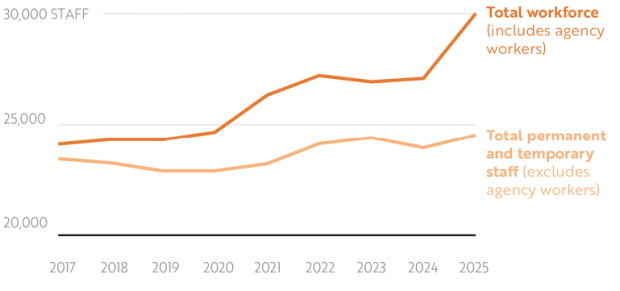
Source: NISRA and NICSHR
4.5 Whilst the breakdown by grade was not available, it is estimated that around 40 per cent of the 4,939 agency workers are filling most of the vacant posts at AO grade (2,259 AO vacancies). However, NICSHR cannot confirm how many agency workers are covering vacant positions and no central record of agency costs is maintained. As a result, it is unclear whether the use of agency workers represents value for money.
Vacancy Rates
4.6 As of 31 March 2025, the NICS declared 5,486 vacant posts for permanent staff. While this equates to around 20 per cent of the workforce, NICSHR noted that filling these vacancies would not necessarily increase headcount by the same amount, as some posts are linked to temporary promotions, retirements, resignations, or internal moves that are not backfilled. The number of vacant posts includes 1,586 substantive vacancies for the DfC. Some of these posts may be occupied by agency workers pending recruitment of substantive staff.
Figure 3: Total number of Vacant Posts Declared

Source: NICSHR
4.7 As part of the vacancy reporting process, departments confirm that budget cover is in place to fund each post. With a pay bill of £1.27 billion (before the 2024 and 2025 pay rises are applied, estimated to be an increase of over 10 per cent), and departments struggling to live within existing budgets, it is difficult to understand how affordable these posts would be in practice. A crude calculation would suggest that an additional £0.3 billion would be needed to fund these posts.
4.8 It is also not clear what essential public services these vacancies relate to and which critical business objectives are suffering as a result. Strategic oversight of manpower planning across the NICS would enable resources to be utilised in priority areas.
4.9 The 2020 Report highlighted the urgent need for a NICS-wide workforce plan to be developed. The PAC reinforced the urgency surrounding this issue in its 2021 report.
NICS’ Senior Leadership must take responsibility for driving the delivery of a NICS-wide workforce plan, which identifies both headcount and skills. Without such a critical plan in place, leaders cannot determine what size and shape the NICS workforce should be and where to concentrate their efforts.
4.10 It is widely recognised that Workforce Planning is essential for good governance. To support this, the Cabinet Office developed a suite of Government Functional Standards aimed at establishing consistent expectations for stewardship, risk management and performance across UK government organisations, including devolved administrations.
4.11 Government Functional Standard, GovS 003: People, published in May 2025, sets out expectations for the leadership and management of human resources across government, ensuring people are recruited, developed and deployed to meet the government’s needs. It states that:
Future workforce requirements in terms of size, shape, composition, locations, capabilities and skills shall be determined. A workforce plan shall be developed with an understanding of its financial implications, in accordance with the organisation’s defined workforce planning and skills framework included in the human resources governance and management framework. The workforce plan shall be aligned with, and cover the same time periods as, the organisation’s business plans. It should follow the guidance provided in the public value framework. Size, shape, locations, composition, capabilities and skills should be tracked and analysed regularly alongside strategic business objectives to ensure the workforce plan remains aligned to the organisation’s business strategy and plan.
4.12 Workforce planning is just as critical as financial planning and budgeting. In an organisation where people are the primary resource, the composition of the workforce must be carefully managed and monitored. To deliver on strategic commitments, a comprehensive workforce plan must be closely aligned with business objectives and financial plans.
4.13 Whilst valuable time has been lost since the 2020 report, Strategic Workforce Planning is now a Key Initiative in the NICS People Strategy 2025-2030.
4.14 In the 2020 Report six recommendations were made in relation to resourcing and vacancy management; a number of further recommendations related to skills; performance management; and talent management, learning and development. These are outlined in Appendix 1, along with the DoF’s responses. The key action points were as follows:
Strategic Recruitment & Resourcing
- Align recruitment with strategic role requirements.
- Define clear role criteria and assess relevant skills and experience.
- Optimise pay and incentives to attract and retain critical talent.
Efficient Vacancy & Workforce Planning
- Improve vacancy management for faster, more flexible placements.
- Identify vacancies earlier and align resourcing plans.
- Streamline processes and clarify responsibilities.
- Forecast future workforce needs and contingencies.
Skills Identification & Development
- Define essential professional, technical, and functional skills.
- Conduct consistent skills audits and maintain a centralised database.
- Analyse skills gaps and develop strategies to build critical capabilities.
- Support emerging professions with dedicated resources.
Performance Management
- Recognise strong performance and manage underperformance.
- Promote a culture of accountability through leadership and communication.
- Ensure consistency with clear guidance and compliance checks.
- Strengthen line manager capability across all levels.
Talent Management, Learning and Development
- Invest in employability programmes, apprenticeships, and fast-track schemes.
- Support initiatives with structured development and mentoring.
- Develop a strategic talent management plan aligned with organisational goals.
- Align learning and development with the People Strategy and skills audit outcomes.
4.15 There has been limited progress in addressing key workforce reform recommendations, with several areas now requiring urgent action. In particular, the NICS has not modernised its recruitment and selection processes to effectively target role-specific skills, which undermines efforts to build a workforce aligned with strategic priorities. Equally concerning is the lack of progress in managing sickness absence rates. These issues reflect a broader weakness in embedding a culture of high performance across the organisation. Further workforce metrics are detailed in Appendix 2.
4.16 The Strategic Learning Needs Analysis exercises demonstrate that leadership and people management skills continue to need development. There remains much work to do in updating some key HR policies to support departments in managing their people effectively. Resourcing goes beyond filling vacancies, it should also focus on attracting, rewarding and retaining individuals with the right skills to sustain organisational capability.
4.17 Without robust workforce plans aligned to departmental objectives, it is difficult to determine accurate resource requirements or identify critical vacancies. The current emphasis on maintaining headcount within existing disciplines does not support strategic workforce development.
4.18 Resourcing and capability risks are now widely recognised across departmental corporate risk registers. Notably, the DoF has flagged resourcing as an amber risk, that it “will not be able to effectively perform key functions due to insufficient levels of staffing and/or a lack of appropriately skilled staff.” It has been rated as both likely and that the consequences are severe. This reinforces the urgent need to strengthen workforce planning, talent management and recruitment practices to support a high-performing, future-ready civil service.
Recruitment
4.19 While HR Connect continues to respond to departmental demands, the heavy reliance on general service competitions often fails to match candidates’ skills and experience to key roles. Combined with a high volume of vacancies, this has become a business-critical issue, affecting some departments’ ability to deliver core objectives. Without data-driven workforce planning, staffing decisions risk misalignment with strategic priorities, leading to capability gaps, inefficiencies and weakened service delivery, ultimately undermining efforts to build a high-performing workforce. This is recognised in the NICS People Strategy 2025-2030 under the Experience and Environment initiative which aims to:
Simplify and streamline the recruitment process: to ensure we continue to recruit the best people and capability gaps are addressed ensuring a continued supply of talent in the Civil Service.
Recruitment activity and NICS Headcount
4.20 In 2023–24, data from the DoF’s Management Information (MI) Workforce Data and Reporting team showed staff departures exceeded new entrants, with 1,083 leavers compared to 742 new starts. Although 2024–25 saw a net intake of 568 staff (1,832 new starts and 1,264 leavers), this remains significantly below the 5,486 declared vacancies, highlighting the scale of the workforce gap. The impact of carrying such a high level of vacancies is not being systematically measured and there is no central visibility of which business-critical services are affected.
4.21 This highlights a fundamental weakness in workforce planning. Without a coordinated, NICS-wide workforce plan aligned to departmental objectives, recruitment efforts risk being reactive and misaligned. Ineffective recruitment planning not only leaves critical roles unfilled but also undermines service delivery, increases operational strain, and weakens organisational resilience.
Figure 4: Number of staff starting and leaving the NI Civil Service between 2019 and 2025
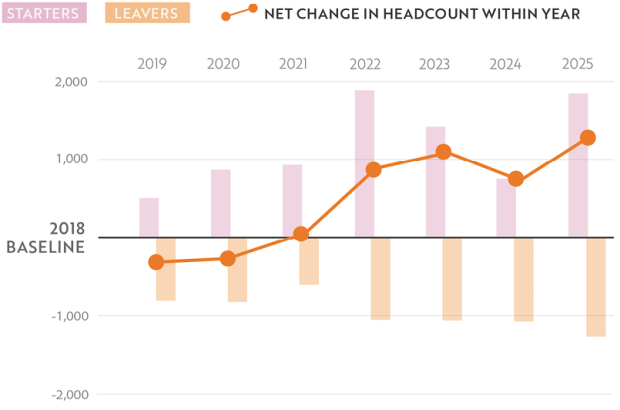
Source: People and OD
NICS Recruitment activity
4.22 Each calendar year the People and OD Directorate publishes a report, ‘Recruitment to the Northern Ireland Civil Service’ with the last report dated 2024.
The level of recruitment activity in the NICS increased in 2024, with 141 competitions externally advertised compared to 112 in 2023, reflecting a 26 per cent increase. The number of applications received for NICS competitions in 2024 also saw a substantial rise, totalling 18,684 compared to 13,169 in 2023, representing a 42 per cent increase.
External recruitment activity increased in 2024 to fill key roles, attract a broader applicant pool, support workforce diversification, and enable succession planning. Other reasons for increased external recruitment activity include re-running competitions due to insufficient applicant interest or low numbers of successful candidates; and additional staffing resources required for work aligned to Ministerial priorities, such as the Windsor Framework in DAERA.
Table 4: Recruitment Activity
Calendar year | Number of competitions | Number of applicants | General service competition applicants | Number of appointment |
|---|---|---|---|---|
2016 | 51 | 4131 | Recruitment restrictions following VES | 196 |
2017 | 88 | 5794 | Recruitment restrictions following VES | 284 |
2018 | 109 | 6282 | Recruitment restrictions following VES | 286 |
2019 | 110 | 28904 | 22521 | 839 |
2020 | 90 | 14707 | 9617 | 135 |
2021 | 132 | 30664 | 22101 | 938 |
2022 | 149 | 18299 | 8306 | 770 |
2023 | 112 | 13169 | Recruitment pause | 344 |
2024 | 141 | 18684 | 12086 | 224 |
Source: NICS – Recruitment to the Northern Ireland Civil Service Annual Reports
Notes to the table:
1 The number of appointments may be incomplete, as they reflect placements at the time of the Annual Reports’ publication, with further appointments potentially made later. NICSHR was unable to compile the data centrally, as information is only available at the level of individual competitions.
2 2020 performance was affected by the COVID-19 pandemic which started in March 2020.
3 2023 performance was affected by a pause in general service competitions for six months.
4 2024 general service competition applications figure of 12,086 includes the external recruitment for the August 2024 AO competition and the internal December 2024 G7 competition, whereas the others do not mix external and internal applicants.
4.23 Table 4 shows that recruitment activity over the last nine years has been generally increasing, with peaks in 2019 and 2021 following large volume competitions for various grades from AO to DP. The high number of applicants suggests that people are still attracted to working in the NICS.
4.24 Much of the recruitment activity by the NICS is for general service grades, which involves running large-scale competitions designed to fill high volume vacancies. General service grades make up the majority of civil service posts and each grade is expected to have a skill set that is interchangeable across many roles in the NICS. Some of the most recent external general service competitions are included in Table 5.
Table 5: General Service Competition Statistics
| General Service Competition | Launch Date | Number of applicants | Days from recruitment initiated to first person starting | Days from application closing to first person starting |
|---|---|---|---|---|
| EO1 (IRC265807) | May 2021 | 11,049 | 184 | 154 |
| EO2 (IRC265817) | May 2021 | 11,052 | 173 | 150 |
| SO (IRC275969) | March 2022 | 4,975 | 213 | 157 |
| DP (IRC277837) | April 2022 | 3,331 | 313 | 269 |
| AO (IRC303169) | August 2024 | 9,906 | 510 | 381 |
| G7 (IRC306697) (internal only) | December 2024 | 2,180 | 424 | 297 |
| G6 (IRC306699) (internal only) | January 2025 | 657 | 452 | 269 |
Notes to the table
1 The G7 and G6 general service competitions were only available within the NICS.
2 NICSHR said that due to budget constraints and risk of unaffordable growth in headcount, the G6 and G7 competitions were run as an NICS-wide internal trawl (not confined to the immediate feeder grade) to enable departments to confirm and fill only genuinely affordable vacancies and to mitigate any potential surplus position. It said that this approach aligned with recruitment policy and was agreed with the trade unions.
Recruitment provider
4.25 HR Connect was contracted to provided HR services to the NICS in 2006, including exclusive responsibility for recruitment, a model expected to continue until the contract ends in 2026–27. HR Connect has encountered difficulties in meeting the scale and pace of departmental recruitment demands. According to NICSHR, these challenges were due to an unprecedented rise in vacancies and competition requests, alongside outdated operational recruitment processes that limit agility and responsiveness in service delivery.
4.26 Departments are currently not permitted by the DoF to run their own recruitment competitions, even when HR Connect is at full capacity. This restriction is increasingly frustrating for departments with urgent staffing needs. In the absence of a flexible, responsive recruitment model and a robust workforce plan, the NICS risks compounding vacancy pressures and undermining its ability to deliver business-critical functions.
How long does recruitment take
4.27 DoF could not provide us with a full list of metrics on end-to-end recruitment over the last five years, indicating that recruitment performance is not being monitored at an organisational level, with data only being available on an individual competition basis. As such, we reviewed a sample of 20 large-scale recruitment competitions over the past four years to assess process speed. On average, it took 207 days, approximately seven months, from the initiation of recruitment with HR Connect to the first appointment. From the application closing date to the first post being filled, the average was 143 days.
4.28 Additionally, the average time from initiating recruitment to the application closing date was 72 days, with competitions typically taking at least one month to go live after agreement with HR Connect.
4.29 The AO competition launched in August 2024, intended to fill 500 posts with salaries of £24,000–£25,000, received nearly 10,000 applications. Despite 1,929 candidates passing the interview stage and a merit list being available on 21 May 2025, no appointments were made until the autumn of 2025. NICSHR said that approximately 360 AOs started on 22 September 2025, approximately 360 AOs on 3 November 2025 and a further intake was planned for January 2026. This represents the poorest-performing large-scale recruitment exercise, highlighting serious delays and inefficiencies in the process.
4.30 NICSHR said that 20 candidates raised issues during the interview window and 26 technical complaints were received and addressed individually. The main cause of delays related to the performance and coordination challenges associated with the large number of assessment panels required for a competition of this scale. Existing vacancies and workload pressures were cited as factors affecting panel performance. This highlights significant capacity constraints within the recruitment system and raises concerns about the NICS’s ability to manage high-volume competitions effectively.
4.31 These findings highlight significant delays and inefficiencies in the recruitment process, which can hinder departments’ ability to fill critical roles in a timely and effective manner.
Successful candidates
4.32 The People and OD Directorate produces annual reports on recruitment and data sets for each competition, and some metrics on recruitment performance are reported to the NICS Board in respect of the number of competitions and vacancy rates. However, it does not track some key metrics, such as the average time-to-fill posts, cost per hire, offer acceptance rate, the number of successful candidates, etc.
4.33 In relation to the number of successful candidates, we calculated that for the sample of competitions we selected, only 65 per cent of candidates offered a post accepted it. While this is based on a small sample, it indicates a low uptake. Each recruitment exercise involves substantial costs, for advertising, assessment panels, administrative support and system resources, so a high rate of declined offers reduces value for money and increases the need for repeated competitions.
4.34 While large-scale competitions support staff development and help fill high-volume vacancies, they often result in internal backfilling, as successful candidates are already employed within the NICS. This reallocation of resources can be disruptive, particularly when experienced staff move on, leading to a loss of established expertise.
4.35 The 2020 Report emphasised the importance of assessing the skills, experience and competencies required for each role. In general service competitions, this remains challenging. Current assignment practices rely on matching ranked candidates to priority vacancies, without considering individual skill sets or experience. A more targeted matching process is needed to ensure the right people are placed in the right roles.
Recommendation 6
DoF’s HR shared service has not yet fully developed sufficient management information for effective oversight of its recruitment operations. It is recommended that further recruitment metrics are developed in the next two years, to analyse performance, measure costs and report them in line with financial reporting periods. These metrics should also be used to drive continuous improvement, demonstrate value for money, and be aligned to strategic workforce planning.
HR Policies need to be reviewed
4.36 The People and OD Directorate is currently progressing a two-year policy review programme (2024–2026) as a key initiative of the NICS People Strategy 2025-30. However, departments have expressed concerns that the application of existing HR operational processes can limit flexibility and timely, risk-based decision-making. There is a clear need to modernise some policies to support agile workforce management.
4.37 The People and OD Directorate said that priority is being given to revising the Recruitment Policy & Procedures Manual, alongside the development of a new Employee Mobility Policy—covering vacancy management, transfers, promotions, and career development—as well as updates to the Performance Management Policy and the NICS competency framework. It said that progress on these policies is closely aligned with the Integr8 Programme’s delivery timeline to ensure coherence and avoid duplication of effort.
4.38 A Hybrid Working Policy was first introduced in June 2022 and later revised and relaunched in September 2025. Whilst this policy makes the NICS more attractive as an employer, no data is currently collected on its impact on recruitment working practices, or productivity, making it difficult to assess its overall effect on workforce costs and behaviours.
4.39 Workforce productivity is not formally measured across the NICS, limiting the ability to assess performance and measure the impact of new or revised policies. Productivity is a measure of how efficiently resources are used to create desired outcomes and is more complex to measure in the public sector. The PAC recommended in 2021 that the NICS should consider introducing a time allocation system which could help measure how people resources are utilised.
4.40 Whilst some operational delivery teams in the NICS measure productivity through the processing of caseload or payments within set parameters and service delivery assessed from user feedback, it can be difficult to develop suitable metrics for areas like policy development, legal drafting and advisory services, where outputs are less easily quantifiable. The Office for National Statistics is in the process of developing official productivity statistics for the public sector and has plans to include the devolved administrations.
4.41 The NICS should implement a structured approach to measuring workforce outputs and integrate this with workforce planning and absence management to enable informed decision-making and improve organisational performance.
4.42 The review of HR policies is necessary, however following developments in implementing the People Strategy 2025–30, further re-engineering may be needed to policies already being revised. It is essential that any major operational changes are fully reflected in updated policies and procedures to ensure consistency and alignment across the NICS.
Recommendation 7
Considering the size and cost of the NICS workforce, combined with increasingly constrained budgets, it is critical that the NICS can measure the efficiency and effectiveness of its workforce. To maintain public confidence and deliver on government priorities, a highly skilled workforce must be able to demonstrate value for money in its implementation of policies and statutory services.
Following the development of a Strategic Workforce Plan, we recommend that NICS establishes data-driven metrics to evaluate performance and outcomes in alignment with its strategic objectives. These measures should include clear key performance indicators, benchmarking against best practice, and regular reporting to senior leadership. This monitoring and reporting mechanism should enable the NICS to identify underutilised capacity, optimise resource allocation, and ensure that staff are skilled and performing to maximum strategic effect.
Resourcing the NICS Professions
4.43 A review of the NICS approach to professions, including the roles of Heads of Profession and the professional standards required to support effective operational delivery, was originally identified as an action within the People Strategy 2018–21. However, due to limited progress during that period, this commitment has been carried forward into the 2025–30 People Strategy. The revised strategy outlines plans to
“Complete a review of Civil Service professions to ensure the necessary infrastructure is in place to ensure a workforce empowered to deliver, develop best practice guidance for Civil Service professions and continue to develop members of professions from entry to deep specialism.”
4.44 The NICS has developed a draft Professions Framework which will require professional groups to take a proactive role in identifying, cultivating and sustaining the skills essential for the effective delivery of government programmes. It will integrate strategic workforce planning, professional standards and structured learning pathways to ensure the Civil Service is equipped to meet both current operational needs and future challenges. It will require Profession based workforce plans in addition to departmental workforce plans that look at recruitment, training programmes, continuous professional development, creating networks, career pathways, quality standards and much more.
4.45 There are currently twenty-six professions within the NICS, two additional ones (Programme / Project management and Engineering) since the 2020 Report. Appendix 3 shows the full list of Professional groups. However, only a fraction of the NICS workforce is linked to a Profession and no central record is held to identify these staff. The figures in Appendix 4 were derived from a survey that was conducted on Heads of Professions in late 2024. As only 60 per cent responded, there was limited data available.
4.46 In comparison, the Cabinet Office assigns all its employees to a specific profession. It identifies four main types of professions as follows:
- Operational delivery is the public face of the Civil Service, responsible for the services that people use every day, such as running benefit offices, job centres, and courts.
- Policy professionals are responsible for the management of the government’s role from designing public services to improving education and health, assessing the infrastructure needs, etc.
- Functional is a grouping aligned across government to manage functional work such as HR, commercial, or finance. Government functions form a framework for collaboration within organisations and across organisational boundaries, to support efficient and effective delivery of policy, outcomes and services e.g. digital and data, statistics, finance, internal audit, comms, etc.
- Specialist professions includes Corporate Finance (separate to the finance profession.); Knowledge and Information Management; Clinical; Occupational Psychology; Planning; Planning Inspection; Science and Engineering; Veterinary.
Structure of the Professions including HoPs
4.47 Each profession within the NICS is led by a Head of Profession (HoP), typically a member of the Senior Civil Service. Feedback from the 2024 Survey revealed that many Heads of Profession lack clarity regarding their roles and responsibilities, and identified the following challenges currently facing professional groups within the NICS:
- Career Pathways: Many HoPs expressed a desire to expand entry routes into their professions through increased use of apprenticeships, trainee programmes and graduate schemes to strengthen early career pipelines.
- Ageing Workforce: A number of professions anticipate short- to medium-term challenges due to an ageing workforce. Concerns were raised about the potential loss of institutional knowledge as experienced staff approach retirement.
- Pay and Rewards: Current pay arrangements are impacting the ability to attract and retain staff. Budgetary constraints continue to limit flexibility in remuneration across professions.
- Recruitment Challenges: Professions highlighted the importance of attracting new entrants with the appropriate skills and capabilities, noting that recruitment processes must support this objective.
- Retention of Experienced Staff: Several professions reported losing experienced staff to the private sector, primarily due to pay and reward disparities. Others noted that high turnover rates are becoming a significant concern.
- Awareness of Role Guidance: Most HoPs were unaware of the existence of the ‘NICS Heads of Profession Responsibilities’ document available on the NICS intranet, indicating a need for improved communication and visibility of role expectations.
- Support Structures: When asked what support is needed to fulfil their role effectively, many HoPs identified the need for a dedicated support team to provide administrative assistance and help drive professional development, career progression and talent management.
- Recruitment Processes: The speed and structure of recruitment, particularly through HR Connect, were frequently cited as barriers. Some professions expressed interest in having greater autonomy over recruitment outside the constraints of current systems.
- Professional Networks: There is strong support for reinstating the Heads of Profession network, which resumed in 2025 following a period of inactivity. This network is seen as a valuable forum for collaboration and shared learning.
4.48 HoPs are accountable for establishing governance structures aligned with their professional disciplines, often informed by external institutions. In addition to driving business outcomes and strategic partnerships, they play a vital role in shaping workforce strategy, focusing on talent acquisition, retention and continuous professional development to build capability across the Civil Service.
4.49 As a result of the survey work done, the NICS recognises that it needs to improve the way it manages its professions by moving to best practice through the establishment of a Professions Framework. It is envisaged that the Professions Framework (which is currently in draft) will be available in March 2026. This will increase the responsibilities of the NICS Heads of Profession and acknowledges that they will need support to discharge the additional responsibilities. As part of their remit, HoPs will be responsible for setting governance and capability standards within their discipline. This may require close collaboration across senior leadership teams to ensure alignment between departmental priorities and professional workforce needs.
4.50 Substantial work and resource commitment is needed to link the skills, qualifications and experience of roles in the Job Families Framework to role profiles in each profession. HoPs will then be responsible for developing career paths, ensuring talent pipelines, optimising capacity and capability and addressing specific learning and development needs for their profession. Appendix 4 outlines the current 62 occupational groups and associated staffing levels as at 31 January 2025, which will inform the mapping process to a standardised Job Families Framework.
Skills gap analysis
4.51 The 2020 Report found there was a general theme of departments highlighting skills gaps and it was recommended a formal NICS-wide skills audit to develop a skills database and a skills gap analysis be undertaken. Whilst this has not been achieved, NICSHR completed a Strategic Learning Needs Analysis in 2022 and 2024. As noted previously, this was devised from a survey of Grade 5s who identified the top 12 generic skills and capabilities gaps. NICSHR said it had engaged with departments and used the findings of the SLNA to inform a Learning and Development Plan currently under development to cover the period 2026-2027, which will be available in January 2026.
4.52 Apart from skills gaps previously mentioned for Leadership Development and People Management, Programme and Project Management, along with Policy Skills and Communications, were among the top five skills gaps identified in the 2024 survey. While Project Delivery was established as a new profession within the NICS in 2022, skills analysis indicates continued shortfalls in this area. We have repeatedly highlighted these gaps in recent reports, including Renewable Heat Initiative reports, Major Capital Projects and Major IT Projects, noting that critical projects often lack appropriately skilled staff, a concern that remains unresolved. However, we understand that work is underway as part of the People Strategy 2025-30 that aims to address these skill shortages.
4.53 In June 2025 a NICS Cross-Departmental Learning and Development Forum was established to,
“co-ordinate, inform, co-design and share learning and development activities across the NI departments, to ensure that all staff are equipped with the necessary skills to enable them to deliver the business needs of the NICS, maximising the resources at our disposal.”
NICS is growing its own talent
4.54 Since the 2020 report, the NICS has made concerted efforts to grow its own talent and diversify its workforce, through increased external recruitment and the expansion of entry routes into the NICS through: new apprenticeships and traineeships; expanded student placement scheme; and the development of new graduate management programme and Civil Service skills academies.
4.55 Once a fully developed Professions structure is established, HoPs should ensure that these talent development schemes are firmly embedded within resourcing and succession plans. This includes clearly defined career pathways, structured competency milestones, mentorship opportunities and robust performance management, ensuring a sustainable pipeline of skilled professionals in that field of expertise.
4.56 This is particularly critical for professions facing acute skills shortages in the external market, such as engineering, where recruitment remains a challenge. It is encouraging to see recent apprenticeship competitions for:
- ICT Level 1 Apprentice Scheme
- ICT Higher Level Apprenticeship Level 2
- Civil Engineering Apprentice Scheme
- Mechanical Engineering Apprenticeship
- Electrical Engineering Apprenticeship
- Industrial 1 Vehicle and Plant Fitter Apprentice
- Trainee Chartered Accountant EO1
4.57 Skills gaps have been identified in a number of reviews, and to build a sustainable talent pipeline, the NICS said it is adopting a multi-channel approach that includes apprenticeships, graduate entry schemes, targeted recruitment campaigns, and secondments from other sectors when appropriate. It said that these initiatives are being integrated with the emerging Job Families and Professions Frameworks to ensure consistency and strategic alignment. Central coordination of apprenticeship and early-career programmes will maintain quality standards, deliver value for money and enable departments to meet specific operational needs within a coherent, organisation-wide strategy.
Difficulties associated with attracting and retaining talent within the NICS Professions
Pay and Reward
4.58 Stakeholder engagement conducted for this report highlighted growing challenges in attracting and retaining talent within the NICS Professions, largely driven by pay disparities with the private sector. There was broad agreement that these gaps are contributing to increased staff turnover and hindering recruitment efforts. HoPs expressed concerns about uncompetitive salaries and outdated employment terms. Without targeted interventions, including pay reform and modernised incentives, the NICS risks a continued loss of skilled professionals in critical areas.
4.59 In January 2025, the NICS introduced a Recruitment and Retention Allowance policy, allowing departments, under exceptional circumstances, to offer starting salaries above the scale minimum (within the scale maximum), or exceed the scale maximum to attract or retain individuals with rare or critical skills, experience, or where market rates justify a higher salary. However, it is too early to assess whether these measures are sufficient to attract and retain staff in critical roles.
4.60 In the 2023 NICS People Survey, Pay and Benefits emerged as the lowest-rated theme, with only 23 per cent of respondents expressing satisfaction. It also saw the most significant decline since the previous survey in 2021, dropping by 17 percentage points. The NICS Pay Offer 2022 was limited due to affordability considerations during a period without Ministers or an Executive. However, the NICS has begun to tackle pay-related concerns through a series of pay increases. These efforts have had a positive impact, with satisfaction in pay rising to 40 per cent in the NICS People Survey 2025.
4.61 The development of a Pay and Reward Strategic Framework is a Key Initiative within the People Strategy 2025-30. A draft Strategic Framework has been shared with the NICS Board and civil service unions which sets the direction of travel on Pay and Reward for the next five years, it does not suggest target pay levels or pay rises as these will be considered through the normal pay award process.
4.62 The draft Strategy sets out a multi-faceted approach to reforming pay and reward across the NICS. It aims to provide greater certainty through multi-year pay deals, develop a clear and competitive pay and benefits package, and improve transparency through internal publication of recruitment and retention allowances. It also proposes launching research into staff perceptions and benchmarking, introducing a new equal pay policy and establishing a NICS Remuneration Committee to advise on pay challenges.
Continuous Professional Development
4.63 Continuous Professional Development (CPD) is essential for maintaining skills across the NICS Professions and plays a key role in recruitment and retention. While the 2025 staff survey showed a modest improvement in Learning and Development scores (rising from 48 per cent in 2023 to 52 per cent in 2025), further progress is needed. CPD is a requirement of many professions to maintain members professional standards. CPD also enhances staff motivation, fosters professional identity through collaboration, and strengthens the NICS’s employer brand, making it more competitive in attracting and retaining talent.
Performance Management
4.64 We noted significant concerns about the effectiveness of performance management in the NICS in the 2020 Report. Performance Management was reviewed in 2019 and some improvements were made as result. A new Performance Management Framework was introduced for Permanent Secretaries and a further review is planned for the rest of the SCS and the remaining NICS staff. However, until then employees’ performance continues to be graded as either ‘satisfactory’ or ‘unsatisfactory’ with very few being assessed as unsatisfactory. Table 6 shows the number of unsatisfactory performance ratings compared to the overall staff headcount.
Table 6: Performance Management Statistics
| 1 April | Headcount | Number of staff with an unsatisfactory performance rating | Ratio |
|---|---|---|---|
| 2021 | 23,216 | 15 | 1 in every 1,548 employees |
| 2022 | 24,126 | 18 | 1 in every 1,340 employees |
| 2023 | 24,407 | 32 | 1 in every 763 employees |
| 2024 | 23,944 | 34 | 1 in every 704 employees |
| 2025 | 24,521 | 32 | 1 in every 766 employees |
Source: NISRA and NICSHR
4.65 The current performance management system fails to effectively recognise high performing people and it is unclear how effectively underperformance is addressed. The satisfactory/unsatisfactory framework does not incentivise excellence, while the process for managing poor performance relies on competent line-management. The lack of meaningful recognition and accountability not only weakens performance standards but also adversely affects staff morale, contributing to frustration, disengagement and reduced motivation across the workforce.
4.66 While a new performance management regime is being reviewed, it remains uncertain whether it will shift managerial attitudes toward assessing staff performance. For meaningful change to occur, it is essential that leaders set the tone, demonstrating how underperformance should be addressed and how strong performance is recognised. Leadership behaviours play a critical role in shaping organisational culture, and without visible commitment, efforts to improve performance management may fall short.
The NICS Brand is important
4.67 The NICS is considering modernising its employer brand to enhance its appeal and strengthen recruitment, retention and staff motivation. A refreshed brand identity could help position the NICS as a more attractive and competitive employer, particularly in a challenging labour market.
Conclusions
4.68 There is an urgent need to improve how the NICS manages its workforce. Lack of performance recognition risks undermining organisational effectiveness and staff morale. To attract and retain the talent required, the NICS must become a more attractive and competitive employer. This includes implementing robust performance and attendance management policies, ensuring fair and competitive pay and reward strategies and aligning resources with departmental priorities.
4.69 Staff must be supported through clear career pathways and meaningful development opportunities. Leadership must set the tone, leading by example and fostering strong leadership at all levels. Recruitment processes should be responsive to market conditions, timely and effective, designed to assess the right skills, be cost effective and provide a positive experience for both candidates and departments.
Appendix 1: Follow-up on recommendations
Progress on the implementation of recommendations from the NIAO 2020 report on Capacity and Capability in the Northern Ireland Civil Service and subsequent recommendations from the Public Accounts Committee (PAC) 2021 report.
The NIAO recommendations have been categorised under seven thematic areas. The Department of Finance has provided an update on progress to date, which we have assessed and assigned a RAG status as outlined below.
| Topic | Number of recommendations | Red | Amber | Green |
|---|---|---|---|---|
| Leadership, Governance and Transformation | 4 | 2 | 2 | |
| Workforce Planning | 3 | 1 | 2 | |
| Review of Resourcing | 4 | 2 | 2 | |
| Vacancy Management Process | 2 | 2 | ||
| Skills | 4 | 2 | 2 | |
| Performance Management | 3 | 3 | ||
| Talent Management, Learning and Development | 3 | 2 | 1 | |
| Total | 23 | 5 | 13 | 5 |
The 12 PAC recommendations have been included under the relevant themes and at, this time, we have assessed progress against these recommendations as five achieved, five partially achieved and two not achieved.
Key
Achieved = Green
Partially Achieved = Amber
Not Achieved = Red
Leadership, governance and transformation
No. 1.1
Recommendation
Further development of the operating model for people management and organisational development in the NICS is vital to ensuring it is in a position to deliver the scale and depth of transformation and cultural change needed. The NICS should therefore embrace good and successful models and practice from elsewhere.
Progress to date – Provided by the DoF
In November 2022, arrangements were put in place for a clear specialisation and focus on (i) operational delivery of HR services (to be taken forward by NICSHR, the DoF) and (ii) Organisational Development commitments critical to NICS renewal and building capacity, capability, and sustainability of the NICS (to be taken forward by People & Organisational Development).
These arrangements were put in place in the context of significant budgetary pressures, with work programmes prioritised commensurate with available resources and regular engagement with HOCS and the NICS Board. A further HR functional review took place in 2023 and was substantially implemented by the end of April 2024.
The NICS new five-year People Strategy sets out commitments to building and sustaining the strategic HR function as a key enabler of the strategy. Further development of a Target Operating Model (TOM) for HR is also a core element of the Integr8 programme. The implementation of the Integr8 programme will support the transformation of how Finance and HR services are delivered within the Civil Service, enabled by a new technology solution.
NIAO Response
The NICS operating model has been developed as recommended in the 2020 Report.
No. 1.2
Recommendation
Exceptionally strong leadership and a collective commitment is required to implement and prioritise, at the necessary pace, the remaining actions set out in the NICS People Strategy and the recommendations required by this report and the RHI Inquiry. This will necessitate some major strategic reform. Particular emphasis should be given to governance structures and clearly defined roles and responsibilities for all stakeholders including: the NICS Board; departmental boards; DoF; NICSHR; departments; line managers; contracted service providers for HR transactional services; and the Civil Service Commissioners.
Progress to date – Provided by the DoF
A Memorandum of Understanding (MOU) was agreed in late 2021 between the then First Minister and Deputy First Minister, Minister of Finance and HOCS. This sets out the arrangements for the planning and delivery of renewal of the Northern Ireland Civil Service and includes the statutory position, respective roles and accountability. It applies to DoF, TEO, HOCS and the NICS Board which is chaired by HOCS.
Work on NICS renewal progressed in line with the MOU and the Executives PfG priority relating to Reform and Transformation of Public Service, led by HOCS and the NICS Board and supported by the DoF Permanent Secretary.
Key actions have included: the implementation and conclusion of a renewal plan by March 2024; the implementation of the NICS People Plan 2024/25; agreement of a revised Board terms of reference; establishment of NICS Board People Committee providing advice and recommendations to the NICS Board on strategic people issues; Non-Executive Member appointments to the NICS Board; completion of an external Board effectiveness review; and the development of the NICS People Strategy 2025–2030 which has moved into implementation, with clear leadership responsibilities, a focus on collective ownership, and strengthened governance arrangements. HOCS and the NICS Board are playing a vital leadership role in the People Strategy delivery, providing collective ownership and strategic direction. Permanent Secretaries are championing key initiatives, supporting alignment and accountability across departments and the Strategic HR function is working alongside managers and leaders as a key enabler to strategy implementation.
NIAO Response
We note that good progress has been made with the establishment of the NICS Board People Committee in January 2024, overseeing the development, consultation and launch of a new People Strategy in April 2025. However, we are disappointed that it has taken so long to get to this position.
The People Committee has defined roles and responsibilities for the NICS Board and assigned a Permanent Secretary to each initiative in the NICS People Strategy 2025-30.
However, there is much work to be done to take forward the initiatives identified and to translate them into actions for individual departments and line managers. Urgent decisions are needed on important policy matters to enable HR processes to be configured in the new HR solution to be delivered under the Integr8 Programme.
Until the transformation of HR services is complete, we are unable to conclude on the effectiveness of the governance structures and collective commitment of the NICS leadership.
No. 1.3
Recommendation
There should be absolute clarity on who will oversee the transformation required and it is imperative that this is sufficiently resourced.
Progress to date – Provided by the DoF
A Memorandum of Understanding (MOU) was agreed in late 2021 between the then First Minister and Deputy First Minister, Minister of Finance and HOCS. This sets out the arrangements for the planning and delivery of renewal of the Northern Ireland Civil Service and includes the statutory position, respective roles and accountability. It applies to the DoF, TEO, HOCS and the NICS Board which is chaired by HOCS. On 27 February 2025 the Executive agreed a Programme for Government 2024-2027 ‘Our Plan: Doing What Matters Most’. It outlines our priorities for making a real difference to the lives of people here including Reform and Transformation of Public Service.
The NICS Board agreed the governance, monitoring and review arrangements for the NICS new five-year People Strategy and identified six key enablers for the strategy including capacity and availability of resources and setting out a commitment to foster greater levels of collaboration and alignment between departments and greater collaboration between the Strategic HR function and the wider Civil Service on resource requirements.
NIAO Response
Each of the nine key initiatives in the NICS People Strategy 2025-30 have been assigned to a Permanent Secretary with progress being overseen by the People Committee, a sub-committee of the NICS Board.
No. 1.4
Recommendation
To further enhance accountability, all senior civil service staff should have capacity and capability related objectives in their annual performance expectations, along with measurable targets.
Progress to date – Provided by the DoF
The inclusion of core objective re capacity and capability through leadership initially piloted at Permanent Secretary with roll out across SCS during 2023-24 for the 2024-25 reporting period. These arrangements will be evaluated as part of the current review of NICS Performance Management policy.
NIAO Response
Permanent Secretaries have capacity and capability objectives built into their performance management regime from 2024-25. However, this is yet to be in place for the rest of the SCS.
Public Accounts Committee
The PAC also made recommendations on leadership, governance and transformation in their report in recommendations one, two and three.
No. 1.
PAC Recommendation
The Committee recommends that the HOCS must have a key leadership role in driving change and transformation in the capacity and capability of the NICS. HOCS should also ensure absolute clarity in defining roles and responsibilities of others to deliver the change and transformation.
This recommendation is accepted by both departments.
No. 2.
PAC Recommendation
The Committee recommends that the governance structure of the NICS Board is revised and strengthened. It should have an independent, non-executive representation to provide a fresh, robust challenge and supportive function to the NICS reform and transformation agenda.
TEO accepts this recommendation.
No. 3.
PAC Recommendation
PAC recommends a review of the operating model for HR to ensure it is in a position to deliver the necessary transformation and cultural change needed and to consider other models and good practice that has been successful. The NICS needs to provide strategic HR at the centre of government and ensure it has the capacity and capability to deliver wide transformation.
DoF and TEO accepts this recommendation
Workforce planning
No. 2.1.
Recommendation
A key goal of workforce planning should be to ensure departments have the necessary resources and skills to deliver key programmes and objectives. Workforce planning should be underpinned by accurate and robust data, including clarity around underlying assumptions in key areas of vacancies, temporary staffing solutions, alternative work patterns and partial retirees.
Progress to date - Provided by the DoF
Strategic workforce planning across the NICS has been impacted by budgets and resource issues with a focus being on the development of rolling, prioritised resourcing and recruitment plans; improved Workforce Management Information with monthly dashboards supporting resourcing decisions and Departmental Boards and six-monthly dashboard supporting overview at NICS Board; and relevant guidance to departments on optimal organisation design including organisational spans and layers.
A new Workforce Model is being developed, grouping roles by job family and category based on required skills—an essential foundation for strategic workforce planning. Additionally, a cross-departmental Community of Practice has been established, encouraging collaboration and the sharing of best practices. Updated guidance on strategic workforce planning was released in July 2025. Enhanced functionality and analytics from the Integr8 programme likely to come online around 2028 will further strengthen strategic workforce planning organisation-wide.
NIAO Response
There is a significant volume of work needed for departments to baseline its critical operational needs and assist on the development of the new Job Families Framework. This work needs to be appropriately resourced and completed in time to match Integr8 deadlines so that an effective NICS-wide SWP can be developed.
The NICS is reliant upon the Integr8 system to enable it to produce a NICS-wide SWP in 2028.
No. 2.2.
Recommendation
An NICS-wide workforce plan should be developed to include both headcount and skills, informed by a workforce planning template applied consistently across departments, and further developed to assist succession planning.
Progress to date - Provided by the Dof
See also response to 2.1
Current work on the NICS corporate approach to strategic workforce planning includes the development of workforce planning toolkits and modelling proposals to support consistent and forward-looking planning across departments.
While departments retain responsibility for workforce planning, a Strategic Workforce Planning Guide will be published in August to provide practical support. The guide will be updated regularly as new data and capabilities become available.
Preparation work for Integr8 is ongoing, with a focus on enabling strategic workforce planning, with the potential to aggregate departmental plans into a NICS-wide view and facilitating succession planning for critical roles.
NIAO Response
As above, there is a lot of work to be done to develop a NICS-wide Workforce Plan.
No. 2.3
Recommendation
The NICS staffing costs profile should be reviewed, including costs of all temporary staffing solutions, to inform whether permanent staffing budgets and headcount baselines require adjustment to better align workforce planning to NICS staff requirements.
Progress to date - Provided by the DoF
Departmental Accounting Officers are responsible for managing their budgets, monitoring expenditure, and determining appropriate staffing solutions to meet operational needs.
Departments have been encouraged to adopt a more strategic, long-term approach to workforce planning. This is supported by the recent plans to develop departmental five-year financial sustainability plans which should explicitly recognise the link between workforce and financial planning.
The Five-Year Plans guidance issued by Budget Sustainability Division in June 2025 is designed to embed workforce planning principles into financial planning processes. This includes a comprehensive view of staffing costs—covering permanent, temporary, and alternative arrangements—to inform budget requirements over a 5-year period. This integrated approach should ensure that staffing resources are strategically deployed, financially sustainable, and aligned with organisational priorities.
NIAO Recommendation
In the absence of a data-driven Workforce Plan aligned to business objectives and priorities, the optimum workforce needs cannot be assessed or baselined. At present financial plans are based upon incremental adjustments around the status quo. They do not critically assess those areas that are not directly contributing to organisational priorities or consider specific skills for each job role. As a result, the current staffing baselines and associated costs may not be appropriate.
The large volume of vacant posts declared by NICS at 31 March 2025, which equates to over 20 per cent of the total headcount figure, questions not just the accuracy of the vacancy position, but also the affordability and value for money of current workforce resourcing.
Public Accounts Committee
The public accounts committee reported on workforce planning as part of their Recommendation four. They noted that ‘urgency be applied to establishing effective workforce planning.’ Over four years on, there has been no Strategic Workforce Planning at a NICS-wide level.
No. 4.
PAC Recommendation
The Committee recommends that urgency be applied to establishing effective workforce planning. NICS’ Senior Leadership must take responsibility for driving the delivery of a NICS-wide workforce plan, which identifies both headcount and skills.
DoF and TEO accepts this recommendation.
Review of Resourcing
No. 3.1
Recommendation
Alongside improvements in workforce planning, a fundamental review of resourcing should be undertaken, focusing on recruitment and selection methods. To place the right people in the right posts, appointments should be to roles or role categories with essential and desirable criteria tailored as appropriate. The emphasis should be on testing the required skills and experience within the recruitment process as well as the competencies and, where appropriate, using these when matching staff to vacancies.
Progress to date - Provided by the DoF
A new NICS recruitment policy framework, approved by the DoF Minister in late 2021, proposes shifting from internal promotion to external recruitment as the default, with internal recruitment under specified circumstances. Consultation with CTUS on the recruitment policy framework was significantly impacted by industrial action and delivery has focused on related policy work (e.g. secondment and apprenticeship) and developing and delivering initiatives such as those outlined in recommendation 7. Work is underway on an employee mobility policy, alongside a review of the competency framework and the development of success profiles selection methodology to assess skills, experience, and behaviours. Draft policies are expected in Q3 2025/26.
NIAO Response
A fundamental review of recruitment and selection methods has not been achieved. NICS is in the early stages of developing pilot competitions with revised recruitment methods. There has much recent success with new apprenticeship, graduate and placement schemes. However, until a new recruitment policy is in place and the number of vacancies is significantly reduced, this recommendation is not considered to be achieved.
No. 3.2.
Recommendation
The resourcing approach should include more external recruitment and a targeted use of secondments and the interchange system. The use of SIB should remain an option, provided departments comply with The Executive Office’s (TEO’s) engagement principles and procedures, including effective arrangements for governance and oversight.
Progress to date - Provided by the DoF
There has been an increase in external recruitment to the NICS, with most SCS posts now filled this way. Since 2021, the NICS has progressed over 500 external recruitment competitions. Options on secondments, interchanges, and use of SIB (where appropriate) remain in place.
A revised NICS Secondment Policy and guidance was launched in July 2022, increasing the maximum periods for inward secondments.
In 2024/25, NICS joined an Intergovernmental Placement Pilot with the GB Civil Service to expand secondment opportunities between jurisdictions. An intergovernmental Job Shadowing pilot between NICS and the GB Civil Service also began in summer 2025.
No. 3.3
Recommendation
The NICS should, on an ongoing basis, review and ensure that its arrangements in relation to market-based pay flexibilities and non-salary incentives are appropriate to attract and retain in-demand skills. If the NICS needs to transition to more attractive arrangements, effective oversight and governance should be established to ensure value for money.
Progress to date - Provided by the DoF
The NICS introduced a Recruitment and Retention Allowance policy in January 2025 which: (i) gives Departments the scope in exceptional circumstances to set a basic starting salary point above the relevant scale minimum, providing it is contained within the pay scale maximum; (ii) also provides additional flexibility to Departments and Professions to offer a salary package above the pay scale maximum to attract or retain individuals with exceptional or scarce skills, expertise or experience to key posts or where market rates for a particular role have been demonstrated to show a higher starting salary is required. The policy sets out clear governance processes.
NIAO Response
NICS has made progress by developing policy and pay strategies. However, the feedback received from departments is that it remains a significant barrier to attracting and retaining staff, particularly for some professions, where they are shortages of critical skills.
The most recent staff survey also highlighted that pay and reward was the worst performing area as far as staff were concerned with a satisfaction rating of 40 per cent.
No. 3.4
Recommendation
The NICS and the Civil Service Commissioners should work in partnership, taking account of how other models operate, to explore how they can best support the delivery of the transformation agenda and the changes needed to reform the recruitment and selection process throughout the NICS.
Progress to date - Provided by the DoF
A Recruitment and Selection Development Group was established in December 2021 between Civil Service Commissioners and the NICS to support the review of recruitment and selection policy and processes in the NICS. The purpose of the group is to:
review existing recruitment and selection policy;
explore and learn from other operating models;
discuss emerging recruitment and selection policy;
promote equality of opportunity for all and an inclusive workplace culture; and
maintain the Merit Principle in all recruitment and selection processes and identify appropriate use of Exceptions to Merit.
The review of NICS recruitment policies (internal and external recruitment) is ongoing and Commissioners are a key stakeholder and drafts of the new or revised recruitment related policies are shared for consideration and comment through this forum. This group has already helped inform the development of a new apprenticeship policy; the graduate management programme and secondment policy.
Public Accounts Committee
The public accounts committee referenced recruitment and selection as part of recommendation six in their report.
No. 6.
PAC Recommendation
The Committee recommends a fundamental revision of recruitment and selection procedures in the NICS, with greater strategic oversight and an increased focus on the efficiency of the end-to-end process with target timescales set and monitored by the NICS and departmental boards. The NICS should have job specific recruitment and selection and should explore the scope to assess public sector values in its procedures.
DoF accepts this recommendation.
Vacancy Management Process
No. 4.1
Recommendation
Improvements in workforce planning and changes to the NICS approach to recruitment and selection processes should be supported by improvements to operational vacancy management processes, to provide a more flexible and responsive approach and reduce the time taken to place candidates in posts
Progress to date - Provided by the DoF
Immediate steps were taken to improve vacancy management, particularly to address temporary staffing measures. These included large-scale recruitment campaigns to maintain a supply of candidates for key General Service grades (from Deputy Principal to Administrative Officer), flexible resourcing principles for EU Exit priorities, job-specific appointments within generalist grades, and job matching as part of volume recruitment.
Ongoing improvements have included new guidance for managers, efforts to sustain supply in General Service Volume Competitions (AO–Grade 6), and collaboration with Heads of Profession on recruitment planning through NICS apprenticeship scheme and specialist competitions. Many recommendations from the end-to-end recruitment review, completed in 2021/22, have been implemented, supported by the updated NICSHR model launched in November 2022. This model clearly divides operational HR delivery (led by NICSHR) from other functions, enabling a focus on service improvement.
Recruitment and vacancy management improvement remains a key part of the NICS five-year People Strategy, focusing on shorter competition times, streamlined and digitised recruitment processes within existing HR technology, and the design of future vacancy management processes to be enabled by Integr8.
NIAO Response
Whilst there were 253 competitions and 3,373 vacancies filled in 2024-25, the number of vacancies rose to 5,486. The time taken for competitions in the last five years has not improved with some alarming outliers such as the recent AO competition, which was launched in August 2024 and first appointments made over 12 months later.
Until there are improvements in vacancy management processes and vacancy numbers reduce significantly, this recommendation is not considered to be achieved.
No. 4.2.
Recommendation
Improved workforce planning should identify vacancies earlier and associated resourcing plans should be developed. Vacancy management processes should be refined; duplication and delays should be removed; roles and responsibilities within the processes should be clear and understood by all stakeholders; best practice timescales for recruitment competitions should be agreed and monitored by the NICS and departmental boards; and more reliable processes for estimating future supply needs and contingency should be introduced
Progress to date - Provided by the DoF
Actions to improve vacancy management include developing a rolling, prioritised recruitment plan, with departments aligning workforce needs to pay bill commitments for better forecasting. Workforce Management Information has been enhanced, with monthly dashboards provided to NICS and Departmental Boards to support resourcing decisions. Recruitment principles and guidance set out stakeholder roles and responsibilities.
There has been ongoing engagement with the NICS service provider on Management Information to support time to hire and time to fill analysis and reporting. Competition dashboards are being introduced to provide transparency on the status and timescales of active recruitment. Further improvements are expected with the Integr8 programme, which will integrate finance and HR data across all resourcing functions.
NIAO Response
Whilst the new management information is welcome, without a robust data-driven NICS-wide Workforce Plan, the true vacancy position is not established and therefore cannot be effectively managed.
A revised end-to-end model will be needed when the new recruitment policy has been made developed and launched. Once these are known then processes can be engineered to facilitate them.
Public Accounts Committee
No. 5.
PAC Recommendation
The Committee recommends that the NICS’ approach to operational vacancy management be significantly improved. A sustained effort must be made to reduce reliance on temporary staffing measures.
DoF accepts this recommendation.
Skills
No. 5.1
Recommendation
The NICS should formally identify the professional, technical and functional skills it requires to successfully deliver current and future government programmes.
Progress to date - Provided by the DoF
Several initiatives are underway or completed, such as learning needs analyses (2022 and 2024), and research and development work for the People Strategy to identify key skills needed for effective public service delivery—such as digital, data, innovation, and leadership capabilities. Skills assessments have informed new NICS apprenticeship schemes, while professional groups—such as CPD and infrastructure professions—are developing both capacity and capability under the auspices of the ISNI enabling actions and NICS People Strategy. For example: the construction profession is building expertise in Net Zero building design and Building Information Modelling (BIM); a review of the existing Policy Skills Framework by the Policy Profession has been initiated to support the development of the policy function within the NICS; and a new Workforce Model is being developed to align roles with skill requirements through professional groupings and job categories.
A new Professions Framework due to be published in autumn 2025 positions Professions as central to workforce capability, requiring Professions to proactively identify, develop, and maintain the skills necessary to deliver government programmes effectively. It integrates strategic planning, professional standards, and learning pathways to ensure the Civil Service is equipped for both current demands and future challenges.
NIAO Response
There are good examples of apprenticeships, graduate programmes and traineeships in pockets of the NICS and in its Arm’s Length Bodies. However, more work needs to be done within NICS including developing the Professions Framework, establishing a co-ordinated approach to onboarding schemes and ensuring there is targeted continuous professional development.
No. 5.2
Recommendation
Each NICS department, applying the same overall methodology and using the same definitions, should undertake formal and ongoing skills audits, to capture intelligence about existing workforce skills, background and experience and store this information on a centralised database. The resulting database should be continually updated and contain sufficient detail to assist departments with workforce planning, succession planning, vacancy management, recruitment, learning, development and talent management. The skills audits process should form part of a continual skills assessment cycle.
Progress to date - Provided by the DoF
The LInKS learning management system used by NICS records all generic learning and development activities completed by staff to HR Connect (the current HR system). Departments can also add ‘line of business’ and externally provided training to the HR system.
The functionality being developed through the Integr8 programme will improve the availability and functionality of skills data to support workforce planning, recruitment, learning, development and talent management. See also references to the development of the new workforce model at recommendation 2.1.
NIAO Response
The achievement of this recommendation depends upon the implementation of the NICS-wide Workforce Model (Job Families and Professions Framework) that identifies not just the skills for each job role, but also the skills of its people.
NICS intend to use the functionality in the new Integra8 system to build a workforce database and produce relevant management information to enable the assessment of skills within the NICS workforce.
No. 5.3.
Recommendation
A skills gap analysis, focusing on critical skills such as project management, commercial, contract management, data and digital technology, fraud and debt, should be undertaken. The NICS should outline how these skills will be acquired and developed within its workforce, with specific consideration given to the creation of new NICS professions and an enhanced role for existing NICS professions, potentially coupled with the development of a functional skills model aligned with that of the GB Civil Service.
Progress to date - Provided by the DoF
In addition to learning needs analysis on generic learning needs (2022 and 2024 exercises), which included, for example, digital leadership and digital skills, NICSHR are working with Professional and Technical colleagues, including CPD, on skills requirements and training gaps.
Work is underway on the NICS new Workforce Model will align roles with professional groupings (job families) and job categories, based on the skills required to perform those roles effectively. This work is drawing on experience in the GB Civil Service and may require creation of new professions over the next year.
NIAO Response
The People Strategy 2025-30 aims to complete a review of the Job Families framework and assign all staff to a specific category.
Although a NICS-wide Workforce Plan is needed to identify all skills gaps, the Learning Needs Assessments in 2024 highlight the priority areas. Top of the priority list in the latest exercise was Leadership Development, followed by Communications, People Management, Programme and project management and policy skills. Whilst these gaps are recognised, steps to address them are at an early stage.
No. 5.4.
Recommendation
All resulting NICS professions, or functions, especially the larger ones or those requiring accelerated development, should be provided with sufficient support and resources, to lead and develop the capabilities of the profession/function, to meet NICS professional skills demands
Progress to date - Provided by the DoF
Efforts to support NICS professions continue to face challenges due to limited budgets and resources. However, work is underway on a review of professions and the development of a Professions Framework and is now continuing as key initiative within the NICS People Strategy, with ongoing efforts to secure appropriate resourcing. It is intended that the Professions Framework, expected to be completed in March 2026, will establish clear standards for Professions in NICS, emphasising the importance of Heads of Profession in shaping future capabilities and maintaining high standards across various professional areas. It will provide Heads of Profession with a Professions Assessment Tool to target scarce resources where they are most needed.
A Professions Network will be created as a community for Heads of Profession, to share knowledge, experience and best practice.
NIAO Response
A survey was undertaken in March 2025 asking Head of professions about the size and shape of its profession. The consensus was that there was insufficient support and resources to meet the aspirations of the role.
NICS has started work on developing a Professions Framework which should incorporate the concerns highlighted by its Heads of Professions.
Public Accounts Committee
No. 7.
PAC Recommendation
The Committee recommends the NICS grows and develops its own key functional skills within a wider skills model, similar to that of the GB Civil Service.
DoF and TEO accept this recommendation.
No. 8.
PAC Recommendation
The Committee recommends the development of rigorous succession planning, not just at the top and business-critical roles but at all levels. At targeted recruitment strategy should aim to ‘open up’ the NICS and attract younger people and diverse talent into the NICS, notwithstanding the need for retraining and further upskilling of existing talent.
DoF and TEO accepts this recommendation.
Performance Management
No. 6.1
Recommendation
The NICS performance management approach, process and guidance should be improved to recognise strong performance, appropriately manage under performance, and incentivise staff to improve and develop. Creating an effective performance management culture will require strong leadership and open, honest and clear communication. The process should be supported by clear guidance to ensure consistency of approach.
Progress to date - Provided by the DoF
The Performance Management policy was reviewed in 2019 to strengthen guidance on early identification and management of underperformance and to include a revised formal procedure for managing unsatisfactory performance.
HOCS has put in place an enhanced Permanent Secretary performance appraisal and personal development planning processes.
The standardisation of employee relations casework underway from June 2025 within NICSHR, which includes performance management cases, will further improve support for staff and managers. Improved management information will provide earlier sight of emerging issues and a ‘wrap around’ suite of support bespoke to the issue will be deployed by NICSHR to support managers and staff where required.
A further review of performance management policy, process and guidance is underway as part of the HR policy renewal programme, a key initiative of the 2025 – 2030 NICS People Strategy.
NIAO Recommendation
Progress has been made for the Permanent Secretary Performance process that requires personal ownership for the delivery of the People Strategy 2025-30 and includes specific capacity and capability objectives. It has been in operation for one full reporting year.
The NICS People Survey showed that more people were satisfied that poor performance was dealt with effectively in their team, increasing from 37 per cent in 2019 to 47 per cent in 2025, following strengthened guidance on managing unsatisfactory performance issued in 2019. Also scores for staff feeling more motivated by their manager increased similarly from 64 per cent to 74 per cent. However, the SLNA highlighted People Management as a skill that needed developed.
Evidence to assess the effectiveness of performance management is limited:
34 people were marked ‘unsatisfactory’ in 2023-24 and 32 in 2024-25.
sickness absence remains high at 13.4 working days lost per staff year.
Although staff with no absence has improved to 57 per cent in 2024-25.
Disciplinary and inefficiency cases have increased in the last three years from 155 to 346
Dismissals for disciplinary and inefficiency cases have also increased from 54 in 2022-23 to 90 in 2024-25.
The People Strategy 2025-30 recognises the need to respond to these issues across several of the initiatives covering leadership, policy renewal, pay and reward, and health and wellbeing.
No. 6.2.
Recommendation
Compliance and consistency across all grades is critical and, to this end, the approach should contain quality-themed compliance checks.
Progress to date - Provided by the DoF
Management Information on performance management compliance, including completion of in-year, end-year reviews and progression of PPAs is provided to line managers, business areas and Departmental Boards.
New reporting arrangements, supported by the Integr8 programme, will give business areas better visibility of performance management and standards.
NIAO Response
A new performance management policy is to be developed. It should incorporate a means of assessing compliance and consistency across the grades. It should also develop these arrangements within Integr8 with suitable management reporting functionality.
No. 6.3.
Recommendation
There should be a continued focus on strengthening the capacity and capability of line managers at all levels in the NICS to deliver on improved performance management and other key areas impacting on capacity, such as managing attendance.
Progress to date - Provided by the DoF
A range of performance management and attendance management training is available for line managers and staff, including mandatory training for line managers on performance management and sickness absence. Available toolkits (and related resources) include Induction, Performance Management, Absence Management, Talent Management, Wellbeing, Line Managers Essential Learning, and Equality Diversity and Inclusion.
Policy development to support managers and staff is ongoing regarding Dignity at Work, Performance Management, and Reasonable Adjustments.
NICSHR Employee Relations continues to assist line managers across all levels in addressing performance and sickness absence issues. This includes, where appropriate, ensuring training products have been utilised. The standardisation of sickness absence management and employee relations casework underway from June 2025 within NICSHR during, along with stabilisation and development of Occupational Health Service, will further improve support for staff and managers. Improved management information will provide earlier sight of emerging issues and a ‘wrap around’ suite of support bespoke to the issue will be deployed by NICSHR to support managers and staff where required. Internal trend data will also enable NICSHR to monitor levels of dismissals and warnings issued over time to ensure cases are being managed consistently and proactively. NICSHR has commissioned work from NISRA to conduct a deeper dive into NICS sickness absence statistics to aid our understanding of sickness absence in terms of demographics, comparator organisation etc.
A new Performance Management policy is anticipated to be developed by the end of 2025/26. Implementation of the new policy during 2027/28 aligned to Integr8 implementation will be accompanied by a communications plan and related learning activities. These will address support from leadership, as well as enhancing line manager capacity and capability in managing various people-related matters.
NIAO Response
Whilst the NICS has delivered training for line managers, some of the statistics indicate that there is more work to do. Sickness absence rates remain high at 13.4 working days lost per staff year in 2024-25 and the number of employees with an unsatisfactory performance rating appears to be low with only 1 in every 766 employees given an unsatisfactory performance rating.
The SLNA highlighted People Management as an area where skills need developed.
Public Accounts Committee
No. 9.
PAC Recommendation
The Committee recommends a radical overhaul of performance management to appropriately manage under performance and incentivise staff to improve and develop. The NICS should consider enhancing accountability by introducing a time allocation system alongside its flexible working. In addition, a home-working policy, reflective of modern-day expectations, should be put in place immediately.
DoF accepts this recommendation.
Talent management, learning and development
No. 7.1
Recommendation
There should be a clear commitment to initiatives such as employability programmes, apprenticeships, graduate and fast-track schemes, not solely for general service grades but also for any new profession or functions arrangements (Recommendation 5.3), underpinned by on-the-job training, mentoring and other support mechanisms.
Progress to date - Provided by the DoF
A range of initiatives have been introduced to diversify the NICS workforce and expand entry routes to careers in the Civil Service:
- Civil Service Skills Academies: SO/DP academy launched July 2022 for unemployed, underemployed, or retraining applicants with Level 5+ qualifications, resulting in 66 permanent job offers. The Skills Academy for Trainee Civil Engineering Assistants launched in summer 2024 and resulted in 32 appointments.
- Student Placement Scheme: Over 100 paid, year-long placements offered in fields such as law, policy, accountancy, architecture, communications, and civil engineering.
- Graduate Management Programme: Started in September 2022 with 36 successful candidates.
- JobStart Employability Scheme: Provides nine-month paid placements for 16-24-year-olds at risk of long-term unemployment. In 2021/22, 15 disabled young people participated, with 9 receiving permanent offers. In 2024, 26 young people joined, 17 of whom were offered permanent positions.
- NICS Apprenticeship Policy: Introduced December 2024 to support new apprenticeship development.
- Apprenticeship and Traineeship Schemes: 8 new and 12 existing apprenticeship/traineeship/graduate schemes were designed as career entry points to several professions (advertised in quarter 2 &3 2024/25); 2 new trainee schemes are under development for 2025/26 intake.
- Intergovernmental Placement and Job Shadowing Pilots: Collaboration with the GB Civil Service to increase secondments and job shadowing opportunities in 2024/25 and summer 2025.
- Employability Schemes for Care Experienced Young People: Early planning underway for implementation in 2025/26.
NIAO Response
NICS has committed to introducing employment schemes which target areas where skills are difficult to access. However, this work needs to be linked to work planned on the Job Families Framework and NICS-wide Workforce Plan skills analysis.
More structured governance arrangements over these schemes is needed along with oversight over the continuous professional development needs of the professions, and link to the general learning and development needs of the workforce.
No. 7.2.
Recommendation
The NICS strategic response to, and leadership role in, the Executive’s Covid-19 recovery plan means that the civil service’s approach to talent management is now more important than ever. It should be further developed and communicated as a clearly defined, prioritised and resourced strategic plan to support change and drive initiatives to help guide recruitment and selection, performance management, workforce planning, succession planning and learning and development.
Progress to date - Provided by the DoF
The NICS approach to talent management includes:
- Comprehensive Policies: NICS has established policies for recruitment, mobility, promotion, performance management, equality, diversity and inclusion, and learning and development to collectively guide talent management across the entire employee journey. These are all subject to ongoing review through a HR policy renewal programme.
- Career Development: Staff are encouraged to take ownership of their own career development, with structured support through performance management and personal development plans. NICS provides targeted learning opportunities aligned with business needs and values workforce diversity.
- Talent Management Toolkit: Tools and guidance exist for managers and staff to identify development needs and facilitate effective development discussions, fostering a culture of learning.
- Senior Civil Servants: A comprehensive structured approach has been put in place for SCS talent management including enhanced Permanent Secretary performance appraisal and personal development planning processes carried out by HOCS; annual career and mobility exercises, supported by quantitative (e.g. MI on length in role etc) and qualitative evidence and tools ( e.g. talent biographies, talent/career conversations); and G5 and G3 development programmes .
- The NICS People Strategy commits to a forward-looking approach to talent management. In the latter half of 2025, work with key stakeholders will shape an organisational blueprint to maximise investments in HR systems, ensuring talent management is effectively delivered through modern, integrated services.
See also actions at recommendation themes 3 and 5 related to talent management.
NIAO Response
NICS has launched its People Strategy for 2025-30 and assigned its leadership to the key initiatives. The Strategy was launched in April 2025 and although clearly defined, it too early to assess whether it has been appropriately prioritised and sufficiently resourced to support change and drive it forward.
No. 7.3.
Recommendation
The NICS should develop a learning and development plan which, like the diversity plan, is aligned to the People Strategy and should be informed by departmental skills audit outcomes and take account of line of business training within departments and NICS professions or functions requirements (Recommendation 5.2)
Progress to date - Provided by the DoF
The NICS Board approved a Learning & Development plan in July 2021 which contained a commitment to learning needs analysis. Subsequently, a NICS Learning Needs Analysis was completed, and a report was issued in June 2022, followed by individual Departmental reports. A second learning needs analysis began in October 2024, with a report delivered to the NICS Board April 2025.
NICSHR is collaborating with departments to review findings, set development priorities, and create effective Departmental Learning Plans. NICSHR is aligning planned learning activities with the strategic goals of the NICS People Strategy, especially for capability and leadership development.
NIAO Response
The findings of the latest Strategic Learning Needs Analysis was shared with departments in April 2025. It is a high-level view of the strategic generic learning needs of NICS. NICSHR has an Annual L&D Portfolio based upon needs identified by the SLNA and engagement with departments.
A NICS-wide Workforce Plan with built-in skills analytics, is needed to produce a prioritised learning and development plan that can more accurately identify the needs of the workforce.
Other PAC recommendations
No. 10.
Recommendation
The Committee recommends that NICS explores the reasons why there has been such a drop in sick absence and identify what lessons can be learned for use in the absence management strategies to help improve not only staff well-being but also sustain the levels of capacity and capability in the NICS workforce.
DoF accepts this recommendation.
NIAO Response
NICS identified that the reason for the drop in sickness absence was the hybrid working model involving home / remote and office-based working. A renewed Hybrid Working Policy was published in September 2025.
No. 11.
Recommendation
The Committee recommends the Commissioners for NI explore with the NICS how they can best support the delivery of change and transformation in recruitment and selection processes and other related areas. The Committee believes this could be achieved through a Memorandum of Understanding although a fundamental change to the legislative framework may be required.
The Committee also recommends that appointment of NI Commissioners by the NI Executive should be explored.
NI Commissioners should also continue to collaborate with those in other jurisdictions.
DoF notes this recommendation.
NIAO Response
The role of Commissioners and the role of the NICS is distinct and provided for in separate legislation. Commissioners’ roles are defined in statute Civil Service Commissioners (NI) Order 1999 – See Section 4 for Commissioners’ functions.
While it would be inappropriate for Commissioners to have a role in operational delivery, however positive influence over recruitment and selection to the NICS in discussion and agreement with the NICS Board and NICSHR is done via agreed structures without the requirement for a Memorandum of Understanding or a change to legislation.
The appointment of NI Commissioners by the NI Executive was explored in widespread discussions with a range of interested stakeholders, including the Secretary of State, NIO and HOCS. The original position is considered to be the most appropriate to clarify the roles of the regulator and the regulated.
Commissioners have strong links and good working relationships with the UK Civil Service Commission and Republic of Ireland’s Commission for Public Service Appointments. They meet regularly with relevant statutory bodies, e.g. the Equality Commission for NI; host workshops with representative groups to learn about the needs and experiences of all sectors of society and potential barriers to recruitment in the NICS; and reach out to the private and voluntary sectors to explore how others recruit. This informs the Commissioners’ practices and input into consultations on NICS policy and practice.
No. 12.
Recommendation
The Committee recommends that all the recommendations in the C&AG’s report dated 18 November 2020 are addressed and implemented.
DoF and TEO accept this recommendation.
NIAO Response
Many of the NIAO recommendations have not been achieved and so this PAC recommendation is considered to be not achieved.
Appendix 2: Workforce Metrics Analysis
1 The NICS Board has introduced a dashboard of people metrics to monitor progress against the 2025–2030 People Strategy, with updates provided on a six-monthly basis from November 2024. While this offers valuable insight into the organisational health of the NICS, its effectiveness is limited by the absence of a comprehensive Workforce Plan. Without a clearly defined view of the optimal size and structure of the organisation, there is no robust benchmark against which to assess performance or inform strategic workforce decisions.
2 Key metrics from the NICS Dashboard as at 31 March 2025 have been incorporated into this report. The following tables track progress across selected areas since the publication of the 2020 Report, offering insight into trends and developments over time.
Sickness Absence Remains High in the NICS
Figure 5: Average number of working days lost per staff year to Sickness Absence

Source: NISRA and Cabinet Office
3 Sickness absence within the NICS peaked in 2023-24 at an average of 13.8 working days per staff year. It subsequently dropped slightly to 13.4 working days per staff year in 2024-25. The decline in absence rates during the COVID-19 pandemic was largely attributed to increased remote working, however absence levels have risen sharply since then and even exceed pre-pandemic levels.
4 In 2023–24, the average number of working days lost per staff year increased by 1.5 days, rising from 12.3 days in 2022–23. The absence rates are significantly higher than the Home Civil Service, which reported an average of 7.8 days lost per staff year, a reduction of 0.5 days from the previous year. Sickness absence levels in Scotland and Wales are broadly similar to the Home Civil Service at around 8 days, indicating that the NICS absence rates are approximately 70 per cent higher than the rest of the United Kingdom. However, the most recent data for local councils (2023–24) shows an average of 17.1 days lost per staff member, suggesting that the NICS is performing better than that sector.
5 The NISRA report on sickness absence noted that,
the Home Civil Service, Scottish Government and Welsh Government report on a per staff year basis although other steps in the recording differ from that of the NICS. Without detailed, published methodologies from these organisations it is not possible to assess comparability of these figures to the NICS.
6 The NICS has not experienced absence levels of this magnitude since 2004–05, when the average number of working days lost per staff year was 14.2 days. NICSHR said that several changes to reporting NICS sickness absence affect the degree to which data can be compared over time. For example, a new HR System and recording process was introduced in 2008-09; and data for DoJ, PPS and Industrial staff was only included from 2010-11 onwards.
7 The direct salary cost of sickness absence in 2024–25 is estimated at £48.8million, equating to 3.8 per cent of the total 2024-25 NICS pay bill.
8 Demographic factors continue to influence absence trends. As of March 2025, over 42 per cent of the NICS workforce was aged 50 or above. Data from the NISRA report Sickness Absence in the Northern Ireland Civil Service 2024/25 highlights that there is a link between age and sickness absence, with average days lost per year ranging from 7.5 for staff aged 16–24 to 16.7 for those aged 55 and over.
9 Consistent with previous years, mental health-related conditions, specifically anxiety, stress, depression, and other psychiatric illnesses, remain the leading cause of sickness absence, accounting for 41.6 per cent of working days lost. Of these, 32.2 per cent were attributed to work-related stress.
10 The NICS has experienced extended waiting times for appointments with the Occupational Health Service (OHS), primarily due to resourcing constraints. OHS, which operates under the DoF, provides specialist occupational health support to NICS departments and their associated agencies. DoF said that sustained efforts to address key vacancies in OHS have resulted in improvements to service delivery, including quicker turnaround times with all types of referrals now regularly meeting internal KPIs.
11 Employees may be referred to OHS for professional health assessments and tailored support plans. Delays in accessing these services may have contributed to the recent upward trend in sickness absence, as timely intervention and support are critical to managing health-related workplace issues effectively.
12 There was an upward trend in dismissals for inefficiency and disciplinary reasons, increasing from 54 cases in 2022–23 to 90 cases in 2024–25. There was a total of 290 dismissals over this three-year period, of which 79 per cent related to three departments, DfC, DoJ and DfI. Dismissals occurred mainly in the range of grades from AO to DP, with 35 per cent at AO grade and 19 per cent at EO2 grade.
13 The People Strategy 2025-30 references health and stress levels of employees. Key initiatives include a Civil Service Health and Wellbeing Strategy, an improved model for Occupational Health Services, and support for mental health and stress related issues.
NICS Workforce Age Analysis
Figure 6: Age Analysis of the NICS
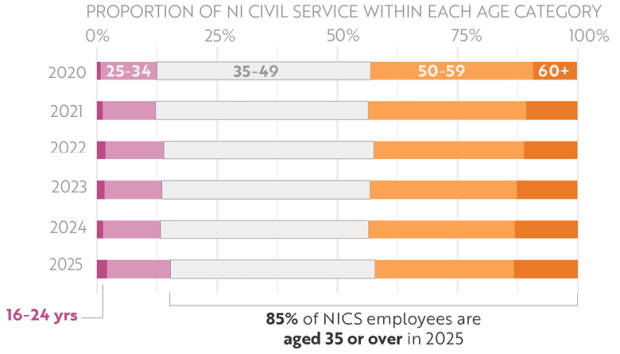
Source: NISRA
14 Monitoring the age profile of a workforce is essential for effective workforce planning, as it provides insight into potential retirement trends, helps identify future skills gaps, and supports succession planning. It enables organisations to proactively manage staffing needs, ensuring a balanced mix of experience and new talent. Additionally, understanding age demographics allows for the development of tailored engagement and retention strategies, while also supporting compliance with equality and diversity obligations. This foresight helps maintain operational continuity and build a resilient, future-ready workforce.
15 The ratio of NICS staff over the age of 50 is 42 per cent which is an improvement from the 45 per cent in the 2020 Report. The cohort of staff aged between 35 and 49 also comprises of around 43 per cent of the workforce, which leaves just 15 per cent of staff aged 34 or below. There is just over two per cent of the workforce (532 staff) under the age of 25 which, although still low, is an important improvement from 2020 when there was just 0.8 per cent or 185 staff in this category.
Highlights from individual department metrics in 2025 include:
- DoH has no staff under the age of 25.
- 58 per cent of PPS staff are between the ages of 35 and 49.
- In DE, 57 per cent of staff are over the age of 50, while for DfI the figure stands at 52 per cent.
- The age profile of the largest department, DfC, which represents approximately a third of the NICS workforce, shows that 80 per cent of its staff are over the age of 35. This is notable given that DfC has the highest concentration of employees in entry-level grades such as AO and EO, where a younger age profile would typically be expected. The total number of staff under the age of 34 was 1,534.
- 93 per cent of staff under the age of 35 work in five departments – DfC, DoJ, DoF, DAERA and DfI.
Vacancy Rates in the NICS have rocketed
Figure 7: Vacancies in NICS

Source: NICSHR
Note:
1 Vacancy figures identified are those approved by NICS departments who then instruct NICSHR to actively progress to fill.
2 The vacancy figure (based on Month End March figures) represents the number of vacant posts that are actively being progressed to fill, as a proportion of current Staff in Post.
Vacancies by Grade
16 The NICS has experienced a significant increase in declared vacancies in recent years, with the DfC accounting for the majority of the growth in demand. While other departments have also seen rising vacancy levels, the rate of increase has been comparatively slower.
17 As of March 2019, there were 1,420 vacant posts across the NICS, representing 5.8 per cent of the workforce by headcount. By March 2025, this figure had risen to 5,486 vacancies, equating to a vacancy rate of 18.3 per cent. In the last six years vacancies have increased almost fourfold.
18 Of the total vacancies, 2,259 were at the Administrative Officer (AO) grade, comprising over 40 per cent of all vacant positions. An AO recruitment competition was launched in August 2024 to fill 500 posts. However, appointments have been made and it is anticipated that a portion of these vacancies will be addressed through this recruitment exercise.
19 DfC supports the Department for Work and Pensions (DWP) in delivering welfare and child maintenance services, under a long-standing partnership spanning over 30 years. In August 2023, DWP renewed its agreement with DfC for a five-year term, increasing staffing requirements from 2,600 to 4,500 by March 2025. The DfC said that agency workers are used to meet this headcount in the short term while competitions take place to substantively achieve the headcount.
Figure 8: Percentage of vacancies per grade in the NICS
| Grade | Headcount | Vacancies Number % | |
|---|---|---|---|
| SCS | 267 | 25......... | 9% |
| G6 | 308 | 61......... | 20% |
| G7 | 1,409 | 315......... | 22% |
| DP | 3,106 | 405......... | 13% |
| SO | 3,377 | 657......... | 19% |
| EO1 | 3,200 | 578......... | 18% |
| EO2 | 4,589 | 727......... | 16% |
| AO | 5,798 | 2,259......... | 39% |
| AA | 442 | 155......... | 35% |
| Industrial | 639 | 146......... | 23% |
| Uniform | 1,386 | 158......... | 11% |
Source: NICSHR
20 As of March 2025, 4,350 FTE staff were assigned to DWP services, with a workforce composition of 44 per cent permanent posts and 56 per cent agency workers. At the same time, there were 1,568 vacancies within DWP Services, representing 61 per cent of the DfC’ total 2,551 vacancies and accounting for 45.5 per cent of all NICS vacancies. The majority of these roles are concentrated at lower grades. Recruitment initiatives, including an Administrative Officer (AO) competition launched in August 2024, are expected to address a proportion of these vacancies.
21 DfC stated that in 2024-25 an average of 45 staff left the department each month, primarily due to retirements, resignations and career moves out of the department. Over the seven years to 2024-25, 2,092 staff left the department, excluding internal NICS transfers. Recruitment services cannot keep pace with these rates of attrition, largely due to limited market supply for some roles and lengthy NICS hiring processes. The Department highlighted that the current recruitment timeline is unsustainable given the rate of staff turnover.
22 This has implications for value for money. Recruitment involves significant time and cost, from role profiling to shortlisting and interviews. Additionally, agency workers trained for DWP services can leave shortly after onboarding, resulting in repeated training costs and operational inefficiencies.
Temporary Promotions
Figure 9: The number of Temporary Promotions in the NI Civil Service have doubled between 2017 and 2025
Temporary Promotions often exceed 12 months
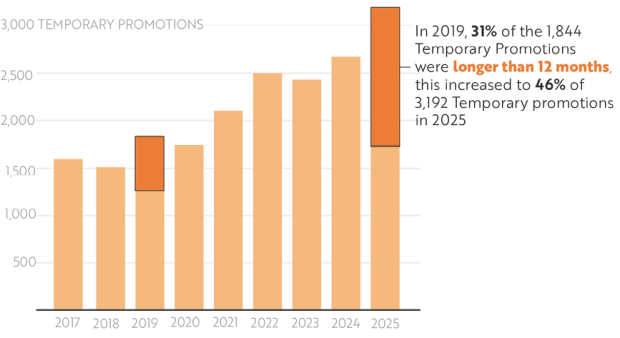
Source: People and OD
23 Temporary promotions were also at an all-time high of 3,192 at 31 March 2025, which equates to 13.0 per cent of the workforce. There has been an alarming increase of 73.1 per cent in the number of temporary promotions since the 2020 Report. DoF said that not all temporary promotion exercises relate to vacant posts. Some are for special exercises or timebound projects exceeding 12 months which are funded for the duration of the project only; therefore, it would not be appropriate to fill such roles on a substantive basis.
Table 7: Temporary Promotion Statistics
| Duration of Temporary Promotions | Number of Temporary Promoted Staff | Temporary Promoted staff as percentage of NICS Headcount |
|---|---|---|
| 12 months or less | 1,708 | 7 |
| One – Two years | 696 | 3 |
| Two to Four years | 586 | 2 |
| Over Four years | 202 | 1 |
| Temporary Promotions Total | 3,192 | 13 |
24 The NICS’s policy on temporary promotions states that,
Temporary promotion is as the name suggests a temporary arrangement, therefore, [NICS] would not expect a post to be filled by temporary promotion or someone to be temporary promoted for longer than 12 months except in very exceptional circumstances. Temporary Promotion arrangements should be reviewed on a regular basis.
25 A significant proportion of temporary promotions within the NICS exceed the standard policy timeframe of 12 months, with almost half extending beyond this limit, 788 continuing for more than two years and 202 over four years. This trend indicates that temporary arrangements are being used as long-term solutions rather than short-term measures.
Overtime Costs remain relatively high
Figure 10: Overtime costs
The total cost of overtime in 2025 was £23.2 million
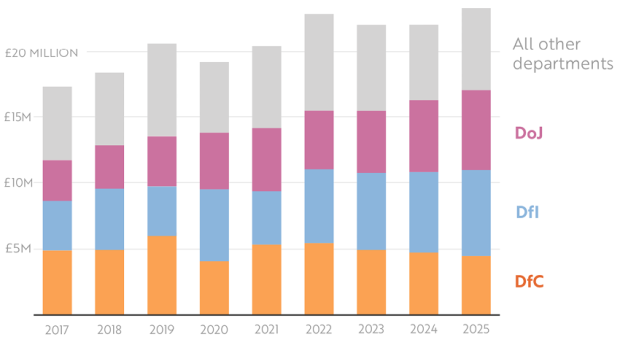
Source: NICSHR
26 Overtime expenditure in the 2020 Report was based upon information received from departments which recorded slightly lower figures than that gathered by NISRA. Figure 10 shows the position using NISRA data which indicates that overtime costs across the NICS have risen by 14.3 per cent since the 2020 Report, reaching £23.2 million in 2024–25 compared to £20.3 million in 2018-19. This increase is partly attributable to the upward movement in salary scales over time. Within the DfC, the DWP contract accounts for 75 per cent of total overtime costs and these are separately funded by DWP as part of a contractual agreement. Overtime is regularly utilised during peak periods to fulfil contractual requirements, particularly when staffing gaps cannot be addressed through standard recruitment processes.
Agency Worker Numbers have almost doubled since the 2020 Report
Figure 11: The number of Agency Workers split between DfC and the rest of the NICS

Source: NICSHR
27 The use of agency workers in the NICS has more than doubled over five years, rising from 2,099 in March 2019 to 4,939 by March 2025. Over 50 per cent of these workers are assigned to the DWP contract. NICSHR was unable to provide the cost of using agency services as each department retains its own data in this respect.
28 While agency workers can provide short-term flexibility, their extensive use may not represent best value for money. Taking into consideration the specific demands of the DWP contract, a strategic workforce plan may support more sustainable staffing solutions and reduce reliance on temporary arrangements.
Summary
29 The NICS workforce is under considerable strain, with high sickness absence, rising vacancies, and increasing reliance on temporary promotions, overtime and agency workers. An ageing workforce and unsustainable staffing practices pose risks to service delivery, financial efficiency and long-term workforce resilience.
Appendix 3: List of Professions
| Professional Group | Number in the Profession – taken from Head of Profession survey Headcount | |
|---|---|---|
| 1 | Agricultural Inspectorate (incl CAFRE) | 295 |
| 2 | Agricultural Economists | Not returned |
| 3 | Economists | 132 |
| 4 | Finance & Governance | 365 in finance post 135 in general service |
| 5 | Internal Audit | 67 |
| 6 | Geographical Information | 185 |
| 7 | Health Estates (Construction) | Not returned |
| 8 | HR | Not returned |
| 9 | Training | Not returned |
| 10 | ICT | 615 |
| 11 | Communications (EIS) | Not returned |
| 12 | Legal | 174 |
| 13 | Medicine | Not returned |
| 14 | Planning | 57 |
| 15 | Policy Delivery | Not known but a recent survey indicated around 800 staff are linked to this profession |
| 16 | Statistics | Not returned |
| 17 | Valuers | 132 |
| 18 | Veterinary Medicine | Not returned |
| 19 | Procurement | 65 |
| 20 | Construction Disciplines | 275 |
| 21 | Science | 137 |
| 22 | Operational Delivery | Under general service so unable to determine |
| 23 | Programme/Project Management * | Data not available |
| 24 | Librarians | 7 |
| 25 | Education and Training Inspectorate | 55 |
| 26 | Engineering * | Not returned |
Source: Provided by the DoF
*New profession since the 2020 Report
Appendix 4: NICS Current Job Architecture – Occupational Groups at 31 January 2025
| Occupational Group FTE | Headcount | |
|---|---|---|
| General Service | 14,862.9 | 16,119 |
| Industrial Grades | 595.8 | 611 |
| Accountant | 320.2 | 336 |
| Agricultural Colleges | 1.0 | 1 |
| Agricultural Economists | 15.8 | 16 |
| Agricultural Inspectors (Grade) | 268.2 | 284 |
| Agricultural Inspectors (Group) | 303.8 | 327 |
| Architects | 84.5 | 89 |
| Auditor | 34.0 | 35 |
| Building Surveyors | 1.0 | 1 |
| Careers Officers | 80.6 | 90 |
| Civil Engineering | 823.7 | 871 |
| Clerks of Works | 2.5 | 3 |
| Computing | 622.4 | 640 |
| Construction Client Adviser/Project Manager | 17.0 | 17 |
| Countryside and Wildlife | 15.9 | 16 |
| Curatorial Grade | 49.3 | 52 |
| DE Inspectorate | 37.8 | 40 |
| Drawing Office Staff | 1.5 | 2 |
| Economists | 115.4 | 118 |
| Environmental Health | 1.0 | 1 |
| Estates Officers | 11.6 | 12 |
| Fisheries | 40.8 | 42 |
| Food Technology Technicians | 6.6 | 8 |
| Foreperson | 22.1 | 23 |
| Forestry | 32.0 | 32 |
| Graphic Designers | 9.6 | 10 |
| Health and Safety Inspectors | 6.5 | 7 |
| Historic Monuments | 3.1 | 6 |
| Imports Inspectors | 1.0 | 1 |
| Information Officers | 60.6 | 66 |
| Landscape Architects | 1.0 | 1 |
| Law Clerks | 1.0 | 1 |
| Legal Grades (Solicitors) | 349.4 | 370 |
| Librarians | 6.7 | 8 |
| M&E Engineers | 90.1 | 97 |
| Mapping and Charting | 185.1 | 196 |
| Meat Inspectors | 96.5 | 108 |
| Medical Enforcement Officer | 2.0 | 2 |
| Medical Officers | 7.8 | 11 |
| Miscellaneous | 30.8 | 33 |
| Nursing | 6.3 | 7 |
| Pharmacists | 10.0 | 10 |
| Photographic | 1.0 | 1 |
| Planning Office Staff | 42.3 | 43 |
| Prison Grades | 1,293.4 | 1,328 |
| Psychologists | 25.8 | 26 |
| Quantity Surveyors | 32.6 | 39 |
| Science Grades | 582.1 | 598 |
| Social Services Inspectorate | 4.0 | 4 |
| Statisticians | 336.2 | 350 |
| Strangford Ferry | 18.0 | 18 |
| Structural Engineers | 4.9 | 6 |
| Supplies Officers | 4.8 | 5 |
| Support Grades | 86.4 | 93 |
| Trading Standards | 27.7 | 29 |
| Typing | 142.8 | 168 |
| Valuation | 161.4 | 174 |
| Vehicle and Driving Examiners | 452.8 | 459 |
| Veterinary Officers | 117.8 | 132 |
| Veterinary Research | 12.0 | 12 |
| YJA Specialisms | 117.6 | 122 |
| TOTAL | 22,698.2 | 24,327 |
Source: The DoF Internal MI (Workforce Data & Reporting)
Appendix 5: Methodology
The review employed a range of investigative and research methods, incorporating both quantitative and qualitative methods, including:
1 A review of key documents and further publications produced by the NICS and other organisations.
2 Meetings, workshops and discussions with various NICS staff, specifically NICSHR, HR Connect, and representatives from five of the NICS professions.
3 Meeting with the Chair of the People Committee, who is also a Non-executive member of the NICS board.
4 Meetings with other key stakeholders such as Northern Ireland Public Service Alliance (NIPSA), and the Civil Service Commissioners.
5 Analysis of statistics and data, to 31 March 2025, produced by:
a NISRA for the NICS;
b NICSHR; and
c People and OD.
6 Analysis of quantitative data requested from NICS departments and HR Connect to 31 March 2025.
7 Review of qualitative information obtained from the Heads of Professions via an NICS survey questionnaire.
8 Meeting with a focus group, made up of five Heads of Professions.