
List of Abbreviations
ASoS Action Short of Strike
C&AG Comptroller and Auditor General
CCEA Council for Curriculum, Examinations and Assessment
CSIS Centre for Strategic and International Studies
DE Department of Education
DI District Inspector
EA Education Authority
ESaGS Every School a Good School (School Improvement Policy)
EOTAS Education Other Than At School
ETI Education and Training Inspectorate
FIP Formal Intervention Process
FSME Free School Meal Entitlement
GCSE General Certificate of Secondary Education
HMIE Her Majesty’s Inspectorate of Education (Scotland)
NAO National Audit Office
NI Northern Ireland
NIAO Northern Ireland Audit Office
OFSTED Office for Standards in Education, Children’s Services and Skills (England)
OECD Organisation for Economic Co operation and Development
PAC Public Accounts Committee
PIRLS Progress in International Reading Literacy Study
PISA Programme for International Student Assessment
SDP School Development Plan
SEN Special Educational Needs
TIMSS Trends in International Mathematics and Science Study
TSN Targeting Social Need
UK United Kingdom
Key Facts
£3 billion is spent each year on the Northern Ireland education system - Approx. 350,000 pupils are in education in Northern Ireland
Almost a decade How long school inspections have been restricted in Northern Ireland, in one form or another - 13 primary schools and 0 post primary schools received a “full” inspection unimpacted by industrial strike between 2018 and 2023
74.5% of pupils achieved five or more GCSEs grades A* to C including English and mathematics in 2024/25 academic year - 2025 The Transform ED NI Strategy was introduced
Executive Summary
Investing in a high quality education system brings societal benefits
1. A high quality education system has many positive impacts, including good outcomes for both pupils and society more generally. Reports by organisations like the Organisation for Economic Cooperation and Development (OECD), World Economic Forum, and research published by the Centre for Strategic and International Studies (CSIS) find that countries that invest in primary, secondary and tertiary education see stronger economic resilience and higher capacity for innovation. Enhancing the quality of the education provided should be at the core of any education system.
2. In Northern Ireland, the Department of Education (the Department) has statutory responsibilities for promoting education and overseeing the curriculum framework. While the day to day performance of individual schools rests with their Boards of Governors, the Department is responsible for determining curriculum policy and ensuring that the statutory curriculum is delivered in accordance with legislative requirements. This includes duties under the Education (Northern Ireland) Order 2006 to set the curriculum’s overall requirements and to support the maintenance and improvement of educational standards across the school system.
3. Measuring the quality of an education system is complex. Any definition of the quality of education will comprise the actions of pupils, schools, parents, communities and the Department.
The education system receives significant public money
4. Around £3 billion is spent annually on the education system in Northern Ireland. In 2024/25, this represented more than 1,440 schools and over 350,000 pupils. Oversight of this investment is important to ensure that value for money is being achieved for the taxpayer. Key to this oversight, are assurance mechanisms that provide the Department with feedback on the quality of the education being provided in schools in Northern Ireland.
The Department’s assessment of the quality of education is constrained by existing performance measures
5. Feedback on the education provided in schools should come from quantitative and qualitative sources. Examination and assessment results are one way to measure the performance of an education system. In Northern Ireland, they are currently the only quantitative measure consistently used by the Department. The results that are collected, however, are not comprehensive and in some areas the Department is without basic information on pupil, school and system performance.
6. There is robust data available for results at Key Stages 4 and 5 (GCSE and A-level), but the Department does not have the examination or assessment result data for pupils before they sit GCSEs. This is very late in a child’s education journey and is the end of the formal education process for some. It is therefore too late to target support and address underachievement. The Department is aware of the challenges this lack of data poses for policymakers and stakeholders to evaluate progress or identify areas for improvement with confidence. The challenges have been highlighted by the Independent Review of Education report in 2023. The Department published its strategy for the transformation of teaching and learning in 2025, TransformED.
7. This lack of information is further compounded by the fact that not all pupils sit GCSE examinations and are therefore not represented in the data submitted to the Department. Fewer pupils again sit A-levels. As a result, there is a group of pupils in Northern Ireland who are not represented in the Department’s data on educational outcomes.
The Department gets feedback on the quality of education through school inspections
8. The Education and Training Inspectorate (ETI), a directorate within the Department, has a statutory duty to monitor, inspect and report on the quality of education being provided for children and young people. ETI conducts inspections of the pre-school sector, primary schools, post primary schools, special schools and Education Other than at School (EOTAS) centres.
9. The school inspection process serves as a mechanism for accountability and quality assurance within the education system. ETI told us that it aims to provide an independent and rigorous evaluation of educational provision for the Department, ensuring that schools are meeting the standards expected.
School inspections have been restricted in Northern Ireland, in one form or another, for almost a decade
10. Teachers in Northern Ireland have engaged in forms of industrial action referred to as Action Short of Strike (ASoS) over the last ten years. As part of this action, teaching unions instructed their members not to cooperate with ETI inspections, not to implement any existing or new policies, initiatives or working practices that have not been agreed.
11. ASoS, combined with the COVID-19 pandemic, significantly impacted ‘full’ school inspections, inspections where ETI inspectors directly observe teaching and learning in the classroom, as inspectors were not permitted to observe teaching in classrooms.
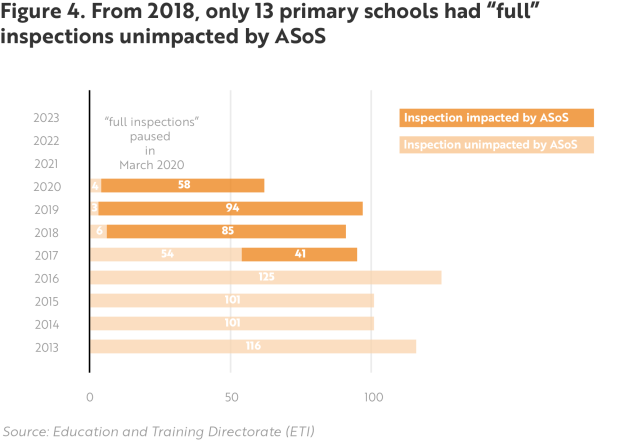
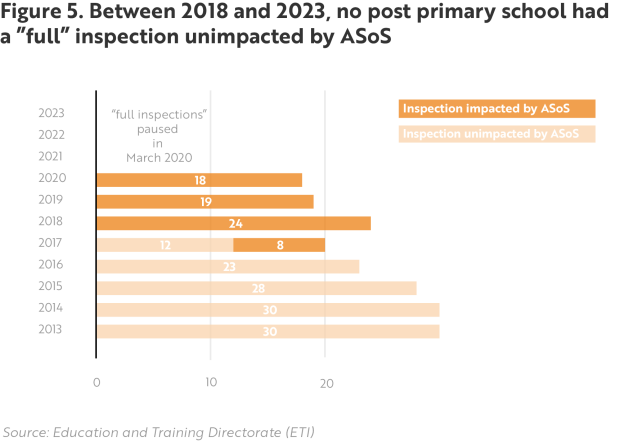
12. For six years from 2017, only 13 Primary Schools, which represents less than 2 per cent, in Northern Ireland had ‘full’ inspections, unimpacted by ASoS. For those schools whose inspections were disrupted, the inspectors’ reports concluded that “the ETI is unable to assure parents/carers, the wider school community and stakeholders of the quality of education provided for the pupils.” Over the same period, no post primary schools in Northern Ireland had a full inspection that was unimpacted by ASoS.
The lack of inspection is likely to have had a greater impact on vulnerable and disadvantaged children
13. ETI is the only organisation in Northern Ireland that inspects the arrangements for child protection and wider safeguarding in schools and educational establishments, including adult safeguarding. From 2017 to 2020, when ASoS prevented ETI from confirming that schools had appropriate safeguarding procedures, the Department implemented a process, adapted over time in line with Trade Union directives, in which ETI identified cases where safeguarding assurance could not be established. The Department wrote to Boards of Governors to highlight the issue, remind them of their legislative duties, and seek safeguarding assurances ahead of a follow up inspection (or, in later years, directly from governors if schools refused to engage). The Department also informed the EA Child Protection Support Service so support could be offered. The Department advised us that records of schools’ compliance are limited, but where a school did engage with the follow-up inspection, ETI issued an amended report.
14. During the period of ASoS, the number of schools identified as having unsatisfactory arrangements for safeguarding fell significantly. In the three years prior to ASoS, 37 schools were identified where child protection arrangements were unsatisfactory. In the five years from 2020 to May 2025, eight schools were identified. Whilst this may be, partially at least, reflective of better safeguarding arrangements, it is also possible that schools in need of support to strengthen their child protection and safeguarding arrangements were not identified by ETI.
15. ETI provides key support for schools’ provision for children with special education needs (SEN). Prior to ASoS, ETI observed the child learning in the classroom, evaluated the quality of the SEN support and reviewed the numbers of children at each of the three stages of the SEN Code of Practice.
16. Over this period, when the number of pupils identified as having SEN increased significantly, the Department concluded that:
“in the absence of inspection, we have no external assurance that our children and young people are receiving a satisfactory standard of teaching and learning. This impacts on all learners but inevitably impacts most on vulnerable and disadvantaged children.”
17. Despite the EA spending more than £620 million on SEN in 2024-25, there is little assurance that this public money is being spent effectively or delivering a high-quality education to those who need it.
TransformEd is the Department’s strategy for educational excellence
18. In March 2025, the Department launched TransformED NI, a strategy aimed at achieving educational excellence through reform focused on five core areas:
- Curriculum
- Assessment
- Qualifications
- Tackling educational disadvantage
- School improvement.
19. TransformED states that educational research is clear that high-quality teaching and learning are at the heart of educational improvement. Among its many objectives, TransformED seeks to strengthen assessment and accountability mechanisms, including proposals to reform key stage assessments and introduce earlier, more meaningful measures of performance before GCSE level. These reforms are designed to provide a clearer picture of learner progress and system effectiveness, helping to address long-standing gaps in educational data.
20. The strategy is committed to putting in place effective mechanisms to collect and analyse effective system level data which demonstrates how the education system in Northern Ireland is performing. As part of this, it is proposed to introduce a system level check for pupils at the end of Key Stages 1 to 3, designed and administered by the Council for Curriculum, Examinations and Assessment (CCEA). This aims to provide robust measurement of standards over time.
21. In addition, TransformED also outlines that new legislation has been proposed by the Department to bring Northern Ireland into line with the rest of the UK and with Ireland, making obstructing a school inspection an offence. We will stay informed of progress in relation to delivery of the TransformED strategy (and delivery plan) and achievement of its objectives.
Recommendations
Recommendation 1
We recommend that the Department create a formal definition of the quality of education and outline the mechanisms through which they will get feedback on the quality of the education system.
Recommendation 2
To ensure that every pupil benefits from a high-quality education, the Department must refine its use of performance data to identify areas for improvement. The Department should identify the data it needs and how it will obtain and analyse this to demonstrate that the education system is providing a quality education for all pupils.
Recommendation 3
The level of non-compliance with the School Development planning process is not acceptable. The Department should ensure it has robust measures in place to ensure that all schools are compliant.
Part One: Introduction
High quality education is central to societal and economic outcomes
1.1 A quality education system has many positive impacts, including good outcomes for pupils and for society more generally. Countries that adequately invest in basic education, higher education, and vocational training see stronger economic resilience and higher capacity for innovation. Enhancing the quality of education should be at the core of any education system.
The Department is responsible for promoting a high quality education system
1.2 The primary statutory duty of the Department of Education (the Department) in Northern Ireland is to promote the education of the people of Northern Ireland and to ensure the effective implementation of education policy. It is responsible for setting policy, strategy and for the central administration of education and related services in Northern Ireland.
1.3 The Department has an important role in maintaining and improving the overall quality of the education system. Individual schools are responsible for performance, while the Department has a statutory obligation to ensure that schools operate effectively and maintain acceptable standards of education. This includes a duty to ensure that the curriculum framework supports quality education outcomes.
1.4 The Department exercises these duties through mechanisms such as school development planning (SDP), performance monitoring, inspection and statutory intervention powers when a school is identified as failing to provide an acceptable standard of education. The Education (Northern Ireland) Order 1998 enable the Department to appoint additional governors and oversee school development plans where intervention is required, while inspection and monitoring arrangements should support ongoing evaluation across the system. These forms of oversight, together with both quantitative and qualitative feedback, should contribute to the Department’s understanding of system performance. These mechanisms are discussed further in Parts two and three.
1.5 The Department’s vision is that “every child and young person is happy, learning and succeeding”. Delivering an effective, child-first, collaborative and high-quality education system is part of that vision. The duty to establish and maintain such a system establishes a framework of curriculum, policy, and oversight through which the Department must promote educational standards and outcomes. This should support quality education across the system.
Quality of education is broadly understood but poorly defined
1.6 The quality of an education system is shaped by a broad range of factors, amongst them high-quality teaching, effective curriculum design, strong school leadership, and well established support structures. School improvement is a critical component of the system. This process begins within each school through ongoing, rigorous self evaluation and strategic planning for development. At the same time, it acknowledges that schools may periodically require external assistance to achieve meaningful progress. Accountability mechanisms, including inspection, play an essential role in identifying schools that could benefit from additional support, as well as highlighting exemplary practice from which others can learn.
1.7 Sources such as the Independent Review of Education and the Department’s corporate plan also indicate that quality of education in Northern Ireland is understood not just as academic achievement, but that it also comprises equity, inclusivity, and fostering a learning environment where every child can thrive.
1.8 Providing definitive measurement of the quality of education is therefore difficult. However, there remains no clear definition to the term ‘quality of education’ in Departmental policy or corporate documents. Without a clear definition, the Department will find it extremely challenging to adequately monitor the quality of education provided.
1.9 The Department set its expectations for what effective education should look like through its school improvement policy Every School a Good School (ESaGS). Introduced in 2009, ESaGS aims to ensure every child has access to high-quality education. The policy includes provision for support through the Formal Intervention Process for schools which, following an inspection, are found to be less than satisfactory in their provision for pupils.
1.10 In recognition of the significant changes within the educational landscape since the publication of the ESaGS policy in 2009, including the introduction of the new inspection framework, the Department is developing an updated school improvement policy alongside a revised operational support model. In 2023, the End to End Review of School Improvement was initiated, with one of its key expected outputs being the formulation of this new policy. The Department is due to issue a draft policy for public consultation in 2026.
Recommendation
We recommend that the Department create a formal definition of the quality of education and outline the mechanisms through which they will get feedback on the quality of the education system.
TransformEd aims to improve the Department’s access to information
1.11 In March 2025, the Department launched TransformED, a strategy aimed at achieving educational excellence through reform focused on five core areas:
- Curriculum
- Assessment
- Qualifications
- Tackling educational disadvantage
- School improvement.
1.12 TransformED states that educational research is clear that high-quality teaching and learning are at the heart of educational improvement. Among its many objectives, TransformED seeks to strengthen assessment and accountability mechanisms, including proposals to reform key stage assessments and introduce earlier, more meaningful measures of performance before GCSE level. These reforms are designed to provide a clearer picture of learner progress and system effectiveness, helping to address long-standing gaps in educational data.
1.13 The strategy is committed to putting in place effective mechanisms to collect and analyse effective system level data which demonstrates how the education system in Northern Ireland is performing. As part of this, it is proposed to introduce a system level check for pupils at the end of Key Stages 1 to 3, designed and administered by CCEA. This will aim to allow for robust measurement of standards over time.
1.14 In addition, TransformED also outlines that new legislation has been proposed by the Department to bring Northern Ireland into line with the rest of the UK and with Ireland, making obstructing a school inspection an offence.
Scope of this report
1.15 This report explores how the Department of Education gains assurance about the quality of education being provided in Northern Ireland. It concentrates on how the Education and Training Inspectorate (ETI) contributes to that assurance. It also outlines some of the other mechanisms used by the Department to evaluate educational provision and the challenges that have impacted system-wide improvement efforts.
Part Two: Measuring educational quality
2.1 Examination and assessment results are one way to measure one element of the performance of an education system. In Northern Ireland, they are currently the only quantitative measure consistently used by the Department. Examination results should be considered as one part of a broader system of indicators of the quality of an education system.
2.2 At the system level, there has been limited data in recent years for results at Key Stages1, 2 and 3, due to the limited number of schools that submitted this data from 2014 to 2019 because of industrial action in the form of Action Short of Strike (ASoS), and the Department’s subsequent suspension of statutory assessment arrangements to alleviate pressures stemming from COVID-19 pandemic from 2020 to 2023.
2.3 There is robust data available for results at Key Stages 4 and 5 (GCSE and A-level), but the Department has only limited assessment result data for pupils before they sit GCSEs. The Department is aware of the challenges this lack of data poses for policymakers and stakeholders to evaluate progress or identify areas for improvement with confidence. The challenges have been highlighted by the Independent Review of Education report in 2023.
2.4 In addition, in 2023/24, out of nearly 25,000 Year 12 pupils, around 1,900 (7.7 per cent) were deemed ineligible for inclusion in the Summary of Annual Examination Results return which schools submit. A school considers a pupil ineligible for inclusion for several reasons including illness, emigration, if the pupil has a statement of special educational needs or there were serious welfare issues. As a result, there are pupils in Northern Ireland who are not represented in the Department’s qualitative data on educational outcomes.
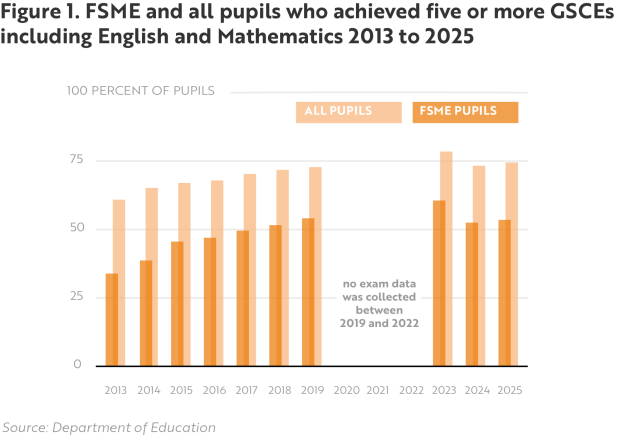
2.5 This report focuses on GCSE results specifically at grades A* to C including English and mathematics. These subjects and grade thresholds are critical indicators of attainment because they represent the minimum academic standards required for young people to progress successfully into further education, training, or employment.
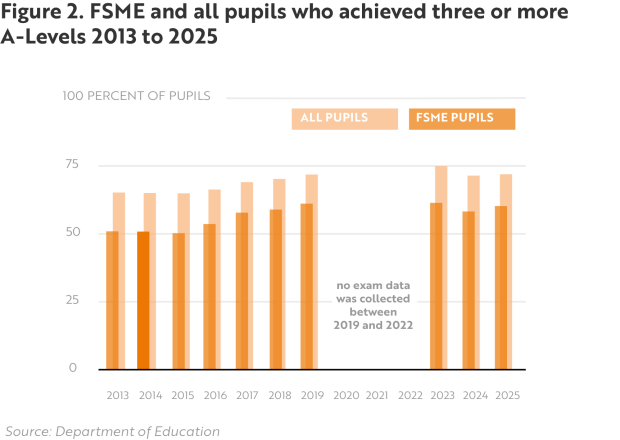
2.6 The most recent data from the 2024/25 academic year show that 74.5 per cent of pupils achieved five or more GCSEs at grades A* to C including English and mathematics (Figure 1) and 71.9 per cent of pupils attained three or more A-levels at grades A* to C (Figure 2). Although the figures dropped for 2023/24, they previously reflected a steady upward trend in overall attainment. Comparable examination result data is not available between 2019 and 2022 due to the impact of COVID-19.
GCSE and A-level results have improved but the gap in educational attainment remains significant
2.7 An important measure of educational inequality in Northern Ireland is the attainment gap between pupils who are entitled to free school meals (FSME), and those who are not. The gap is typically assessed by comparing the percentage of pupils achieving five or more GCSEs grades A* to C including English and mathematics. For example, in 2024/25, 53.3 per cent of FSME pupils achieved five or more GCSEs at grades A* to C including English and mathematics, compared to 74.5 per cent of all pupils and 80 per cent of non-FSME pupils.
2.8 Disparities in performance between pupils with and without free school meal entitlement have narrowed meaning disadvantaged pupils are performing better relative to their peers before. Despite the improvements, the gap remains significant. It is important that the Department has access to robust data for every stage of the education system, not just from GCSEs onwards, to inform and encourage continuous improvement.
Northern Ireland has performed well in international assessments
2.9 Northern Ireland’s participation in international assessments also offers a comparative perspective on student performance. Progress in International Reading Literacy Study (PIRLS) and Trends in International Mathematics and Science Study (TIMSS) are designed to evaluate students’ command of the curriculum and ability to apply their learning and skills. The Programme for International Student Assessment (PISA) aims to evaluate the country’s education system and emphasises socio-economic and equity factors. In 2022, PISA found that, since 2018 in Northern Ireland, the performance of the top 10 per cent of high achievers has been maintained but performance of low achievers, the bottom 10 per cent, has deteriorated.
2.10 Taken together, PISA, TIMSS and PIRLS, can be good indicators of country achievement. Northern Ireland has performed well in international assessments, indicating the region’s educational strengths in a global context, when compared with other education systems. Such international studies may offer a level of benchmarking data but are not a substitute for regular national assessments and the collation of data over the entire education journey, by the Department.
Statutory national assessments measures have been affected by Industrial Action and COVID-19
2.11 Since 2010, there has been a requirement for statutory Key Stage assessments to be conducted to assess pupils’ progress in literacy and numeracy at Key Stages 1, 2, and 3, using the Levels of Progression (LoP) framework. The cross-curricular skills of Communication and Using Mathematics were introduced in the 2012/13 school year, followed by the addition of Using ICT in 2016/17. These assessments were intended to provide a consistent, system-wide measure of pupil attainment and to support the monitoring of school performance and improvement over time.
2.12 However, the effectiveness of these statutory assessments has been significantly undermined by prolonged industrial action, particularly Action Short of Strike (ASoS), and the disruption caused by the COVID-19 pandemic. As a result, the Department has been unable to collect reliable Northern Ireland level assessment data for several years.
2.13 This has created a substantial gap in the evidence base needed to monitor pupil outcomes, evaluate the impact of school improvement policies, and make informed decisions about resource allocation. The absence of this data has left Northern Ireland without a functioning national performance measure at primary and lower post primary levels, limiting the Department’s ability to assess progress across the education system.
The Department has plans for new pupil assessments through the TransformED Strategy
2.14 The TransformED NI Strategy (2025) identified the need for a stronger, more coherent accountability framework to ensure high standards across the education system. The current absence of national performance measures at Key Stages 1-3 has resulted in limited system-wide data on school effectiveness. TransformED commits to commissioning an independent review of the existing statutory assessment arrangements with the aim of developing a new system of attainment measures that sets high standards and clearly defined learning outcomes for all pupils throughout both primary school and Key Stage 3.
2.15 While awaiting the completion of this review and implementation of new arrangements to address the lengthy deficiency of national assessment data, the Department has developed new system-level assessments in literacy and numeracy at ages 8, 11, and 14, to be introduced from the 2025/26 academic year. The Department advises us that these will be “low-stakes”, sample-based assessments designed to provide reliable data, albeit at a broader level than that envisioned 15 years ago by the original Levels of Progression legislation in 2010.
2.16 Sample-based assessments do not offer granular data for every pupil or school, limiting their usefulness for targeted intervention, school improvement planning, or performance management.
Current performance measures do not provide the Department with a complete picture of the quality of education being provided
2.17 The Department acknowledges that the absence of statutory assessment data has created a significant gap in its evidence base. In turn, this has impacted on the Department’s ability to monitor educational outcomes, evaluate policy impact, and direct resources effectively. This prolonged data deficit has weakened accountability across the system. Furthermore, the time taken for the new assessments to rebuild a national picture of performance means that accountability will remain compromised for the foreseeable future.
2.18 While large-scale international assessments may provide valuable insight into the academic performance of students, they do not capture the full complexity of the education system. They provide only a snapshot of pupil outcomes, at a specific age, missing how they evolve throughout childhood.
2.19 Similarly, GCSE and A-level results do not reflect the performance of the entire pupil cohort in any given year. Additionally, the current lack of any national measures to assess the performance of literacy and numeracy in the education system through Key Stages 1-3 makes Northern Ireland an outlier internationally.
Recommendation
To ensure that every pupil benefits from a high-quality education, the Department must refine its use of performance data to identify areas for improvement. The Department should identify the data if needs and how it will obtain and analyse this to demonstrate that the education system is providing a quality education for pupils.
Part Three: Inspection
The Department gets feedback on the quality of education in NI through school inspections
3.1 Educational attainment is one indicator of a successful education system. The Department’s school improvement policy, ‘Every School a Good School’ (ESaGS) (2009), identified inspection as an indicator, providing one of the most direct and established ways to assure the quality of educational delivery. TransformED also highlights that inspection is vital to all learners and inspections can provide critical insights into teaching quality, leadership, and learner outcomes.
3.2 The Education and Training Inspectorate (ETI) has a statutory duty to monitor, inspect and report on the quality of education being provided for children and young people. ETI conducts inspections of the pre-school sector, primary schools, post primary schools, special schools, and other education establishments. This report focuses primarily on ETI’s inspection of primary and post primary schools.
3.3 In addition to inspections, ETI is commissioned by the Department to complete thematic evaluations on a range of topics. The Department and the EA use the evaluations to assess policy implementation and inform future policy development.
3.4 The school inspection process serves as a mechanism for accountability and quality assurance within the education system. It aims to provide an independent and rigorous evaluation of educational provision, ensuring that schools are meeting the standards expected in areas such as:
- the quality of teaching and learning in the classroom;
- the effectiveness of leadership and governance;
- the school’s ethos and environment;
- the treatment of pupils with special needs;
- any indicators determined by the school through its self-evaluative work; and
- safeguarding and the quality of pastoral care arrangements.
3.5 School inspections are part of the education systems for all four nations of the UK. In England (Ofsted) and Wales (Estyn), school inspections are undertaken by a non-ministerial government department with responsibility for inspecting schools and other educational institutions. In Scotland, inspections are the responsibility of HMIE, an executive agency under Education Scotland, which has a range of system-wide responsibilities including the curriculum and school improvement.
Not all schools submit a School Development Plan despite the school improvement guidance
3.6 Effective self-evaluation should be an integral part of the school development planning process with the resulting actions and targets that flow from it captured in the school development plan (SDP). The school development plan is a central document used to guide discussions on areas such as strategic leadership, governance, teacher professional learning, curriculum development and standards/outcomes for children and young people.
3.7 School development plan regulations, which are statutory requirements, state that the identification of priority areas for improvement should be informed by a schools’ own self-evaluation. Self-evaluation includes consultation with all members of the school community. Schools are required to submit a copy of their SDPs to the EA and, in the case of Catholic Maintained Schools, also to the Council for Catholic Maintained Schools.
3.8 ETI evaluates the standard of school development planning in the individual schools it inspects. Schools must update their SDP within six months of inspection. Where intervention is needed, school leaders receive a clear, evidence-based assessment from inspectors. This facilitates timely and focused action planning, often with external support, to drive improvement. ETI told us that their qualitative evidence shows schools that required follow up or progress inspections often do not demonstrate effective self-evaluation.
3.9 ASoS and COVID-19 impacted ETI’s ability to evaluate schools’ self-evaluation and their SDPs. There is a statutory duty on Boards of Governors of every school to prepare a plan, and schools are required to submit their plans to the EA. However, SDPs were not collected in recent years due to COVID-19 and ASoS. On 29 November 2024 and at the Department’s request, EA asked schools to submit their SDPs by 20 December 2024. Only 414 schools, or 38 per cent, submitted their plans (Table 1).
Table 1: Number of School Development Plans submitted by schools in the academic year 2024/25
| School Type | Number of SDPs Submitted | Total number of schools | Percentage |
|---|---|---|---|
| Nursery | 30 | 93 | 32% |
| Primary | 274 | 778 | 35% |
| Post Primary | 87 | 190 | 46% |
| Special | 23 | 41 | 56% |
| Total | 414 | 1102 | 38% |
Recommendation
The level of non-compliance with the School Development planning process is not acceptable. The Department should ensure it has robust measures in place to ensure that all schools are compliant.
3.10 Both EA and the Department told us that they do not review the submitted SDPs. EA assists schools in their school development planning process through a professional learning and development programmes, focused on ‘Self-Evaluation and Planning for Improvement’.
3.11 Typically, SDPs should set out the school’s priorities and plans for three years. With the relaxed requirements during the COVID-19 restrictions schools developed their SDP on a one year basis. Due to the impact of COVID-19, and ASoS until April 2024, there is now variation in the how schools plan. Some schools are continuing to plan on a one-year basis whilst others have returned to planning on a three-year cycle.
3.12 The guidance from the Department in April 2024 stated:
“Where they have not already, schools are encouraged to return to a three-year school development planning cycle. However, until the outcomes of the reviews are known, schools have the opportunity to use their discretion to develop an SDP appropriate to the current context of their school.”
3.13 As part of the End-to-End Review of School Improvement, the Department completed a review into the school development planning process. The Department told us that it anticipates that the legislation will be revised to reduce the prescriptive nature of what must be included in the SDPs. The new legislation will provide a framework for schools to develop a short three year strategic overview alongside one year actions plans. The Department advises that the legislative change will take considerable time to fully implement. Until new guidance is in place schools continue to follow the current SDP guidance.
School inspections have been restricted in Northern Ireland, in one form or another, for almost a decade
3.14 As of 2024/25, there are 1,105 schools in Northern Ireland, including 93 pre-schools, 781 primary schools, 190 post primary schools, 40 special schools and 13 independent schools. Teachers in Northern Ireland have engaged in forms of industrial action referred to as Action Short of Strike (ASoS) over the last ten years. As part of this action, teaching unions instructed their members not to cooperate with ETI inspections, not to implement any existing or new policies, initiatives or working practices that have not been agreed.
3.15 Industrial action began in 2011, in the context of the introduction of Key Stage Assessment legislation and a public sector pay freeze, when one of the five teaching unions began ASoS. By 2017, four out of the five unions were engaged in industrial action and by October 2019, all five unions were engaged in strikes and ASoS.
3.16 In 2020, the Pay and Workload Agreement brought an end to the extensive period of industrial action but coincided with the start of COVID-19 restrictions, which resulted in school closures and the suspension of inspection and other non-critical services. In October 2022, teaching unions formally returned to ASoS over pay, until a resolution was reached in April 2024. Unions returned to ASoS in February 2025 but ceased in April 2025.
3.17 ASoS significantly impacted “full” school inspections (inspections where ETI inspectors directly observe teaching and learning in the classroom) as inspectors were not permitted to observe teaching in classrooms. For schools that were willing to cooperate, ETI’s district inspectors continued to engage through visits and communication.
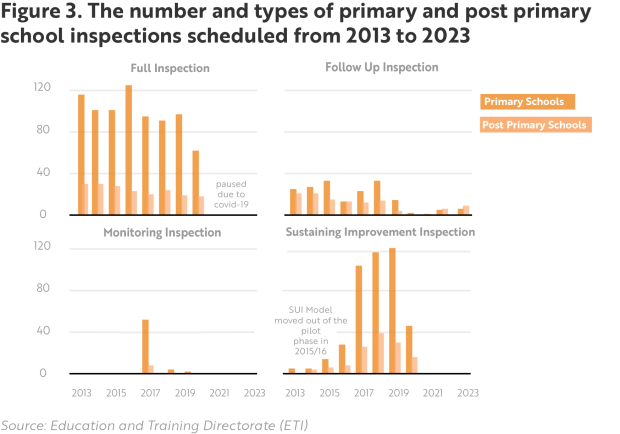
3.18 Between 2009/10 and 2016/17, 866 primary schools and 206 post primary schools were inspected across Northern Ireland, 41 and eight respectively were impacted by ASoS (see Figures 4 and 5). Of these, 170 were satisf actory with the need to address important areas for improvement. A further 57 were inadequate, providing unsatisfactory provision and with the need to urgently address significant areas for improvement.
3.19 Between 2016/17, when ASoS commenced and 2019/20, 345 primary schools and 81 post primary schools were inspected. However, of these inspections, more than 80 per cent (347) were impacted by ASoS in some way. For these schools, inspection reports stated that:
“the ETI is unable to assure parents/carers, the wider school community and stakeholders of the quality of education provided for the pupils.”
As a result, the Department was not obtaining assurance on the quality of education being provided in schools over this period.
ASoS has restricted the effectiveness of inspection for schools that need additional support
3.20 The Formal Intervention Process (FIP) is intended to support schools that are underperforming or are at risk of underperforming. It is a key mechanism of the school improvement policy ESaGS which aims to maintain the quality of education. Formal Intervention is triggered when ETI identifies significant concerns during an inspection. Issues can relate to leadership, teaching quality or pupil outcomes. The school is formally notified and enters formal intervention.
3.21 When a school enters FIP, it must produce an action plan to address identified issues. The Department reviews and approves this plan with input from ETI and the EA. Schools then receive targeted support, such as extra resources, training, or curriculum guidance. ETI monitors progress through follow up inspections, and the Department decides when a school moves into or out of FIP. Improvement must be demonstrated for a school to exit, and inspections are required for both entry and exit.
3.22 ASoS significantly reduced the number of schools moving into or out of FIP. From January 2017 to mid April 2024, some schools remained ‘stuck’ in FIP, while others missed opportunities for identification and support. Historically (2010–2016), about 20 per cent of early and primary pupils and 30 per cent of post primary pupils attended schools requiring follow up inspection, and around half of pupils were in schools needing improvement. From 2009/10 to 2016/17, 135 primary schools exited follow up.
3.23 From 2009 to 2018, when inspections were less affected by ASoS, 55 primary and 19 post primary schools entered FIP, while 39 primary and nine post primary schools exited. Three primary and five post primary schools closed while in FIP. This contrasts sharply with the limited movement seen from 2018 to 2025. Between 2009 and 2018, 18,303 pupils attended schools in FIP. By 2018, 13,888 pupils were in schools that had exited FIP. As of May 2025, 1,091 pupils (209 primary, 770 post primary, and 112 special school pupils) were attending schools still in FIP.
NI is the only jurisdiction in Ireland and GB without legislation to support and protect the inspection process
3.24 The cumulative effect of industrial action has been significant. The ongoing industrial action, at that time, was added to the Department’s corporate risk register in January 2023 with a specific reference to the quality of education. It is noted in the Department’s Annual Report and Accounts for 2022/23:
“Failure to resolve ongoing industrial action across the education workforce has a detrimental impact on the quality of education provided to children and young people. The industrial action risk not only focusses on the management of the current action short of strike being taken by teachers’ unions, but also on the impact industrial action could have on the provision of education for children and young people going forward.”
3.25 Not cooperating with school inspections is a legal offence in England, Scotland, Wales and the Republic of Ireland. However, there have been no prosecutions with regards to obstructing school inspections in these four regions.
3.26 Strengthening the legislative position on school inspection is one of the recommendations from the Independent Review of Education published in 2023. In response to the Review, new legislation has been proposed by the Department to bring Northern Ireland into line with the rest of the UK and with Ireland, making obstructing a school inspection an offence.
3.27 The Department launched a public consultation (May to July 2025) on proposals to strengthen the legal framework for school inspections. The consultation outcome report was published in August 2025, with the majority disagreeing with the proposals to make it an offence to obstruct inspection.
3.28 The Department concluded that there is strong international and empirical evidence supporting the need for enforceable cooperation with inspections. Despite opposition from teaching unions, the Minister has stated he intends to proceed with legislation.
No other organisation fulfils the role of assessing safeguarding when ETI inspections are impeded by ASoS
3.29 ETI is the only organisation in Northern Ireland that inspects the arrangements for child protection and wider safeguarding in schools and educational establishments, including adult safeguarding.
3.30 ETI advised that, between 2017 and 2020 when ASoS impacted inspections, it was:
“unable to assure parents/carers, the wider school community and stakeholders of the quality of education being provided for the pupils [and] unable to evaluate fully the outworking of the arrangements for safeguarding in the school.”
3.31 During this time, ETI requested that the Department liaise with schools directly to request assurances from the boards of governors on the arrangements for child protection/safeguarding. The Department advised us it followed a process that involved notifying Boards of Governors, seeking assurances of engagement, and alerting EA Child Protection Support Services. Over time the process was adjusted in line with Trade Union directives, and while records of compliance are limited, schools that engaged with follow up inspection received amended ETI reports.
3.32 ETI identified 37 schools where child protection was unsatisfactory in the three years prior to ASoS. In the five years from 2020 to May 2025, eight schools were identified. There is an increased risk that schools in need of support to strengthen their child protection and safeguarding arrangements were not identified by ETI.
Inspection is one important element in assuring the quality of education for children with Special Education Needs
3.33 ETI supports schools in their provision for children with special education needs (SEN). Prior to ASoS, ETI observed the child learning in the classroom, evaluated the quality of the support and reviewed the numbers of children at each of the three stages of the SEN Code of Practice.
3.34 The SEN Code of Practice is provided by the Department as guidance for how children with SEN are identified, assessed and supported. The new three stage model focuses on the intensity of support needed. It is within ETI’s remit. The Department consulted on a new SEN Code from September 2020 to March 2021, but it is not yet operational. Schools rely on the 1998 Code and 2005 supplement.
3.35 The SEN Code states that ETI must evaluate the effectiveness of schools’ SEN policies and their adherence to the Code. ASoS prevented ETI from fulfilling this role. The TransformED Strategy states:
“In the absence of inspection, we have no external assurance that our children and young people are receiving a satisfactory standard of teaching and learning. This impacts on all learners but inevitably impacts most on vulnerable and disadvantaged children.”
3.36 ASoS limited classroom observation weakening ETI’s evidence based, including for SEN reports. During this time, there was a significant increase in the number of children being identified with SEN at Stages 2 and 3. Nearly one in five pupils in Northern Ireland now have SEN. EA spend rose from £255 million in 2017/18 to £622 million in 2024/25.
3.37 The NIAO ‘Impact Review of Special Educational Needs’ in 2020 stressed ETI’s role in evaluating SEN provision and highlighted that ASoS prevented ETI from carrying out this work. This report found that without ETI monitoring, there was no evidence of consistent practice in identifying and supporting pupils with SEN.
3.38 The Department commissioned ETI to evaluate SEN provision. ETI selected 30 schools previously judged highly effective and published a SEN survey report in May 2019. ETI reported rising SEN numbers, increasing complexity of needs and financials pressures for some schools, particularly around SEN budgets.
Inspections have commenced under Empowering Improvement, the new inspection framework
3.39 ETI has undertaken a comprehensive review of its inspection activities, initially through the Foundations for Change corporate programme and subsequently through the Development of Inspection initiative. Between April 2022 and June 2023, ETI carried out extensive consultation involving 403 schools and organisations and 39 focus groups. In response, ETI designed a new inspection framework placing increased emphasis on school context, professional dialogue, and conclusions focused on improvement rather than compliance. Empowering Improvement: New Framework for Inspection was published in May 2024 and subsequently updated in September 2024.
3.40 Under the new inspection framework, schools are given a bespoke conclusion which identifies the ‘next steps’ following the inspection. ‘Next steps’ may include, dissemination of practice, district inspector monitoring, progress inspection, external support, sustained external support, and/or a Child (and Adult) Protection/Safeguarding progress inspection.
3.41 Self-evaluation remains an important part of the school inspection process under the new framework. ETI does not use a scoring system to evaluate how well self-evaluation is embedded in a school. The inspection team reaches a professional consensus based on the available evidence, including the school’s evaluation of the strengths and areas of improvement in the context of the individual school.
3.42 The new inspection framework aims to take account of the context and uniqueness of each school or organisation and provide bespoke conclusions. ETI describe it as “lowering the stakes but raising the impact” associated with inspection.
Inspection planning remains constrained by data gaps
3.43 Effective school inspection requires evidence and should be informed by a robust understanding of sector-wide performance and individual school contexts. Ideally, inspections would be risk-based, targeting schools where indicators suggest potential underperformance or where improvement is most needed. While schools are data rich, the Department has not sought to obtain performance data prior to GCSE results. The Department does not collect performance data prior to GCSE outcomes at individual school level.
3.44 Without consistent data on pupil outcomes, school progress, or comparative benchmarks, inspections are often scheduled on a cyclical or reactive basis rather than being strategically targeted. The lack of data has limited ETI’s ability to target resources or provide assurance to the Department that funding supports high-quality provision.
3.45 Without consistent comparative data, inspections are scheduled on a cyclical or reactive basis. The lack of data has limited ETI’s ability to target resources or provide assurance to the Department that funding supports high-quality provision. However, ETI highlighted the role of the District Inspector (DI) model, whereby each school has a nominated DI. Over time, the DI develops working relationships with senior leaders and governors of the schools and organisations, building up an evidence base around the context and performance of the school or organisation in a broad sense. DI nominations are an important part of the inspection scheduling process. The level of information available over time has been variable, but in the last two academic years, because of DI work, ETI advised it has been able to include a more comprehensive assessment of the quality of provision for a growing number of schools and organisations.
3.46 The costs of providing inspection have remained constant in cash terms across the last seven years. However, ETI have estimated that to build back to their identified professional inspector staffing numbers of 65 that would require approximately £8.2 million per annum. ETI had 65 FTE inspectors in 2010 to conduct a full programme of inspections, in 2025, there were 36 inspectors with recruitment exercises ongoing.
3.47 Inspections resumed after April 2024 under the new framework. By the end of the 2024/25 academic year, ETI completed 129 inspections under the new framework, 222 district visits and around 3,000 lesson observations across all schools and organisations. ETI’s aim is to use the existing, but incomplete, dataset of District Inspector knowledge, then take a stratified sample of schools based on geographical spread (rural and urban), size, sector (controlled, maintained etc.) and phase (primary, post primary etc).
3.48 ETI have told us that it has started work towards the provision of a broader evidence base than previous years and, on that basis by June 2026, will have a substantive evidence base of largely uninterrupted inspection over two academic years to provide a system-wide evaluation of the quality of education.