
List of Abbreviations
ALBs Arm’s Length Bodies
BCC Belfast City Council
BRCD Belfast Region City Deal
CCG Causeway Coast and Glens (Growth Deal)
CDG Commercial Delivery Group (DoF)
DAERA Department of Agriculture, Environment and Rural Affairs
DCSDC Derry City and Strabane District Council (City Deal)
DfC Department for Communities
DfE Department for the Economy
DfI Department for Infrastructure
DLUHC Department for Levelling Up, Housing and Communities [superseded by MHCLG]
DoF Department of Finance
DoH Department of Health
FBC Full Business Case
FE Further Education
IDM Investment Decision Maker
IFF Inclusive Future Fund
MHCLG Ministry of Housing, Communities and Local Government [preceded by DLUHC]
MSW Mid South West (Growth Deal)
NI Northern Ireland
NICGDs Northern Ireland City and Growth Deals
NICS Northern Ireland Civil Service
NIECF NI Executive Complementary Fund
NIO Northern Ireland Office
OBC Outline Business Case
P3O Portfolio, Programme and Project Office
PMO Project Management Office
QUB Queen’s University Belfast
SOC Strategic Outline Case
SRO Senior Responsible Owner
UK United Kingdom
UKG United Kingdom Government
UU Ulster University
VfM Value for Money
Key Facts
2018
Year NI City and Growth Deals Initiative announced in Northern Ireland
15 years
Funding timeframe for delivering Deals (after Deal signing)
£1.3 billion
Total value of Central Government Capital Funding across all four Deals
4.4%
Central Government Capital Funding utilised to 31 March 2025 (£58 million)
8.5%
Central Government Capital Funding forecast to be utilised by 31 March 2026 (£113 million)
150
Estimated number of Central and Local Government staff involved in Deal governance and oversight
£22 million
Estimated Expenditure on Deal-related Administration and Technical Support between 2018 and 2025
£37 million
Inflation reduces the real value of the funding by £37 million per year (based on 3% inflation)
Executive Summary
Background and Context
1. Northern Ireland (NI) City and Growth Deals represent one of the most ambitious and wide-ranging capital investment programmes undertaken in Northern Ireland. Introduced in 2018, the Deals bring together the United Kingdom (UK) Government, the NI Executive, Local Government, Universities, Further Education Colleges and other partners to deliver transformational investment aimed at supporting sustainable economic growth, improving employability and skills, strengthening innovation and regenerating communities across all regions. There is also an intention that the Deals will act as catalysts for other future investment.
2. Across four Deals – the Belfast Region City Deal, the Derry City and Strabane District Council City Deal, the Causeway Coast and Glens Growth Deal and the Mid South West Growth Deal – Central Government capital funding of approximately £1.2 billion has been committed, jointly funded by the NI Executive and the UK Government on equal partnership terms, along with a further £100m in support provided for a NI Executive Complementary Fund. In addition, Deal partners have committed more than £500 million in funding, representing a significant net funding benefit to the Northern Ireland economy and a good example of collaboration between Central and Local Government.
3. The Deals are intended to be delivered over a 15-year timeframe from formal signing, although many of the intended economic, environmental and social impacts are not expected to be fully realised until well beyond this timeframe.
Cross-government collaboration across the Deals is evident, but the governance arrangements underpinning them need to be finalised
4. The governance and accountability framework for the Deals reflects its innovative and partnership-based nature and encompasses a wide range of organisations and decision-making bodies at Programme and Project level. Overall responsibility for strategic oversight and the management of Central Government funding rests with the Department of Finance (DoF) Senior Responsible Owner, with delivery responsibility devolved to Accountable Bodies (councils) working alongside Accountable Departments.
5.We found evidence of constructive and evolving collaboration across the Deals, including positive examples of governance arrangements being tailored to local circumstances where appropriate. In particular, the sharing of Programme and Project management capability by the Department for the Economy and its Arm’s Length Bodies has supported progress in a number of areas and represents an example of good practice.
6. Another form of collaboration has been seen in the agreement between the Causeway Coast and Glens Growth Deal and the North Wales Growth Deal, which are comparable both geographically and economically. This makes use of a ‘Critical Friend’ Terms of Reference, with a view to encouraging joint working and the sharing of ‘lessons learned’,
on an ongoing basis.
7. However, some weaknesses remain. Since the first Deal was announced in 2018, there have been a number of versions of the overarching guidance document (‘Northern Ireland City and Growth Deals Governance and Funding Arrangements’) in place governing the Deals as they have evolved. Whilst a review of the latest agreed arrangements was commissioned in 2023, the outcomes of this review currently remain subject to UK Government approval. In addition, governance arrangements for the Mid South West Growth Deal remain subject to final sign-off by the City and Growth Deals Delivery Board. These issues reduce clarity, weaken assurance and present a governance gap in relation to effective delivery.
Significant Deal funding investment is potentially at risk if the pace of delivery does not accelerate
8. Since the launch of the first Deal, Belfast Region City Deal, in 2018, overall progress has been slower than originally anticipated. By March 2025, less than 5 per cent of total NI Executive and UK Government capital funding (£58 million) had been utilised across the Deals; by March 2026, utilisation is forecast to reach approximately 8 per cent. Only a small number of projects have reached operational stage to date, which are within the Belfast Region City Deal.
9. Benchmarking against City and Growth Deals in other UK regions indicates that delivery in Northern Ireland has progressed more slowly, even allowing for the complexity of multi-partner working; the impacts of Covid-19 and several other contributory factors highlighted to us by DoF and the Deals (detailed in paragraph 3.9 of the report). Delays have contributed to funding pressures, cost escalation and the erosion of the real value of the fixed funding envelope. At March 2026, approximately £1.2 billion of Central Government funding remained unspent – assuming a 3 per cent annual inflation rate, the real-terms value of this funding reduces by approximately £37 million for each year of delay. These factors point to the need for the pace of Deal delivery to be accelerated in order to maximise the benefit to Northern Ireland.
10. We also found that the timeframe around potential availability of Deal funding is not currently recognised and formally managed as a strategic risk across Deal Risk Registers, despite a potential risk to funding if delivery does not accelerate.
Assessing Deal costs and long-term benefits is not currently possible
11. Approximately £22 million of expenditure on Deal-related governance, administration and technical support has been incurred since 2018. This is an estimate, reflecting weaknesses in the arrangements in place to capture the full costs of Deal delivery, particularly staff time and central oversight costs.
12. While Value for Money is considered at business case approval stages, we found limited evidence that it is being systematically re-examined and documented as projects progress through the later stages of the project lifecycle (as the DoF Commercial Delivery Group recommends in ‘Lessons Learned’ from completed Programmes and Projects). Given the scale of cost escalation and delay identified across the Deals, this limits transparency and weakens assurance.
13. Only a small number of projects are operational, meaning that a comprehensive assessment of long-term outcomes is not yet possible. However, weaknesses in arrangements for outcomes measurement, benefits realisation and independent validation of data all limit the ability to demonstrate impact strategically over time, at a NI City and Growth Deals Initiative level.
Overall Value for Money Conclusion
14. The Deals have secured a substantial net funding gain for Northern Ireland and demonstrate the potential benefits of coordinated investment between Central and Local Government and other partners.
15. However, at this stage of delivery, overall Value for Money cannot yet be demonstrated. Progress has been slow; funding utilisation remains low; delays continue to erode the real value of the available investment; and weaknesses in governance maturity and cost capture limit transparency and accountability.
16. Without decisive action to address these issues, there is a risk that the Deals will not maximise the benefits of the significant public investment committed over their remaining lifetimes.
Recommendations
17. To ensure effective governance, accelerate delivery and improve Value for Money,
we recommend the following:
Effective governance and clarity of accountability
Recommendation 1
The review of the ‘Northern Ireland City and Growth Deals Governance and Funding Arrangements’ commissioned in 2023 should be concluded without delay, to enable Deal-wide application and ensure effective governance.
Recommendation 2
Final sign-off of the governance arrangements for the Mid South West Growth Deal should be achieved without delay, in order to close the existing governance gap for the Deal as a whole.
Accelerated delivery and management of strategic risks
Recommendation 3
Clearer expectations and monitoring of progress against key delivery milestones for individual projects should be introduced, including business case approval stages.
Recommendation 4
The timeframe around potential availability of Deal funding should be explicitly recognised and managed as a strategic risk across all Deals and within DoF’s own risk framework.
Recommendation 5
As Senior Responsible Owner whose role encompasses the management of Central Government funding across the Deals, the DoF Permanent Secretary should, for the duration of the Northern Ireland City and Growth Deals Initiative, continue to seek the relevant assurances, through the Accountable Departments, that the necessary financial provisions are in place so that the future funding commitments arising from approved Deal projects can be met.
Enhanced transparency around costs and Value for Money
Recommendation 6
All bodies involved in Deal delivery should put robust arrangements in place to capture and report the full costs associated with governance, oversight and delivery.
Recommendation 7
Deal oversight arrangements should embed explicit consideration and recording of ongoing Value for Money assessments, particularly in the later stages of the project lifecycle.
Recommendation 8
‘Lessons Learned’ around Value for Money considerations for Programmes and Projects published by DoF’s Commercial Delivery Group should also be widely shared across the Deals for application going forward.
Benefits realisation and performance measurement
Recommendation 9
Key Performance Indicators aligned to the strategic objectives of the overall Northern Ireland City and Growth Deals Initiative should be introduced, in order to support collective oversight and accountability.
Recommendation 10
A Deal-wide framework should be developed to support consistent monitoring and reporting of outcomes against agreed interim and long-term targets.
Delivery capability
Recommendation 11
Collaboration should continue and be further strengthened between Central and Local Government to address Programme and Project management capacity and capability constraints, particularly as delivery activity accelerates.
18. Taken together, these improvements are necessary to provide assurance that the NI City and Growth Deals Initiative can realise its full potential and deliver Value for Money for the public funds committed.
19. Given the extent of progress to date, implementation of the City and Growth Deals across Northern Ireland may be the subject of a follow-up NIAO review in the future.
Part One:
Introduction and Background
1.1 The concept of City Deals began in England in 2012, with the United Kingdom Government (UKG) funding providing a means to give specific regional powers and freedoms to help support economic growth, create jobs and invest in local projects. Over time, this progressed to incorporate Scotland and Wales, with the introduction of Region and Growth Deals in those regions.
1.2 The first deal for Northern Ireland (NI), the Belfast Region City Deal (BRCD), announced in 2018, marked the beginning of a new approach to large scale capital investment in the region – BRCD highlighted to us that Belfast City Council and other Local Government Deal partners had proactively developed and presented a City Deal proposition to UKG to secure Deal funding before Deals under the Levelling Up agenda had become formally established. Subsequently, within NI, an ‘NI City and Growth Deals Initiative’ was developed under the UKG’s Levelling Up agenda in 2019, led by the then Department for Levelling Up, Housing and Communities (DLUHC), now the Ministry for Housing, Communities and Local Government (MHCLG).
1.3 The NI Executive agreed to the implementation of the City and Growth Deals policy in May 2020, including the provision of capital match funding. The Deals now represent a significant investment of public funds, totalling £1.334 billion of capital investment across four Deals – BRCD; Derry City & Strabane District Council City Deal (DCSDC); the Causeway Coast and Glens Growth Deal (CCG) and the Mid South West Growth Deal (MSW). The funding package comprises £1.124 billion provided jointly by the NI Executive and UKG on equal partnership terms (£562 million each). In addition, £110 million has been channelled through an Inclusive Future Fund, equally funded by both governments and directed to DCSDC. A further £100 million has been made available through an NI Executive Complementary Fund, supporting additional capital investment for BRCD, CCG and MSW, with £52 million allocated to date across five projects in a first funding round in December 2021. Figure 1.1 provides a summary of these funding arrangements.
1.4 UKG funding is primarily focussed on innovation and digital projects, while NI Executive funding is specifically directed towards infrastructure, regeneration and tourism projects. A list of projects for each Deal is set out in Appendix 1. It is also important to note that the value of each of these capital funding envelopes is fixed. Alongside this financial package, Deal partners have made substantial financial commitments of their own. DoF has told us that, to date, partner contributions exceed £500 million. Taken together, this brings the overall scale of investment associated with the Deals to more than £1.8 billion, representing a significant net funding benefit to the NI economy and a notable example of collaboration between Central and Local Government.
Figure 1.1: Breakdown of Deal-related Capital Investment Funding Allocations through the NI Executive and the UK Government
| Deal | NI Executive funding £m | UK Government funding £m | Total Deal funding £m | Number of Projects# |
|---|---|---|---|---|
| BRCD | 350 | 350 | 700 | 19+ |
| DCSDC | 50 | 50 | 100 | 3+ |
| Inclusive Future Fund (IFF)* | 55 | 55 | 110 | 6 |
| CCG | 36 | 36 | 72 | 9 |
| MSW | 126 | 126 | 252 | 11 |
| NI Executive Complementary Fund (NIECF)** | 100 | – | 100 | 5 |
| TOTALS | 717 | 617 | 1,334 | 53+ |
*IFF provided additional Deal funding for DCSDC.
**NIECF provided additional Deal funding which is available to BRCD, CCG and MSW.
# The “+” notation indicates that some projects under BRCD and DCSDC are categorised as programmes and encompass a number of individual projects and separate Outline Business Cases.
Source: NIAO, based on Deal documentation
1.5 Given the innovative nature of NI’s City and Growth Deals, the need for collaborative working is central to their successful rollout, particularly between Central and Local Government in enabling project delivery. Managing the delivery of any project also includes addressing associated risks, such as the impact of time delays on projected delivery costs, which may, in turn, affect planned outcomes. In the context of the Deals, the costs associated with progressing projects through business case development are borne by Local Government Deal partners or in some cases, by project promoters.
1.6 While the intended duration of the Deal capital investment funding is 15 years, the impact measures against which the success of the Deals will ultimately be assessed are long-term in nature. These measures focus on areas such as sustainability, employability and skills, and inclusivity. As a result, the full impact of the Deals may not be capable of being fully assessed until around 2050. This long-term timeframe provides important context for both the timing of this study and the nature of the issues examined within it.
1.7 The value and scale of public funding committed across the Deals means that the establishment and effective operation of appropriate oversight mechanisms are fundamental to ensuring sound governance and accountability. These arrangements need to be clearly defined and function effectively in the short and medium-term, while also providing assurance over the longer-term management of public funds and delivery of intended outcomes.
1.8 Responsibility for delivery across the Deals is shared among a wide range of organisations spanning both the public and private sectors. The scope of our review includes Central Government, with the Department of Finance (DoF) acting in an oversight capacity, as well as other NI Executive departments acting as ‘Accountable Departments’ with responsibility for review processes, advice and guidance and funding approvals, in addition to Central Government expenditure and Value for Money considerations. Local Government also plays a central role, with all 11 Councils having made funding commitments and being involved, to varying degrees depending on the Deal, in delivery-related activities. Other partners include Further Education Colleges; Universities and a Health and Social Care Trust acting as part-funders and project promoters, together with access to external funding sources which have helped address funding gaps that have arisen over time. The extent of partner involvement across the Deals is summarised in Figure 1.2 with further detail provided in Appendix 2.
Figure 1.2: Summary of Partner Involvement across the NI City and Growth Deals
| Deal | Number of Council partners | University partners | FE College partners | Central Government Departments | Number of Deal Projects# |
|---|---|---|---|---|---|
| BRCD | 6 | 2 | 4 | 3 | 19+ |
| DCSDC* | 1 | 1 | 1 | 4 | 9+ |
| CCG | 1 | 1 | 1 | 4 | 9 |
| MSW | 3 | - | - | 4 | 11 |
| NI Executive Complementary Fund | 6 | - | - | 3 | 5 |
# The “+” notation indicates that some projects under BRCD and DCSDC are categorised as programmes and encompass a number of individual projects and separate Outline Business Cases.
*The Western Health and Social Care Trust also has partner involvement in DCSDC.
Source: NIAO, based on Deal documentation
Governance and Accountability
1.9 Since BRCD, the initial Deal, was announced in 2018, DoF has worked alongside its counterparts in UKG to develop a broad governance and accountability framework. The intention has been that this framework should provide a consistent overall structure, while allowing sufficient flexibility around the particular circumstances, governance models and delivery arrangements of each of the four Deals.
1.10 Under this framework, responsibility for establishing and operating appropriate governance and accountability arrangements rests with the Departments, Councils and other bodies involved in Deal delivery. These arrangements are intended to ensure that funding provided to each Deal project is applied appropriately to achieve agreed delivery targets, which in turn form the basis for the realisation of longer-term impacts. Devolving responsibilities in this way represents a new and innovative approach to capital investment for NI, but it also introduces additional challenges, including the effective management of risk, minimising duplication and ensuring that governance and accountability requirements are consistently applied and fully met.
Scope of the Study
1.11 This study examines a range of aspects of the NI City and Growth Deals, including the governance and accountability arrangements in place; overall Deal progression; utilisation of available funding allocations; expenditure incurred on Deal-related inputs to date, including general administration and other cost inputs; and the availability and use of performance data. The period covered by the study is from 2018 onwards, when BRCD, the first Deal, was announced.
1.12 This study does not consider business case development processes for individual projects, planning application work by councils, or detailed delivery activity at individual project level. However, where appropriate, specific projects are referenced for illustrative purposes, in order to provide context and support understanding of wider issues.
1.13 The main objectives of our study are to assess how economically the Deal funding envelope agreed by the NI Executive and UKG is being utilised; how efficiently and effectively the rollout of Deal projects has progressed through the decision-making mechanisms and delivery processes in place, given the number and diversity of partners involved; and the principal risks to the delivery of the Deals’ intended outcomes, and how these risks are being identified and managed.
1.14 In line with the scope, our report focusses on:
- Governance and Oversight (Part Two);
- Assessing Deal Progression (Part Three); and
- Costs, Benefits and Value for Money (Part Four).
Audit Methodology
1.15 This study has been undertaken using a range of audit methodologies including:
- review of NI City and Growth Deal-related documentation from NI Executive Departments and Local Government organisations, including minutes of key governance groups;
- review and analysis of Deal funding allocations and utilisation;
- review and analysis of general administration and other support costs incurred since the inception of the Deals;
- review of performance data published by DoF in relation to Deals;
- benchmarking against City and Growth Deals rolled out in other regions of the UK;
- discussions with staff within DoF’s City and Growth Deals Team;
- examination of Deal Programme Board minutes and related documentation to assess the focus of Board deliberations and the support mechanisms available; and
- engagement through Focus Groups and discussions with a broad range of stakeholders involved in various aspects of Deal rollout across Northern Ireland, including Northern Ireland Civil Service (NICS) Departmental staff, Local Government Officers and other partners.
Part Two:
Governance and Oversight
Introduction
2.1 A wide range of public and private sector organisations are involved in the Deals, including Northern Ireland (NI) Central Government departments; all 11 Councils; Further Education institutions; NI’s two Universities; a Health and Social Care Trust and the Innovation Commissioner. While responsibilities vary between partners and among Deals, delivery is dependent on effective, collaborative partnership working. This is particularly important given the scale and innovative nature of the projects included, as well as the current financial climate. Clear and well-defined governance and accountability arrangements, established at the outset and capable of being adapted to meet the needs of individual Deals, are therefore essential.
2.2 The Department of Finance (DoF) has a central role in the Deals. The DoF Permanent Secretary is responsible for overall governance, strategic direction and the management of Central Government funding from both the NI Executive and the UK Government (UKG). DoF’s oversight includes setting governance and funding frameworks and providing ongoing advice and guidance to the Deals, as needed. In addition, there is Accountable Department representation on Deal Programme Boards in an observer capacity (Figure 2.1 provides more detail around roles and responsibilities).
2.3 In terms of overall progression of the Deals, and with BRCD the furthest advanced, DoF told us that the Deals were expected to progress at different rates, rather than to a common timetable.
Since the first Deal for Northern Ireland was announced in 2018, governance and accountability arrangements have continued to evolve
2.4 The NI Executive’s Programme for Government 2024-2027 ‘Our Plan: Doing What Matters Most’ refers to continuing to streamline City and Growth Deals processes and approvals to accelerate delivery of these transformational projects. DoF advised that this reflects lessons learned, particularly from the BRCD, including the need to refine governance requirements and provide additional support where needed.
2.5 Deal funding supports projects aligned to a number of agreed investment ‘pillars’: Innovation and Digital; Infrastructure; Tourism and Regeneration with Employability and Skills impacts as a cross-cutting theme. While regional differences initially made it challenging to achieve coverage across all pillars, these issues were addressed collaboratively to meet funding requirements.
2.6 A key stage in Deal progression is the establishment of a Deal Programme Board, given its overall responsibility for delivering on a Deal – we therefore held a series of Focus Group discussions with Board members who are contributing to Deal delivery, in order to gain a wider understanding of the progress made and the challenges involved.
Overarching governance framework
2.7 Governance, funding and monitoring arrangements for the Deals are set out in a ‘Northern Ireland City and Growth Deals Governance and Funding Arrangements’ document (subsequently referred to as ‘the overarching guidance document’). This overarching guidance document has been endorsed by “the UK and NI departments with responsibility for NI City/Growth Deals” and provides a high-level template for Deal initiation, with scope for individual Deals to develop more detailed, tailored arrangements. Although City Deals have existed elsewhere in the UK since 2012 and the first Deal (BRCD) was announced in 2018, DoF told us that, over time, there have been a number of versions of this overarching guidance document, as the governance and funding arrangements have evolved. The Department also told us that a review of the latest agreed arrangements was commissioned in 2023, although the outcomes of this review currently remain subject to final UKG approval.
Recommendation 1
The review of the ‘Northern Ireland City and Growth Deals Governance and Funding Arrangements’ commissioned in 2023 should be concluded without delay, to enable
Deal-wide application and ensure effective governance.
2.8 The guidance defines the roles and responsibilities of key governance groups, including Accountable Bodies (led by Local Government), Accountable Departments (within Central Government), and representatives of the NI Executive and UKG. Strategic oversight is exercised through a series of groups, supported by Deal-specific Programme Boards, which have overall responsibility for delivering on each Deal. Roles and responsibilities of the main governance groups are summarised in Figure 2.1.
Figure 2.1: Roles and Responsibilities of NI City and Growth Deals Governance Groups
| Governance Body | Membership | Roles & Responsibilities |
|---|---|---|
| Delivery Board | Joint Chair
Members include officials from:
|
Deal progress is also reported quarterly via the Delivery Board to the NICS Board. |
| Oversight Group | Chair
Members include officials from:
|
|
| Working Group | Chair
Members include officials from:
|
|
| Deal Programme Board |
The Programme Board is unique to each Deal |
|
| Pillar Advisory Board | Chair
Members
|
Overlapping membership is a feature across different Pillar Advisory Boards, which can provide opportunities for information-sharing across aspects of common interest. |
Source: Deal documentation
2.9 The information flows amongst these groups are also represented diagrammatically within the overarching guidance document. During our fieldwork, we identified a number of other groups feeding into the Deals, both at key points and throughout Deal progression. We used this additional information to extend these information flows and develop a Governance and Accountability Flowchart for a typical Deal – see Figure 2.2. This structure is representative of 40 of the 53+ Deal projects in place (see Figure 1.1) where the Department for the Economy (DfE) is the Accountable Department. For the remainder, there will be some variation in the complex governance structure shown.
Strategic oversight and accountability
2.10 As Figure 2.2 shows, strategic responsibility for the Deals rests with the NI Executive and UKG. This is exercised through the joint Senior Responsible Officers (SROs) in the Northern Ireland Office (NIO) and the Ministry of Housing, Communities and Local Government (MHCLG, which superseded DLUHC) and DoF. These SRO roles are intended to facilitate coordination between the sponsors, delivery structures and Ministers.
2.11 Acting on behalf of UKG, MHCLG’s SRO focuses on compliance with UK-wide City and Growth Deals policy and co-ordination of UKG input into the UKG-funded projects. The NIO SRO role provides strategic coordination across Deals, primarily through the Delivery Board and Working Group to bring Deal partners at all levels together in order to deliver soundly-based projects.
2.12 The NI Executive is represented by an Oversight Group in relation to its agreed funding provision across the Deals. DoF’s SRO role, on behalf of the NI Executive, covers overall governance, strategic direction and management of the Central Government funding allocations (both NI Executive and UKG), for the Deals as a whole.
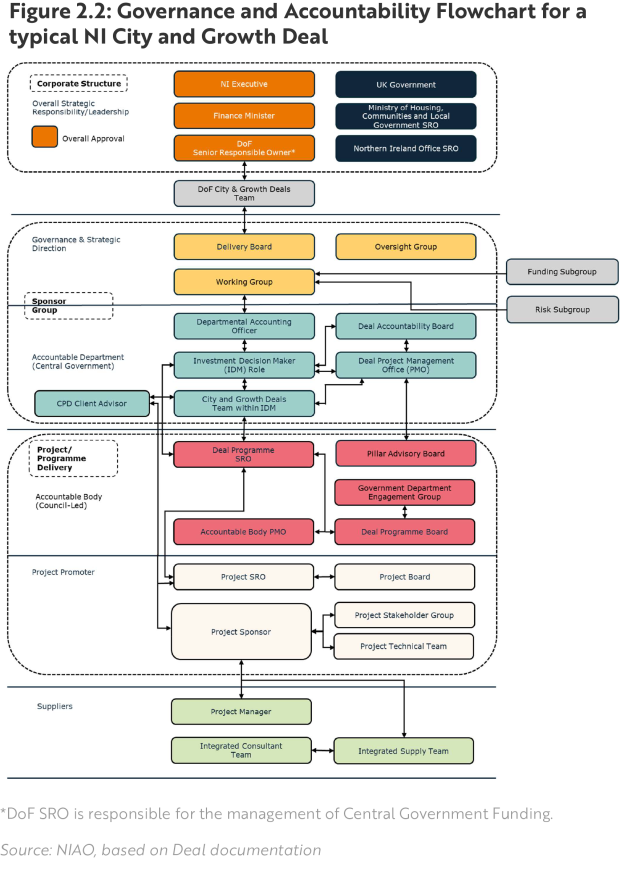
2.13 Accountability for Deal expenditure sits with the relevant Accountable Department, which is the central control point for funding approvals and financial accountability within the Deals’ governance framework. An Accountable Department manages funding drawdowns from the NI Executive and UKG, holding Accounting Officer accountability for this funding; approves City and Growth Deal funding expenditure; enforces the conditions in place which govern the provision of funding to an Accountable Body (council-led) and provides a lead on business case approval and assurance processes, while also ensuring governance; Value for Money and compliance across Deal projects.
2.14 An Accountable Body fulfils a number of roles in relation to Deal project progression, including ensuring compliance with funding arrangements, and is overseen by the Deal Programme Board. The responsibility for the delivery of a Deal project rests with a project promoter. In his role as SRO for the four Deals, the DoF Permanent Secretary requires sufficient assurance that projects are being delivered on time and to plan. Focus Group attendees told us that monthly informal meetings, facilitated by DoF staff, take place with Accountable Department representatives.
Governance and accountability arrangements have been tailored according to the nature of the projects within the Deals
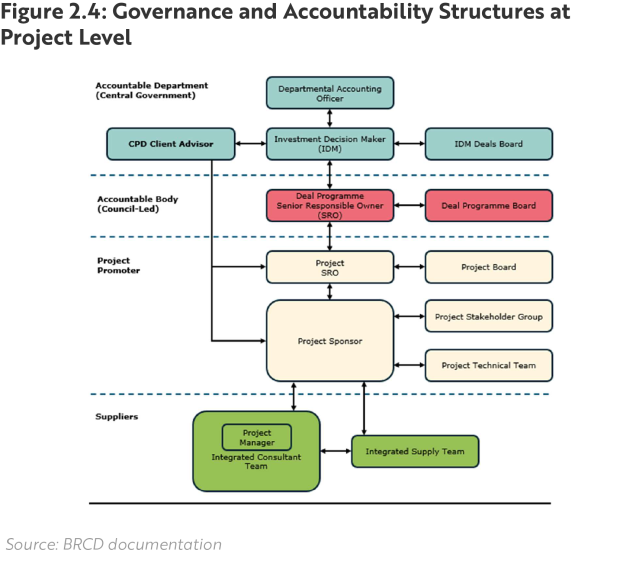
2.15 The overarching framework allows governance arrangements to be tailored to reflect the nature of individual Deals. In practice, this has become more evident as Deals have progressed. In the case of DCSDC, two investment pillars have been developed to progress innovation and regeneration projects, while CCG has adopted alternative arrangements, with Delivery Board agreement, to achieve similar outcomes. DCSDC also utilises steering groups at Programme and Project level. In Figure 2.3, BRCD has been used to illustrate an example of governance and accountability structures at Deal level. Figure 2.4 sets out the equivalent structures in place for a Deal at project level.
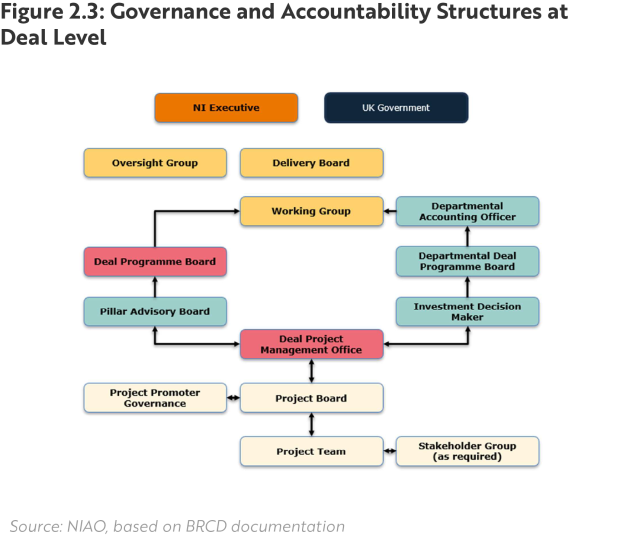
2.16 As Figure 2.3 shows, for BRCD, the Deal Programme Board collaborates with a Pillar Advisory Board. Deal Programme Boards work closely with advisory or project-specific boards, while strategic oversight remains with central governance groups – the Working Group, Delivery Board and Oversight Group. Reporting is primarily by exception, supported by informal engagement with DoF to address emerging issues. Focus Group participants highlighted the value of this approach, including cross-Deal cooperation and the sharing of ‘lessons learned’ on an ongoing basis.
Project-level governance and programme management
2.17 In the case of BRCD, the ‘Accountable Body’ referred to in Figure 2.4 is Belfast City Council (the ‘Lead Council’) within which a Deal Project Management Office (PMO) was established to support and guide the Deal Programme Board in meeting its governance responsibilities. Each Deal, whether several Councils (BRCD and MSW) or a single Council are involved (DCSDC and CCG), has established a PMO to support the Accountable Body and the Deal Programme Board. PMOs coordinate with project boards, project teams and promoters as projects move into delivery.
2.18 Where Councils are also project promoters, or where projects are Department-led, arrangements have been adapted to reflect these roles. For example:
- for the CCG Deal, the Council is also acting as project promoter for several of its projects. Staff from the Strategic Investment Board are working with the CCG PMO (under an Operating Partnership Agreement) on project progression across all Deal projects; and
- for the MSW Deal, many of its projects are Department-led (such as Department for Infrastructure (DfI) on the A4 Enniskillen Bypass construction project) and the liaison role is conducted through an MSW PMO in conjunction with Deal representation on the associated Project Boards.
Both of these approaches illustrate ways in which clear lines of reporting can be promoted.
2.19 Within the BRCD Deal, its PMO liaises across two Accountable Departments – DfE and Department for Communities (DfC), according to the projects involved. DfE is involved in over 40 projects across all four Deals, and for BRCD, it has appointed SROs to act in an Investment Decision Maker (IDM) role within its Arm’s Length Bodies, including Invest NI, Tourism NI and NI Screen. The IDM role is the provision of delivery expertise, each with their own arrangements. For the Studio Ulster project, for example, the appointed IDM
is NI Screen.
2.20 We understand that the purpose behind the use of IDMs has been to integrate City and Growth Deals within the wider remit of those organisations through direct engagement, as a means to enhance and accelerate Deal delivery. We are also aware that, over time, the internal arrangements for IDM involvement at the project level have evolved in response to progress delays.
2.21 The IDM model, formally established in 2023, integrates Deals within existing departmental structures and – in the case of DfE – this has removed the need for a separate Departmental Deal Programme Board. It also means that the focus of liaison roles is between the City and Growth Deals Team within the IDM and the Departmental City Deal PMO. We consider that this approach promotes clear lines of accountability and reporting.
Deal Programme Boards are central to the governance and oversight of overall Deal delivery
2.22 Deal Programme Boards are central to the governance and oversight of each Deal and its overall delivery. Membership typically includes Local Government Officers and staff working within the Accountable Body, as well as partner organisations (project promoters) including Universities; Further Education Colleges and a Health and Social Care Trust. For the CCG Deal, councillors also play a role. PMO support staff attend in an advisor or observer capacity, with a Delivery Board member also present as an observer.
2.23 Effective collaboration alongside co-operative working is essential to delivery, given the breadth of Programme Board membership. This was observed from our Focus Group discussions, where Board members also acknowledged the benefit of learning from BRCD’s experience for their Deals. The ‘Critical Friend’ arrangement between the North Wales Growth Deal and the CCG Deal has also provided a good opportunity for collaboration.
2.24 The MSW Deal has not yet finalised its governance arrangements in full. As the Deal progresses towards this point, the first meeting of its Programme Executive Board took place in late April 2026. Prior to this, arrangements took the form of a Project Governance Reference Group of Chief Executives and councillors to steer the Deal, and the majority of its Deal projects across all three Council areas are externally-led. Final sign-off of the MSW governance arrangements by the City and Growth Deals Delivery Board is currently awaited.
2.25 While we acknowledge ongoing engagement between DoF and MSW, the absence of finalised governance arrangements represents a governance gap for the Deal as a whole.
Recommendation 2
Final sign-off of the governance arrangements for the Mid South West Growth Deal should be achieved without delay, in order to close the existing governance gap for the Deal as a whole.
Governance structures are being revisited over the Deal lifecycle as key milestones are achieved
2.26 We found evidence that Deal Programme Boards are reviewing governance arrangements as Deals reach key milestones, for example by reconstituting steering groups as formal project boards, once delivery begins. This is good practice and helps ensure that governance remains proportionate and fit for purpose throughout the lifetime of each Deal.
There are more than 150 Central and Local Government staff currently involved in progressing a Deal
2.27 To understand the scale of governance activity, we reviewed the number of Central and Local Government staff involved in supporting a single Deal. Based on information from the overarching guidance document, additional governance groups identified during fieldwork, and meeting records, we estimate that more than 150 staff may be involved in governance and oversight of any one Deal. This is based on the roles set out in the Governance and Accountability Flowchart at Figure 2.2. This figure has been adjusted to avoid double counting individuals with multiple responsibilities.
2.28 In Part 3 of this report (paragraphs 3.55-3.59), we consider the extent to which general administrative and support costs associated with Deal governance (direct and indirect) are currently being captured. This information will be important in supporting future assessments of Value for Money across the Deals.
Part Three:
Assessing Deal Progression
Introduction
3.1 This Part of the report examines the utilisation of public monies across Deals since the announcement of the BRCD in 2018. This assessment is undertaken in the context of the governance and accountability arrangements described in Part Two.
3.2 The City and Growth Deals represent a significant opportunity for Central and Local Government to work collaboratively to deliver long-term economic and social benefits across all parts of Northern Ireland. This opportunity is underpinned by substantial capital investment commitments from the UKG and the NI Executive. In addition, Deal partners have committed funding in excess of £500 million, demonstrating a significant level of local investment. Our review of progress at this early stage highlights areas of ongoing good practice and aspects where improvement is required to support effective and timely delivery.
Since the introduction of the Northern Ireland City and Growth Deals in 2018, overall progress on delivering Deal projects has been slow
3.3 There has been insufficient progress across the Deals at this stage to provide the basis for a comprehensive assessment around delivery to budget and time. At the time of writing this report, the MSW Deal has not yet been signed; the CCG Deal signing has recently taken place; DCSDC projects are advancing and there are only a small number of projects operational within BRCD, which were delivered later than planned. Overall, since the introduction of the Deals in 2018, progress has been slow.
A number of Deal-related strategic risks have been identified
3.4 As part of our review, we held Focus Group discussions with Deal Programme Board members, who identified a number of strategic risks affecting the delivery of the Deals. These included:
- continuing financial affordability at both Deal and individual project level;
- shared accountability for projects that are not Council-led, giving rise to potential reputational risk, without direct control over delivery;
- project delays and slippage against agreed timelines;
- future sustainability risks, depending on the project type; and
- the ability to realise the intended benefits of approved projects (‘benefits realisation’).
3.5 We found that financial affordability risks are reflected within Deal Risk Registers. However, other strategic risks identified by Programme Board members were not consistently captured or managed through formal risk management processes. The 15-year timeframe around the funding envelope from Deal signing from the NI Executive and UKG is not currently included as a key risk. This is discussed further in the next section.
Although Central Government funding allocations are linked to a 15-year delivery timeframe, this has not been included as a key strategic risk in Deal Risk Registers
3.6 Figure 3.1 summarises progress by Deal since 2018. For each Deal, potential projects will have initially been developed through a Strategic Outline Case (SOC) and, with approval, moved on to the Outline Business Case (OBC) stage. Achieving SOC development allows a ‘Heads of Terms’ Agreement to be drafted, consulted on and agreed as a non-binding arrangement with the NI Executive and UKG for an indicative investment of funds for the agreed list of projects. Deal signing then progresses this further, by formally establishing the commitment of the parties involved to full Deal implementation, detailed within a formal ‘Deal document’.
Figure 3.1: Key Stages in the Progression of the NI City and Growth Deals
| Deal | Initial Announcement | Heads of Terms Agreement signed | Deal signing | Deal Delivery commenced | First Operational Project | Funding timeframe after Deal signing |
|---|---|---|---|---|---|---|
| BRCD | 2018 | 2019 | 2021 | 2022 | 2024 | 2036 |
| DCSDC | 2019 | 2021 | 2024 | 2025 | - | 2039 |
| CCG | 2019 | 2024 | 2026 | 2026* | - | 2041 |
| MSW | 2019 | 2024 | - | - | - | - |
*estimated
Source: NIAO, based on Deal documentation
3.7 Central Government capital funding allocations across the Deals total £1.334 billion and are fixed in value. A Heads of Terms Agreement notes that there is a timeframe associated with this funding of 15 years from the signing of the Deal and the Financial Agreement. For the signed Deals, this means a funding timeframe of 2036 for BRCD, 2039 for DCSDC and 2041 for CCG.
3.8 Given the timeframe and fixed value linked to these allocations, delays in Deal progression present a potential risk to funding if delivery does not accelerate. Despite this, we found no evidence that the risk of future loss of funding resulting from delays has been recognised or addressed within Deal Risk Registers. When we asked DoF how it was managing this risk, it told us that it will propose to the Delivery Board the addition of this as a risk in the overarching Central Government RAIDD (Risks, Assumptions, Issues, Dependencies, Decisions) document. The Delivery Board considers the RAIDD document as part of its quarterly meetings and reviews it on an annual basis. The next review is due in Summer 2026.
Recommendation 4
The timeframe around potential availability of Deal funding should be explicitly recognised and managed as a strategic risk across all Deals and within DoF’s own risk framework.
DoF and Deal Programme Board members have identified factors affecting rollout
3.9 DoF told us that a slower than expected rollout of the Deals since their initial announcements was due to several factors:
- the length of time normally required for major capital projects to progress from Strategic Outline Case through to Full Business Case, procurement, construction, fit-out and operation, which can exceed seven years;
- the impact of Covid-19 and wider economic conditions which required some projects
to be reshaped; - the additional complexity associated with Deals involving more than one Council; and
- the need to ensure that ‘Social Value’ considerations, including wider financial and
non-financial impacts on the wellbeing of individuals, communities and the environment (extract from the ‘DoF Scoring Social Value Policy’), are fully addressed.
From in-year budgetary monitoring information provided by DoF, we have also noted the extent to which initial expenditure profiles (which reflect the expected utilisation of Deal project funding allocations) have been subject to in-year adjustments, reflecting a slower rate of progress than originally anticipated. DoF and the Deals have also highlighted to us the uncertainty and delays around Deal progression resulting from periods of suspension of the Northern Ireland Assembly (from January 2017 to January 2020 and again from February 2022 to February 2024) and the temporary pause in funding by UKG affecting some Deals which began in September 2024, alongside extraordinary cost inflation. DfI has told us that climate change-related legal issues around an infrastructure project (external to the Deals) have also had a wider impact.
3.10 We also undertook benchmarking against City and Growth Deals in other UK regions and found that, by comparison, the NI Deals have progressed at a slower overall rate. NI Deal representatives have told us that, in their view, the variation in governance structures operating and the nature of Deal rollout in other UK regions, in addition to the circumstances highlighted in paragraph 3.9, means that it is not possible to make a direct, like-for-like comparison with the NI Deals.
3.11 Deal Programme Board members identified further factors affecting delivery, including:
- the time taken to establish effective working relationships between Deals, Accountable Bodies and government Departments;
- lengthy approval timescales between initial SOC approval and subsequent business case stages; and
- perceptions that the level of scrutiny applied to submissions prepared by appropriately skilled and often experienced staff was, in some cases, overly cautious.
3.12 Deal Programme Board members also highlighted that delays in project delivery have different impacts across the governance framework. While Accountable Departments managing ring-fenced funding may face limited immediate operational consequences, Accountable Bodies and Deal Programme Boards must manage the ongoing impacts of delays. Accountable Departments may also face reputational risks arising from project slippage and potential funding shortfalls.
Time delays and financial pressures reported through governance structures
3.13 Figures 2.1 and 2.2 explained the purpose and positioning of the various established groups which operate at the Governance and Strategic Direction level for the Deals. We reviewed minutes from the City and Growth Deals’ Delivery Board, Working Group and Oversight Group meetings during 2025 to examine the nature of issues escalated under ‘reporting by exception’ arrangements. This review identified repeated references to delays, funding uncertainty and financial pressures across multiple Deals.
3.14 Issues reported during the year included:
- delays in agreeing Deal governance arrangements;
- slow progress in Deal progression following signing;
- expectations of delay in formal Deal sign off;
- changes in Accountable Department responsibilities and funding shortfalls affecting individual projects;
- projects progressing ‘at risk’ through temporary self funding; and
- financial pressures leading to timeline slippage, re-scoping and reduced project ambitions in several projects.
Since 2018, changes in the arrangements governing the timing of Deal funding have led to better alignment with funding needs
3.15 Northern Ireland Civil Service (NICS) Internal Audit examined the City and Growth Deal arrangements in 2024 and identified weaknesses in the accuracy of funding profiles prepared by councils. The original approach involved UKG funding being allocated on a flat-line basis over a 15-year period. However, limited project readiness meant that £40 million allocated in 2019-2020 and 2020-2021 could not be fully utilised.
3.16 As a result, £22.2 million was returned to UKG, with £17.8 million retained by the NI Executive for other non-Deal capital projects. No further UKG funding was released over the following three years. By 2024-25, arrangements had been made to clear the remaining £10 million balance ‘owed’ by the NI Executive in respect of UKG-funded projects. However, if project momentum had surged between 2021-22 and 2024-25, the NI Executive could have been called on to replace UKG project funding at a time when it also needed to be prioritised elsewhere. There was an ongoing risk of this occurring throughout the period.
3.17 DoF told us that it subsequently worked with the UKG to amend the methodology, achieving better alignment between funding availability and project delivery timelines.
3.18 We note that Accountable Departments, working with Accountable Bodies, are now more actively involved in in-year budget monitoring and that the signing of Deal documents provides a stronger framework for financial oversight.
By March 2025, the Deals had utilised less than 5 per cent (£58 million) of the Central Government capital funding allocation
3.19 Figure 1.1 in Part One set out details of the fixed capital funding allocations across the Deals. After each Deal signing, the Deal document is linked to a ‘Financial Agreement’ and a ‘Financial and Implementation Plan’. This Agreement outlines the collective financial commitment to delivering the project outcomes detailed in each approved business case, over the Deal’s lifetime, while the Plan provides detailed project funding profiles, along with the arrangements for financial stewardship and accountability controls around delivery.
3.20 Each operational Financial and Implementation Plan links profiled spend with in-year budgetary monitoring processes for each stage of a project, from OBC to Contract for Funding (CfF), Full Business Case (FBC) and into the delivery phase. Following the Internal Audit findings around the misalignment of UKG funding allocations referred to already, DoF proposed that “18-24 months after Deal signing would be the most appropriate time to conduct a reprofiling exercise to ensure that the funding plan better aligns UKG funding provision with the Deals’ implementation plans”. For the BRCD Deal signed in 2021, this was actionable immediately. Internal Audit subsequently noted an agreement reached with UKG “that the BRCD reprofiling exercise can be postponed until August 2025, in order for delivery to progress further in anticipation of greater certainty on projected spend” and “the DoF City Deals Team advised that they plan to conduct a scrutiny exercise of the BRCD’s financial profiles for all projects, in collaboration with Accountable Departments, to assist in informing the UKG reprofiling exercise”. This was completed in mid-2025.
3.21 Prior to this, DoF’s City and Growth Deals Team issued a ‘Lessons Learned’ document in February 2024 which emphasised requirements around the generation of robust, accurate and realistic funding profiles by the Deals and the importance of the inputs from each Deal’s Project Management Office (PMO) within the Accountable Body; the Accountable Department role and DoF’s challenge function being exercised throughout Deal progression.
3.22 Given DoF’s oversight of the Deals, it holds details of annual NI Executive and UKG funding utilisation across each of the Deals. Confirmed spend figures were available for the three years to 2024-25. Budget forecast figures were provided for 2025-26, with actual spend to be confirmed to DoF in late 2026, once expenditure figures have been finalised by the Accountable Departments. The table at Figure 3.2 is based on our analysis of this information.
3.23 Unused ring-fenced Deal funding remains available for future use, in line with agreed arrangements. We also note that there are detailed arrangements in place for use by Accountable Departments in the management of funding drawdowns.
Figure 3.2: Actual and Budgeted Central Government Funding Allocation Expenditure for the period 2022-23 to 2025-2026
| Deal | NI Ex/UKG Deal Funding Allocations £m | 2022-23 Expenditure £m | 2023-24 Expenditure £m | 2024-25 Expenditure £m | % of NI Ex/UKG Funding utilised at March 2025 | Budget Forecast Expenditure for 2025-26 after January 2026 In-Year Monitoring Round adjustments £m | % of NI Ex/UKG Funding Budgeted for use during 2025-26 | Total Value of NI Ex/UKG Funding utilisation by March 2026 (Budget Forecast) £m | % of Total NI Ex/UKG Funding utilisation by March 2026 (Budget Forecast) |
|---|---|---|---|---|---|---|---|---|---|
| BRCD | 700 | 3.060 | 5.356 | 47.922 | 8.05 | 47.879 | 6.84 | 104.217 | 14.89 |
| DCSDC | 100 | – | – | – | – | 3.257 | 3.26 | 3.257 | 3.26 |
| Inclusive Future Fund (IFF)* | 110 | – | 0.088 | 0.095 | 0.17 | 0.685 | 0.62 | 0.868 | 0.79 |
| CCG | 72 | – | – | – | – | – | – | – | – |
| MSW | 252 | – | – | – | – | – | – | – | – |
| NI Executive Complementary Fund (NIECF)** | 100 | – | 0.364 | 1.281 | 1.65 | 3.126 | 3.13 | 4.771 | 4.77 |
| Overall Funding Utilisation by % and Value | £1,334m | £3.060m | £5.808m | £49.298m | 4.36% | £54.947m | 4.12% | £113.113m | 8.48% |
| £58.166m overall |
*additional Deal funding for DCSDC from the IFF.
**additional Deal funding which is available to BRCD; CCG and MSW - the NIECF comprises up to £100 million, with £52 million allocated across five projects in a first round of funding in December 2021.
Source: NIAO, based on DoF documentation
3.24 Overall, Figure 3.2 shows that by March 2025, less than 5 per cent (£58 million) of the total £1.334 billion Central Government capital funding allocation had been utilised across all Deals. Forecasts indicate that utilisation was expected to reach approximately 8.48 per cent by March 2026.
3.25 Our detailed analysis has highlighted the following:
- for the BRCD Deal (excluding any NIECF funding utilised), 8.05 per cent of the £700 million in available funding had been used by March 2025 and the forecast utilisation by March 2026 was 14.89 per cent;
- funding utilisation for the other Deals by March 2025 was 0.17 per cent for DCSDC; 0 per cent by CCG and 0 per cent by MSW;
- total utilisation by March 2026 was forecast at 4.05 per cent for DCSDC; 0 per cent for CCG and 0 per cent for MSW; and
- for the 5 projects currently in receipt of funding allocations from the NI Executive Complementary Fund (totalling £52 million to date), funding utilisation by March 2025 had reached £1.65 million, with forecast spend of £4.77 million by March 2026.
3.26 Our analysis also identified instances of misalignment between profiled and budgeted expenditure. For BRCD and DCSDC, profiled expenditure to March 2026 was estimated to exceed current budget forecasts by approximately £29 million (60 per cent) and £6 million (60 per cent) respectively.
3.27 The 2025-26 Financial and Implementation Plan for BRCD shows that NI Executive/UKG funding drawdowns were expected to begin in 2021-22 and that by the end of 2024-25, 6.9 per cent (£47.97 million) of the available monies were profiled to be spent. In fact, an additional £8.37 million (1.2 per cent) had been spent by March 2025, with a further £76.59 million profiled for use by March 2026. This is around £29 million more than the current budgeted expenditure forecast of £47.88 million. For DCSDC, equivalent documentation shows that £0.39 million was profiled to be spent by March 2025 (actual was £0.18 million) with a further £10.26 million in funding to be utilised by March 2026, some £6.13 million more than the current budgeted expenditure forecast of £4 million.
The inflationary impact on funding, along with delays in Deal progression, increase the potential that future funding shortfalls will occur
3.28 In our review of Deal Programme Board minutes, the inflationary effects on funding from any delays in Deal rollout was discussed by one of the Deals in late 2025. Even with the effects of inflation factored in to business cases, any delays in Deal progression increases exposure to ongoing inflationary pressures, reducing the real value of fixed funding envelopes, particularly in the present economic climate. As shown in Figure 3.3, based on an estimated annual inflation rate of 3 per cent, the unspent funding balance of approximately £1.221 billion at 31 March 2026 would lose around £37 million in value for each year of delay, equivalent to £3.05 million per month and an annual reduction of between £2 million and £18 million per Deal. This highlights the importance of timely project delivery in maximising the value achieved from available public funding.
3.29 With time delays and financial pressures having been consistently highlighted across the Deals, the inflationary impact on funding from all sources, in the present economic climate, will continue to present a further challenge to the successful management of ongoing Deal project development and delivery.
Figure 3.3: The annual impact of inflation on Deal funding is estimated to be around £37 million
| Deal | Total Value of NI Ex/UKG Deal Funding Allocations £m | Total Value of NI Ex/UKG Funding Utilisation by March 2026 (Budget Forecast) £m | NI Ex/UKG Funding Balance at 31 March 2026 £m | Annual Inflationary Impact at 3% £m | Monthly Inflationary Impact at 3% £m |
|---|---|---|---|---|---|
| BRCD | 700 | 104.22 | 596 | 17.88 | 1.49 |
| DCSDC | 210 | 4.12 | 206 | 6.18 | 0.51 |
| CCG | 72 | - | 72 | 2.16 | 0.18 |
| MSW | 252 | - | 252 | 7.56 | 0.63 |
| NI Executive Complementary Fund | 100 | 4.77 | 95 | 2.85 | 0.24 |
| TOTAL | 1,334 | 113.11 | 1,121 | 36.63 | 3.05 |
Source: NIAO, based on Deal documentation
Achievement of planned delivery outcomes
3.30 The need for additional funding is an issue that has been raised across the Deals. In addition to Deal partners, particularly councils and the education sector, supplementing initial funding commitments, sources of external funding, such as the Heritage Lottery Fund, have also been accessed. In parallel, requirements for Deal projects to meet climate change obligations, including climate action plans and net zero targets, may give rise to additional costs that were not fully anticipated at the outset. Any uncertainty around funding availability increases risks to project delivery. If inflationary pressures and the need for additional funding persist, there may be implications for other council-funded activities and future ratepayer levies, as well as for other Deal partners.
Responsibility for managing strategic risks associated with Deal projects is devolved to Accountable Departments and Accountable Bodies
3.31 An Overall Deal Risk Assessment covering the period April-June 2025, circulated to members of the Delivery Board highlighted a ‘High Status’ risk relating to the identification of Digital and Innovation projects, and a ‘Critical Status’ risk associated with revenue pressures. These revenue pressures relate to the future costs of operating and maintaining projects once they become operational and may be exacerbated by delivery delays or by inaccurate cost projections at earlier stages. DoF told us that, under the devolved accountability framework, responsibility rests with the relevant Accountable Department, any associated Investment Decision Maker (IDM), and the Accountable Body for the Deal, working through the project promoter.
While approaches to project development have evolved over time, the duration of the review process at key stages remains a significant issue for Deal progression
3.32 Each Deal PMO, located within the Accountable Body, supports project development activities and manages submissions to the relevant Department/s for clearance prior to approval. Initially there was a DoF requirement in place that all OBCs should be signed off prior to a formal Deal financial document being signed. However, over time, this was amended to assist with more timely Deal progression, and the current requirement for OBC approval is for at least 50 per cent of each funding source to be confirmed. Since BRCD, this is being managed through the use of a phased approach, which allows groups of projects to attain the 50 per cent threshold required to progress to the next development stage.
3.33 Across the Focus Groups, Deal Programme Board members told us that the duration of the OBC stage has largely been driven by the volume and nature of clearance queries raised by Departments. These delays affected delivery timelines, eroded project value through inflation and, in some cases, affected viability. DCSDC records show that average OBC approval times across five projects were 11.8 months.
3.34 The Deals participate in a Government Department Engagement Group – depending on the Deal, this may bring together Accountable Bodies, UKG and NICS Departments and their Arm’s Length Bodies. Meeting minutes record an expectation that Departments may require up to six months to review OBCs. Departments have also indicated that reducing unnecessary detail in submissions would support more efficient review and have told us that the purpose behind “detailed business case review is to ensure that these are fit for purpose”.
3.35 Deals have had sight of ‘Lessons Learned’ outcomes circulated to highlight the importance of early procurement consideration; validation of cost estimates; explicit articulation of assumptions, including worst-case scenarios, and clear demonstration of post-completion financial sustainability. Costs associated with business case development work up to the approval of the OBC stage are funded by the relevant Accountable Body (council) or, in some cases, by project promoters. One Focus Group highlighted that retrospective procurement advice increased time and cost pressures.
In addition, DoF has told us that further updates of the City and Growth Deal Team’s specific City and Growth Deal-related ‘Lessons Learned’ document had been circulated across the Deals in January 2025 and again in May 2026.
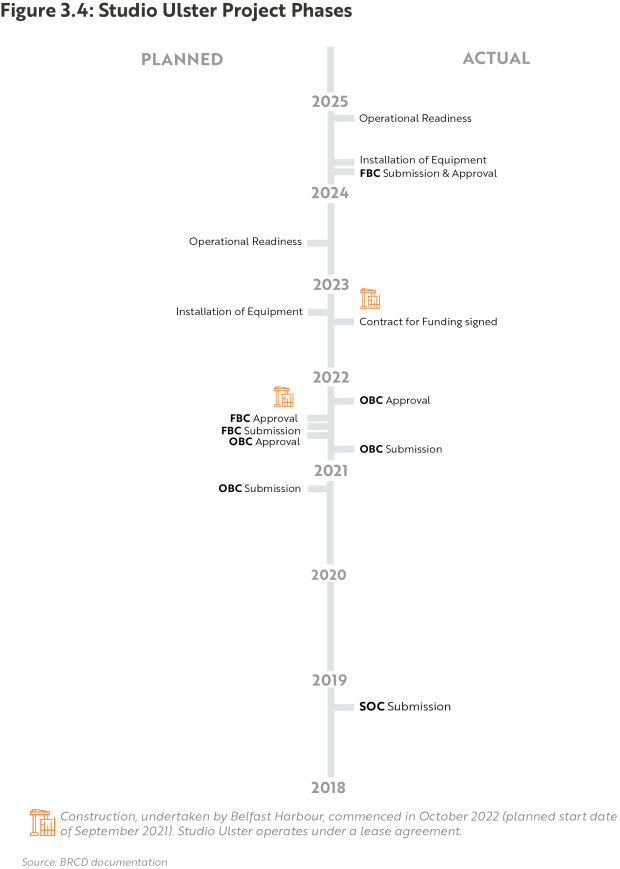
3.36 BRCD’s Studio Ulster project was the first Deal project to reach ‘operational readiness’, in late 2024. From the submission of an initial Strategic Outline Case (SOC) which took place in September 2018, planned and actual delivery milestones are illustrated in Figure 3.4.
Recommendation 3
Clearer expectations and monitoring of progress against key delivery milestones for individual projects should be introduced, including business case approval stages.
Each Deal Programme Board is tasked with managing the ongoing challenges to enable project delivery to be achieved
3.37 Deal Programme Boards play a central role in managing delivery challenges. Evidence from minutes and Focus Groups shows that several projects have been re-scaled, reshaped or discontinued following business case review and advice from Accountable Departments, where business case approval conditions cannot be met or where cost inflation has become excessive. Examples include:
- the shelving of a Greenway project at concept stage (CCG), due to vesting issues;
- a Mountsandel site project (CCG) being dropped due to an inability to demonstrate Value for Money and sustainability;
- reshaping of the Coleraine Leisure and Wellbeing Centre (CCG), due to funding concerns;
- reshaping of the Dungiven Regeneration project (CCG) following DfI advice;
- the merging of two projects with separate SOCs into a single project with shared facilities, now known as the Cognitive Analytics and Digital Robotics Innovation Centre (CADRIC) (DCSDC), due to cost escalation;
- the re-scaling of BRCD’s i4C (Innovation and CleanTech Centre) project due to additional funding pressures that could not be met by the lead promoter involved [Mid and East Antrim Council] – this required submission of a casework addendum; and
- cessation of the BRCD Mourne Mountains Gateway project, due to land leasing issues related to environmental concerns.
3.38 Benchmarking with other UK Deals highlights the importance of early, decisive intervention. The actions taken to mitigate the impact of delays have generally been to seek additional funding from existing Deal partners while identifying other possible external sources of funding, alongside project re-scaling or re-scoping. However, this can result in time delays, when existing cost estimates can escalate and additional funding may not be available. Any substantial change in a project’s coverage risks reducing its original integrity, while significantly diluting the outcomes originally envisaged. If this occurs on a high-profile project, this can overshadow the wider positive impacts of the Deal as a whole. However, it is also acknowledged that, on occasion, a decision to re-scope or cease a project may be appropriate if better overall Value for Money can be achieved as a result.
3.39 Changes also result in nugatory expenditure and lost staff time and delays on progressing other (viable) projects, with additional inputs needed to generate replacement projects in order to utilise the allocated funding. For the Mourne Mountains Gateway project (with a £30 million NI Executive funding allocation), BRCD estimated sunk development costs to be approximately £1 million, £0.5 million of which was funded by Newry, Mourne and Down District Council and a further £0.5 million by BRCD.
Timing and cost issues associated with Deal projects have been raised in previous reporting by NIAO on major capital projects
3.40 Timing and cost pressures mirror those identified in previous NIAO reporting. The February 2024 Major Capital Projects: Follow-up Report referenced persistent time delays and cost overruns which had also featured in the original NIAO Major Capital Projects report published in 2019, linked to a number of internal and external factors. It highlighted: (1) Belfast Rapid Transit (BRT), a NI Executive Flagship project, setting out the timeline and spend and noting that final costs incurred were £6 million more than the approved business case (although within the DoF permitted tolerance limit); and (2) BRT2, which was identified in August 2018 for potential future delivery as part of BRCD, with a capital investment funding allocation of £35 million from the NI Executive (and an estimated £148 million project cost at that time).
3.41 By February 2025, and with a revised OBC reported to be ‘at an advanced stage’, the DfI Minister announced that the proposed BRT2 extensions to Glengormley and Carryduff were not considered ‘economically viable’ and would not be added to the original project scope – the project cost estimate is currently £124.5 million. Despite an additional £13 million being committed by DfI to proceed with Phase 1 of BRT2, a funding shortfall of some £76.5 million remains. DfI told us that, although a public consultation in 2021 had indicated 2027 as a potential operational start date, over the four-year period to 2025 the project remained largely unfunded and progress was significantly constrained by the period of suspension of the Northern Ireland Assembly from 2022 to 2024, in terms of decision-making. As a result of these factors, the anticipated operational date has been revised to 2033, allowing for a six-year construction phase, if the full funding allocation is made available. Of the original £35 million ring-fenced capital funding allocation, forecast spend of £5 million by March 2026 was reduced to £0.5 million following the January 2026 In-Year Monitoring Round – DfI has told us that this downward adjustment to the original £5 million of forecast spend was linked to planned land acquisition that did not proceed, as the land was not available at that time, and that the funding profile adjustment aligns with updated delivery timelines.
3.42 If delivered as currently envisaged in 2033, the BRT2 project will have been subject to inflationary and other economic factors over a prolonged period and delivered some six years later that initially planned. DfI told us that, while this extended timeframe is notable, particularly in light of experience from the completed BRT project, lessons learned have been actively incorporated into the planning and delivery approach for BRT2, which has informed the more streamlined and efficient delivery model currently being implemented.
In its role as an Accountable Department, the Department for the Economy has identified capacity and capability as a key strategic risk for NI City and Growth Deals
3.43 In its role as an Accountable Department, the Department for the Economy (DfE) has identified capacity and capability as a key strategic risk to the successful delivery of the City and Growth Deals. In line with its Departmental policy responsibilities, DfE acts as an Accountable Department for the Tourism and Innovation pillars of the Deals. Given its involvement in more than 40 projects across the Deals, with funding totalling approximately £800 million, we met with Departmental staff to understand the nature and scale of the activities required to fulfil this role.
3.44 DfE’s involvement in Deal progression is delivered through its City and Growth Deals Project Management Office (PMO), working in conjunction with three Investment Decision Makers (IDMs), as described in paragraph 2.19. The Accountable Department role includes:
- supporting the development of robust projects that deliver Value for Money;
- ensuring strategic alignment between projects and across Deals;
- approving all project expenditure; and
- ensuring that appropriate governance and accountability arrangements are in place throughout project development and delivery.
3.45 DfE told us that the extent of Departmental and IDM Deal-related inputs includes significant involvement in project development, from initial proposals to SOCs and through all stages of the business case process. This has also included co-design activity, such as leading development of the business case for a £74 million Decarbonisation Programme to secure UKG funding for the MSW Deal, thereby enabling the signing of its Heads of Terms Agreement. More recently, NI Screen has been undertaking post-delivery promotional activity following the launch of Studio Ulster. Departmental Board minutes indicate that these activities were undertaken in response to recognised programme and project management capacity and capability issues within BRCD and MSW. The costs associated with these and other Deal-related inputs are examined further in paragraphs 3.55 to 3.59. MSW has told us that it regards the issues highlighted as challenges which were largely forseeable, given the complexity, scale and multi-stage approval processes associated with innovative Deal projects. Given this context, MSW also considers that there was an opportunity for Accountable Departments to anticipate these requirements and make appropriate provision at an earlier stage to mitigate emerging capacity and capability constraints.
3.46 ‘Failure to deliver City and Growth Deal projects’ has been included as a corporate risk on the DfE Risk Register since 2021. Mitigating actions have included establishment of the Departmental PMO, development of the IDM roles and implementation of a Development and Capability Strategy. While sharing expertise has mitigated skills gaps, it also places pressure on DfE’s wider workload. The BRCD and MSW Risk Registers also include references to capacity and capability. For MSW, these relate to insufficient resourcing, with gaps in expertise partly linked to the unavailability of university sector input for the Deal.
3.47 The extent to which some Deals rely on DfE’s programme and project management expertise indicates a broader skills shortfall outside the Accountable Department framework. While DfE’s willingness to share expertise represents good practice, its extensive involvement across the Deals also creates pressure on the Department’s ability to progress its wider ‘business as usual’ responsibilities in a timely manner.
3.48 Issues relating to the availability of project-related expertise are reflected in NIAO’s January 2026 report on Leading and Resourcing the Civil Service. This report notes that Programme and Project Management featured among the top five skills gaps identified from an NICS survey in 2024. Despite the introduction of a Project Delivery profession within the NICS in 2022, skills analysis indicates that these shortages have yet to be resolved. Given the long timescales and complexities of the Deals, this creates urgency for the work underway through the NICS People Strategy 2025-30 to address Programme and Project Management capability to be progressed at pace.
Recommendation 11
Collaboration should continue and be further strengthened between Central and Local Government to address Programme and Project management capacity and capability constraints, particularly as delivery activity accelerates.
Although current efforts are focused around individual Deal development and project progression, the Deals consider that the financial sustainability of projects could represent a future strategic risk
3.49 Although current efforts are primarily focused on individual project development and progression, Deal partners consider the financial sustainability of projects once operational to represent a significant future strategic risk. Each Deal project has a designated project promoter that has made an initial financial commitment and provided a formal undertaking to underwrite future revenue costs and any project cost overruns. This arrangement underpins both the ongoing viability of the project and the realisation of agreed benefits, as set out in each project’s Contract for Funding.
3.50 DoF first identified the potential for revenue pressures in November 2020, recognising the risk that project promoters may be unable to meet operating costs and could look to the NI Executive to protect the viability of the original capital investment. At that time, likely contributory factors were identified as:
- unrealistic revenue generating assumptions;
- underestimation of operating costs by project promoters; and
- continued submission of OBCs that assumed the availability of revenue support.
3.51 Controls introduced to manage this risk included Departmental affordability and funding source assessments; formal promoter underwriting of revenue costs; testing of affordability assumptions throughout the business case approval stages and ongoing liaison between parties. The City and Growth Deals Delivery Board is accountable to both the NI Executive and UKG for the successful implementation of each Deal.
3.52 In our Focus Group discussions with Deal Programme Board members, including project promoter representatives, financial sustainability was consistently identified as a significant strategic risk going forward. This risk is included in Deal Risk Registers and is considered regularly by Boards. Participants also highlighted concerns regarding the Employability and Skills Strategy in place, which currently lacks a dedicated funding stream to support its implementation. Given DoF’s efforts since late 2020 to actively manage the revenue pressure risks, the persistence of these concerns is notable.
3.53 The long-term nature of Deal projects, with control periods of up to 25 years depending on project type, increases the importance of ensuring that funding sustainability commitments made by project promoters are realistic and deliverable over time. In this context, and with the responsibilities of the DoF Permanent Secretary, as SRO across the Deals, encompassing the management of Central Government funding, Accountable Departments will have a role in ensuring that future funding commitments arising from approved Deal projects can be met.
Recommendation 5
As Senior Responsible Owner, whose role encompasses the management of Central Government funding across the Deals, the DoF Permanent Secretary should, for the duration of the Northern Ireland City and Growth Deals Initiative, continue to seek the relevant assurances, through Accountable Departments, that the necessary financial provisions are in place so that the future funding commitments arising from approved Deal projects can be met.
3.54 There are various collaborative working fora in place between Central Government and Local Government, which could provide a means by which to address funding sustainability issues at an earlier stage of project development. Achieving the delivery of a project creates a level of momentum around the generation of the tangible impacts initially envisaged as part of the business case. If this can also be linked through to related departmental and other strategies in existence, this approach may contribute to maximising Deal outputs, while also creating the potential for individual project impacts to be further developed.
A significant level of general administration and other support costs have been incurred in progressing the Deals since their announcement in 2018, and these are understated
3.55 To determine the extent of these costs, we requested information directly from Accountable Departments (management), Accountable Bodies (delivery) and DoF (oversight). The information provided highlighted a lack of uniformity and completeness in cost capture arrangements.
3.56 Expenditure incurred by DfE and its Investment Decision Makers (IDMs) has been considered earlier and totalled £13.4 million over the seven-year period to 2025. Of this, £7.2 million related to Departmental expenditure and £6.2 million to the three IDMs, as shown in Figures 3.5 and 3.6. General administration costs accounted for £0.75 million, representing less than 11 per cent of DfE’s total reported spend. The majority of costs related to programme and project management inputs, including business case development; support through co-design and partnership working; appraisal; governance support, alongside specialist expertise which has included international market promotion; sector-specific events; extensive market-testing and support to explore alternative funding sources.
3.57 We found that, in a number of cases, cost information from other Accountable Departments and DoF over the 2018 to 2025 period was not being captured, in order to be readily available – this has been estimated at £3 million. In these cases, Deal-related inputs have often been treated as part of routine ‘business as usual’ activity (DoF); staff time has not been routinely costed; significant staff turnover has affected the reliability of estimates and there is no central system to capture staff inputs.
Figure 3.5: Expenditure by DoF and Accountable Departments on
Deal-related support, 2018 to 2025
| 2018-21 £m | 2021-22 £m | 2022-23 £m | 2023-24 £m | 2024-25 £m | Total £m | |
|---|---|---|---|---|---|---|
| DAERA | – | – | – | 0.098 | 0.196 | 0.294 |
| DfC | 0.260 | 0.109 | 0.244 | 0.560 | 0.512 | 1.685 |
| DfI | Only available figures would be indicative | Unknown | ||||
| DoH | – | – | 0.010 | 0.010 | 0.010 | 0.030 |
| DoF | 0.149 | 0.071 | 0.262 | 0.292 | 0.314 | 1.088 |
| DfE | 0.665 | 1.250 | 1.373 | 1.131 | 1.317 | 5.736 |
| CPD Input (DfE) | – | 0.152 | 0.336 | 0.386 | 0.536 | 1.410 |
| Total Costs | 1.074 | 1.582 | 2.225 | 2.477 | 2.885 | 10.243 |
Source: DoF and Accountable Department Data
Figure 3.6: Expenditure on DfE Investment Decision Maker Deal-related support, 2018 to 2025
| 2018-21 £m | 2021-22 £m | 2022-23 £m | 2023-24 £m | 2024-25 £m | Total £m | |
|---|---|---|---|---|---|---|
| NI Screen | ||||||
| Salaries | – | – | 0.047 | 0.061 | 0.060 | 0.168 |
| Invest NI | ||||||
| Salaries/Technical Appraisals/Expenses | 0.131 | 0.468 | 1.205 | 1.347 | 1.504 | 4.655 |
| Tourism NI | ||||||
| Salaries/Appraisals/Evaluations/Expenses | – | – | 0.341 | 0.374 | 0.666 | 1.381 |
| Total Costs | 0.131 | 0.468 | 1.593 | 1.782 | 2.230 | 6.204 |
Source: DfE Data
Figure 3.7: Accountable Bodies’ Expenditure on Deal-related administration, 2018 to 2025
| 2018-21 £m | 2021-22 £m | 2022-23 £m | 2023-24 £m | 2024-25 £m | Total £m | |
|---|---|---|---|---|---|---|
| BRCD | – | – | 0.605 | 0.660 | 0.700 | 1.965 |
| DCSDC | – | 0.078 | 0.247 | 0.316 | 0.375 | 1.016 |
| CCG | – | 0.001 | 0.047 | 0.158 | 0.158 | 0.364 |
| CCG (Strategic Investment Board inputs) | – | 0.085 | 0.085 | 0.085 | 0.085 | 0.340 |
| MSW | 0.405 | 0.154 | 0.351 | 0.164 | 0.326 | 1.400 |
| Total | 0.405 | 0.318 | 1.335 | 1.383 | 1.644 | 5.085 |
Source: Accountable Body data
3.58 Accountable Bodies reported expenditure of £5.1 million on Deal-related administration between 2018 and 2025, as shown in Figure 3.7. Overall, known Deal-related support costs exceed £22 million over the seven-year period. This figure is an estimate, as the current arrangements in place to identify and accurately capture this information are not sufficiently robust. Of the total identified costs, Accountable Departments account for approximately £16.5 million (76 per cent) and Accountable Bodies the remaining £5.1 million (24 per cent). The proportion attributable to Central Government activity is higher than might be expected.
Recommendation 6
All bodies involved in Deal delivery should put robust arrangements in place to capture and report the full costs associated with governance, oversight and delivery.
3.59 Given the level of reported progress across the Deals, and that less than 5 per cent (£58 million) of the total NI Executive and UKG funding envelope had been utilised by March 2025, it is open to question (even with a reasonable level of oversight being undertaken by Accountable Departments, and particularly during the initial years of Deal rollout) whether this level of expenditure on administration and support can be considered proportionate or represents Value for Money. This issue is examined further in Part Four.
Part 4:
Costs, Benefits and Value for Money
Introduction
4.1 This Part of the report sets out the findings from our review of the data currently available to measure progress against agreed delivery targets for Deal projects. It also considers the extent to which existing cost and performance information can support future assessments of outcomes and Value for Money (VfM) across the Deals as a whole.
4.2 At this stage of Deal rollout, only a small number of Deal projects have been delivered so far. This limits the extent to which a comprehensive assessment of long-term outcomes and VfM can be undertaken. However, the arrangements now being put in place for benefits realisation; performance monitoring and cost capture will be critical in determining whether the Deals can demonstrate Value for Money over their full lifetimes.
The achievement of agreed delivery outcomes will rely heavily on project promoters meeting their future funding commitments
4.3 As noted, only a small number of Deal projects have been delivered to date. The most significant of these is Studio Ulster which became operational in late 2024. Performance monitoring information for Studio Ulster has been prepared against delivery targets established at OBC stage. We note that this information has been updated to include supplementary targets, such as those relating to carbon reduction, following the introduction of the Climate Change Act (Northern Ireland) 2022.
4.4 We also note that data reported against a ‘Jobs Creation’ target includes employment generated during the construction of the premises where Studio Ulster is located. The premises are owned by Belfast Harbour, which undertook the construction work and now leases the premises to Studio Ulster. With Deal funding directed towards the provision and fit-out of the specialist equipment required for operational purposes, we asked why indirectly related short-term construction jobs should be counted against employment targets, and were told that Belfast Harbour would not have constructed the building in the absence of BRCD and the Studio Ulster project and that the benefits generated are a consequence of the Deal.
4.5 As projects move into operation, the achievement and sustainability of agreed delivery outcomes across the Deals will depend on project promoters meeting their commitments to underwrite future costs. As set out in Part Three, a recommendation has been made in relation to the management of this risk.
A Deal-wide methodology which enables outcomes reporting against intermediate project delivery targets will assist in maintaining a focus on impact generation, particularly over the long-term
4.6 Across the Deals, benefits derived from the use of public funds are intended to be assessed against agreed delivery targets, often linked to job creation, skills development and wider economic impacts. These outcomes are long-term and may take up to 30 years to be fully realised. While project-level benefit registers can be used to monitor in line with FBC arrangements, there is currently no Deal-wide methodology for assessing progress against interim targets beneath these long-term objectives.
4.7 Benchmarking work indicated that a lack of clarity around evaluation measures, interim targets and long-term objectives can undermine effective performance management. In Northern Ireland, evaluation is currently undertaken at individual Deal level through benefits realisation processes, but there is no overarching framework to assess progress against suitable Key Performance Indicators or the strategic objectives of the NI City and Growth Deals Initiative as a whole.
Recommendation 9
Key Performance Indicators aligned to the strategic objectives of the overall Northern Ireland City and Growth Deals Initiative should be introduced, in order to support collective oversight and accountability.
4.8 Introducing a Deal-wide outcomes framework would enable delivery against interim targets to be assessed within existing lifetime targets, support consistent data capture across the Deals, and provide for independent validation and formal reporting. A framework would allow data capture against each intermediate target and for this to be independently validated and formally reported. Deal partners indicated openness to this approach. Economic performance data already sourced through Ulster University’s Economic Policy Centre could support such arrangements. These intermediate performance outcomes could also be used by DoF, given its oversight across the Deals.
Recommendation 10
A Deal-wide framework should be developed to support consistent monitoring and reporting of outcomes against agreed interim and long-term targets.
Value for Money is not being closely monitored throughout the Deal project lifecycle
4.9 Value for Money (VfM) is a core component of the ‘Five Case Model’ applied in OBC and FBC stages. It forms part of the Economic Case with the inclusion of project costs and monetary and other benefits which are subject to formal and informal review processes. Deal Programme Board members told us that VfM considerations have been central to decision-making during project development, particularly where projects have been
re-scoped or re-scaled at OBC stage to address affordability, deliverability and VfM concerns.
4.10 While mechanisms exist to assess VfM at OBC and FBC stages, arrangements for testing the ongoing validity of the VfM case during the later stages of the project lifecycle are less clear. We did not find evidence of systematic VfM reassessment once projects move beyond approval and into delivery, despite cost escalation being reported across a number of projects.
DoF’s Commercial Delivery Group has published Value for Money-related ‘Lessons Learned’ of particular relevance to the Deals
4.11 DoF’s Commercial Delivery Group (CDG) provides the Department’s Portfolio, Programme and Project (P3O) service, and also acts as the lead in supporting a network of P3Os across the NICS. We note that the CDG webpage includes a series of Programme and Project Management ‘Lessons Learned’ – these include VfM considerations, highlighting the importance of regular reviews of decisions to proceed, including explicit assessment of whether the VfM case remains valid. Lessons learnt include the following (emphasis added):
Issue: There should be regular reviews of decision to proceed, including assessment of whether [the] value for money argument remains.
Recommendation: This should occur at each project board meeting and [be] embedded in project board and programme board workings.
4.12 Our review of Deal Programme Board minutes did not identify evidence that these VfM review practices are being applied consistently across the Deals. This is of concern given reported cost escalation and delivery delays.
Recommendation 8
‘Lessons Learned’ around Value for Money considerations for Programmes and Projects published by DoF’s Commercial Delivery Group should also be widely shared across the Deals for application going forward.
The capture and collation of Deal-related support costs is currently insufficient to properly assess Value for Money
4.13 Undertaking a meaningful assessment of Value for Money requires comprehensive information on all relevant costs, including direct delivery costs and indirect costs associated with governance, oversight and administration.
4.14 Part Two of this report outlines the complex and wide-ranging governance and accountability arrangements in place to help ensure the appropriate and effective use of Deals funding in Northern Ireland. However, as outlined in Part Three, there are significant deficiencies in current arrangements for capturing administrative and oversight costs. Until these weaknesses are addressed, it is not possible to undertake robust Value for Money assessment work.
Recommendation 7
Deal oversight arrangements should embed explicit consideration and recording of ongoing Value for Money assessments, particularly in the later stages of the project lifecycle.
4.15 At this stage of Deal rollout, Value for Money across the Deals is currently difficult to assess in a meaningful way, given the small number of operational Deal projects so far. However, weaknesses in VfM monitoring and cost capture already limit transparency and accountability in the use of public funds. Addressing these issues now will be essential if the Deals are to demonstrate that they deliver Value for Money over their full lifetimes.
4.16 We have recommended the introduction of a Deal-wide methodology to maintain the focus on impact generation at the strategic NI City and Growth Deals Initiative level over the long-term, which will enable outcomes reporting against intermediate project targets – this also includes independent validation of data inputs. We have also recommended that the City and Growth Deals Delivery Board gives consideration to the establishment of a set of Key Performance Indicators which align with the Deals’ strategic objectives, as a further outcome measurement tool.
Appendix 1:
Projects included in the NI City and Growth Deals
| Belfast Region City Deal (BRCD) | ||||
|---|---|---|---|---|
| Pillar | Project | Accountable Department | ||
| Tourism and Regeneration | Carrickfergus Regeneration | DfC | ||
| Newry City Centre Regeneration | DfC | |||
| i4C Innovation and CleanTech Centre – Tourism and Regeneration element | DfE | |||
| Belfast Stories | DfE | |||
| Destination Royal Hillsborough | DfE | |||
| The Gobbins Phase 2 | DfE | |||
| Bangor Waterfront | DfC | |||
| Infrastructure | Lagan Pedestrian and Cycle Bridge | DfI | ||
| Belfast Rapid Transit (Glider) Phase 2 | DfI | |||
| Newry Southern Relief Road | DfI | |||
| Digital and Innovation | Advanced Manufacturing and Innovation Centre (AMIC) | DfE | ||
| iREACH Health | DfE | |||
| Momentum One Zero | DfE | |||
| Studio Ulster | DfE | |||
| Centre for Digital Healthcare Technology (CDHT) | DfE | |||
| Augment the City | DfE | |||
| Research on Advanced Wireless Investment Models | DfE | |||
| Infrastructure Enabling Fund Investment Programme | DfE | |||
| BRCD Collaborative Grant for R&D Programme | DfE | |||
| Contracts for Innovation Programme | DfE | |||
| AI Adoption Grants Programme | DfE | |||
| AI Council Adoption Programme | DfE | |||
| UK Digital Twin Centre | DfE | |||
| Shed 1.0 (Ards and North Down Innovation Hub) | DfE | |||
| Ards and North Down Digital Hub | DfE | |||
| i4C Innovation and CleanTech Centre – Digital Element | DfE |
| Derry City and Strabane District Council City Deal (DCSDC) | ||||
|---|---|---|---|---|
| Pillar | Project | Accountable Department | ||
| Tourism and Regeneration | Health Hub | DoH | ||
| Public Realm/Site Enabling Works | DfC | |||
| North West Regional College (NWRC) Campus | DfE | |||
| Walled City Regeneration PR & Lighting | DfC | |||
| Walled City Regeneration – Tower Museum Repurposing/Craft Village 2 | DfC | |||
| Derry~Londonderry on the North Atlantic (DNA) Museum | DfE | |||
| Infrastructure | Strabane Footbridge Project | DfI | ||
| The Central Riverfront Project | DfI | |||
| Digital and Innovation | Cognitive Analytics & Digital Robotics Innovation Centre (CADRIC) | DfE | ||
| Digital Innovation Hub | DfE | |||
| Digital Enabling Infrastructure | DfE | |||
| Digital Challenge Fund | DfE | |||
| Digital Transformation Flexible Fund | DfE | |||
| Positive Energy District | DfE | |||
| School of Medicine – Magee Teaching Block | DfE | |||
| Altnagelvin Teaching Space | DoH | |||
| Western Health and Social Care Trust (WHSCT) Research & Development Expansion | DoH |
| Causeway Coast and Glens Growth Deal (CCG) | ||||
|---|---|---|---|---|
| Pillar | Project | Accountable Department | ||
| Tourism and Regeneration | Bushmills Regeneration | DAERA | ||
| Dungiven Regeneration | DAERA | |||
| Cushendall Innovation Centre Phase 2 | DAERA | |||
| Coleraine Leisure & Wellbeing Centre | DfC | |||
| Connected Causeway | DfE | |||
| Infrastructure | Greenways – Portrush to Bushmills | DfI | ||
| Digital and Innovation | Business Innovation & Incubation Hub (BIHH) | DfE | ||
| Centre for Food and Drug Discovery (CFDD) | DfE | |||
| Foodovation & Skills Centre | DfE |
| Mid South West Growth Deal (MSW) | ||||
|---|---|---|---|---|
| Pillar | Project | Accountable Department | ||
| Innovation and Digital | Productivity and Innovation Energy Park | DfE | ||
| Green Energy District | DfE | |||
| Robotics, Automation & Packaging Innovation Centre (RAPIC) | DAERA | |||
| Agri-Bio Innovation Centre (ABC) | DfE | |||
| Desertcreat Green Innovation Park | DfE | |||
| Clean Growth Innovation Challenge Fund | DfE | |||
| Infrastructure, Regeneration and Tourism | A4 Enniskillen Southern Bypass | DfI | ||
| A29 Cookstown Bypass | DfI | |||
| Ulster American Folk Park | DfC | |||
| Armagh Gaol | DfC | |||
| Cuilcagh Lakelands Geopark | DfE |
| NI Executive Complementary Fund Projects | ||||
|---|---|---|---|---|
| Deal | Project | Accountable Department | ||
| BRCD | Whitespots Country Park | DAERA | ||
| HyTech NI - Hydrogen Hubs | DfE | |||
| Newry City Park | DfC | |||
| MSW | Business Productivity Initiative | DfE | ||
| All City and Growth Deals | Digital Transformation Flexible Fund | DfE |
Source: DoF documentation
Appendix 2:
Partner Involvement across the NI City and Growth Deals
| Deal | Council Partners | University Partners | FE College Partners | Central Government Departments | Deal Projects# |
|---|---|---|---|---|---|
| BRCD | Belfast City Council Mid and East Antrim Borough Council Newry, Mourne and Down District Council Ards and North Down Borough Council Antrim and Newtownabbey Borough Council Lisburn and Castlereagh City Council | Queen’s University, Belfast Ulster University | Northern Regional College Belfast Metropolitan College South East Regional College Southern Regional College | DfE DfI DfC | 19+ |
| DCSDC* | Derry City and Strabane District Council | Ulster University | – | DfE DfI DfC DoH | 9+ |
| CCG | Causeway Coast and Glens Borough Council | Ulster University | North West Regional College | DfE DfI DfC DAERA | 9 |
| MSW | Armagh City, Banbridge and Craigavon Borough Council Fermanagh and Omagh District Council Mid Ulster District Council | – | – | DfE DfI DfC DAERA | 11 |
| NI Executive Complementary Fund (NIECF) | Belfast City Council Ards and North Down Borough Council Mid and East Antrim Borough Council Antrim and Newtownabbey Borough Council Newry, Mourne and Down District Council Armagh City, Banbridge and Craigavon Borough Council | – | – | DfE DfC DAERA | 5 |
#The “+” notation indicates that some projects under BRCD and DCSDC are categorised as programmes and encompass a number of individual projects and separate Outline Business Cases.
*The Western Health and Social Care Trust also has partner involvement in DCSDC.
Source: NIAO, based on Deal documentation