
List of Abbreviations
ALB Arm’s Length Bodies
BHSCT Belfast Health and Social Care Trust
BMAP Belfast Metropolitan Area Plan
CTCC Community Treatment and Care Centre
GIA Gross Internal Area
GIRFT Getting it Right First Time (Project Team)
KPI Key Performance Indicator
MDES Medical Device and Estate Safety
MPMNI Managing Public Money Northern Ireland
NHS National Health Service
NBV Net Book Value
NHSCT Northern Health and Social Care Trust
NIAS Northern Ireland Ambulance Service
NIFRS Northern Ireland Fire and Rescue Service
PAMP Property Asset Management Plan
RAG Red, Amber, Green
SAI Serious Adverse Incident
SEHSCT South Eastern Health and Social Care Trust
SHSCT Southern Health and Social Care Trust
SOTER State of the Estate Report
WHSCT Western Health and Social Care Trust
Key Facts
£3.7 billion
the estimated value of the Health Estate
46%
the proportion of the Health Estate over 50 years old
40%
the proportion of Health Estate assessed as being in overall acceptable condition
£22.9 million
the net book value of the vacant Trust-owned estate
60%
the proportion of the Health Estate that is fully compliant with statutory regulations
£16.5 million
the net book value of the vacant estate retained by the Department
16%
the proportion of the Health Estate over 75 years old
£1.6 billion
the estimated overall level of backlog maintenance in the Health Estate (£251 million of which is assessed as high risk)
Executive Summary
1. The health estate is a valuable asset which exists to facilitate the Department of Health (the Department) in fulfilling its statutory responsibilities with regard to health and social care and public safety in Northern Ireland. The estate supports and enables the delivery of services, providing facilities for patients and accommodation for staff delivering services.
2. With a value of approximately £3.7 billion, the health estate is extensive, encompassing around 1,500 freehold buildings and over 200 leasehold properties across more than 400 sites and with an internal area extending to over 2 million square metres. The majority of the estate is owned, occupied and managed by Arm’s Length Bodies (ALBs), primarily the Health and Social Care Trusts (including the Northern Ireland Ambulance Service) and the Northern Ireland Fire and Rescue Service. It comprises a diverse range of facilities including major hospital complexes, residential accommodation, day centres, health clinics, ambulance stations and fire stations. Only a small proportion of the estate is retained by the Department, with a value of almost £36 million.
3. Responsibility for the management of the estate primarily lies with ALBs as owners. The Department however, as the sponsor department, retains overall accountability for the management of the estate. As a critical enabler for the delivery of services, it is important that the estate is managed effectively. Effective estate management can protect the value of assets, ensure they remain fit for purpose and support investment decision making.
Key findings
There are opportunities to strengthen the governance and oversight of the estate
4. As part of its oversight role, and in line with good practice, the Department requires ALBs to maintain current and reliable information on their estate and to have estate strategies in place. ALBs are also required to develop and submit annual property asset management plans to the Department, information within which facilitates the production of a Departmental property asset management plan. Information submitted to the Department also supports the publication of a State of the Estate Report, providing a snapshot of the condition and performance of the estate managed by the six Trusts and the Northern Ireland Fire and Rescue Service. The Department’s oversight and governance of the estate relies heavily on assurances provided to it by its ALBs.
5. The property asset management plans and the State of the Estate Report contain a significant amount of detail and are resource intensive exercises. However, there is limited evidence that this information is used strategically by the Department to address the issues identified and drive improvement. Failure to make better use of the data represents a missed opportunity by the Department to more effectively and efficiently manage the health estate.
A more strategic approach is needed to the management of the health estate
6. The Department has set out a high-level vision for the health estate and key guiding principles for its approach to the management of the estate. However, this has not been underpinned by a long-term estate management strategy or plan. The absence of a comprehensive long-term estate strategy, aligned to service and investment planning, limits the Department’s ability to make the best use of available resources and address risks in a coordinated, strategic manner. The absence of a strategy must be addressed urgently by the Department to provide a clearer direction for the long-term management of the estate.
The estate is ageing and in poor condition which presents a risk to service delivery
7. Nearly half of the estate is over 50 years old and around one sixth (16 per cent) is over 75 years old. Many of these buildings have seen increased footfall and demand for services and are no longer considered fit for purpose in delivering modern health, public safety and social services. According to independent surveys, only 40 per cent of the estate is assessed as being in acceptable overall condition. Just under one fifth of the estate (19 per cent) is assessed as becoming largely untenable for the delivery of services.
8. In addition, while the majority of the estate is identified as compliant with statutory regulations (for example fire safety, health and safety at work), 40 per cent is not fully compliant and in need of upgrade. Of this, some 10 per cent of the estate requires major expenditure to become compliant. A further 2 per cent is assessed as too expensive or impractical to upgrade. Much of the estate predates the current regulations and standards. Buildings were designed to meet the relevant standards at the time of construction, while assessments of compliance reflect current standards. The Department told us there is no legal requirement to uprate compliance and services can continue to be delivered from existing buildings, if risks are identified and proactively managed. Of the 508 buildings which do not comply with statutory standards, the vast majority (430 buildings) remain in use with risk mitigation in place.
9. The condition of the health estate remains a significant and longstanding challenge, with the overall position remaining broadly unchanged over the past decade. The Department’s State of the Estate Report has reported that the level of investment in the estate has been insufficient to keep pace with the rate at which the estate is ageing and deteriorating.
Backlog maintenance continues to increase and there is no plan to address it
10. Essential maintenance spend has been reduced to absolute minimal levels in recent years. Delaying necessary works and planned preventative maintenance, can significantly increase future costs and lead to a cycle of deterioration. The Cabinet Office has estimated that deferring backlog maintenance can multiply costs by more than 1.5 times over a two-to-four-year period.
11. Backlog maintenance represents a substantial and escalating pressure across the health estate. The estimated backlog has increased to over £1.6 billion, reflecting the cumulative impact of ageing assets, the condition of the estate, reduced maintenance spend and also the impact of inflation. Of this, around £251 million has been assessed as high risk.
12. Since 2020-21, approximately £25 million per annum has been provided by the Department in relation to backlog maintenance however funding levels are insufficient to reduce or materially slow the rate of estate deterioration. The risks arising from backlog maintenance will continue to persist and are likely to intensify in future years as more assets are classified as no longer being fit for purpose. Estimates indicate the potential for a further £215 million of ‘impending backlog’. This reflects those properties, based on knowledge of the anticipated rate of deterioration, likely to fall below acceptable levels over the next five years. There is a need for a long-term strategy and action plan to address backlog maintenance.
Mitigations are in place to enable safe and effective delivery of services to continue
13. Failure to maintain buildings to the required statutory standards and the increasing level of backlog maintenance increases the risk to the safe and effective delivery of services. It is the responsibility of ALBs to provide a safe environment for visitors, patients and staff and they continue to manage the associated risks, introducing mitigations as necessary to allow facilities to be assessed as remaining safe to support service delivery. There is a relatively low number of reports of health estate safety incidents in Northern Ireland indicating that there are suitable mitigations in place to enable the continued safe use of the deteriorating facilities.
Prolonged retention of vacant and underused assets is poor value for money
14. Vacant and underused properties are underperforming assets and do not represent value for money. Around 5 per cent of the ALB estate (91 properties) is vacant and just under one fifth (19 per cent) of the estate is underused. While the level of vacant property has remained consistent over the past decade, the proportion of the estate that is underused has almost doubled.
15. The majority of vacant property is in larger and older hospital sites, primarily owned by the Belfast and Western Trusts. The Department expects ALBs to have Estate Control Plans in place for these larger sites which demonstrate that there is a disposal strategy in place for land and buildings with no operational need. We sought copies of Estate Control Plans in relation to several of the major sites, including vacant land and buildings, across the health estate. None were provided.
16. In addition to the 91 vacant properties across the ALB estate, there are a further 20 vacant sites in the Department retained estate. Many properties have been vacant for prolonged periods, in some cases decades, often without realistic or time-bound plans for reuse or disposal. Vacant property incurs ongoing costs to keep the sites secure and to minimise health and safety and fire protection risks. The costs incurred since properties became vacant are in excess of £4.7 million.
17. The total net book value of the vacant estate, including both the ALB estate and the Department retained estate, is just under £40 million. For the majority of the vacant estate, with an estimated net book value of around £26 million, there is no agreed plan for future use or disposal, and it is possible that the price achieved through sale at some sites could be greater. This demonstrates a significant lack of strategic planning and opportunities forgone in terms of capital receipts that could have been received at an earlier stage and reinvested in public services across Northern Ireland.
Conclusions and Recommendations
18. The continued deterioration in estate condition alongside a substantial and increasing backlog maintenance liability, currently estimated at £1.6 billion, presents risks to the safe and effective delivery of services. With 19 per cent of the estate underused and a further 5 per cent vacant, use of the estate is not being maximised. Decisions regarding disposal of assets are protracted, with many vacant assets retained for lengthy periods of time, with no clearly defined, realistic plans for future use. This represents a lost opportunity to generate capital receipts.
19. Progress to address these issues has been constrained by limited resources and the absence of a clear, long term strategic estate framework. The Department holds substantial data on the performance and condition of the health estate. It now needs to use that data to much better effect to inform estate priorities and develop plans to improve the condition of the estate. A more strategic approach to the optimal management of the health estate is needed to ensure that the estate is aligned to regional operational needs, both now and in the future. This would improve decision making, enable better use of the limited resources available and provide better value for money.
20. To support sustained improvement, this report makes a number of recommendations focused on strengthening strategic leadership, governance and value for money.
Recommendation 1
To support effective management of the overall health estate, and to provide an appropriate basis for investment and disposal decision making, the Department should develop a long-term estate strategy, linked to service and investment strategies. By providing clearer direction, an estate strategy will ensure that the estate better matches current and future operational service needs and provide the Department with a means to ensure best use of resources with a regional focus. The estate strategy should be set within a robust governance framework, including oversight and reporting at Board level, and underpinned by a clear delivery plan.
Recommendation 2
Given the crucial role of the estate in delivering healthcare to the public, the Department should take the lead in working with its ALBs to develop a framework, supported by realistic plans, to manage the issues arising from the State of the Estate report and the Property Asset Management Plans.
Recommendation 3
To ensure it has a comprehensive understanding of the entire health estate the Department should update the Property Asset Management Plan for the Department-owned estate.
Recommendation 4
The Department should provide clarity to its ALBs to ensure a standardised and reliable approach to calculating and reporting backlog maintenance. This should include ensuring consistency in the levels of additional costs included in backlog maintenance calculations.
Recommendation 5
We recommend that the Department, in conjunction with the ALBs, develop a backlog maintenance strategy setting out clearly how and over what period it intends to bring the backlog maintenance liability under control. The Department and ALBs must also ensure that where possible, planned, preventative maintenance is carried out. This is essential to end the cycle of continued deterioration.
Recommendation 6
Complete and consistent data in relation to estate safety incidents within ALBs is essential to the Department’s oversight role. The Department should review and strengthen the guidance to ALBs on the reporting of estate safety incidents. Reporting should clearly identify the cause of any incident, to ensure that the Department has a complete and accurate understanding of the impact of the estate condition.
Recommendation 7
The Department should work with the relevant ALBs to ensure that any opportunities to reduce overcrowding through better use of the underused estate are explored. Any such opportunities should be fully costed and future benefits/efficiencies clearly identified to enable informed decision making.
Recommendation 8
The Department and the ALBs must work together to ensure that there is a clearly defined, realistic plan in place to underpin the retention of surplus or vacant assets. Where there is no current or clearly foreseeable future need to retain the asset, more timely decisions must be taken that have the potential to generate income and reduce security and maintenance costs.
Part One:
Background and Introduction
Background
1.1 The Department of Health (the Department) has a statutory responsibility to promote an integrated system of health and social care designed to secure improvement in the physical and mental health of people in Northern Ireland, and in the prevention, diagnosis and treatment of illness; and the social wellbeing of people in Northern Ireland. The Department is also responsible for establishing arrangements for the efficient and effective management of the Northern Ireland Fire and Rescue Service (NIFRS). These responsibilities are carried out through 16 arm’s length bodies (ALBs), including the Health and Social Care Trusts, the Northern Ireland Ambulance Service (NIAS) (referred to collectively as ‘the Trusts’) and NIFRS.
1.2 The delivery of health and social care services requires an estate of land and buildings. Similarly, NIFRS also needs an estate to support the provision of its public safety services. The principal aim of the estate is, therefore, to support and enable the delivery of the Department’s objectives, and to provide quality buildings which are safe, secure and capable of supporting current and future service delivery needs.
The health estate is substantial and diverse
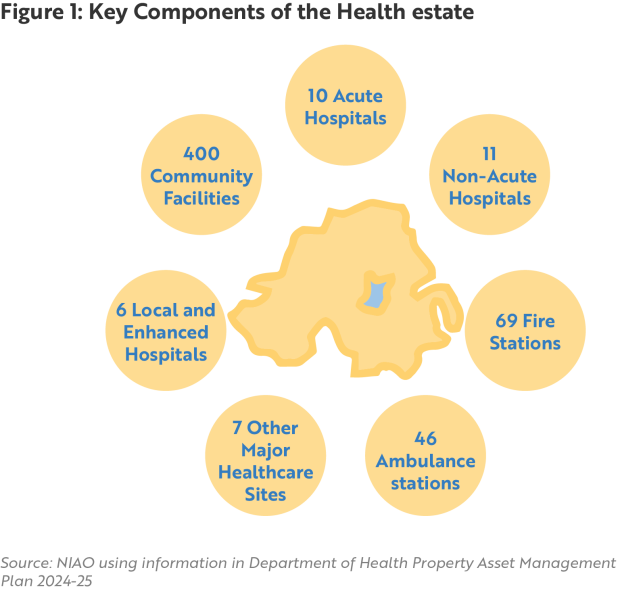
1.3 Most of the health and social care estate is owned, occupied and managed by the six Trusts and NIFRS. The Trust and NIFRS estate is valued at approximately £3.7 billion, including buildings worth some £3.4 billion and land of around £300 million. It encompasses around 1,500 freehold buildings and over 200 leasehold properties across more than 400 sites, covering an internal area of over 2 million square metres. It comprises a diverse range of facilities including major hospital complexes, local hospitals, residential accommodation, day centres, health clinics, ambulance stations, fire stations, warehouses, and storage and administration buildings (see Figure 1). The majority of this estate is purpose built and designed for the delivery of healthcare and public safety services. Leasehold property is mainly used for community facilities such as health centres and day centres.
1.4 There are also approximately 70 Department-owned properties. This is referred to as Departmental retained estate, however much of it is managed by the Trusts on the Department’s behalf. The retained estate predominantly comprises operational properties occupied by Health and Social Care (HSC) bodies, land and buildings leased to housing associations and/or charitable/community organisations for health-related purposes, and non-operational sites either declared surplus to health requirements or retained for future health-related needs (subject to review by HSC Trusts). It extends to over 227 hectares and is valued at more than £36 million. A significant proportion of the retained estate is concentrated in older hospital sites and is generally surplus to requirements. For example, at around 94 hectares, the Gransha Hospital site represents around two fifths of the total retained estate size and, with a net book value (NBV) of £10 million, just over a quarter of its overall value.
1.5 The Department has legislative power to make its premises available to any body or person providing health or personal social services (under the Health and Personal Social Services (Northern Ireland) Order 1972 Articles 14A (2)(a) & 15 (1B)(a), amended by the Registered Homes (Northern Ireland) Order 1992). On this basis, there are currently 30 properties within the retained estate leased to housing associations or charitable organisations who provide health-related services. The Department’s long-term plan for all retained estate is to transfer to ALBs where a health-related need is identified or dispose of those properties surplus to health requirements via the public sector disposal process.
The Department has an overarching responsibility to ensure effective estate management
1.6 As a key strategic asset and an essential platform for the delivery of services, the estate should be managed and maintained effectively. Effective estate management can help prioritise investment and promote best value for money from capital investment. Good maintenance regimes can protect the value of assets, ensure they remain fit for purpose, protect the health and safety of end users and secure business continuity.
1.7 Responsibility for the management of the majority of the estate rests with ALBs, as owners, and specifically with Chief Executives, as Accounting Officers. The Department has direct responsibility for the management of the retained estate. In addition, as the sponsor department, the Department retains overall accountability for the management of the entire health estate, ensuring that ALBs are effectively and efficiently managing their estates and achieving value for money from the funding it provides for this purpose. Estate management at ALBs is supported and overseen by the Department’s Health Estates Division.
1.8 The maintenance and development of the estate is funded out of capital and revenue allocations provided by the Department to its ALBs. Development and upgrade of the estate is funded out of capital budgets, while on-going, day-to-day, maintenance is paid out of revenue funds. Approximately £93 million was spent on the improvement and maintenance of the health estate in 2024-25. This includes capital expenditure in developing and upgrading the estate of approximately £56 million, some £31 million out of general capital allocations and £25 million specifically in relation to backlog maintenance (see Part Three). A further £37 million was spent in relation to day-to-day maintenance from revenue funding.
The Department faces challenges in effectively managing both the legacy and new estate
The impact of financial constraints on the estate
1.9 The Department has reported that essential maintenance spend has been reduced to absolute minimal levels due to the challenging budget position in recent years. This is despite the recognition that much of the extensive estate is old and in need of investment, resulting in the accumulation of a considerable backlog maintenance liability, estimated to be £1.6 billion. The Department has stated that in the absence of sufficient funding it is likely that the backlog maintenance liability will continue to increase.
Ongoing cost and time overruns in major capital projects
1.10 In addition to the substantial backlog maintenance burden within the existing health estate, the Department continues to face challenges in successfully delivering new major capital project builds. Our previous reports on Major Capital Projects in Northern Ireland (in 2019 and 2024) highlighted significant time and cost overruns in major capital projects. At the time of our 2024 report, cost overruns in the health portfolio were estimated to be £786 million. These cost overruns continue to add pressure to the health budget and divert much needed resources.
The legislative requirement to reduce greenhouse gas emissions from the health estate
1.11 The Climate Change Act (Northern Ireland) 2022 commits Northern Ireland to an ambitious target of net zero emissions by 2050. In addition, the Energy Management Strategy and Action Plan to 2030 for Northern Ireland Central Government, sets a 30 per cent energy reduction target across all of the Northern Ireland public sector. The Department and its ALBs are required to make a fair contribution towards achieving these targets.
1.12 The Department, including its ALBs, is the largest estate contributor to building emissions in the Northern Ireland public sector. The Belfast Trust pays an annual fee for over emissions to the UK Emissions Trading Scheme for its Royal Victoria and Belfast City hospital sites, estimated at around £265,000 for the 2025-26 year (£178,000 and £87,000 respectively).
1.13 The Department told us that ALBs employ estate professionals, including energy managers to monitor and manage energy consumption. In respect of new capital projects, it is working to ensure that projects are designed in a way to minimise energy use and consider low carbon heat sources, with renewable energy incorporated where feasible. However, energy use in the health estate is predominantly based on fossil fuels - natural gas (85 per cent), followed by oil (14.5 per cent). The Department has advised that achieving net zero for health estate buildings is dependent on fundamental changes in the energy supply system and that significant budgetary constraints will limit the delivery of any actions designed to work towards achieving net zero. It is important, nevertheless, that the Department continues to seek opportunities to maximise its contribution towards achieving overall emission reduction targets.
The Department is aware that there are opportunities to achieve efficiencies in the management of the health estate
1.14 The Department commissioned the Getting it Right First Time (GIRFT) Project Team at the Royal National Orthopaedic Hospital to undertake a review of efficiency opportunities and savings in a number of areas across health and social care in Northern Ireland. The review included the health estate and the January 2025 report made several recommendations designed to improve efficiencies, including in estate governance, management and estate rationalisation. Progress to implement the recommendations has been referenced, where relevant, within this report.
Scope and Structure
1.15 As a key enabler in the provision of health and social care services, it is essential that appropriate governance arrangements are in place to ensure that the health estate remains fit for purpose and safe for both the public and employees that use it. This report considers whether the Department is effectively managing its estate and is structured as follows:
- Part Two outlines the roles and responsibilities for the management of the health estate including governance and oversight;
- Part Three provides an overview of the current condition of the health estate and backlog maintenance. It also considers the impact of the condition of the estate on the safe and effective delivery of services; and
- Part Four considers the utilisation of the estate and includes details on vacant estate. Several case studies are included.
1.16 For the purposes of this report, we have focused on the freehold health and social care estate owned by the six Trusts and NIFRS. Where appropriate, we also refer to the Department’s retained estate. The report reflects the most up-to-date data available, drawn from both the Department’s 2024 State of the Estate Report and the Department’s Property Asset Management Plan 2024-25. Our methodology is set out in Appendix 1.
Part Two:
Management of the Health Estate
The majority of the estate is owned and managed by the Department’s ALBs
2.1 As set out at Part One, the health estate exists to support and enable the Department’s delivery against its statutory responsibilities in relation to health, social care and public safety. The Department’s 2018 Property Asset Strategy identifies its aim to maintain an estate that is capable of supporting the Department’s vision, aims and objectives and which is effectively and efficiently managed. The Property Asset Strategy is a single page, high-level vision-type document which sets out four guiding principles to estate management which seek to:
- have the right size and type of property assets in the right place;
- optimise the use of existing assets;
- provide functionally effective, environmentally appropriate, safe and resilient facilities; and
- identify surplus and underperforming assets and reduce and/or improve these through rationalisation, re-use or disposal.
2.2 Most of the health estate is owned, occupied and managed by the six Trusts and NIFRS. These seven ALBs collectively own 99.9 per cent of the ALB freehold health estate portfolio. ALBs as owners, are directly responsible for the management of their individual estates and have established estate management structures and teams for this purpose. The Chief Executives of the ALBs are accountable to the Department, which, as the sponsor department, is responsible for setting policy and strategic direction in respect of the regional health estate and retains overall accountability for the management of the estate.
2.3 The Department’s Health Estates Directorate plays an important role in the management and oversight of the health estate. Its role includes providing property management advice to the Department and its ALBs, supporting ALBs in the production of estate strategies, providing a comprehensive construction procurement service (as the recognised Centre of Procurement Expertise) for capital projects and monitoring the performance of the ALB estate. The Property Management Branch within the Health Estates Directorate collates information provided by ALBs on their respective estates and produces an annual ‘State of the Estate’ report (SOTER) see paragraph 2.12. Information collected from ALBs is also used to inform the Department’s annual Property Asset Management Plan (PAMP).
Organisations should have a clear understanding of their asset base and the assets needed to deliver services
2.4 As set out in Department of Finance guidance on the proper handling and reporting of public resources, ALB Chief Executives, as Accounting Officers appointed by the Department, are directly responsible for the management of the assets at their disposal. In particular, ‘Managing Public Money Northern Ireland’ (MPMNI) highlights the need for organisations to have a clear grasp on the content of their asset bases.
2.5 The Department expects each ALB to retain current and reliable information in relation to their individual estate portfolios. ALBs maintain separate estate databases recording detailed information on their estates, for example, size, nature, condition and associated costs. Estate information should be kept up-to-date through an ongoing programme of survey (discussed in more detail at Part Three).
The Department requires its ALBs to have estate strategies
2.6 Good practice, including our joint report with the Strategic Investment Board ‘A Strategic Approach to the Use of Public Sector Assets’ recognises the importance of estate strategies and plans. In line with guidance issued by the Department, ALBs are required to have Board approved estate strategies in place. Estate strategies are intended to provide strategic direction in respect of estate development, outlining how the estate will be utilised to support service delivery, identifying both how the estate meets current service needs and how the estate is to be developed to meet future service needs. The estate strategies which we reviewed cover the short to medium term (3-5 years), identify the current poor condition of the estate in meeting service needs and highlight a particular focus on improving the current estate to meet basic expectations (see Part Three for further detail). In addition, the estate strategies identify the need for transformation of health services as outlined in overarching health strategies (e.g. ‘Delivering Together’), and particularly the move away from hospital provision and towards more local, primary and community-based services, as an important driver in relation to the future development of the estate. Estate strategies emphasise the risks associated with the lack of available capital funding to deliver transformation.
2.7 We note that, while ALBs are required to develop estate strategies, these are not specifically submitted to the Department, nor reviewed by it. Rather the Department seeks and receives assurances from ALB Chief Executives that Board approved strategies are in place (albeit some were noted to be in draft form).
Property Asset Management Plans are submitted annually to the Department
2.8 All ALBs are required to complete PAMPs and submit these to the Department. These provide an overview of the current position of the estate and set out plans for the estate looking forward for a period of five years. PAMPs include details of freehold properties; leased properties; planned disposals; details of historic buildings and their use; details of vacant and underused properties and actions for future use or disposal; performance against key indicators and targets; and details of backlog maintenance levels and risk profile. PAMPs also include details of energy usage and cost. Information provided in ALB PAMPs is collated to form a Departmental PAMP.
2.9 There is no centralised database for the health estate. The Department’s ALBs migrated to new estate management databases in 2023-24, and whilst the Department had access to the previous system, it does not have access to the new databases. It is therefore heavily reliant on manual spreadsheets to collate estate information. This is a lengthy exercise. The Department told us that it has commenced a project to assess the feasibility of procuring the same system as ALBs. This will be on a read-only and report-generating basis which will reduce the reliance on manual spreadsheets and requests for information from ALBs.
2.10 As part of our review, we were provided with an example copy of a Trust PAMP. Strategic priorities identified in the plan included the importance of ongoing review challenging the need to hold property and that a proactive disposal plan is in place for surplus property; improving the utilisation of available assets; improving estate condition and ensuring it remains fit for purpose through a focus on reducing backlog maintenance. However, it highlighted the difficulties, associated with constrained capital resources, in balancing the need to maintain the current estate, to ensure that it remains in a safe and secure condition capable of supporting current service needs, and the need to enhance the estate to meet expected transformational future service needs.
2.11 ALBs provide the Department with several assurances as part of the PAMP process. In addition to an assurance that key information sets (including cost information) are available on an estate management database, ALBs confirm the availability of appropriately skilled resources to manage their estates and that they have effective and robust processes in place for the management of leases. ALBs are also required to confirm that they have timed disposal strategies in place for land and buildings which no longer have a foreseeable health need.
The Department publishes a report on the State of the Estate
2.12 The SOTER provides a snapshot of the condition of the health estate, performance data to monitor the efficiency and effectiveness of the buildings in the estate and identifies associated risks and constraints to estate transformation to meet service needs. SOTER captures the freehold estate occupied and managed by each of the six Trusts and NIFRS. The report is based on mandatory data (there is much commonality between the data provided for PAMP and SOTER) submitted by these ALBs to the Property Management Branch in the Department. The latest report, published in October 2025, relates to the 2023-24 year and is considered in detail at Part Three of our report. The time lag in publication reflects the work necessary for the collation of information and in ensuring the accuracy and consistency of data provided. It also, the Department told us, relates to the resources available in its Property Management Branch to undertake this collation and quality control work.
The Department’s Property Management Branch monitors the condition and performance of the ALB estate
2.13 The information collated in the SOTER forms the basis of the Department’s monitoring against key performance indicators (KPIs) relating to the condition and performance of the estate. KPIs broadly identify the age and condition of the estate, while targets seek improvements in estate condition. Following condition surveys completed in 2021-22, ALBs agreed improvement targets, for achievement by 2026-27, in relation to the level of vacant and underused property, the proportion of property not functionally suitable for the delivery of services and the level of backlog maintenance. Targets were also set in relation to planned property disposals. Performance to date (see Figure 2) indicates some progress in relation to improving the proportion of the ALB estate that is functionally suitable for the delivery of services and that it is compliant with statutory standards. However, there has been no progress to date against the target to reduce vacant property, an increase in the percentage of underused property, and a substantial increase in backlog maintenance.
Figure 2: Performance to date against property improvement targets (2021-22 to 2026-27)
| Improvement Target | Baseline 2021-22 | Position at 2023-24 | Change | |
|---|---|---|---|---|
| Reduction in vacant property | -2% | 5% | 5% | – |
| Reduction in underused property | -4% | 13% | 19% | +6% |
| Reduction in functionally unsuitable estate | -9% | 51% | 47% | -4% |
| Reduction in estate not meeting statutory standards | -10% | 42% | 40% | -2% |
| Reduction in Backlog Maintenance | -11% | £1,324m | £1,634m | +23% |
Source: NIAO using data in DoH SOTER 2024
2.14 On completion, the SOTER is provided to the Departmental Permanent Secretary, the Departmental Board and the Minister for information. Copies of the report are also issued to ALB Chief Executives to inform them (among other things) on the performance and condition of the overall health estate, to identify areas of underperformance, to assist in strategic planning and investment prioritisation, and to encourage information sharing on best practice at meetings.
2.15 In sharing the results of the SOTER to its ALBs, and in addition to the other assurances noted above, the Department also seeks detail on actions to be taken by organisations in addressing the findings of the report, the measures in place to mitigate risks represented by the condition of the estate, and confirmation that ALB Boards are aware of and are content with estate risks and mitigation measures. Review of ALB responses notes, in particular, reference by ALBs to their estate strategies in setting out how their estates are to be managed and improved, the use of condition surveys and associated risk assessment of maintenance backlogs and prioritisation of investment (within available resources) towards high risk areas. Responses also indicate that estate risks are managed through established risk management processes. This is largely a self-certification exercise, with the Department relying on the responses and assurances provided to it.
The Department’s Property Asset Management Plan is incomplete
2.16 The Departmental PAMP, which is updated annually, incorporates the condition information identified in the SOTER and the information provided in individual ALB asset management plans. The most recent PAMP covers the period 2024-25 to 2028-29. It highlights that the level of funding available represents the greatest risk to the effective management of the estate in supporting current and future service delivery. Its production fulfils a requirement under the Northern Ireland Executive’s 2017 Asset Management Strategy for all Departments to prepare asset management plans with a five-year planning horizon. However, we found that the Department’s PAMP does not include retained estate. We were told that there previously was a standalone Department-owned estate PAMP but it has not been updated for several years due to resourcing issues. As the retained estate has an estimated value of £36 million, we consider that these valuable public assets should be appropriately recorded in the PAMP.
It is not clear how the information collected is used by the Department to inform strategic decision making
2.17 While the Department obtains a significant amount of information from ALBs, other than to enable the production of the Departmental PAMP and SOTER, it is unclear how this information is being actively used as part of estate governance to address the issues arising and drive improvements. The current mechanism through which the Department seeks to hold the ALBs to account for their estate management responsibilities relies largely on a form of self-certification through the provision of assurances.
2.18 We found reference to various groups and forums such as a Regional Estates Directors Group, a Strategic Investment Group and an Estates Leadership Group, however there was a lack of clarity on the purpose of these groups and how they interacted with one another on estate issues. There are missed opportunities for the Department and ALBs to work more effectively together to manage the estate.
2.19 The use of information and a lack of central governance to manage the issues arising from reports was also identified as an issue in the 2025 GIRFT report (see paragraph 1.14), which recommended the establishment of an overarching Health Property Asset Management Board drawing together the key estate leads from ALBs. GIRFT recommended that the Board’s duties should include strategic planning of the health estate, monitoring performance of properties, sharing expertise and good practice, estate investment decisions, oversight of property maintenance, risk management and reporting to the Departmental Board. The Department told us that it is currently reviewing its governance arrangements with a view to establishing an overarching governance framework.
The Department has not developed a long-term estate management strategy
2.20 While the Department’s Property Asset Strategy (referred to at paragraph 2.1) does set out a high-level vision for the health estate and high-level principles for its approach to estate management, this has not been underpinned by a long-term estate management strategy or plan. Whilst the ALBs are required to have estate strategies in place, there is no overarching strategy at Departmental level.
2.21 Our discussions with the Department highlighted that the absence of a long-term estate strategy results from a lack of a long-term service strategy (and linked to an investment strategy), setting out specific service development plans on the basis of which estate needs can be determined and planned for. In the absence of this the Department told us that strategic direction in estate management is focused on the disposal of surplus property and assets, maximising use of existing assets where possible and only constructing new assets when there is evidence that services cannot be accommodated from within the current estate.
2.22 In December 2025, the Departmental Board agreed, subject to available funding, for a greater focus towards the repurpose, refurbishment and reuse of the current estate. In particular, we note the establishment of a Health Estates Asset Review Team to identify opportunities for the use of underused property assets. The Department has also stated the intention to require a thorough review of all existing vacant, underused and surplus estate to ensure that no retrofit solutions can be applied to existing property before approving any further new build projects that would increase floor area. This is in keeping with the approach in England where HM Treasury is strongly encouraging departments to consider improving their existing properties before submitting spending review bids for new builds.
Recommendation 1
To support effective management of the overall health estate, and to provide an appropriate basis for investment and disposal decision making, the Department should develop a long-term estate strategy, linked to service and investment strategies. By providing clearer direction, an estate strategy will ensure that the estate better matches current and future operational service needs and provide the Department with a means to ensure best use of resources with a regional focus. The estate strategy should be set within a robust governance framework, including oversight and reporting at Board level, and underpinned by a clear delivery plan.
Recommendation 2
Given the crucial role of the estate in delivering healthcare to the public, the Department should take the lead in working with its ALBs to develop a framework, supported by realistic plans, to manage the issues arising from the State of the Estate report and the Property Asset Management Plans.
Recommendation 3
To ensure it has a comprehensive understanding of the entire health estate the Department should update the Property Asset Management Plan for the Department-owned estate.
Part Three:
The Condition of the Health Estate
Estate condition should be assessed through regular independent survey
3.1 The condition of the estate can impact on the ability to deliver services and also plays an important role in patient experience. Understanding the condition of the estate is an essential aspect of good estate management. Best practice highlights the importance of regular independent estate surveys in maintaining an accurate and up-to-date understanding of the condition of the estate to inform operational and strategic planning and investment prioritisation.
3.2 Our discussions with the Department highlighted a past record of patchy survey activity across its ALBs, in part resulting from the challenging funding position faced by these bodies. To improve the accuracy of estate information, in 2020 ALBs agreed to undertake full surveys of their estates. Thereafter, ALBs aim to re-survey 20 per cent of their estate on a rolling basis, covering the full estate over a five-year period. While survey activity was impacted by the COVID-19 pandemic, all ALBs had completed their full estate surveys by the end of the 2021-22 financial year.
3.3 Estate surveys are commissioned from independent professionals and are undertaken according to professional standards to provide an assessment of the estate across several different criteria including:
- physical condition (of the building fabric and mechanical and electrical systems);
- functional suitability (to meet clinical and operational needs);
- compliance with statutory standards (for example fire safety, health and safety and building requirements); and
- space utilisation (efficiency of space use to support patient care and administrative functions). See Part Four of this report.
3.4 Survey results are recorded, and updated, on ALB estate management systems. The Department does not check the extent of survey activity ongoing across ALBs and is, therefore, unaware as to whether survey activity continues to meet expected levels i.e. for 20 per cent of the estate to be re-surveyed annually (and full estate over a five-year period). The Department noted some concerns that survey activity may be curtailed going forward, due to ongoing budgetary pressures. However, given the importance of independent surveys in providing accurate and up-to-date information on the condition of the estate, it is important that the Department ensures that survey activity continues in line with expectations.
Nearly half of the health estate is over 50 years old and a significant portion is in poor condition
3.5 The Department’s SOTER 2024 provides a snapshot of the condition and performance of the health estate, covering the period 1 April 2023 to 31 March 2024. This reported that the level of investment in the estate has been insufficient to keep pace with the rate at which the estate is ageing and deteriorating. Some 46 per cent of the estate is over 50 years old, while 16 per cent is over 75 years old (see Figure 3). According to SOTER, many older buildings are considered no longer fit for purpose in terms of providing accommodation suitable for the delivery of modern health, public safety and social services.
Figure 3: Age Profile of the Health Estate at 2023-24
| Age of Property | Proportion of Freehold Estate Area (m2) |
|---|---|
| Under 10 years old | 11% |
| Between 10 and 50 years old | 43% |
| Over 50 years | 46% |
| Over 75 years old | 16% |
Source: NIAO using data in DoH SOTER 2024
The physical condition of less than half of the health estate was assessed as acceptable
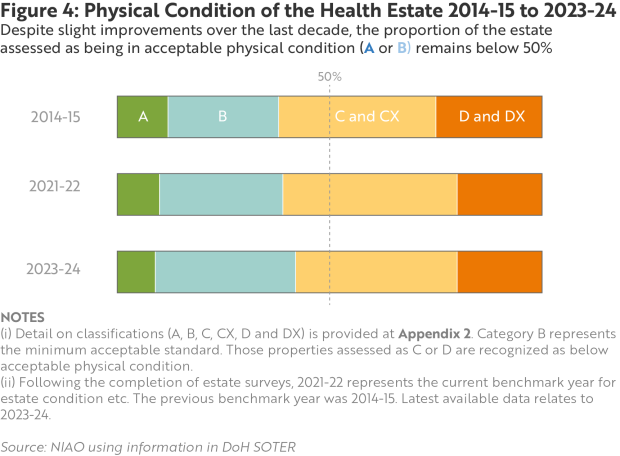
3.6 The physical condition of the estate is assessed against a recognised acceptable standard. The acceptable standard reflects buildings which are deemed to be generally sound although some elements could be unacceptable (Category B) – see detail on condition rating at Appendix 2. Much of the estate is in need of repair or upgrade. As at 2023-24, just over two-fifths (42 per cent) of the overall health estate was assessed as being in or above acceptable physical condition. Just under three-fifths of the estate (58 per cent) fell below acceptable standard. Around one third of this was deemed unacceptable (some 20 per cent of the overall estate), two-thirds (38 per cent of the overall estate) was identified as operational but in need of significant repairs. The proportion of the estate assessed as being in acceptable physical condition has remained broadly steady over the last decade, improving only slightly from around 38 per cent in 2014-15 (see Figure 4).
Just over half of the estate is reported to be in a functionally suitable condition
3.7 Functional suitability assesses the ability of properties to meet clinical and operational needs and support service delivery. Similar to the assessment of physical condition, the rating system applied establishes a minimal acceptable standard (Category B – see Appendix 2) whereby buildings are broadly suitable for intended use, although they may not fully comply with national guidance. Buildings assessed below Category B are deemed to be functionally unsuitable.
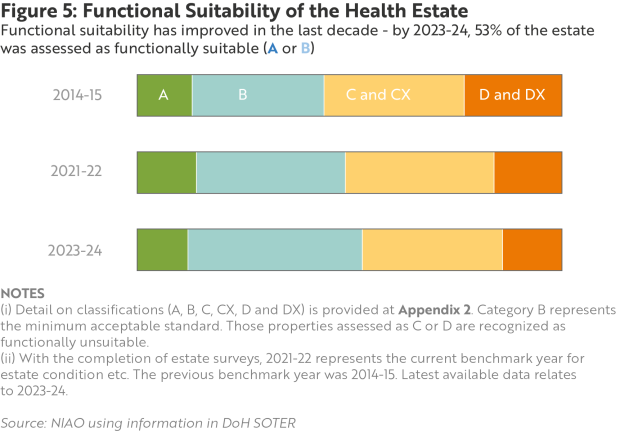
3.8 Functional suitability has improved since 2014-15 when only 44 per cent of the estate was deemed to be in a functionally suitable condition, to just over half (53 per cent) of the estate in 2023-24 (see Figure 5). The remainder requires investment to ensure it is suitable for the delivery of services. Some 14 per cent of the estate is identified as in need of major expenditure to improve its suitability. Within this, some 2 per cent of the estate is considered impossible or impractical to improve without replacement.
The majority of the estate is compliant with statutory standards
3.9 All buildings must comply with health and safety standards and other relevant codes of practice and are subject to ongoing inspection and regulation by statutory authorities. This includes, for example, fire safety regulations, health and safety at work, electricity at work regulations, construction design and management regulations, control of asbestos regulations and the Disability Discrimination Act. Similar to the assessment of physical condition and functional suitability, Category B reflects the minimum acceptable standard (see Appendix 2 for details).
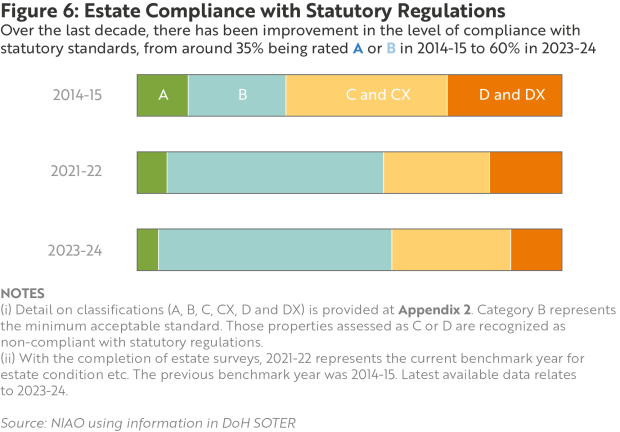
3.10 SOTER 2024 reports that the majority of the estate (60 per cent) is fully compliant with statutory regulations (see Figure 6). Some 40 per cent (equating to 508 buildings) is not fully compliant and requires upgrade, with just over a quarter of that (10 per cent) requiring major expenditure to become compliant. A small proportion of the estate (2 per cent), while not in compliance, is assessed as too expensive or impractical to upgrade. Over the last decade, there has been improvement in the level of compliance with statutory standards, from around 35 per cent in 2014-15.
3.11 The Department told us that buildings were designed to meet the relevant standards at the time of construction, however assessments of compliance reflect current standards. It noted that there is no legal requirement to uprate compliance and services can continue to be delivered from existing buildings, if risks are identified and proactively managed. Of the 508 buildings which do not comply with statutory standards, the vast majority (430 buildings) remain in use with risk mitigation in place.
Overall, only 40 per cent of the estate is in acceptable condition
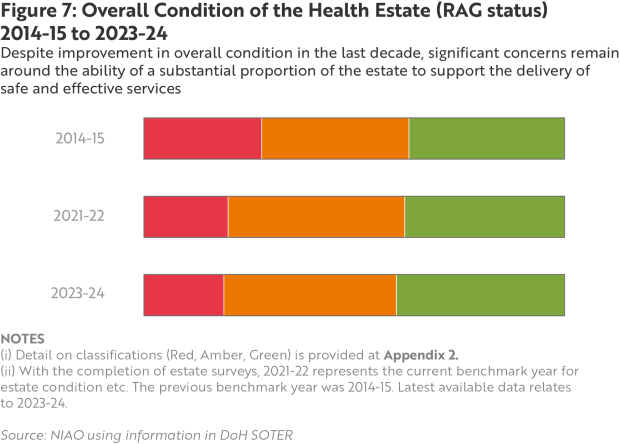
3.12 The overall condition of the estate is categorised using a Red, Amber, Green (RAG) status (see Appendix 2 for details on the definition of ratings applied). Physical condition is the main factor used to drive the overall condition rating. As noted at paragraph 3.6, less than half the health estate was assessed as being in or above acceptable physical condition and this has a significant bearing on the overall condition assessment. Only 40 per cent of the estate is reported to be in an overall acceptable condition (Green). Of the remainder of the estate, 19 per cent is categorised as red, and 41 per cent amber (see Figure 7).
3.13 Whilst there has been some small improvement in overall condition in recent years, including a reduction in the proportion of the estate deemed as unsuitable from which to deliver safe and efficient services, there remain significant concerns around the ability of a substantial proportion of the estate to support the delivery of safe and effective services.
Backlog maintenance in the health estate is estimated at over £1.6 billion
3.14 The condition of the estate can impact on its ability to deliver services. Good property maintenance is, therefore, important in ensuring buildings remain safe and functional. The Department has reported that, as a result of its challenging budgetary position, essential maintenance spend has been reduced to absolute minimal levels in recent years. Delaying necessary works and planned preventative maintenance can significantly increase future costs and lead to a cycle of deterioration. The Cabinet Office has estimated that deferring backlog maintenance can multiply costs by more than 1.5 times over a two-to-four-year period.
3.15 Backlog maintenance cost is the cost associated with bringing underperforming property assets up to acceptable physical condition and into compliance with statutory standards. As such it represents delayed/deferred maintenance. Best practice in establishing and managing backlog maintenance costs requires both an estimation of the costs of bringing property assets up to an acceptable standard and rating the risk associated with backlog maintenance. Cost estimates and risk ratings are developed jointly between estates teams and independent surveyors, in line with the NHS Guidance ‘A risk-based methodology for establishing and managing backlog’.
3.16 Backlog maintenance costs have increased over time (see Figure 8), reflecting the age of the estate and its condition, together with the impact of inflation. The Department told us that the slight decrease in 2021-22 reflects improved data accuracy following the completion of condition surveys. The Department’s SOTER 2024 reported that, as a result of ongoing budget constraints, no significant inroad has been made in addressing the backlog. It accepts that unless action is taken to address backlog maintenance the estate will continue to deteriorate further and the costs of reducing or eliminating the backlog will continue to increase.
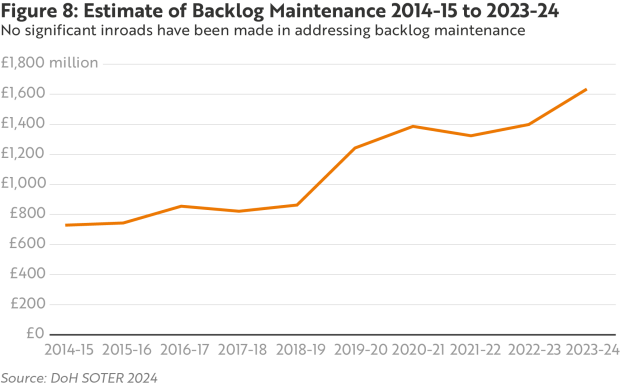
3.17 Latest available figures (2023-24) estimate the overall maintenance backlog across the health estate at just over £1.6 billion. In line with guidance, stand-alone property that is completely vacant is not included within the backlog maintenance figure. However, vacant properties that share a common building structure with operational facilities, and underused properties are included. Approximately £110 million of the £1.6 billion backlog maintenance relates to underused property (6.7 per cent).
3.18 The figure of £1.6 billion reflects the base cost of necessary works and other additional costs (known as on-costs) such as professional fees and contingencies and is exclusive of VAT (which will add a further £255 million to the costs). Information provided by the Department shows inconsistency in the level of on-costs applied in backlog maintenance across ALBs, ranging from 37 – 55 per cent of works costs. The Department told us that it has commenced an exercise to identify key differences in approaches and to bring standardisation in the costing and risk rating of backlog maintenance.
3.19 Estimates also indicate the potential for a further £215 million of ‘impending backlog’. This reflects the surveyed condition of properties, and professional opinion regarding the anticipated rate of deterioration, which are likely to fall below acceptable standard (moving from Category B to C) over the next 5 years.
Recommendation 4
The Department should provide clarity to its ALBs to ensure a standardised and reliable approach to calculating and reporting backlog maintenance. This should include ensuring consistency in the levels of additional costs included in backlog maintenance calculations.
High-risk backlog maintenance is in the region of £251 million
3.20 Assessing the risk associated with backlog maintenance considers both the likelihood of risks being realised and the severity of the resulting impact and aims to identify those aspects of the backlog which need to be urgently addressed. Risks are classified according to whether they are assessed as low, medium or high. The Department classifies high risk as representing circumstances where the probability of property failure is likely or certain and where the consequences would be severe.
3.21 Within the overall maintenance backlog of £1.6 billion at 2023-24, the majority (just under 60 per cent and equating to over £950 million) is assessed as medium risk, while a further 25 per cent (over £400 million) is assessed as low risk. High-risk backlog maintenance is estimated at some £251 million.
3.22 Of the total £251 million, almost half (£115 million) of all high-risk backlog maintenance relates to issues with building structure. This includes the need for roof replacements to avoid leaks, internal damage and disruption to services; guttering and downpipes in need of replacement to ensure against sections falling and causing injury to staff, service users and visitors; and problems with spalling brickwork or concrete and the potential for material to fall from height and cause injury to staff, service users or visitors. A further £48 million reflects issues of statutory safety compliance including, for example, the need for remedial actions resulting from legionella risk assessments to avoid the spread of bacteria in water systems. A breakdown of overall high-risk backlog maintenance by category is provided at Figure 9.
Figure 9: Breakdown of High-risk Backlog Maintenance Costs (2023-24)
| Category | Cost £m | Proportion of Overall Cost (%) |
|---|---|---|
| Buildings | 115 | 46% |
| Statutory Safety | 48 | 19% |
| Electrical | 42 | 17% |
| Mechanical | 34 | 13% |
| Fire Safety | 12 | 5% |
| Total High-risk Backlog Maintenance | 251 |
Source: NIAO using data provided by DoH
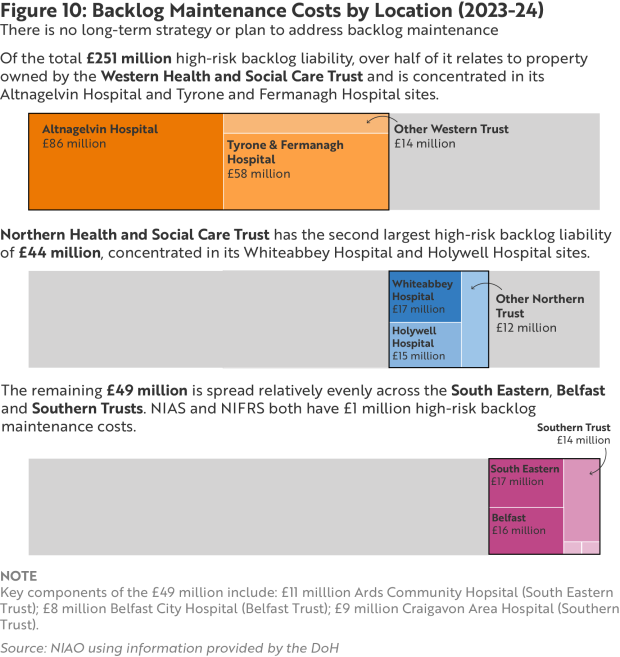
3.23 Figure 10 shows the high-risk backlog maintenance costs by Trust and the main healthcare facilities at which the backlog has accumulated. Over half (63 per cent) of the total high-risk backlog liability relates to property owned by the Western Health and Social Care Trust and is concentrated in its Altnagelvin Hospital and Tyrone and Fermanagh Hospital sites. The Department told us that the methodology for backlog maintenance calculations is being reviewed with Trusts to ensure consistency.
There is no long-term strategy or plan to address backlog maintenance
3.24 While recognising the continued rate of increase in backlog maintenance liability as a matter of concern, the Department has no specific long-term strategy or plan to reduce or eliminate the backlog. It advised that there is insufficient funding available to suitably slow the rate of estate deterioration.
3.25 Since 2020-21, the Department has provided funding to its ALBs specifically to address the level of backlog maintenance, with funding allocated in proportion to their respective share of the overall backlog. This funding, in the region of £25 million per annum, represents only a small proportion of the overall backlog (around 1.5 per cent). In line with Departmental advice, ALB spend has been prioritised towards high-risk backlog. As illustrated in Figure 11, the majority of backlog maintenance spend over the last five years has been focused on structural building defects. While ALBs have developed short-term backlog maintenance programmes based on the results of their estate surveys, given single year budgets, these plans also take consideration of what can actually be completed within available funding.
Figure 11: Prioritisation of backlog maintenance spend 2020-21 to 2024-25
| Category | Cost £m | Proportion of Overall spend (%) |
|---|---|---|
| Buildings | 57 | 58% |
| Statutory Safety | 9 | 9% |
| Electrical | 14 | 14% |
| Mechanical | 9 | 9% |
| Fire Safety | 9 | 10% |
| Total High-risk Backlog Maintenance | 98 |
Source: NIAO using data provided by DoH
3.26 Not unexpectedly, given the level of funding available, this spend has not resulted in any significant reduction in the level of high-risk backlog maintenance liability which has remained broadly unchanged in recent years at around £250 million.
3.27 In acknowledging the insufficiency of available funding to impact substantively on backlog maintenance, the Department made reference in SOTER to the Scottish Government’s decision, in February 2024, to hold all significant building projects until 2026 and instead focus funding in the immediate future towards addressing its backlog maintenance liability.
Recommendation 5
We recommend that the Department, in conjunction with the ALBs, develop a backlog maintenance strategy setting out clearly how and over what period it intends to bring the backlog maintenance liability under control. The Department and ALBs must also ensure that where possible, planned, preventative maintenance is carried out. This is essential to end the cycle of continued deterioration.
Poor property conditions can impact on the safe and effective delivery of services
3.28 Failure to maintain buildings to the required statutory standards and the increasing level of backlog maintenance increases the risk that services will not be delivered safely and effectively. Issues may arise which compromise the health and safety of those using the buildings and may eventually render buildings or parts of buildings unsafe for use. It is the responsibility of ALBs to provide a safe environment for visitors, patients and staff. The level of high-risk backlog maintenance is recognised by the Trusts in their corporate risk registers, and they continue to manage the associated risks, introducing mitigations as necessary to allow facilities to be assessed as remaining safe to support service delivery. Despite the Department reporting its concerns on the condition of the estate through SOTER, it does not consider the condition of the estate to be a corporate risk at Departmental level.
3.29 The National Audit Office reported that on average, between 2019-20 and 2023-24, approximately 5,400 clinical service incidents occurred in the National Health Service (NHS) in England every year due to property and infrastructure failures.
3.30 In Northern Ireland, there are two ways in which estate safety issues are reported to the Department: Medical Device and Estate Safety (MDES) reports and Early Alert reports which can cover a variety of issues, including estate safety. The ALBs also operate a Serious Adverse Incident (SAI) procedure in certain circumstances. However, Departmental officials told us that they would expect any SAI report to have been captured in the reporting outlined above.
3.31 We considered 79 MDES reports and 57 Early Alert reports from ALBs to the Department covering the period from 2021 to 2025. The reports do not stipulate the cause of the issue, therefore we were unable to confirm specifically if there was a connection to the current condition of the estate and backlog maintenance. However, issues reported included the presence of bacteria in water systems, water leaks and collapsed ceiling tiles. The impact of the incidents included the cancellation of elective surgeries, relocation of patients, no CT scanning facilities and ambulance diversions.
3.32 The relatively low number of reports could indicate that there are generally suitable mitigations in place to enable the continued safe use of facilities. However, there may be gaps in the data held by the Department and inconsistency across ALBs in the reporting methods used. For example, we are aware of an incident reported in the media where four people sustained minor injuries after a section of a suspended ceiling collapsed in an acute hospital. This incident was not included in the reports. In addition, our review of the Early Alert reports identified several incidents regarding leaks and water pipe issues however there was no MDES reporting for these incidents.
Recommendation 6
Complete and consistent data in relation to estate safety incidents within ALBs is essential to the Department’s oversight role. The Department should review and strengthen the guidance to ALBs on the reporting of estate safety incidents. Reporting should clearly identify the cause of any incident, to ensure that the Department has a complete and accurate understanding of the impact of the estate condition.
Part Four:
Utilisation of the Health Estate
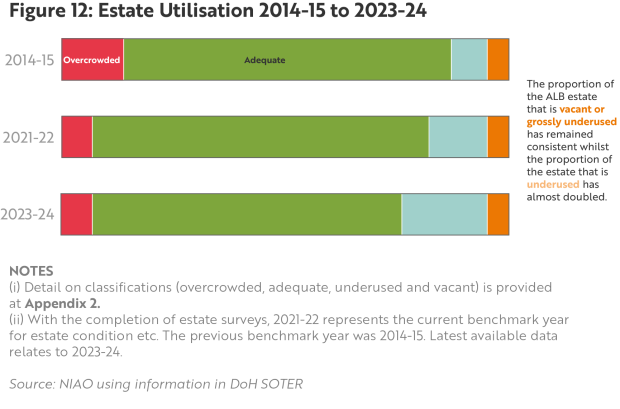
4.1 Space utilisation considers how well the estate is being used. Vacant and underused parts of the estate are defined in the Department’s SOTER as under-performing assets, and do not represent value for money. According to SOTER 2024, 5 per cent of the ALB estate is vacant or grossly underused (encompassing 91 properties), and just under one fifth (19 per cent) is underused. In contrast seven per cent of the estate is assessed as overcrowded.
4.2 Trend data presented in SOTER (see Figure 12) shows that over the past decade the proportion of the ALB estate that is vacant or grossly underused has remained consistent whilst the proportion of the estate that is underused has almost doubled. This is despite the strategic requirement to optimise the use of existing assets; and to identify surplus and underperforming assets and reduce and/or improve these through rationalisation, reuse or disposal (as identified at Part Two).
The majority of vacant property is in larger and older hospital sites
4.3 There are 91 properties, covering almost 93,000 square metres (and representing 5 per cent of the estate by internal floor area), over 25 different sites vacant within the ALB health estate included in SOTER 2024. Most of the vacant property is owned by the Belfast Trust (56 vacant properties) and the Western Trust (26 vacant properties) and is located within larger and older hospital sites such as Muckamore, Knockbracken, Forster Green and Gransha. The other Trusts held three vacant properties each at 31 March 2024. There are also six vacant parcels of land owned by the Belfast Trust. Based on information provided by the Trusts, the NBV of the vacant properties within the ALB-owned estate is approximately £22.9 million.
4.4 Within the vacant estate, there are 28 properties assigned a “red” condition rating, meaning they are in a significant state of disrepair and require substantial investment. The estimated total backlog maintenance cost associated with the vacant ALB estate is £82 million. (This is not included within the £1.6 billion backlog maintenance liability in accordance with guidance).
In addition to ALB vacant estate, the Department holds vacant property valued at over £16 million
4.5 As noted at paragraph 1.4, there are 70 properties still within the ownership of the Department. These are in addition to the ALB estate. Of these, 20 properties are classed as vacant across 11 geographic locations. The vacant retained estate sites are a mix of unused land and buildings. The total area of retained land which is classed as vacant is around 111 hectares. The total floor area of vacant buildings is 18,362 square metres, which is mainly concentrated in Knockbracken Healthcare Park (former farm buildings) and Gransha Hospital (former Stradreagh Hospital Buildings). The estimated NBV of the vacant properties within the retained estate is in excess of £16.5 million, almost half the value of the total retained estate (£36 million).
There is a need to consider if better use can be made of the underutilised estate to address overcrowding in other areas
4.6 In addition to the property assets which are classified as vacant, the Department and ALBs also have properties which are underused. Within the ALB-owned estate, there are 49 properties categorised as underused, with the underused proportion covering almost 50,000 square metres. The highest number of underused properties were situated in the Southern Trust (16), followed by the Western Trust (12). In five instances, an entire property/unit was categorised as underused, with the remainder involving partial underuse of properties. Complete data was not available to show when all assets became underused, however the available data did show that some properties/parts of units have been underused for 20 years.
4.7 In addition, there are three underused sites in the retained estate, comprising approximately 66 hectares of land held for either disposal purposes or for future health-related needs. This land has been put to meanwhile use through conacre licence agreements. Given that seven per cent of the estate is overcrowded further consideration should be given to making better use of the underused estate, both for service provision as well as back-office functions such as administration and storage.
Recommendation 7
The Department should work with the relevant ALBs to ensure that any opportunities to reduce overcrowding through better use of the underused estate are explored. Any such opportunities should be fully costed and future benefits/efficiencies clearly identified to enable informed decision making.
Targets were introduced to improve space utilisation however these are unlikely to be achieved
4.8 In accordance with MPMNI ‘it is good practice to dispose of surplus property’. The Department requires the ALBs to dispose of assets (buildings/sites) which have been identified as surplus and one of the principles per the Property Asset Strategy is ‘to identify surplus and underperforming assets and reduce and/or improve these through rationalisation, re-use or disposal’ (see paragraph 2.1).
4.9 As noted in paragraph 2.13, in 2022-23, each ALB agreed targets with the Department for improvement in relation to estate-related KPIs by 2026-27, using 2021-22 as a baseline. The KPIs related to utilisation are:
- Space reduction for vacant freehold estate – an average of 2 per cent of total vacant freehold Gross Internal Area (GIA) which will be reduced/improved via disposal, demolition or re-use; and
- Space reduction in underused freehold estate – an average of 4 per cent of total underused freehold will be reduced / improved via disposal or re-use.
4.10 Individual targets were set for each ALB for each KPI. Performance against the targets has been variable. In relation to the target to reduce the vacant freehold estate, only two ALBs reduced the vacant freehold GIA between the baseline year and 2023-24 (see Figure 13). There was one disposal, which returned a capital receipt of £125,000 and one instance where a vacant area was brought back into use.
Figure 13: Performance of ALBs against space reduction targets in the vacant estate
| Percentage of ALB’s Total Freehold GIA Vacant | ||||
|---|---|---|---|---|
| ALB | 2021-22 Baseline | 2023-24 Actual | Change from Baseline | Improvement Target |
| BHSCT | 9.95% | 8.74% | -0.85% | -1% |
| NHSCT | 1.01% | 0.78% | -0.23% | -1% |
| SEHSCT | 1.47% | 2.45% | +0.98% | -1% |
| SHSCT | 0.35% | 0.82% | +0.47% | -1% |
| WHSCT | 3.97% | 3.97% | 0.00% | -1% |
| NIAS | 0.00% | 0.00% | 0.00% | 0% |
| NIFRS | 0.00% | 0.00% | 0.00% | 0% |
Source: DoH SOTER 2024
4.11 In three of the ALBs, there has been an increase in the percentage of the estate that is underused. Performance against the target is shown in Figure 14.
Figure 14: Performance of ALBs against space reduction targets in the underused estate
| Percentage of ALB’s Total Freehold GIA Underused | ||||
|---|---|---|---|---|
| ALB | 2021-22 Baseline | 2023-24 Actual | Change from Baseline | Improvement Target |
| BHSCT | 20.01% | 23.76% | +3.75% | -3% |
| NHSCT | 29.32% | 31.15% | +2.83% | -3% |
| SEHSCT | 10.73% | 11.51% | +0.78% | -1% |
| SHSCT | 8.96% | 8.76% | -0.20% | -3% |
| WHSCT | 13.91% | 13.58% | -0.33% | -4% |
| NIAS | 15.77% | 0.00% | -15.77% | 0% |
| NIFRS | 0.00% | 0.00% | 0.00% | 0% |
Source: DoH SOTER 2024
Many assets have been vacant for prolonged periods of time without realistic plans for future use
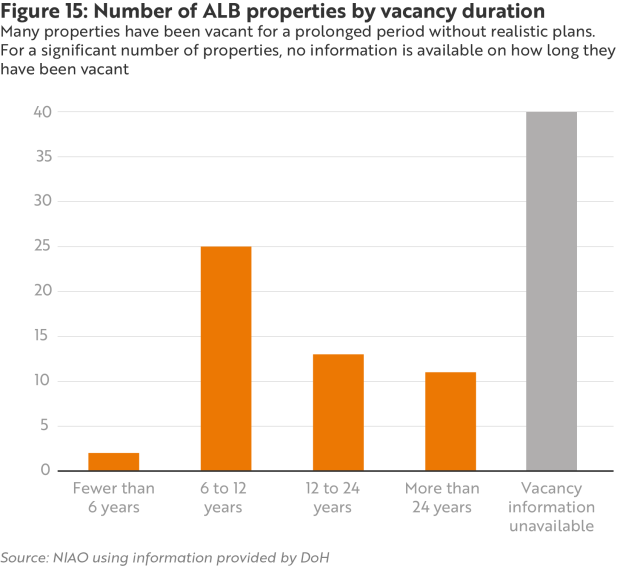
4.12 Each ALB is required to have in place a PAMP and submit it to the Department annually (see paragraph 2.8). ALBs are required to report on their use of space and buildings as part of this annual process. This includes a requirement to provide annual assurances to the Department that ‘all property assets retained are limited to the minimum required for the performance of present and clearly foreseeable service delivery need’. However, we found that many properties have been vacant for a prolonged period without realistic plans. In respect of the 91 vacant properties, information was available to show when 51 of these became vacant. The information shows that most have been vacant for more than 12 years, with 11 properties classed as vacant for more than 24 years (see Figure 15).
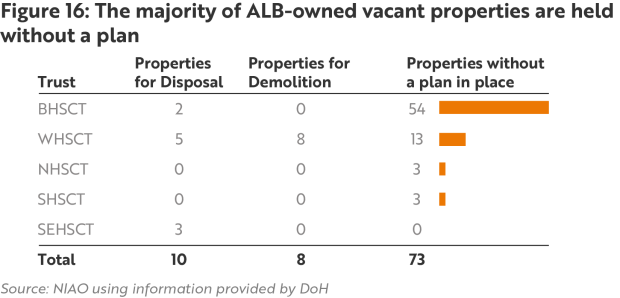
4.13 The Department provided information in relation to future plans in respect of the ALB-owned vacant properties. Of the 91 vacant properties reported, 10 have a plan to be disposed of and 8 are to be demolished. However, 73 properties, with a NBV of £19.1 million, are being retained without any agreed plan for future use or disposal (see Figure 16). We note that 22 of the properties in this category relate to the Muckamore Abbey Hospital site. A public consultation on the hospital’s closure was launched in October 2022 and closed over three years ago in January 2023.
4.14 The majority of the vacant ALB estate is in larger sites and the Department expects ALBs to have Estate Control Plans in place for these sites which demonstrate that there is a disposal strategy in place for land and buildings with no operational need. We sought copies of Estate Control Plans in relation to several of the major sites, including vacant land and buildings, across the health estate. None were provided. Several of the ALBs advised that the Estate Control Plans were under development, however it was not clear how long this had been the case.
4.15 Regarding the Department’s retained estate, the Department’s objective is to either transfer operational assets to the relevant health ALBs for the purpose of enabling them to carry out their functions; or dispose of non-operational assets that have been formally declared surplus to health requirements via the public sector disposal process. Despite this, we found that of the 20 vacant retained properties, four have been vacant for over 20 years, and a further three have been vacant for over 15 years. In addition, we note that 12 of the 20 vacant retained properties, with a NBV of £7.3 million, are being held without an agreed plan for their use or disposal. The Department told us that this position is mainly due to the Trusts not declaring the sites surplus to health requirements on a timely basis. We note that some of the vacant retained estate properties currently are or have previously been let on conacre or long-term leases, which generate some income for the Department.
4.16 There was more detail provided by ALBs to the Department as part of the PAMP process for the planning and management of underused properties, in comparison to vacant assets. However, the information provided indicates that many of the plans to bring underused areas back to full utilisation require Departmental investment and that has not been agreed at Departmental level. While ALBs await Departmental approval and investment, additional costs continue to be incurred on retained properties. The level of backlog maintenance accrued on the underused sites is estimated to be almost £110 million.
Case studies
4.17 During our review, we considered four case studies where the sites, or parts of the sites, have remained vacant for a significant period - including one that featured in our 2004 report on The Management of Surplus Land and Property in the Health Estate. The case studies are drawn from the Belfast and Western Trust due to the concentration of vacant sites in these Trust areas (see Figure 16).
Case Study 1: Belfast Trust
Royal Victoria Hospital (RVH) Broadway Towers
Located near the Royal Victoria Hospital main site, the Broadway Towers site is owned by the Belfast Trust and comprises three towers namely Victoria, Grosvenor and Broadway towers. Historically, the towers were used as residential space for healthcare workers in the nearby hospital and encompass approximately 240 flats across three buildings. The site also includes 327 parking spaces and the Royal Daycare Nursery, which continues to provide pre-school childcare places for children whose parents work in the health and social care sector, primarily in the Royal Group of hospitals. The nursery is operated by a Parents’ Committee on a non-profit making basis and is secured through a lease agreement. The total NBV of Broadway Towers is estimated at £5 million.
The towers were built in 1975 and together represent a GIA totaling 13,220 metres squared. Broadway Tower has been vacant since 2007, and both the Victoria and Grosvenor Towers have been vacant since 2015. Costs incurred on the vacant towers are approximately £35,000 per annum per tower. Therefore, the total cost incurred on these towers since they became vacant is in excess of £1 million.
Departmental officials told us that for many years they have been pressing the Belfast Trust to put affordable plans in place but to no avail. They also told us that there has been significant interest from other government departments and third parties in purchasing the site.
The Belfast Trust advised that this site remains of strategic importance to the future development of the Royal Victoria Hospital site and it has been identified as a potential option for the development of new laboratory accommodation. This development would require demolition of the existing buildings and major redesign and is currently included in a list of the Belfast Trust’s Capital Priorities. However, it remains dependent on service requirements, funding and planning approval. The Belfast Trust advised that the Estate Control Plan for the Royal site is in development. It is unclear how long this has been the case.
Case Study 2: Belfast Trust
Knockbracken Healthcare Park
The Knockbracken Healthcare Park site is located on Saintfield Road in South Belfast. It is a multi-use site but is primarily used for the provision of mental health services, including inpatient care. The ownership of the Knockbracken Estate was divided between the Department and Belfast Trust in 1994. The element retained by the Department, an area of 143.5 acres, was considered surplus to requirements then and was designated for disposal. The protracted nature of deliberations over the fate of Knockbracken was highlighted in our 2004 report. More than 20 years later there has been marginal progress.
The current NBV of the retained estate land is almost £6 million. The vacant ALB estate at the Knockbracken site has a NBV of £3 million.
When we last reported, work was underway to seek to have the vacant land designated as a Strategic Employment Location within the Belfast Metropolitan Area Plan (BMAP). Since then, BMAP was published and underwent several iterations. The most recent BMAP 2015 was quashed in 2017. Subsequently, Lisburn and Castlereagh City Council’s Local Development Plan has designated the Knockbracken site as a Strategic Mixed Use site.
Buildings/units on the site comprise a mix of Trust and Department-owned property, some of which have been leased or licensed to third sector bodies for health-related purposes. The Department told us that since we last reported, it has obtained vacant possession of the majority of the retained estate.
The area of the site retained by the Department has reduced in recent years to approximately 80 acres (from 143.5 acres). This follows transfer of around 50 acres of land, known as the ‘Ravine Lands’, to the Belfast Trust in 2020 for health-related purposes, as well as the transfer of Foyle Villa (approximately 0.5 acres) to NIAS in 2020. The majority of the retained estate land had been subject to meanwhile use conacre agreements until Burn Equestrian Centre closed in October 2023. The Department subsequently established a disposal stakeholder group in November 2024 to progress several public sector interests in the site for alternative public sector uses. Approximately 3.5 acres of retained land (adjacent to Cairnshill Park & Ride) is currently in the public sector disposal process.
The Department also said that there has been engagement with Belfast Trust and NIAS regarding potential re-use of the vacant sites. The current plan is for the vacant retained estate to be divested and the Department informed us it has requested that Belfast Trust critically reviews its own land holdings at Knockbracken to potentially rationalise its estate and to see if additional Trust-owned lands can be released in a joint disposal project. Pre-disposal due diligence is currently ongoing in collaboration and partnership with other public sector organisations via the disposal stakeholder group.
In addition to the retained estate, there are currently 12 Trust-owned buildings vacant at Knockbracken Healthcare Park, encompassing over 13,000 square metres, with an estimated NBV of £3 million. Two of the properties have been vacant for 34 years (Water Tower and Divis Villa) one has been vacant for 29 years (Lagan Villa) and another for 13 years (Boiler House). Belfast Trust told us some of these vacant properties are being considered for potential reuse, however the progression of any re-use plan is dependent on the availability of funding. Many of the vacant properties are in poor condition and will require investment to put them back into use. The total backlog maintenance outstanding for the Trust-owned vacant sites is almost £6 million. In addition, some vacant sites are, or incorporate, listed buildings and the Belfast Trust advised this presents further challenges to their redevelopment.
Departmental officials stated that they are not aware of any agreed redevelopment plan in respect of these 12 properties. The Belfast Trust told us that the Estate Control Plan was in development, in draft form and subject to capital funding. It was unclear how long the Estate Control Plan has been in development.
There has been a clear lack of decisive action to determine the fate of this site and benefit from potential capital receipts at a much earlier juncture.
Case Study 3: Western Trust
Gransha Park
Gransha Park is located on Clooney Road, Derry/Londonderry. It comprises a variety of healthcare buildings set within an expansive site. At the northern end of the site sits the vacant former Stradreagh Hospital, which comprises a B2 listed building (constructed 1903) and several non-listed buildings on a site of approximately 11 acres enclosed by a steel palisade fence. The operational healthcare buildings to the south, which include Lakeview and Waterside Hospitals, were developed post-1960.
The Gransha Park estate is managed by the Western Trust and comprises a mix of Trust-owned (approximately 83 acres) and Department-owned estate (approximately 231 acres). The majority of the Department-owned estate is currently let on conacre. The Department-owned land includes around 23 acres of woodland (Gransha Woods), as well as a 3.5 acre portion of Lough Enagh Western.
The NBV of the Department-owned estate at Gransha Park, the majority of which has been declared surplus, is estimated at £9.8 million. The NBV of the vacant sites owned by the Western Trust on the Gransha Park site is £956,000.
The former Stradreagh Hospital site has been vacant since the mid-to-late 2000s following Oakgrove College’s move into a newly built school campus on neighbouring lands formerly owned by the Department. The Stradreagh site has been subjected to several incidents of antisocial behaviour and arson, which has significantly damaged the listed building and other structures. The majority of the Department-owned estate at Gransha (approximately 178 acres), including the former Stradreagh site, has been declared surplus to health requirements and a process of disposal is currently underway. The Department intends to fully divest from all retained estate at Gransha Park, with the remaining 53 acres of Department-owned estate to be transferred to the Western Trust for ongoing health-related purposes.
A Gransha Project Board was established to oversee the disposal of the surplus Department-owned land and ministerial approval was secured for the Department’s disposal plans in October 2022. The Department is collaborating with a number of public sector bodies with development interests in the Gransha Park site to develop an overall site masterplan and enter into a Pre-Application Discussion with Council planners. Disposal plans have been complicated by external factors including the Department for Infrastructure’s A6/A2 road infrastructure project, as well as the resolution of legal title issues.
There are nine vacant units within Gransha Park owned by the Western Trust which have been vacant for between 9 and 65 years. The backlog maintenance costs for the Gransha Park site are £19 million. In contrast to other Trust-owned sites, the vacant costs per annum in respect of these properties are minimal (£19,000 so far since becoming vacant). Information provided by the Western Trust to the Department as part of SOTER shows that of the sites, four buildings are to be demolished, three are to be retained but have no current plan for future use, one is to be retained with a plan and one portion of a site is available for disposal.
The Department has requested that the Western Trust carry out a critical review of its land holdings at Gransha Park and update its Estate Control Plan.
Case Study 4: Western Trust
Tyrone and Fermanagh Hospital site
The Tyrone and Fermanagh Hospital is located on the outskirts of Omagh town centre. There has been a hospital on the site since the 19th Century. Similar to the Gransha site, the Tyrone and Fermanagh Hospital site comprises a mix of Trust-owned and Department retained estate.
The total NBV of the vacant Departmental-owned estate at the Tyrone and Fermanagh Hospital site is almost £6 million. The NBV of the Trust vacant sites is approximately £210,000.
There are seven vacant plots of Departmental retained estate, comprising 36 hectares of greenfield land, within the wider Tyrone and Fermanagh Hospital site. This is managed by the Western Trust. The Department told us that these plots had until 2020/2021 been let on meanwhile conacre agreements to local farmers, however the Western Trust has advised the Department that the lands are no longer capable of being let on conacre due to its poor quality for grazing purposes.
Two of the vacant plots have been formally identified by the Western Trust as surplus to health requirements and a process of disposal is currently underway. The Department is awaiting confirmation from the Western Trust as to whether the other Department-owned land is required for future health-related purposes. As such, there is no firm plan in place for the remaining five vacant plots. The Department stated that it plans to fully divest from all retained estate at the Tyrone and Fermanagh Hospital site and this may include part-transfer of land to the Western Trust for future health-related needs.
In addition to the vacant retained estate, there are also ten vacant sites within the ownership of Western Trust. Of these ten sites, one has been vacant for 30 years, two have been vacant for 19 years and the remaining sites have been vacant for between eight and thirteen years. Information on the physical condition of the vacant sites shows that they are in particularly poor condition. The total estimated backlog maintenance costs for the Trust vacant sites in the wider Tyrone and Fermanagh Hospital site is over £3 million.
The Department is awaiting an Estate Control Plan from the Western Trust for the overall Tyrone and Fermanagh site.
There are a number of themes which must be addressed to improve the performance of the health estate
4.18 Despite different composition, location and the involvement of different Trusts, there are some common themes arising from the case studies and our wider conversations with the Department and Trusts including:
- Prolonged vacancies – some of the properties have been vacant for long periods, sometimes for decades. As previously stated, vacant property assets do not represent value for money, are inefficient and result in increased ongoing costs, which accumulate the longer the asset is vacant;
- There are substantial costs to retaining vacant property – vacant property incurs ongoing necessary expenditure as some of the vacant sites require spend to keep them secure and to minimise health and safety and fire protection risk. The condition of these sites continues to decline and incur ongoing costs, which is poor value for money. At March 2024, the costs incurred by the ALBs since the properties became vacant were in excess of £3.4 million. The Department was only able to provide partial costs associated with vacant retained properties (limited in many cases to the last five years), with costs estimated in the region of £1.3 million. Therefore collectively, vacant sites across the overall health estate (both Departmental retained and ALB-owned) have cost in excess of £4.7 million. This expenditure does not represent value for money, particularly in the context of ongoing financial pressures within the public sector;
- Lack of Estate Control Plans – no Estate Control Plans could be provided to us and there is little evidence of agreed, timebound actions to manage and improve efficiency across these larger sites. It is concerning that even where elements of wider estates have been vacant for some time, Estate Control Plans remain ‘in development’. Without a clear plan the risk of stagnation is increased;
- Lack of realistic strategic decision making – assets are being retained for prolonged periods of time in anticipation of future investment. Retaining assets indefinitely in anticipation of funding being received from a limited pot is not a realistic or strategic approach; and
- Completeness of data – there is incomplete data in respect of some vacant properties. Complete and accurate data is important not just for transparency but also allows the Department and Trusts to have a more robust understanding of the estate.
4.19 The retention of surplus, vacant and underused properties for extended periods of time, without a defined, achievable plan for transfer, reuse or disposal, demonstrates a significant lack of strategic planning. The rationalisation of the estate must be an integrated process which takes account of the needs of the sector as a whole. The absence of a health estate strategy, aligned to investment and service strategies, impacts negatively on timely, evidence-based decisions regarding the future of assets. Much more needs to be done to ensure the estate is aligned to operational needs, both now and for future delivery models. As noted at paragraph 2.22 the Department has recently established a Health Estates Asset Review Team to identify opportunities for the repurpose, refurbishment and reuse of the current estate which is a positive step towards more effectively and efficiently managing the estate.
4.20 The NBV of the assets with no agreed future plan for use or disposal is over £26 million, and it is possible that the price achieved through sale at some sites could be greater. The prolonged retention of surplus and vacant assets represents opportunities forgone in terms of capital receipts that could be reinvested in public services across Northern Ireland.
Recommendation 8
The Department and the ALBs must work together to ensure that there is a clearly defined, realistic plan in place to underpin the retention of surplus or vacant assets. Where there is no current or clearly foreseeable future need to retain the asset, more timely decisions must be taken that have the potential to generate income and reduce security and maintenance costs.
Overcrowded
Adequate
The proportion of the ALB estate that is vacant or grossly underused has remained consistent whilst the proportion of the estate that is underused has almost doubled.
Appendix 1 (paragraph 1.16)
Study Methodology
The main elements of our study methodology were as follows:
- We reviewed a range of key strategic and policy documents produced by the Department, NHS England and the Northern Ireland Executive.
- We interviewed key staff at the Department involved in the governance and oversight of the management of the health estate.
- We reviewed and analysed key data, statistics and financial information in relation to the health estate. With regard to the condition of the health estate, we have particularly relied upon detail reported in the Department’s State of the Estate Report.
- We reviewed and analysed available data (Medical Device and Estate Safety Reports and Early Alert Reports) in relation to the impact of estate condition on the safety of staff and service users.
- We engaged with the Department and Health and Social Care Trusts for the case studies relating to the management of vacant and underused property.
Appendix 2 (paragraphs 3.6, 3.7, 3.9 and 3.12)
Condition Survey Ratings
Surveys assess the condition and performance of the estate across a number of criteria. The tables set out below provide detail on the ratings applied within the separate areas assessed, as identified in SOTER 2024.
Overall Condition
| Red | Services are currently being provided out of buildings which are becoming largely untenable as points of delivery |
| Amber | If managed appropriately, buildings may have a significant remaining life, but which will need major refurbishment/re-planning within 5-10 years |
| Green | Buildings are new, or relatively new, and capable of delivering satisfactory service for the foreseeable future, subject to appropriate management |
Physical Condition
| A | As new and can be expected to perform adequately for its full normal life |
| B | Sound – some elements could be unacceptable |
| C | Operational, but the need for significant repairs has been identified – some elements could be in an unacceptable state |
| D | Unacceptable |
| X | Appended to ‘C’ or ‘D’ to indicate that it is impossible to improve without replacement |
Functional Suitability
| A | Either in full compliance with or exceeds the appropriate nationally published guidance and has a ‘full life’ expectation. No expenditure, except for routine maintenance, is required |
| B | Reasonable even though it does not have a ‘full life’ expectation or does not fully comply with national guidance. In most cases, this will be perfectly acceptable for the provision of health care. No capital expenditure would be required to improve the building |
| C | Below ‘B’ standard and would require capital expenditure to upgrade to ‘B’ |
| D | Below ‘C’ standard and major capital expenditure required to achieve ‘B’ |
| X | Appended to ‘C’ or ‘D’ to indicate that it is impossible to improve without replacement |
Space Utilisation
| Yellow | Vacant, or grossly underused |
| Blue | Underused |
| Green | Adequate, in both provision and use |
| Red | Overcrowded |
Compliance with Statutory Standards
| A | Conforms to statutory legislation and is a new building |
| B | Conforms to statutory legislation |
| C | Does not conform to statutory legislation but capable of being upgraded with minor expenditure |
| D | Does not conform to statutory legislation but capable of being upgraded with major expenditure |
| X | Does not conform to statutory legislation, improvements are either impractical or too expensive to be tenable |