
List of Abbreviations
AFMD Accountability and Financial Management Division
ALB Arm’s Length Body
CPANI Commissioner for Public Appointments
DAERA Department of Agriculture, Environment and Rural Affairs
DAO Dear Accounting Officer
DE Department of Education
DfC Department for Communities
DfE Department for the Economy
DfI Department for Infrastructure
DoF Department of Finance
DoH Department of Health
DoJ Department of Justice
MPMNI Managing Public Money Northern Ireland
MSFM Management Statement Financial Memorandum
NAO National Audit Office
NDNA New Decade New Approach
NI Northern Ireland
NIAO Northern Ireland Audit Office
NICS Northern Ireland Civil Service
NISCHR Northern Ireland Civil Service Human Resources
PfG Programme for Government
PSRD Public Sector Reform Division
TEO The Executive Office
Key Facts
101 - The number of Arm’s Length Bodies (as advised by Departments, January 2026)
77% - The proportion of Northern Ireland Executive’s 2024-25 Departmental Expenditure Limit Budget spent by ALBs
2019 - The year the Department of Finance issued guidance on Partnership Agreements and proportionate autonomy
27.2% - Partnership Agreements yet to be signed and published on sponsor department websites as required by DoF guidance (at January 2026)
£3.35 billion - The Education Authority’s expenditure but no Partnership Agreement is yet in place
10.9% - Increase in sponsor team staff since 2019
Executive Summary
1. Arm’s Length Bodies (ALBs) play a vital role in delivering public services across Northern Ireland, accounting for approximately 77 per cent of the Northern Ireland Executive’s Departmental Expenditure Limit provisional outturn in 2024-25 and undertaking functions critical to health, education, justice, infrastructure, and cultural development. Despite their significance, this review highlights widespread shortcomings in the way Central Government Departments oversee and work with their ALBs.
2. In 2017, the Department of Finance (DoF) commissioned the Innovation Lab to review sponsorship arrangements for ALBs. The subsequent report dated February 2018, referred to as the Insight Report, made 16 recommendations to develop a more effective approach to sponsorship which benefits Departments and their ALBs in the delivery of public services. The NIAO noted that progress in implementing the Insight Report’s recommendations has been slow.
3. Five of the Insight Report recommendations were addressed with the publication of the ‘Departments and Arm’s Length Bodies: NI Code of Good Practice’, and the issue of Partnership Agreement templates and guidance on proportionate autonomy, together with workshops to discuss the role of sponsor departments. The sixth was considered under ‘New Decade New Approach’. However, in NIAO’s view, only three of the remaining ten recommendations have been fully implemented. Work on the other seven recommendations has begun but remains to be completed.
4. DoF indicated that the Innovation Lab’s recommendation regarding a review of the ALB landscape could not be taken forward as this required Ministerial/Executive support and there were no Ministers/Executive in place from 2017 to 2020 and from 2022 to early 2024. NIAO noted that DoF had commenced an ALB Pay Landscape review in January 2025 and that a wider review of ALBs by DoF’s Strategic Policy and Reform Directorate commenced in September 2025.
5. DoF issued guidance in 2019 which included a Partnership Agreement template and proportionate autonomy principles. However, implementation of this guidance has been inconsistent and slow. While the NIAO is aware that a number of Partnership Agreements are being drafted, as of January 2026, only 59 of 81 ALBs requiring Partnership Agreements had them in place, despite the requirement having been introduced over five years earlier.
6. Some of the largest and most strategically critical bodies continue to operate without signed Partnership Agreements. It is particularly disappointing that the Education Authority and Police Service of Northern Ireland did not have signed Partnership Agreements in place at the time of this review, thereby failing to implement the governance improvements intended by the 2019 guidance. .
7. Our review also identified a lack of central oversight. Unlike the Cabinet Office, neither DoF nor any other Department maintains a definitive list of ALBs. In addition, DoF does not routinely track which bodies have Partnership Agreements in place, and has not monitored whether Departments are conducting the required annual and three yearly reviews of partnership working arrangements. Despite leading the development of the 2019 guidance, DoF did not create a mechanism to monitor its implementation. DoF advised that it is not its role to monitor the implementation of any guidance and that this is the responsibility of individual Accounting Officers. DoF advised that it does not undertake a Cabinet Office role in relation to ALBs.
8. Stakeholder engagement reinforces these concerns. While some ALBs reported improved clarity and more constructive dialogue with their Sponsor Department, many described ongoing challenges, including rigid adherence to templates; excessive paperwork; lack of proportionality; a poor understanding of ALB business by Sponsor Teams; and a continuing “parent/child” dynamic, inconsistent with the intended partnership ethos. It is particularly disappointing that several ALBs noted that proportionate autonomy assessments, which inform the level of oversight, were not shared with them, thus undermining transparency and trust.
9. Despite the introduction of proportionate autonomy, which was designed to reduce unnecessary administrative burden, staffing levels in Sponsor Teams have increased by 10.9 per cent since 2019. Although each ALB has established governance structures such as Boards, Audit Committees and Internal Audit, Departments continue to exercise significant oversight of their ALBs. This raises questions about efficiency and effectiveness, and whether Departments are truly embracing proportionate oversight.
Conclusions and Recommendations
10. Despite the vital role that ALBs play in delivering public services and the expenditure which they incur in doing so, there has been no central review of the consistency and appropriateness of Departmental oversight of ALBs. While the foundations for good partnership working exist, there has been inconsistent implementation of DoF’s guidance and principles, with some Departments seemingly reluctant to adopt a proportionate oversight of their ALBs.
Recommendations
Recommendation 1
The Department of Finance should ensure that a formal definition of what constitutes an Arm’s Length Body is prepared and that this definition is communicated to all Departments and Public Bodies to ensure that guidance which is applicable to Arm’s Length Bodies is adhered to in all instances.
Recommendation 2
The NICS Board should ensure that all recommendations contained in the Insight Report issued in 2018 remain applicable and are implemented fully as a matter of urgency.
Recommendation 3
DoF should remind departments of the need and benefits of having Partnership Agreements in place with their ALBs and ensure that these are progressed urgently.
Recommendation 4
DoF should remind Departments of their responsibility to undertake Annual and Formal Reviews of Partnership Agreements in accordance with DoF requirements and that Formal Reviews are made available on the Departmental and ALBs’ websites.
Recommendation 5
Whilst it is essential that Departments comply with the DoF guidance, DoF should also ensure that there is an appropriate and effective mechanism which allows for the identification and sharing of good practice.
Recommendation 6
In collaboration with relevant stakeholders, DoF should review the Cabinet Office’s ‘Arm’s length body sponsorship code of good practice’ and consider whether comparable guidance needs to be issued in NI to ensure that all Departments adopt a proportionate approach to sponsorship/partnership working.
Recommendation 7
Departments should ensure that proportionate autonomy assessments are completed and that, in the interests of partnership working and transparency, these assessments are completed in co-operation with ALBs and subsequently shared with ALBs.
Recommendation 8
Departments should review Sponsor Team staffing levels to ensure they reflect the assessed proportionate oversight requirements and deliver value for money.
Recommendation 9
Given the vital role that ALBs play in delivering public services and the expenditure which they incur in doing so, the NICS Board should review the consistency and appropriateness of Departmental oversight of ALBs. The NICS Board should also ensure that any information and data collated during this review is held centrally and updated as and when necessary.
Part One: Introduction
Background
1.1 In Northern Ireland (NI), Arm’s Length Bodies (ALBs) play a vital role in delivering public services. ALBs operate independently from government departments but are accountable to them. Such bodies are established to deliver public services, provide expert advice or regulate sectors. They are legally incorporated, have their own legal identity and are allocated budgets, allowing them to operate with a degree of independence from government.
Number and spend of ALBs
1.2 When we commenced our review, the NIAO was advised that neither the Department of Finance (DoF) nor any other Department maintains a definitive list of ALBs. Consequently, the NIAO wrote to each of the Permanent Secretaries requesting details of their Department’s ALBs. Based on the returns provided by Departments, as of January 2026 there were 101 ALBs in NI (see Figure 1). A full listing of these 101 ALBs and their 2024-25 provisional outturn is included at Appendix 1.
Figure 1: Analysis of ALBs by Department
| Department | Number of ALBs (January 2026) |
|---|---|
| Department of Agriculture, Environment and Rural Affairs (DAERA) | 6 |
| Department of Education (DE) | 7 |
| Department for Communities (DfC) | 15 |
| Department for the Economy (DfE) | 20 |
| Department for Infrastructure (DfI) | 4 |
| Department of Finance (DoF) | 8 |
| Department of Health (DoH) | 18 |
| Department of Justice (DoJ) | 8 |
| The Executive Office (TEO)1 | 15 |
| Total | 101 |
Source: NIAO analysis of information provided by Departments
1 Three new TEO ALBs (The Office of Identity and Cultural Expression, The Irish Language Commissioner and the Commissioner for the Ulster Scots and the Ulster British Tradition) were created under the Identity and Language (Northern Ireland) Act 2022. The heads of these bodies only took up post on 13 November 2025. Consequently, there was no expenditure in 2024-25 for these ALBs.
1.3 In March 2026, DoF subsequently provided the NIAO with a copy of the paper which it had provided to the NI Assembly’s Finance Committee in January 2026 in response to the Committee’s request for a list of all ALBs.
1.4 The paper advised that “Members may be aware that there is no formal definition of an ALB”. As a consequence, DoF provided the Committee with a list of all Public Bodies which had been provided and validated by Departments.
1.5 A summary of the list of 140 Public Bodies provided to the Finance Committee is provided at Appendix 2.
1.6 NIAO asked DoF how its list of 140 Public Bodies reconciled with the 101 ALBs as advised to the NIAO by Departmental Permanent Secretaries. DoF advised that “While there is no single formal definition of an Arm’s Length Body (ALB), generally ALBs are considered to be ‘bodies which have a role in the process of Government, but are not a Government Department, or part of one, and which accordingly operate to a greater or lesser extent at arm’s length from Ministers’, plus where Accounting Officer Status has been allocated. Examples of ALBs include Non-Ministerial Departments, Executive NDPBs, Advisory NDPBs, Public Corporations, Government Owned Companies, Companies Limited by Guarantee and North/South Bodies. Executive Agencies are not considered to be ALBs in Northern Ireland.”
1.7 Based on this, DoF considered that of the 140 Public Bodies advised to the Finance Committee, 95 of these would be classified as ALBs, noting that three of these are currently in the process of being set up. NIAO noted that some of the Public Bodies which Departmental Permanent Secretaries advised us were ALBs were not considered to be ALBs by DoF. Similarly, some of the Public Bodies which DoF currently considers to be ALBs were not considered to be ALBs by their Sponsoring Department. In addition, four Public Bodies, which a Department advised the NIAO were ALBs, were not included in the list of 140 Public Bodies advised to the Finance Committee. DoF does not consider these to be ALBs.
1.8 NIAO noted that the Cabinet Office has provided the following guidance:
“Arm’s-length bodies (ALB) are a specific category of central government public bodies that are administratively classified by the Cabinet Office. There are three types of ALB:
- An executive agency (EA) is a clearly designated unit of a central government department. It is administratively distinct, but legally remains a part of it. It focuses on delivering specific outputs within a framework of accountability to ministers.
- A non-departmental public body (NDPB) is a body which has a role in the processes of national government. It is not a government department but operates at arm’s length from ministers. NDPBs have different roles. Some advise ministers while others carry out executive or regulatory functions. They work within a strategic framework set by ministers.
- A non-ministerial department (NMD) is a government department in its own right,
but does not have its own minister. However, it is accountable to Parliament through
its sponsoring ministers. A non-ministerial department is staffed by civil servants and usually has its own estimate and accounts. “
1.9 NIAO was surprised to find that although DoF issues guidance which ALBs are required to follow, neither they nor the other Departments have a clear definition of what an ALB is and thus whether the guidance needs to be applied to the Public Bodies which they sponsor.
Recommendation 1
The Department of Finance should ensure that a formal definition of what constitutes an Arm’s Length Body is prepared and that this definition is communicated to all Departments and Public Bodies to ensure that guidance which is applicable to Arm’s Length Bodies is adhered to in all instances.
1.10 Overall ALB expenditure was approximately 77% of the Northern Ireland Executive’s
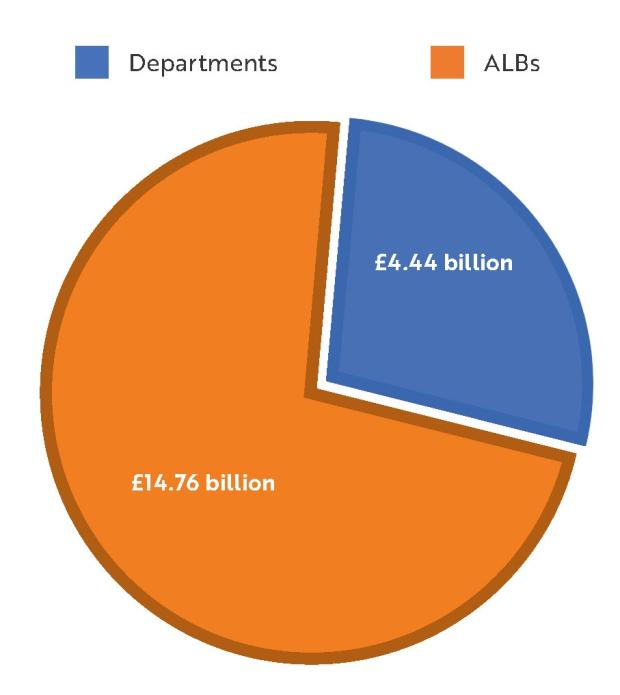
2024-25 Departmental Expenditure Limit of £19.20 billion (see Figure 2), with significant spend by a number of ALBs such as the health and social care trusts (£6.91 billion), the Education Authority (£3.35 billion), and Police Service of Northern Ireland (£0.99 billion).
Figure 2: Breakdown of 2024-25 expenditure
Source: Department of Finance
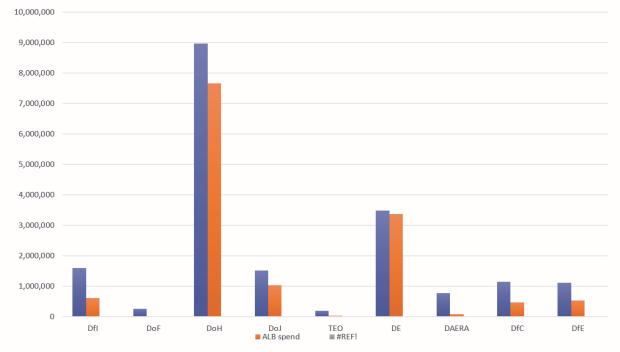
1.11 Although ALB expenditure varied significantly across departments, ALB spend represented a high proportion of departmental spend for all departments in 2024-25 (see Figure 3). Two departments, the Department of Health (DoH) and the Department of Education (DE), accounted for 66 per cent (£12.4 billion) of the Total DEL spend in Northern Ireland, with their ALB spend accounting for the majority (88 per cent, £11.048 billion) of this spend.
Figure 3: Total DEL spend by Departments and their ALBs in 2024-25
Source: Department of Finance
1.12 Given the scale of their financial and operational responsibilities, it is imperative that Departments and their ALBs maintain robust and collaborative working relationships.
Such partnerships are essential to ensuring effective governance, accountability, and the delivery of high-quality public services. However, the NIAO noted that there has been a number of reports which have made recommendations relevant to ALBs and their relationships with their Sponsoring Departments.
Review of Invest NI
1.13 Invest Northern Ireland (Invest NI) is one of the largest arms-length bodies in Northern Ireland with an annual budget of approximately £114 million. As the regional business development agency, Invest NI’s role is to grow the local economy by supporting growth, innovation and international competitiveness. It provides financial support, tailored guidance and trade support to attract foreign investment. The Department for the Economy (DfE) commissioned a review to assess whether Invest NI was fit for purpose to deliver the Department’s strategic vision.
1.14 The review panel, chaired by Sir Michael Lyons, published its report, Independent review
of Invest Northern Ireland in January 2023 which made 17 recommendations. Whilst the review panel made observations and recommendations that were specific to Invest NI, it also included a number of recommendations with regards to the relationship between the ALB and its Sponsoring Department:
- DfE needs to set clear policy and guidance and communicate this to Invest NI in a formal manner within a new Partnership Agreement as soon as possible. This should be reported on, and reviewed, on a regular basis.
- A formal agreement should be established between DfE and Invest NI that outlines the expectations and responsibilities of both parties but allows for an agile and responsive economic development agency. Appropriate proportionate control measures, including strong post hoc scrutiny, should be included in the agreement.
- There is a need for greater clarity between DfE and Invest NI, outlining expectations and responsibilities on both parties. DfE should look to strengthen its policy development and monitoring capability and resources across the Department.
1.15 The NIAO notes that a Partnership Agreement has since been put in place between DfE and Invest NI in March 2024. The NIAO intends to undertake a review of the implementation of the recommendations made in the review panel’s report and will report separately to the NI Assembly on the progress made.
Landscape Review of the Education Authority
1.16 In 2021, the DE commissioned its first review of the Education Authority (EA) since its establishment in 2015, following the replacement of the former Education and Library Boards. The review, which was undertaken by Baker Tilly Mooney Moore, commenced in November 2021 and the findings were published in the Education Authority Landscape Review (the Review) in June 2022.
1.17 The Review identified significant shortcomings in EA’s operations and made 13 recommendations grouped into three themes: Future Form, Function, and Financing; Capacity and Capability; and Governance and Accountability.
1.18 DE and EA accepted all the findings and developed a joint Action Plan to take forward
the recommendations which included:
- the need for a Partnership Agreement between EA and DE; and
- DE should review sponsorship team capacity and capability.
1.19 The NIAO will publish a report on the progress made by DE and EA on the implementation of the Review’s recommendations later in 2026.
Pivotal Report
1.20 In June 2025, Pivotal produced a report Policy Delivery in Northern Ireland, based on interviews with former Ministers, senior civil servants, and special advisors. The report identified systemic barriers to effective policy implementation, highlighting that these included issues such as siloed Departmental working, lack of cross-cutting collaboration, and limited accountability mechanisms.
1.21 One of the ten key features of effective delivery identified in the Pivotal report is the importance of strong relationships with delivery bodies and partners. The report highlighted that a significant portion of service delivery is carried out by ALBs, as well as by organisations in the community and voluntary sectors. Pivotal recommended to support effective outcomes, the NICS should foster collaborative and supportive relationships with these entities, ensuring clear communication, shared objectives, and mutual accountability.
1.22 The Pivotal report highlighted concerns regarding the effectiveness of sponsored body arrangements. Notably, a senior civil servant remarked, “I have never seen a sponsored body arrangement that has worked well,” while another cited a “lack of trust between Departments and their delivery bodies.”
Part Two: The development of current oversight arrangements
The Work of the Innovation Lab
2.1 In August 2017 the Permanent Secretary of the Department of Finance (DoF) wrote to
the Permanent Secretary Group members on a range of governance issues including
a proposed review of departmental sponsorship of ALBs. Annex A of the letter, which
set out the rationale for the review, indicated that guidance on sponsorship has not
been formally issued and that “in recent years there has been a growing acknowledgement, both by departments and ALBs, that departments need to provide proportionate oversight/sponsorship of ALBs”. The Permanent Secretaries of the Northern Ireland Civil Service (NICS) agreed that a comprehensive review of Departmental sponsorship arrangements was required and the NICS Board gave approval to DoF to carry out this review.
2.2 The Northern Ireland Public Sector Innovation Lab (the Innovation Lab), facilitated by
the Public Sector Reform Division (PSRD) within DoF, was commissioned to help identify and develop measures to improve the relationship between ALBs and NI departments.
The Innovation Lab’s objectives were to:
- Gather new insights into departmental sponsorship of ALBs from key stakeholders;
- Understand the benefits and disadvantages of existing sponsorship arrangements to departments and ALBs;
- Facilitate stakeholders to develop a shared understanding of the operating context;
- Involve key stakeholder groups in the consideration of what good sponsorship looks like;
- Explore and develop ways of improving the sponsorship arrangements;
- Bring key stakeholders together in a collaborative process in order to develop proportionate approaches to Departments and ALBs sponsorship; and
- Produce a report of the key issues and recommendations which will be used to inform
a review of ALB sponsorship to be taken forward by DoF.
2.3 The Innovation Lab held a two-day innovation event attended by a range of stakeholders including Chief Executives, Chairs of ALBs, representatives from the Northern Ireland Audit Office (NIAO) and Sponsor Teams within the NICS. The resulting Department Sponsorship of Arm’s Length Bodies Lab report (the Insight Report) dated February 2018 made 16 recommendations for Departments and ALBs (see Figure 4).
Figure 4: Insight Report recommendations issued in 2018
- Adopt the Cabinet Office Code of Good Practice with NI revisions if necessary
- Consideration of a language that fits with a collaborative and partnership approach
- Develop guidance on what ‘Earned Autonomy’ looks like
- Define and agree roles in the context of value and risk sharing
- Utilise a 360-degree approach to develop honest, trusting and supportive relationships between ALBs and sponsor Departments
- Consider the role of Tailored Reviews and how they can be rolled out (to include guidance)
- Develop a shared understanding and openness of dialogue to enable policy development
- Establish a Forum for Shared Leadership in The Executive Office with members from ALBs
and Departments - Take forward a high-level review of ALBs their purpose, functions and number of ALBs
within the context of Programme for Government - Review and streamline ALB support services where appropriate to include consideration
of shared and sharing services - Develop integrated and inclusive strategic planning processes that focus on outcomes
- Develop shadowing, secondment and training opportunities at senior level for ALBs and Departments
- Work on shared projects between Departments and ALBs potentially through a policy symposium
- Consider a talent pool for Board appointments, with the intention of ensuring good governance skills
- Encourage/influence Assembly Committees and Minister Briefs to focus/report on outcomes
- Review and simplify the Business Case Approval process
Source: The Insight Report
2.4 Following publication of the Insight Report, DoF established the ALB Sponsorship Working
Group (the Working Group), which included representatives from DoF, NIAO, the Chief
Executives’ Forum, the Chairs’ Forum, and a number of government departments.
2.5 The Working Group met for the first time in September 2018 and agreed a terms of reference, stating that they would be responsible for implementing six of the Insight Report’s recommendations (recommendations one to six in Figure 4).
2.6 The Working Group’s first output was the development of the ‘Departments and Arm’s Length Bodies: NI Code of Good Practice’ (the Code). Issued by DoF in March 2019 under cover of DAO (DoF) 03/19, the Code and subsequent guidance addressed the first five recommendations of
the Insight Report (recommendation six was considered as part of the New Decade New Approach – see paragraph 2.13).
2.7 We asked DoF what action had been taken in relation to the other ten Insight Report recommendations. A summary of the responses from DoF is included at Figure 5.
Figure 5: Update on Insight Report recommendations issued in 2018
| Recommendation | DoF Update | NIAO Comment |
|---|---|---|
| 7 Develop a shared understanding and openness of dialogue to enable policy development | ‘Making A Difference - The NICS Guide to Making Policy that Works’ issued in February 2023 includes reference to the engagement of ALBs by Departments as a fundamental part of the policy development process. | Whilst not specially referring to ALBs, DoF’s guidance outlines how stakeholder engagement supports effective policy design. |
| 8 Establish a Forum for Shared Leadership in The Executive Office with members from ALBs and Departments | A Shared Leadership Forum was established in late 2022/early 2023. This is now known as the Shared Leadership Board (SLB) which is led by The Executive Office and includes representatives from Departments, the Chief Executives’ Forum and the NI Public Sector Chairs Forum. | We note that the SLB continues to meet and that its terms of reference state that “The Board will provide shared direction, support, and challenge for the purposes of developing, promoting and supporting shared leadership and good governance through effective partnership and collaboration across the public sector (Departments and Arm’s Length Bodies) improving societal wellbeing.” |
| 9 Take forward a high-level review of ALBs their purpose, functions and number of ALBs within the context of Programme for Government | In March 2018, the NICS Board agreed the Innovation Lab recommendations with the exception of this recommendation as review of the ALB landscape would have required Ministerial/Executive support and there were no Ministers/Executive in place from 2017 to 2020. DoF’s Strategic Policy and Reform (SPaR) Directorate are currently completing work on the New Decade New Approach review of ALBs which has overtaken this particular recommendation but is relevant in overall terms. | In 2025, SPaR commenced an overarching review of the ALB landscape, with the ALB pay landscape review commencing in January 2025 and the wider ALB review exercise commencing in September 2025. |
| 10 Review and streamline ALB support services where appropriate to include consideration of shared and sharing services | The action is now subsumed within the wider Interg8 Programme to replace the current shared services provided by HR Connect and Account NI. DoF has reported this recommendation as closed. | We asked DoF what action had been taken in relation to ALBs that are not included within the Interg8 Programme and were advised that they are outside of the scope of the Programme but that “following a period of stabilisation, the solution delivered through the Integr8 Programme will be available to other central government bodies, subject to them securing business case”. The Insight report recommendation stated that a “review could mean the sharing of services across ALBs such as front line service provision or sharing services between ALBs and Departments”. Therefore, this recommendation remains to be addressed. |
| 11 Develop integrated and inclusive strategic planning processes that focus on outcomes | A paper was presented and accepted by NICS Board in September 2020 on the Review of Departmental Business Planning. Following this, Departments are required to consider how they adopt and incorporate that approach into their own strategic planning. DoF has reported this recommendation as closed. | The Insight recommendation stated that “the purpose of this recommendation is to ensure that strategic planning processes are aligned to the Programme for Government strategic outcomes and performance indicators and ALBs and Departments to align themselves more effectively as partners and collaborators”. Therefore, whilst a paper was presented to the Board in 2020, it is not clear how this recommendation has been actioned and followed up. |
| 12 Develop shadowing, secondment and training opportunities at senior level for ALBs and Departments | Officials within NICSHR in DoF have been supporting the Regional Community Planning Working Group to develop a shared leadership programme to support cross-sectoral collaboration in the delivery of community plans. A small working group is currently developing recommendations in this area, including identifying opportunities to share existing resources and expertise, and options around content and delivery and evaluation mechanisms. DoF has reported this recommendation as closed. | Although this recommendation was made over seven years ago, it is disappointing to note that work to implement the recommendation is still ongoing. |
| 13 Work on shared projects between Departments and ALBs potentially through a policy symposium | The ‘Short Guide to the Policy Function’ specifically refers to the engagement of ALBs by departments as a fundamental part of the policy development process. | Guidance on the need to involve ALBs has been issued. |
| 14 Consider a talent pool for Board appointments, with the intention of ensuring good governance skills | Currently ongoing and will be taken forward in collaboration with the new Commissioner for Public Appointments NI (CPANI) who was appointed in August 2025. | It is disappointing that a recommendation that was made over seven years ago is only now being addressed. |
| 15 Encourage/influence Assembly Committees and Minister Briefs to focus/report on outcomes | Initial work is already underway in the form of briefing colleagues on outcomes-based work. As a next step, TEO is to hold an internal meeting to establish how to approach the task of aligning briefings to Ministers and Committees. DoF has highlighted that no Assembly/Committees/Ministers were in place from 2017 to 2020, and from 2022 to 2024, and that from 2020 to 2021 the priority focus was on responding to the Covid Pandemic. | Work to address the recommendation made in 2018 commenced recently. |
| 16 Review and simplify the Business Case Approval process | The Better Business Case guidance was published in NI in July 2020. Proportionate business case templates were also published in October 2020 to help simplify the process. A review of the delegations was completed in October 2021, following which a revised list of delegations was issued to Departments. | Despite the revision of guidance, from discussions with stakeholders (see Figure 11), it appears that the business case approval process still has significant issues. |
Source: The Insight Report and the Department of Finance
2.8 Whilst as noted in paragraph 2.6, the ALB Sponsorship Working Group addressed five of the Insight Report’s recommendations and a sixth was considered as part of NDNA, as indicated in Figure 5, the NIAO considers that progress in implementing the other ten recommendations has been limited and that, to date, only three of the ten recommendations have been fully actioned.
2.9 While some actions have been taken in relation to the other seven recommendations, these are at an early or developmental stage. This includes initiatives such as establishing a talent pool for Board appointments, reviewing and streamlining ALB support services, and undertaking a high level review of the ALB landscape. More sustained, coordinated and timely actions are required to deliver on the recommendations included in the Insight Report issued in 2018.
The NI Code of Good Practice
2.10 As noted in paragraph 2.6, the ‘Departments and Arm’s Length Bodies: NI Code of Good Practice’ (the Code) was published in 2019. The purpose of the Code is to ensure that:
- Its principles can be formalised in framework documents/partnership agreements;
- Its principles act as a set of common standards for departments and ALBs to live by
and measure their relationships against, on a continuing basis; - Its principles of good practice can be applied to derive greater value from, and bring consistency to, relationships between Departments and ALBs; and
- It complements documents such as Managing Public Money Northern Ireland (MPMNI).
2.11 The Code includes five principles and examples of what good practice looks like to promote consistency and strengthen the effectiveness of relationships between Departments and their ALBs (see Figure 6).
Figure 6: NI Code of Good Practice Principles
Leadership
Partnerships work well when departments and Arm’s Length Bodies demonstrate good leadership to achieve a shared vision and effective delivery of public services. Strong leadership will provide inspiration, instil confidence and trust and empower their respective teams to deliver good outcomes for citizens.
Purpose
Partnerships work well when the purpose, objectives and roles of Arm’s Length Bodies and the sponsor department are clear, mutually understood and reviewed on a regular basis. There needs to be absolute clarity about lines of accountability and responsibility between departments and Arm’s Length Bodies. In exercising statutory functions Arm’s Length Bodies need to have clarity about how their purpose and objectives align with those of departments.
Assurance
Partnerships work well when departments adopt a proportionate approach to assurance, based on Arm’s Length Bodies’ purpose and a mutual understanding of risk. Arm’s Length Bodies should have robust governance arrangements in place and in turn departments should give Arm’s Length Bodies the autonomy to deliver effectively. Management information should be what is needed to enable departments and Arm’s Length Bodies to provide assurance and assess performance.
Value
Partnerships work well when departments and Arm’s Length Bodies share knowledge, skills and experience in order to enhance their impact and delivery. Arm’s Length Bodies are able to contribute to policy making and departmental priorities. There is a focus on innovation, and on how departments and Arm’s Length Bodies work together to deliver the most effective policies and services for its customers
Engagement
Partnerships work well when relationships between departments and Arm’s Length Bodies are open, honest, constructive and based on trust. There is mutual understanding about each other’s objectives and clear expectations about the terms of engagement.
Source: NI Code of Good Practice
2.12 The Working Group also produced a Partnership Agreement template designed to replace the Management Statement Financial Memorandum (MSFM) framework (see Part Three) and developed guidance on proportionate autonomy, outlining how Departments should tailor oversight based on the size and complexity of each ALB (see paragraph 5.7).
New Decade New Approach
2.13 We asked DoF what action has been taken in relation to recommendation six within the Insight Report, to “consider the role of tailored reviews and how they can be rolled out”.
2.14 DoF informed the NIAO that they had not taken any further action in relation to this recommendation and that it had been superseded by the commitment in New Decade New Approach (NDNA) published in January 2020 which states that “there will be a review of Arm’s Length Bodies with a view to their rationalisation.”
2.15 DoF informed us that they conducted a desk-top review in 2021 in response to the NDNA commitment but acknowledged that this “high-level assessment did not provide a sufficient robust review of ALBs to allow decisions to be taken and that it was for individual Ministers to determine the status of their ALBs”.
2.16 Consequently, the NI Executive agreed in December 2021, that sponsoring Departments would be responsible for taking forward reviews of their ALBs.
2.17 The Executive also agreed to prepare legislation enabling Ministers to reform their ALBs. DoF advised us that the collapse of the NI Executive in February 2022 meant that a bill could not be progressed at that stage. DoF also advised that, whilst a bill has been drafted, progress of the bill is dependent on the completion of departmental reviews of ALBs, briefing the Executive on the reviews’ findings and the Executive’s agreement of the need for the proposed legislative approach.
2.18 DoF informed us in September 2025, that they were commencing a new exercise with Departments. The purpose of the exercise, which is being undertaken by DoF’s Strategic Policy and Reform Directorate is to assess the status of ALB reviews; their conclusions; and the priority current Ministers are giving to the reform of individual ALBs. DoF anticipate that this exercise will be completed in early 2026.
2.19 NIAO also noted that the NI Assembly’s Committee for Finance raised several questions during 2025 in relation to the review of ALBs and asked that DoF provide a written briefing. This briefing, which sets out the progress to date, was provided in December 2025 and the Committee is expected to receive an update in May 2026.
2.20 Whilst acknowledging that further work is planned, the NIAO was disappointed to note that some of the recommendations made in the Insight Report have yet to be implemented fully over eight years later.
Recommendation 2
The NICS Board should ensure that all recommendations contained in the Insight Report issued in 2018 remain applicable and are implemented fully as a matter of urgency.
Part Three: Partnership Agreements
Partnership Agreement Template
3.1 In November 2019, DoF issued guidance (DAO (DoF) 05/19), introducing a new Partnership Agreement template between Departments and ALBs. This template, approved by the NICS Board, replaced the MSFM template.
3.2 The purpose of the Partnership Agreement is to clearly define the overall governance framework within which each ALB operates and the assurances which they are required to provide to stakeholders. Other elements of the Partnership Agreement include clearly defined roles and responsibilities, an annual Engagement Plan and delegated authorities (see Appendix 3).
3.3 Apart from the inclusion of the Engagement Plan, the key difference between the Partnership Agreement and the MSFM which it replaced, is the removal of general financial information which is already comprehensively covered in MPMNI. For example, the MSFM template included information on fraud which is covered in Annex 4.9 of MPMNI and banking which is covered within Chapter 5 of MPMNI.
3.4 The Partnership Agreement template aligns with the ‘Departments and Arm’s Length Bodies: NI Code of Good Practice’ (see paragraph 2.6) and emphasises the need for open, honest, trust-based communication, together with the need for a mutual understanding of each other’s objectives and clear expectations.
3.5 Annex 2 of the Partnership Agreement template provides an illustrative annual Engagement Plan which outlines the key areas of engagement between departments and ALBs, including assurances required, strategic planning and budget management.
3.6 In terms of roles and responsibilities, the Partnership Agreement indicates that the ALB Chair should lead the Board and maintain liaison with the Minister, while the Chief Executive serves as the operational lead and Accounting Officer. The Department is responsible for providing oversight, setting strategic direction, and ensuring accountability of the ALB.
3.7 The DoF guidance indicates that the template is designed to be flexible and tailored to the specific context of each ALB, ensuring that governance arrangements are proportionate to the size, complexity, and risk profile of the body.
3.8 DoF’s guidance requires that there is a formal review of the Partnership Agreement every three years and that they are publicly available on the Department’s and ALB’s websites.
Partnership Agreements in place
3.9 NIAO noted that while DAO (DoF) 05/19 states that the Partnership Agreements should be phased in from 1 April 2020, the guidance does not include a deadline for when the Departments were expected to have all the Partnership Agreements in place. We asked DoF why this was the case. DoF informed us that no date had been added in recognition of the Departments which had a large number of ALBs. DoF added that “it was envisaged that Partnership Agreements would be in place as appropriate within a couple of years. Unfortunately, in early 2020, the COVID-19 pandemic occurred and that undoubtedly had a big impact across all departments in getting their Agreements in place.”
3.10 As DoF was unable to provide the NIAO with a complete and up to date list of ALBs within NI and does not know which ones have Partnership Agreements in place, NIAO requested this information from each Department. Returns received from the Permanent Secretaries indicate that of the 101 ALBs listed at Appendix 1, only 59 currently have Partnership Agreements in place and published on sponsor department websites, as per DoF guidance.
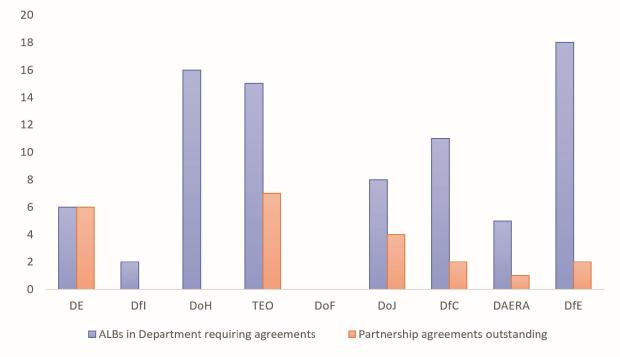
3.11 Twenty of the other 42 ALBs do not require such agreements, primarily due to their size or their designation as a North-South Body. However, this means that 22 (27.2 per cent) of the 81 ALBs for which agreements are required, still do not have a Partnership Agreement in place, despite the requirement for them being introduced over five years ago. The NIAO noted that some of the bodies without signed Partnership Agreements include those with significant expenditure such as the Education Authority and Police Service of Northern Ireland.
3.12 The NIAO noted that DoH has Partnership Agreements in place with all 16 of its ALBs that require them (see Figure 7). It should be noted that DoF advised the NIAO that none of its ALBs required a Partnership Agreement as, for example, they are North/South or non-statutory bodies.
Figure 7: Partnership Agreements not yet signed and published on sponsor department websites at January 2026
Source: NIAO analysis of information provided by Departments
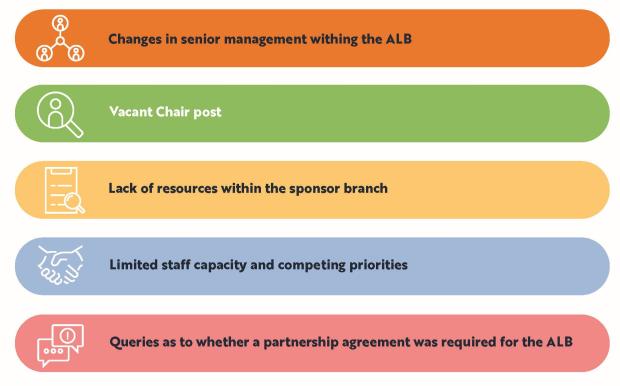
3.13 We asked each department why all of the required Partnership Agreements are not yet
in place. A summary of explanations provided to the NIAO are included at Figure 8.
Figure 8: Reasons why Partnership Agreements not in place
Source: NIAO analysis of information provided by Departments
Recommendation 3
DoF should remind departments of the need and benefits of having Partnership Agreements in place with their ALBs and ensure that these are progressed urgently.
NIAO examination of Partnership Agreements
3.14 The NIAO examined 13 Partnership Agreements which have been signed by the Departments and ALBs, covering all Departments and a range of ALBs (see Appendix 4). Although we noted that in some cases, there was minimal adaptation or tailoring of the Partnership Agreement narrative, the Engagement Plans within them had been tailored to reflect the individual ALB’s circumstances.
The Need for Review of Partnership Agreements
3.15 Paragraph 2.4 of the ‘Departments and Arm’s Length Bodies: NI Code of Good Practice’ advises that there should be an agreed process for reviewing Partnership Agreements, indicating that as a minimum, Agreements should be reviewed formally at least once every three years. It also states that the depth of reviews should be proportionate to the size and/or responsibilities of the ALB concerned and that all such reviews should be published.
3.16 This need for regular review is reflected in the Partnership Agreement template which requires an Annual Review of Partnership Effectiveness and a Formal Review of the Partnership Agreement every three years (see Figure 9). The template also advises that the outcome of a Formal Review should be published on both the Departmental and ALB websites.
Figure 9: Partnership Agreement Reviews
Annual Review of Partnership Effectiveness
The annual review should identify areas for improvement or enhancement and inform future engagement strategies. This review aims to assess the effectiveness of the partnership between the Department and the ALB. It should evaluate the Engagement Plan, communication, strategic alignment, and risk management, using existing governance mechanisms such as joint meetings and reporting cycles. The review should highlight areas for improvement and guide future engagement strategies.
Formal Review of the Partnership Agreement
The aim of the three-year formal review ensures the Partnership Agreement remains current and aligned with governance standards and service delivery objectives. It should assess roles, responsibilities, assurance mechanisms, and strategic goals, proportionate to the ALB’s scale and complexity.
Source: Partnership Agreement Template
3.17 The Corporate governance in central government departments: code of good practice NI published in February 2025 also includes the need for review of review and updating of Partnership Agreements, advising that certain events may trigger such a review, such as the appointment of a new chair or chief executive officer in an ALB, changes of senior personnel in the sponsor team in the host department or a significant change in government policy relating to the ALB’s business.
3.18 NIAO requested information from Departments on the number and frequency of Partnership Agreement reviews. Our analysis of the information provided (see Figure 10) shows that of the 59 Partnership Agreements signed to date, only eight, that is those that were signed in 2021 and 2022, required a Formal Review. The NIAO were informed by the Departments that reviews had taken place of seven of these agreements. A Formal Review of the eighth Partnership Agreement will take place once an overall review of the ALB has been completed.
Figure 10: Analysis of signed Partnership Agreements
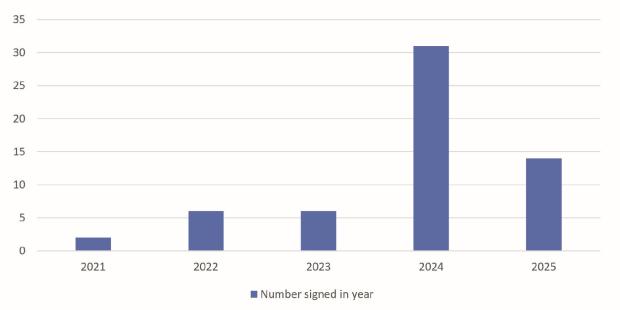
Insert Figure 10 here
Source: NIAO analysis of information provided by Departments
3.19 Although, as indicated in paragraphs 3.15 and 3.16, there is need for Formal Reviews of Partnership Agreements to be publicly available, NIAO noted that only one of the seven Formal Reviews which have been carried out to date has been published on the either the Department’s or the ALB’s website.
Recommendation 4
DoF should remind Departments of their responsibility to undertake Annual and Formal Reviews of Partnership Agreements in accordance with DoF requirements and that Formal Reviews are made available on the Departmental and ALBs’ websites.
Part 4: Stakeholder Engagement
Stakeholder Engagement
4.1 NIAO met with a number of stakeholders, including Forum Chairs, Chief Executives,
Non-Executive Directors (NEDs), and representatives from Departments, to obtain their views and observations on Partnership Agreements and the relationships between ALBs and their sponsoring Departments. We received positive and negative feedback from these stakeholders.
4.2 A number of the stakeholders welcomed the introduction of Partnership Agreements, indicating that they had led to improved clarity of roles and responsibilities of the Department and ALBS, streamlining of processes, and stronger collaborative relationships.
4.3 Conversely, concerns were raised about the rigid adherence to templates, lack of flexibility for smaller ALBs and that there has been no change in behaviours since the Partnership Agreement had been introduced.
4.4 Some of the comments received from stakeholders are included at Figure 11.
Figure 11: Observations and experiences of stakeholders
Positive experiences
“Partnership agreement is more streamlined.”
“Department has their own procedures which are shared with their ALBs.”
“Partnership should be equal.”
“Grown up and productive relationship.”
“Roles and responsibilities between ALBs and departments are clear.”
“Partnership agreement was progressive thinking and a sound concept.”
Negative experiences
“Need to recognize one size doesn’t fit all.”
“It is not clear why some information is being requested by the sponsor branch.”
“Implementation and reviews took longer than expected.”
“Regular changes in sponsor branch, takes a while for the staff to get up to speed.”
“Paperwork for a small ALB is horrendous.”
“Creation of partnership agreement has not happened in the spirit of how it was supposed to happen.”
“No relationship with the Department.”
“Sponsor branch does not understand the ALB’s business.”
“Business cases create a lot of work for ALBs and it takes a long time to be approved.”
“Some elements such as proportionate autonomy were difficult to get into the agreement.”
“Parent/child relationship.”
Source: NIAO discussions with stakeholders
4.5 Based on our discussions with stakeholders and their negatives comments, it was clear that Partnership Agreements are not working as intended.
4.6 One of the Sponsor Teams we spoke to indicated that they developed detailed sponsorship guidance to be followed when managing their ALBs to ensure a consistency of approach and reduce duplicate information requests. The Team indicated that consideration is being given to the appropriateness of rolling out this guidance to other Sponsor Teams within the Department. The NIAO considers that documentation of sponsorship arrangements is essential, especially where is there a high turnover or increase in Sponsor Branch staff. DoF advised that it will be producing a good practice sponsor guide based on the Cabinet Office version, which should also help bring some consistency of approach.
4.7 We were also advised that a number of initiatives had been adopted to strengthen relationships, promote collaboration and address any issues arising. These include annual meetings between the Departmental Audit and Risk Committee Chair (ARAC) and ALB ARC Chairs, and workshops involving Sponsor Teams within Departments to discuss common issues and share ideas on effective sponsorship practices.
Recommendation 5
Whilst it is essential that Departments comply with the DoF guidance, DoF should
also ensure that there is an appropriate and effective mechanism which allows for
the identification and sharing of good practice.
Part Five: Sponsorship
Sponsorship
5.1 In its report ‘Arm’s length body sponsorship code of good practice’ (the Sponsorship Code) published in May 2022, the Cabinet Office defined sponsorship as “the activity that delivers effective relationships between departments and their ALBs.”
5.2 The Sponsorship Code sets out why sponsorship is essential, what effective sponsorship entails, and how it can be undertaken. It states that “Sponsorship requires a whole department effort. There should be a focus on forging strong and trusting relationships between the relevant individuals at all levels of the ALB and the department. This will help to ensure both that ALBs feel supported and that departments are assured of their delivery. Working together to create trust and a culture of no surprises is the foundation of good sponsorship.”
5.3 The Sponsorship Code indicates that there are four key principles of great sponsorship: Purpose, Assurance, Value and Engagement (see Figure 12).
Figure 12: The Key Principles of Great Sponsorship
| Purpose | A mutual clear understanding of the purpose of the ALB |
| Assurance | A proportionate approach to assurance |
| Value | A mutual sharing of skills and experience |
| Engagement | Open, honest and constructive relationships |
Source: Cabinet Office’s ‘Arm’s Length Body Sponsorship Code of Good Practice’
5.4 The Sponsorship Code also sets out how the four key principles should be applied across six key capabilities (Relationship management; Agreeing strategy and setting objectives; Outcome assurance; Financial oversight, Risk management, and Governance and accountability) and provides checklists of activities that demonstrate each of these capabilities.
5.5 The Sponsorship Code also includes a Maturity Model approach which enables departments to assess their sponsorship capability as ‘emerging, maturing or advanced’ and aids continuous improvement in their sponsorship approach.
5.6 The NIAO noted that DoF has not, to date, issued any comparable guidance in NI. DoF advised the NIAO that they recognise the need to consider this guidance and they are planning to do so now that they have secured additional resources to take this forward.
Recommendation 6
In collaboration with relevant stakeholders, DoF should review the Cabinet Office’s ‘Arm’s length body sponsorship code of good practice’ and consider whether comparable guidance needs to be issued in NI to ensure that all Departments adopt a proportionate approach to sponsorship/partnership working.
Proportionate Autonomy
5.7 DoF issued Partnership Working: Proportionate Autonomy for ALBs in December 2019 undercover of DAO(DoF) 06/19, advising that the “concept of “proportionate autonomy”
is about the level of independence and autonomy with which an ALB can operate from the department, and relates to the extent and nature of engagement and assurance required between a department and an ALB. Essentially, it is about trust, and the basis for it. It is however flexible, and will be subject to individual circumstances – i.e. not one size fits all, all of the time.”
5.8 Assessing proportionate autonomy involves evaluating the ALB’s governance procedures, internal controls, financial management, and compliance with guidance. The guidance states that departments should rely on these assurances and not carry out excessive checking of information/returns provided by ALBs or duplicate administrative functions of ALB staff. The negative comments made during the NIAO’s engagement with stakeholders (see Figure 11) indicate that some ALBs do not think that all Sponsor Teams have embraced the principles of proportionate autonomy.
5.9 The guidance also states that ALBs that consistently deliver agreed outcomes and provide reliable assurances - demonstrated through strong governance, sound financial management, and compliance with guidance - should be granted a high degree of autonomy. This autonomy reflects the trust earned through sustained performance and accountability.
5.10 Annex A of the proportionate autonomy guidance provides a summary of assurances that Departments and ALBs should consider when establishing Engagement Plans to be included with the Partnership Agreement. These Engagement Plans reflect the appropriate level of ALB autonomy based on assurances/indicators of good governance and the maturity of the partnership/relationship.
5.11 The DoF guidance advises that “it is essential that relationships between departments and ALBs are based on trust, shared values and outcomes, transparency and clear lines of accountability and responsibility”. However, we noted during discussions with stakeholders (see Part Four) that, although Departments may have completed a proportionate autonomy assessment, the assessment was not shared with the ALB.
Recommendation 7
Departments should ensure that proportionate autonomy assessments are completed and that, in the interests of partnership working and transparency, these assessments are completed in co-operation with ALBs and subsequently shared with ALBs.
Sponsor Teams
5.12 Each ALB in NI has a Sponsor Team within their sponsoring Department. Sponsor Teams
may be responsible for more than one ALB.
5.13 The NIAO obtained the details of the number of staff working in Sponsorship Teams from each Department, both currently and before the introduction of Partnership Agreements. The information obtained shows an increase in staff within Sponsor Teams (see Figure 13).
Figure 13: Staff numbers within Sponsor Teams
| Department | Staff in Sponsor Team 2019 | Staff in Sponsor Team 2025 |
|---|---|---|
| DAERA1 | 10 | 12 |
| DE1 | 21 | 20 |
| DfC | 54.5 | 68 |
| DfE1 | 149.86 | 157.27 |
| DfI | 18.5 | 21.5 |
| DoF | 9.33 | 12.25 |
| DoH1, 2 | 19.65 | 24.61 |
| DoJ | 11 | 9 |
| TEO | 15.4 | 18.3 |
| Total | 309.24 | 342.93 |
Source: NIAO analysis of information provided by Departments
1 Staff numbers in both years include those with responsibilities other than sponsorship.
2 Staff numbers in 2019 for one Sponsor Team are not available. We have assumed that staff numbers in 2019 for the Sponsor Team were the same as those in 2025 (0.9 FTE).
5.14 It should be noted that the sponsorship staff numbers for DfE in Figure 13 includes all staff within the Department’s Higher Education Division as DfE considers that all staff are involved in some level of “partnership activity” in relation to the colleges and universities. A breakdown of DfE’s sponsor staff numbers and those for DE, DfC and DoH, who have some of the larger ALBs in terms of budget, is included at Appendix 5.
5.15 The NIAO noted that within Departments there does not appear to be a correlation between the ALBs’ 2024-25 spend and the number of Departmental staff involved in sponsorship:
- Within DfE, Invest NI’s 2024-25 spend (£113.9 million) was more than five times that of Screen NI (£21.0 million). However, there were 12.8 staff involved in sponsorship activities relating to Invest NI compared with 9.5 for Screen NI, a difference of 3.3 (35 per cent).
- Within DoH, less staff (5.2) are involved in overseeing the Trusts with spend of £6.91 billion than are involved in sponsoring activities relating to the NI Fire and Rescue Service (6.61) which had spend of £130.1 million in 2024-25.
- Within DfC, 11 staff are involved in the sponsorship of Sport NI which had spend of £8.3 million. However, only two more staff, that is, 13 are involved in overseeing the NI Housing Executive which had spend of £369.6 million in 2024-25.
5.16 We also noted that there does not appear to be a correlation between Departments with regards to ALB spend and the number of staff involved in sponsorship:
- Less DE staff (nine) are involved in the sponsorship of the Education Authority, the Council for Catholic Maintained Schools and the Council for Curriculum, Assessment and Examinations with a combined spend of £3.38 billion than there are DfC staff involved in the oversight of Sport NI (11) whose spend was £8.3 million.
- Similarly, the number of DoH staff (5.2) overseeing the Trusts, with a combined spend of £6.91 billion, is less than half the DfC staff overseeing the NI Housing Executive (13) which had a spend of £369.6 million.
5.17 Whilst the need to deal with specific governance issues involving some ALBs might explain why there is not always a direct correlation between spend and the size of the sponsor team, this does not explain the magnitude of the differences noted by the NIAO, given that each ALB has established governance structures such as Boards, Audit Committees and Internal Audit.
5.18 Given that DoF’s proportionate autotomy guidance was intended to reduce the need for intensive oversight, it is somewhat surprising that the number of Departmental staff in Sponsor Teams increased by 10.9 per cent between 2019 and 2025.
Recommendation 8
Departments should review Sponsor Team staffing levels to ensure they reflect the assessed proportionate oversight requirements and deliver value for money.
Part Six: Central Oversight of ALBs
The role of Department of Finance
6.1 The NIAO noted that the role of DoF in relation to ALBs differs from that of the Cabinet Office.
6.2 The Public Bodies Team within the Cabinet Office is responsible for providing guidance and support to Departments on the classification and operation of public bodies, including ALBs. This includes ensuring that public bodies ae effectively funded and deliver public or government services effectively. The team also produces annual public bodies data, including an ALB Landscape Analysis (the latest version of which can be found at ALB Landscape Analysis 2023/24) and Sponsor Team staff numbers.
6.3 In contrast, when we commenced this review, neither DoF nor any other Department was able to provide the NIAO with a current listing of all ALBs by Department and thus we had to obtain the information at Appendix 1 from each Department. Similarly, DoF did not know the status of Partnership Agreements between Departments and ALBs.
6.4 The NIAO asked DoF why no one was appointed to oversee the implementation of Partnership Agreements. DoF informed us that “as with any guidance issued by DoF they do not assume a policing role, it is the responsibility of the Accounting Officers to ensure that guidance is followed.”
6.5 DoF advised us that in addition to issuing guidance, they also facilitated workshops with Departments to explain the context of the new guidance and Partnership Agreements. DoF also advised that they had set up a Departmental Implementation Group which met on several occasions between 2019 and 2022, to discuss issues and share lessons learned. DoF advised that although they had planned to have another meeting of the Group, at that time they had severe resource constraints and other priority work. Although DoF advised that during the meeting they reminded Departments of the importance of getting Partnership Agreements in place, as indicated in paragraph 3.11, Departments were slow to implement Partnership Agreements.
Recommendation 9
Given the vital role that ALBs play in delivering public services and the expenditure which they incur in doing so, the NICS Board should review the consistency and appropriateness of Departmental oversight of ALBs. The NICS Board should also ensure that any information and data collated during this review is held centrally and updated as and when necessary.
Appendix 1 (paragraph 1.2) - ALBs and 2024-25 Departmental Expenditure Limit Outturn per Department
| £,000 | |
|---|---|
| DAERA | 687,935 |
| Agri-Food and Biosciences Institute | 74,344 |
| Council for Nature Conservation and the Countryside1 | – |
| Livestock and Meat Commission for Northern Ireland | -158 |
| The Loughs Agency of the Foyle, Carlingford and Irish Light Commission | 4,222 |
| Northern Ireland Fishery Harbour Authority | 2,724 |
| Agricultural Wages Board for Northern Ireland1 | – |
| Total DAERA Group | 769,067 |
| £,000 | |
|---|---|
| DE | 108,175 |
| Education Authority | 3,348,033 |
| Council for Catholic Maintained Schools | 4,189 |
| Council for Curriculum Examination and Assessments | 23,129 |
| Comhairle na Gaelscolaíochta | 797 |
| Northern Ireland Council for Integrated Education | 648 |
| Middletown Centre for Autism | 1,562 |
| General Teaching Council for Northern Ireland | -6 |
| Total DE Group | 3,486,527 |
| £,000 | |
|---|---|
| DfC | 674,849 |
| Armagh Observatory and Planetarium | 3,062 |
| Arts Council Northern Ireland | 13,602 |
| Charity Commission Northern Ireland | 2,056 |
| Commissioner Older People Northern Ireland | 1,632 |
| Libraries Northern Ireland | 36,817 |
| Local Government Staff Commission for Northern Ireland1 | – |
| National Museums Northern Ireland | 24,033 |
| Northern Ireland Museums Council | 264 |
| Northern Ireland Commissioner Children & Young People | 1,806 |
| Northern Ireland Housing Executive | 369,581 |
| Northern Ireland Local Government Superannuation Committee1 | – |
North/South Language Body Foras na Gaeilge North/South Language Body Ulster-Scots Agency | 5,881 |
| Sport Northern Ireland | 8,302 |
| Ulster Supported Employment Limited | 4,110 |
| Total DfC Group | 1,145,995 |
| £,000 | |
|---|---|
| DfE3 | 579,422 |
| 328,948 | |
| Consumer Council Northern Ireland | 2,468 |
| Health and Safety Executive | 1,043 |
| Labour Relations Agency | 5,777 |
| Tourism Northern Ireland | 44,436 |
| Northern Ireland Screen | 20,999 |
| Invest Northern Ireland | 113,925 |
| Construction Industry Training Board | 164 |
| Stranmillis University College | 7,758 |
| St Mary's University College1 | – |
| Queens University Belfast1 | – |
| Ulster University1 | – |
| Open University Northern Ireland1 | – |
| Tourism Ireland | 150 |
| Intertrade Ireland | 6,613 |
| Total DfE Group | 1,111,703 |
| £,000 | |
|---|---|
| DfI | 975,620 |
| Northern Ireland Transport Holding Company1 | – |
| Waterways Ireland | 7,468 |
| Northern Ireland Water | 615,030 |
| Drainage Council Northern Ireland1 | – |
| Total DfI Group | 1,598,118 |
| £,000 | |
|---|---|
| DoF | 262,043 |
| Utility Regulator | 9,334 |
| Fiscal Council | – |
| Legal Services Oversight Commissioner1 | – |
| Northern Ireland Building Regulations Advisory Committee1 | – |
| Northern Ireland Civil Service Appeals Board1 | – |
| Northern Ireland Civil Service Pension Board1 | – |
| Special EU Programmes Body | 1,461 |
| Statistics Advisory Committee1 | – |
| Total DoF Group | 272,838 |
| £,000 | |
|---|---|
| DoH | 1,309,798 |
| Business Services Organisation Northern Ireland | 391,961 |
| Children’s Court Guardian Agency Northern Ireland | 4,932 |
| 6,907,711 | |
| Northern Ireland Ambulance Service1 | – |
| Northern Ireland Blood Transfusion Service | 16,071 |
| Northern Ireland Fire and Rescue Service | 130,066 |
| Northern Ireland Practice and Education Council | 1,479 |
| Northern Ireland Medical Dental Training Agency | 199,959 |
| Northern Ireland Social Care Council | 4,045 |
| Patient Client Council | 2,080 |
| Public Health Agency1 | – |
| Regulation Quality Improvement Authority | 8,929 |
| Food Safety Promotion Board (Safefood) | 2,174 |
| The Institute of Public Health in Ireland CLG | 422 |
| Total DoH Group | 8,979,573 |
| £,000 | |
|---|---|
| DoJ | 481,725 |
| Police Service of Northern Ireland | 989,451 |
| Northern Ireland Policing Board | 5,926 |
| Police Ombudsman for Northern Ireland | 10,729 |
| Royal Ulster Constabulary George Cross Foundation | 187 |
| Probation Board for Northern Ireland | 27,172 |
| Police Rehabilitation and Re-training Trust | 1,992 |
| The Northern Ireland Police Fund | 1,472 |
| Criminal Justice Inspection Northern Ireland | 1,407 |
| Total DoJ Group | 1,520,061 |
| £,000 | |
|---|---|
| TEO | 164,293 |
| Victims Payment Board1 | – |
| Historical Institutional Abuse Redress Board1 | – |
| Northern Ireland Community Relations Council | 3,208 |
| Northern Ireland Judicial Appointments Commission | 1,109 |
| Commissioner for Survivors of Institutional Childhood Abuse | 845 |
| Attorney General Northern Ireland1 | – |
| Strategic Investment Board | 3,796 |
| Equality Commission Northern Ireland | 6,238 |
| Maze Long Kesh Development Corporation | 2,202 |
| Victims and Survivors Service | 19,950 |
| Commission for Victims and Survivors Northern Ireland | 702 |
| Commissioner for Public Appointments Northern Ireland1 | – |
| Office of Identity and Cultural Expression2 | – |
| Irish Language Commissioner2 | – |
| Commissioner for the Ulster Scots and the Ulster British Tradition2 | – |
| Total TEO Group | 202,343 |
1 Costs for these ALBs are included within the Departmental spend.
2 New ALB in 2025-26.
3 Excludes Student Loans
Appendix 2 (paragraph 1.5) - List of Public Bodies provided to the Northern Ireland Assembly Finance Committee in January 2026
Bodies which DoF advised the NIAO that they consider to be ALBs
DAERA Agricultural Wages Board
DAERA Agri-food and Biosciences Institute
DAERA Council for Nature Conservation and the Countryside
DAERA Livestock and Meat Commission for NI
DAERA NI Fishery Harbour Authority
DAERA Loughs Agency of the Foyle, Carlingford and Irish Lights Commission
DE Comhairle Na Gaelscolaíochta
DE Council for Catholic Maintained Schools
DE Education Authority
DE Exceptional Circumstances Body
DE General Teaching Council for NI
DE Middletown Centre for Autism
DE NI Council for the Curriculum, Examinations & Assessment
DE NI Council for Integrated Education
DE Voluntary Grammar Schools
DE Youth Council for Northern Ireland
DfC Armagh Observatory and Planetarium
DfC Arts Council for NI
DfC Charity Commission for NI
DfC Commissioner for Older People NI
DfC Historic Buildings Council
DfC Historic Monuments Council
DfC Local Government Staff Commission for NI
DfC National Museums and Galleries of NI
DfC NI Commissioner for Children and Young People
DfC NI Housing Executive
DfC NI Library Authority
DfC NI Local Officers’ Superannuation Committee
DfC NI Museums Council
DfC Sports Council for NI
DfC Ulster Supported Employment and Learning
DfC North South Language Body - Foras na Gaelige
DfC North South Language Body - Ulster Scots Agency
DfE Construction Industry Training Board NI
DfE Belfast Metropolitan College
DfE Northern Regional College
DfE North West Regional College
DfE Southern Regional College
DfE South Eastern Regional College
DfE South West College
DfE Health & Safety Executive for NI
DfE Invest NI
DfE Labour Relations Agency
DfE NI Screen Commission
DfE Stranmillis University College
DfE The General Consumer Council for NI
DfE Tourism NI
DfE InterTrade Ireland
DfE Tourism Ireland
DfI Drainage Council for NI
DfI NI Water
DfI Waterways Ireland
DfI NI Transport Holding Company
DoF NI Fiscal Council
DoH Belfast Health and Social Care Trust
DoH Business Services Organisation
DoH NI Ambulance Service
DoH NI Blood Transfusion Service
DoH NI Fire and Rescue Service
DoH NI Medical and Dental Training Agency
DoH NI Practice and Education Council for Nursing and Midwifery
DoH NI Social Care Council
DoH Northern Health and Social Care Trust
DoH Patient and Client Council
DoH Public Health Agency
DoH Regulation and Quality Improvement Authority
DoH Southern Health and Social Care Trust
DoH South Eastern Health and Social Care Trust
DoH The Children’s Court Guidance Agency for NI
DoH Western Health and Social Care Trust
DoH Food Safety Promotion Board
DoH The Institute of Public Health in Ireland
DoF Utility Regulator for NI
DoF Special EU Programmes Body
DoJ Criminal Justice Inspection NI
DoJ NI Policing Board
DoJ NI Police Fund
DoJ Police Ombudsman for NI
DoJ Police Rehabilitation & Retraining
DoJ Probation Board for NI
DoJ PSNI
DoJ RUC George Cross Foundation
TEO Commissioner for Survivors of Institutional Childhood Abuse
TEO Commissioner for Ulster Scots and the Ulster British tradition
TEO Commission for Victims & Survivors Northern Ireland
TEO Equality Commission for NI
TEO Irish Language Commissioner
TEO Maze/Long Kesh Development Corporation
TEO NI Community Relations Council
TEO NI Judicial Appointments Commission
TEO NI Climate Commissioner (established in law, not operational as yet)
TEO Office of Identity and Cultural Expression
TEO Strategic Investment Board Limited
TEO Truth Recovery Redress Service (not yet established, expected by Summer 2026)
TEO Victims and Survivors Service
Bodies which DoF advised the NIAO that they do not consider to be ALBs
DAERA Forest Service
DAERA NI Environment Agency
DAERA Office for Environmental Protection
DE Grant-maintained Integrated Schools
DE Voluntary Maintained Schools
DfC The Appeals Service
DfC Rent Assessment Panel
DfC Vaughan’s Charitable Trust
DfC Ministerial Advisory Group for Architecture and Build Heritage
DfC NI Central Investment Fund for Charities Advisory Committee
DfC The Discretionary Support Commissioner
DfE Industrial Court NI
DfE Office of the Industrial Tribunals and Fair Employment Tribunal
DfE Students Loan Company
DfE NI Certification Office
DfI Driver and Vehicle Agency
DfI Belfast Harbour Commissioners
DfI Coleraine Harbour Commissioners
DfI Foyle Port
DfI Warrenpoint Harbour Authority
DoF NI Statistics and Research Agency
DoF NI Civil Service Pension Board
DoF Civil Service Appeals Board
DoF NI Buildings Regulations Advisory Committee
DoF Statistics Advisory Committee
DoF Legal Services Oversight Commissioner
DoJ Forensic Science NI
DoJ Legal Services Agency
DoJ NI Courts & Tribunals Service
DoJ NI Prison Service
DoJ The Planning Appeals Commission and Water Appeals Commission
DoJ Youth Justice Agency
DoJ Biometrics Commissioner
DoJ Independent Monitoring Board
DoJ NI Prison Service Sports Association Ltd
DoJ Prisoner Ombudsman for NI
DoJ PSNI Police Pension
DoJ RUC GC Widows Association
DoJ State Pathologist’s Department
DoJ Commissioner for Hearings under Prison Rule 109B
DoJ Independent Assessor of PSNI Recruitment Vetting
TEO Historical Institutional Abuse Redress Board
TEO Victims’ Payment Board
TEO Commissioner for Public Appointments for NI
TEO Office of the Attorney General for Northern Ireland
The following bodies were not included in the list of Public Bodies provided to the Finance Committee
DfE St. Mary’s University
DfE Queens University
DfE Ulster University
DfE Open University
Appendix 3 (paragraph 3.2) - Key elements of a Partnership Agreement
Introduction & Strategic Context
Purpose of the agreement: Outline the objectives of the partnership between the Department and the Arm’s Length Body (ALB), including mutual expectations and shared goals.
Reference to NI Code of Good Practice: Confirm alignment with the Northern Ireland
Code of Good Practice, ensuring transparency, accountability, and effective governance.
Governance Arrangements
Legal status of the ALB: Clarify whether the ALB is a statutory body, company limited by guarantee, or another legal form, and its implications for governance.
Board structure and appointment process: Detail the composition of the board, including number of members, roles (e.g., Chair, Non-Executive Directors), and how appointments are made (e.g., public appointments process).
Audit and Risk Assurance Committee details: Describe the committee’s remit, membership, reporting lines, and how it supports risk management and internal control.
Roles and Responsibilities
Department, ALB Chair, Chief Executive: Define the distinct responsibilities of each
party, including strategic oversight (Chair), operational leadership (Chief Executive),
and Departmental sponsorship and assurance.
Ministerial oversight: Explain the Minister’s role in setting strategic direction, approving
key decisions, and ensuring public accountability.
Engagement Plan
Timing and nature of interactions: Specify the frequency and format of meetings
(e.g., quarterly reviews, annual strategic sessions), and the channels for communication.
Strategic planning, policy development, joint working: Outline how the ALB and Department collaborate on long-term planning, policy alignment, and shared initiatives.
Assurance Framework
Internal audit standards: Confirm adherence to Public Sector Internal Audit Standards (PSIAS) and the role of internal audit in providing assurance.
External audit arrangements: Identify the external auditor (e.g., NI Audit Office), scope of audits, and reporting requirements.
Board appraisals and effectiveness reviews: Describe the process for evaluating board performance, including annual appraisals and periodic effectiveness reviews.
Delegated Authorities
Financial and operational limits: Set out the thresholds for expenditure, staffing, and operational decisions that the ALB can make without Departmental approval.
Approval requirements for novel or contentious decisions: Define what constitutes a novel or contentious issue and the process for seeking Departmental or ministerial sign-off.
Review Mechanisms
Annual and formal reviews: Detail the schedule and scope of performance reviews, including KPIs, financial health, and strategic delivery.
Procedures for handling complaints or concerns: Provide a framework for escalating issues, including whistleblowing, public complaints, and internal grievances.
Signatories
ALB Chair, Chief Executive, and Departmental Official: Identify the individuals responsible for signing the agreement, confirming their authority and commitment to its terms.
Annexes
Legislation, engagement plan template, delegations, assurance system, guidance list, complaints procedure, Minister’s role: Include supporting documents and templates that provide operational clarity and reinforce the governance framework.
Appendix 4 (paragraph 3.14) - Partnership Agreements reviewed by NIAO
- Agri-food & Biosciences Institute
- Construction Industry Training Board
- Criminal Justice Inspection Northern Ireland
- Arts Council Northern Ireland
- Northern Ireland Housing Executive
- National Museums Northern Ireland
- Probation Board for Northern Ireland
- Stranmillis University College
- Historical Institutional Abuse Redress Board
- Commissioner for Survivors of Institutional Childhood Abuse
- The Northern Ireland Ambulance Service Trust
- The Belfast Health and Social Care Trust
- The Northern Ireland Transport Holding Company
NB. No Partnership Agreements were selected for review in respect of the Department of Education, as there were none in place at the time of the NIAO’s review. The Department of Finance advised the NIAO that none of their ALBs require a Partnership Agreement.
Appendix 5 (paragraph 5.14) - NIAO Analysis of Departmental Sponsor Team staff
Department of Education
| ALB | Staff in Sponsor Team 2019 | Staff in Sponsor Team 2025 |
|---|---|---|
Education Authority Council for Catholic Maintained Schools Council for Curriculum, Assessment and Examinations | 10 | 9 |
Comhairle na Gaelscolaíochta Northern Ireland Council for Integrated Education | 5 | 4 |
| Middletown Centre for Autism | 2 | 3 |
| General Teaching Council for Northern Ireland | 4 | 4 |
| Total | 21 | 20 |
Department for Communities
| ALB | Staff in Sponsor Team 2019 | Staff in Sponsor Team 2025 |
|---|---|---|
Armagh Observatory and Planetarium Libraries NI National Museums NI NI Museums Council Arts Council NI | 9 | 9 |
| Charity Commission NI | 4 | 6 |
| Commissioner for Older People for NI | 2 | 6 |
| Local Government Staff Commission for NI | 5 | 6 |
| Northern Ireland Commissioner for Children & Young People | 2 | 6 |
| Northern Ireland Housing Executive1 | 11 | 13 |
| Northern Ireland Local Government Superannuation Committee | 5 | 6 |
North/South Language Body Foras na Gaeilge North/South Language Body Ulster-Scots Agency | 3 | 2 |
| Sport NI | 10.5 | 11 |
| Ulster Supported Employment Limited | 3 | 3 |
| Total | 54.5 | 68 |
1 Staff numbers in both years include those with responsibilities other than sponsorship
Department for the Economy
| ALB | Staff in Sponsor Team 2019 | Staff in Sponsor Team 2025 |
|---|---|---|
| Consumer Council NI | 8 | 4.4 |
| Health and Safety Executive | 4 | 4.4 |
| Labour Relations Agency | 7 | 6 |
| NI Screen | 5.5 | 9.5 |
| Tourism NI | 9.6 | 10 |
| Tourism Ireland | 10.6 | 11 |
| Invest NI | 5 | 12.8 |
| CITB | 3.6 | 3.6 |
| Intertrade Ireland | 4 | 5.6 |
Belfast Metropolitan College Northern Regional College North West Regional College South Eastern Regional College Southern Regional College South West College | 46.65 | 37.23 |
Stranmillis St Mary’s Queens Ulster Open University | 45.91 | 52.74 |
| Total | 149.86 | 157.27 |
The staffing figures for the colleges and universities are the total staff complement within the Higher Education Division as DfE considers that all staff in the Division are involved in some level
of ‘partnership’ activity.
Department for Health
| ALB | Staff in Sponsor Team 2019 | Staff in Sponsor Team 2025 |
|---|---|---|
Belfast HSC Trust Northern HSC Trust South Eastern HSC Trust Southern HSC Trust Western HSC Trust NI Blood Transfusion Service NI Ambulance Service | 3.1 | 5.2 |
| Business Services Organisation | 0.75 | 0.3 |
| Children’s Court Guardian Agency1 | 0.9 | 0.9 |
| NI Fire and Rescue Service | 1.9 | 6.61 |
| NI Practice and Education Council | 0.2 | 0.2 |
| NI Medical Dental Training Agency | 0.4 | 0.4 |
| NI Social Care Council | 0.4 | 0.4 |
| Patient Client Council | 0.4 | 0.9 |
| Public Health Agency | 0.5 | 0.5 |
| Regulation Quality Improvement Authority | 4.1 | 2.2 |
| Food Safety Promotion Board2 | 4 | 4 |
| Institute of Public Health2 | 3 | 3 |
| Total | 19.65 | 24.61 |
1 Staff numbers in 2019 for the Sponsor Team are not available. We have assumed that staff numbers in 2019 were the same as those in 2025.
2 DoH advised that staff in these Sponsorship Teams for these bodies are not engaged fulltime in sponsorship activities but also have policy and other responsibilities.