
List of Abbreviations
ALB Arm’s Length Body
AO Accounting Officer
C&AG Comptroller and Auditor General
CAFRE College of Agriculture, Food and Rural Enterprise
CDG Commercial Delivery Group
CLG Chairpersons’ Liaison Group
CM Content Manager
CPD Construction and Procurement Delivery
CSC Civil Service Commissioner
CTUS Central Trade Union Side
DAO Dear Accounting Officer
DARC Departmental Audit and Risk Committee
DARD Department of Agriculture and Rural Development
DE Department for Education
DETI Department of Enterprise, Trade and Investment
DfE Department for the Economy
DoF Department of Finance
EDRMS Electronic Document and Records Management System
FBC Full Business Case
FM and dFM First Minister and deputy First Minister
GB Great Britain
GCC Government Commercial College
GES Government Economic Service
GIAFIS Group Internal Audit and Fraud Investigation Service
GOST Government On-line Skills Tool
HMT Her Majesty’s Treasury
HPRM Hewlett Packard Records Management
HR Human Resources
IfG Institute for Government
IGB Information Governance Board
IGEES Irish Government Economic and Evaluation Service
IGR Inter-Governmental Relations
Invest NI Invest Northern Ireland
IPA Infrastructure and Projects Authority (GB)
IT Information Technology
kW Kilowatt
kWh Kilowatt-Hour
L&D Learning and Development
MoU Memorandum of Understanding
MPMNI Managing Public Money Northern Ireland
MPP Major Programme and Project
MS365 Microsoft Office 365
NDPB Non-Departmental Public Body
NI Northern Ireland
NIA Northern Ireland Assembly
NIAO Northern Ireland Audit Office
NICS Northern Ireland Civil Service
NICSHR NI Civil Service Human Resources
OBA Outcome-Based Accountability
OBC Outline Business Case
Ofgem The Office of Gas and Electricity Markets
PAC Public Accounts Committee
PD Project Delivery
PfG Programme for Government
P3O Portfolio, Programme and Project Offices
R&D Retention & Disposal
RaC Raising a Concern
RaCPF Raising a Concern Policy Framework
RHI Renewable Heat Incentive
SCS Senior Civil Service
SIB Strategic Investment Board
SIRO Senior Information Risk Officer
SOC Strategic Outline Case
SpAd Special Adviser
SRO Senior Responsible Owner
TEO The Executive Office
ToR Terms of Reference
UK United Kingdom
Executive Summary
Introduction and Background
1. In November 2012, the Non-Domestic Renewable Heat Incentive Scheme (‘the RHI scheme’) was launched in Northern Ireland (NI), with the objective of encouraging a switch from conventional to renewable heating technologies, such as biomass-fueled boilers.
2. In a 2015-16 report on the accounts of the Department for the Economy, the then Comptroller and Auditor General (C&AG) reported that the RHI scheme was estimated to cost £140 million over the following five years. It was noted that the scheme had “serious system weaknesses from the start” and did not “include any viable cost controls”. The combination of these weaknesses created a perverse incentive for successful applicants to needlessly burn fuel in order to generate an increased financial return.
3. In January 2017, an Independent Public Inquiry into the Non-Domestic Renewal Heat Incentive Scheme in Northern Ireland (‘the Inquiry’) was established. In March 2020, the Inquiry published a report containing 314 findings and made 44 recommendations to address the deficiencies it had found.
4. One of these recommendations was that the Northern Ireland Audit Office (NIAO) should have a role in assessing and validating the extent of progress in implementing the lessons learned from the RHI scheme and in the implementation of these recommendations, including reporting on such progress periodically to the Northern Ireland Assembly and the people of Northern Ireland.
5. Following publication of the Inquiry report, an Executive Sub-Committee was established to oversee the response by government to the Inquiry’s findings and recommendations. The Executive Sub-Committee on Reform Following the RHI Inquiry (‘the Executive Sub-Committee’) was supported in this task by the Department of Finance (DoF), and last met in December 2020. DoF told us that, having been established under the previous Executive, this sub-committee did not continue in existence after the end of that Executive’s mandate. The Department has also confirmed that, to date, no equivalent sub-committee has been constituted by the present Executive.
6. Work to address all but two of the Inquiry’s recommendations has subsequently been taken forward by DoF under seven themes, with the remaining two recommendations being the responsibility of NIAO and the NI Assembly. The themes are as follows:
- Ministers and Special Advisers;
- Professional Skills;
- Resourcing and People;
- Collaboration and Communication;
- Governance and Financial Controls;
- Record Keeping; and
- Raising Concerns.
7. The NIAO carried out its first assessment of progress in implementing the Inquiry’s recommendations during the 2021-22 financial year and issued its report in March 2022. At that point, the NIAO report concluded that, whilst progress had been made by the NI Departments, only 18 (42.9 per cent) of the recommendations could be categorised as implemented and progress was minimal for some themes.
8. In an attempt to ensure that the Inquiry’s recommendations were effectively embedded, NIAO made three of our own recommendations in the March 2022 report.
9. A second review of the progress in implementing the Inquiry’s recommendations has now been undertaken by the NIAO and this report sets out the results. The purpose of this review is to consider whether the actions taken to date by the Executive and the NICS, and any further proposed actions, are likely to be sufficient to address the recommendations raised by the Inquiry. The review also considers the actions taken in response to the recommendations made in our March 2022 report.
10. In relation to the two Inquiry recommendations that lie outside the seven themes being taken forward by DoF, the production and publication of this report meets the requirement of the recommendation attributed to the NIAO. This report will also update the position relating to the Inquiry recommendation attributed to the NI Assembly.
Progress with the implementation of the RHI Inquiry’s recommendations
11. In March 2024, DoF published the results of its assessment of progress made by the NI Departments in implementing the Inquiry’s recommendations. This DoF assessment was used as the basis for our own review of the evidence to support the progress made to date.
12. We reviewed the evidence available to confirm the actions taken across the seven themes against each of the recommendations, and discrete elements of these recommendations where appropriate. Based on the evidence available, we have assessed whether the Inquiry’s recommendations have been fully implemented. Where we have deemed that a recommendation is not implemented, we have assessed whether the actions taken and proposed are likely to fully address the recommendations given more time or whether those actions are unlikely to fully meet the recommendations.
13. The results may be summarised as follows:
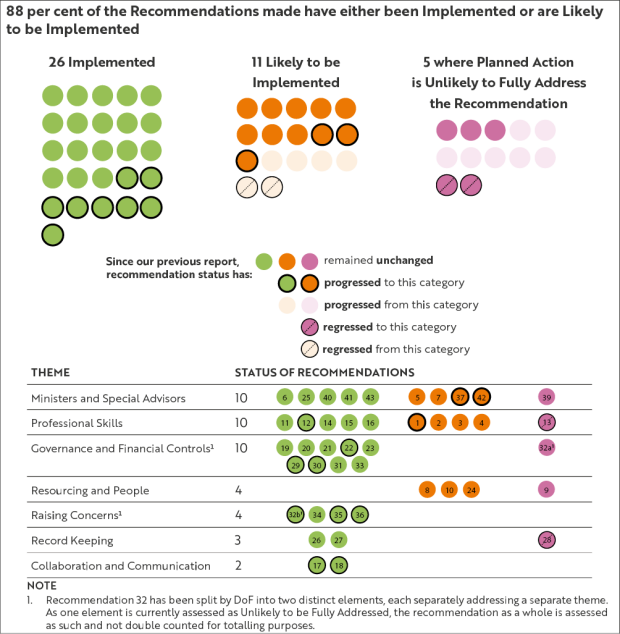
14. Taking the overall assessment of progress in implementing recommendations across all themes, we found that 26 of the recommendations (61.9 per cent) were deemed to be fully implemented. This compares favourably with the position reported in 2022, when we reported the equivalent figure to be 18 recommendations or 42.9 per cent.
15. In relation to those recommendations where the actions taken and proposed are likely to fully address the recommendations given more time, we found that 11 recommendations, or 26.2 per cent, fell into this category, with the corresponding figures reported in 2022 being 14 or 33.3 per cent.
16. Turning to those recommendations where we assess that the actions taken or proposed are unlikely to meet the Inquiry’s recommendations in full, there were 5 recommendations in this category equating to 11.9 per cent. The equivalent position reported in 2022 was 10 recommendations, or 23.8 per cent.
17. Looking at the position of each theme individually, we noted that progress has been made in the number of recommendations that are deemed to be implemented for the following five themes:
- Ministers and Special Advisers;
- Professional Skills;
- Collaboration and Communication;
- Governance and Financial Controls; and
- Raising Concerns.
18. The degree of progress is assessed by NIAO as being the same as it was in 2022 for the Resourcing and People theme.
19. The position has regressed for the Record Keeping theme - this relates to Inquiry Recommendation 28, which required regular audits of record keeping to be undertaken. DoF has now confirmed that it believes the arrangements in place across NI Departments are sufficient to meet the Inquiry’s recommendation and, at this point, there is no firm commitment to undertake an audit of record keeping. Nevertheless, following on from our 2022 assessment, we continue to conclude that this is required in order to fully address the Inquiry’s recommendation in this area.
20. In the case of 10 of the Inquiry’s recommendations across 5 of the 7 themes, we do not concur with the degree of progress reported in the DoF assessment published in March 2024. DoF assessed that all 10 of these are implemented. In 5 of these 10 cases, we assess that the actions taken or planned will not result in the Inquiry’s recommendations being fully implemented, even if given further time (see Appendices 3 and 4 for further details). In the 5 remaining cases of the 10, we have assessed that the planned actions are likely to adequately address the Inquiry’s recommendations given further time, but that the required threshold has not yet been reached.
21. As noted already, a number of the recommendations of the Inquiry related to the theme of records management. On that general topic, I wish to draw attention to the fact that my Audit Team encountered difficulty in securing timely access to adequate records in support of the assessment of progress in implementing the Inquiry’s recommendations published by DoF in March 2024. This caused a delay in my Team’s ability to progress the fieldwork phase for this second RHI follow-up report, as this information formed the basis for NIAO’s current assessment of progress.
22. Despite DoF having placed its report on its latest assessment outcomes - Implementation of the Recommendations of the RHI Inquiry - in the public domain during March 2024, we found that a complete and readily accessible audit trail of the relevant documentation was largely absent when we requested this in April 2024. This led to delays in obtaining the supporting evidence required, as a result of which, it was not possible for me to report to the NI Assembly ahead of summer recess at the beginning of July 2024 as had been planned. I have included a specific recommendation in that regard later in this report. DoF told us that it is important to note that teams would not as a rule have a readily available body of evidence to support the assessment of the March update and that the assessment was based upon the collation of business areas’ own responses, rather than an audit.
23. As regards the Inquiry recommendation that was attributed to the NI Assembly to take forward, the Executive published a Response to the RHI Inquiry and Action Plan on 7 October 2021, which set out the changes that the Executive considered necessary to improve the transparency, accountability and the functioning of government and to rebuild public confidence. An undertaking was given that the Executive would produce an annual report on the implementation of these actions and on how standards were being adhered to. The Executive collapsed shortly afterwards in February 2022, and consequently there has not yet been an annual report produced.
24. DoF told us that, in the absence of the Executive, The Executive Office, DoF and the wider NICS have worked to pursue the renewal of the Civil Service taking account of the RHI Inquiry and other inputs, and some individual areas of work have been advanced relating directly to the recommendations of the Inquiry.
25. To date, three reports assessing progress on the implementation of the Inquiry’s recommendations have been completed by DoF and these were issued in September 2021, August 2023 and March 2024.
26. Further detail on the NIAO assessment of the work carried out to achieve progress against each of the Inquiry’s recommendations is set out in Part Two of this report.
Conclusion and Recommendations
27. Since the NIAO’s last review in March 2022, progress has undoubtedly been made by the NI Departments in achieving further implementation of the RHI Inquiry’s recommendations. 26 recommendations (61.9 per cent) have now been fully implemented compared to 18 (42.9 per cent) back in 2022.
28. If we include those areas where we believe actions are likely to see full implementation of the recommendations given more time, the figures increase to 37 recommendations or 88.1 per cent. This compares to 32 recommendations or 76.2 per cent in March 2022.
29. There were 10 cases where we did not concur with the DoF assessment that the Inquiry recommendations have been implemented. In a number of these cases, DoF told us that the NI Departments believed that they had completed what they deemed was necessary to meet these recommendations, and that they had not planned to carry out any assessment of the operational implementation of the applicable policies or guidance that they issued. We have assessed that such operational assessment is required in order to fully address the Inquiry’s recommendations. In one case (Recommendation 39), DoF told us that it is unsure what arrangements could be put in place to adequately evidence that the Inquiry’s recommendation has been addressed in full going forward.
30. We conclude that the overall pace of implementation has been slow. The Inquiry’s recommendations were published in 2020 and, some 4 years later, almost 40 per cent of those recommendations have still not been fully implemented. In the case of five of these recommendations, we assess that the planned actions of the NI Departments will not adequately address the Inquiry’s recommendations (Recommendations 9, 13, 28, 32a and 39) – these recommendations and the assessment work undertaken are set out in Appendices 3 and 4 respectively. In only two of the seven themes have all recommendations been fully addressed. These findings are concerning, particularly given the significance of the Inquiry’s findings, the degree of public interest and the need for the NICS to restore public confidence by demonstrating that the relevant lessons have been learned.
31. NIAO made three recommendations in our 2022 report, and we are disappointed that these have still not been implemented. We have reviewed the nature of our recommendations and we believe that they are still valid as a means of helping to ensure that effective procedures are embedded to support the intention of the RHI Inquiry. On that basis we have repeated them in this report. We have also made two further recommendations. One arises from our recent experience of issues around timely access to records while undertaking our latest assessment. The other relates to the need for a formal re-evaluation of the position to be undertaken as regards the remaining outstanding Inquiry recommendations, together with a need for an increase in the pace of progression of any remaining actions:
Recommendation One
We recommend that the Group Internal Audit and Fraud Investigation Service (GIAFIS) within the NICS monitors compliance with requirements for DoF to maintain and publish registers of declared interests, lobbying and meetings as appropriate. This recommendation was included within our 2022 report.
Recommendation Two
We recommend that attendance at departmental inductions and developmental training for Ministers and Special Advisers should be regarded as compulsory within a reasonable timeframe of assuming their position, as circumstances permit. In addition, we recommend that attendance at both inductions and briefings for Special Advisers should be mandatory and form part of their contract of employment. Full engagement by Ministers also continues to be a necessity, with a particular role to be fulfilled by each Minister’s Department in this area. This recommendation was included within our 2022 report.
Recommendation Three
We recommend that GIAFIS monitors compliance with standards and processes for record keeping across all departments on an ongoing basis, particularly where matters should be documented for complex or major decisions. This recommendation was included within our 2022 report.
Recommendation Four
It is acknowledged that the evidence in support of the DoF assessment of progress in implementing the Inquiry’s recommendations is sourced from a number of NI Departments. However, given NIAO’s recent experience of issues around timely access to records while undertaking our latest assessment, we recommend that measures are put in place by DoF to ensure that appropriate documentation and records in support of future published assessments are held centrally by DoF, and are made available on a timely basis for audit inspection.
Recommendation Five
It is four years since the Inquiry’s recommendations were published, and almost forty per cent of the Inquiry’s findings have not yet been fully implemented. This includes five recommendations where the NIAO assessment is that planned actions are unlikely to fully address the Inquiry’s recommendations, but DoF does not concur with this. In light of the above position, and given that the Executive Sub-Committee has not met since December 2020, we recommend that DoF takes the necessary steps to have appropriate mechanisms put in place to provide suitable oversight of full implementation of the Inquiry’s recommendations. In addition, we recommend that those oversight arrangements include a formal re-evaluation of the way forward on the five recommendations where there is disagreement, as well as urgent approval of measures that will ensure a significant increase in the pace of implementation for any remaining outstanding actions.
Part One: Introduction and Background
The design of the Northern Ireland Non-Domestic Renewable Heat Incentive Scheme enabled participants to claim financial support from government in excess of the cost of fuel burnt
1.1 In November 2012, the Department for the Economy (DfE; formed in May 2016 by the merger of the Department of Enterprise, Trade and Investment and the Department of Employment and Learning) introduced the Northern Ireland Non-Domestic Renewable Heat Incentive Scheme (‘the RHI scheme’). This scheme offered long-term, public sector, financial support to commercial, public or industrial premises switching from conventional to renewable heating technologies, such as biomass fuelled boilers.
1.2 The then Comptroller and Auditor General (C&AG) for Northern Ireland qualified his opinion on the DfE 2015-16 financial statements following the identification of two issues, both relating to the RHI scheme. The first qualification issue related to scheme expenditure of £11.9 million which had not been approved by the Department of Finance [(DoF), formerly the Department of Finance and Personnel (DFP)]; the second qualification concerned the absence of robust DfE systems to prevent or detect scheme abuse, which prevented the C&AG from gaining sufficient assurance that £30.5 million of RHI scheme expenditure had been incurred for the purposes intended. The C&AG reported that the RHI scheme, estimated to cost £140 million over the following five years, had “serious system weaknesses from the start” and did not “include any viable cost controls”. The combination of these weaknesses created a perverse incentive for successful applicants to needlessly burn fuel in order to generate an increased financial return.
The report by the Independent Public Inquiry into the RHI scheme contained 44 recommendations
1.3 An Independent Public Inquiry into the Non-Domestic Renewable Heat Incentive scheme (‘the RHI Inquiry’), chaired by a retired Lord Justice of Appeal, was formally established in January 2017. The purpose of the RHI Inquiry was:
“To investigate, inquire into and report on the Non-Domestic Renewable Heat Incentive Scheme (“the RHI scheme”). This will include its design, governance, implementation and operation, and efforts to control the costs of that scheme, from its inception in 2011 to the conclusion of the Inquiry”, and
“To make findings of fact, report on these matters and to make such other observations and recommendations as the Inquiry considers appropriate”.
1.4 The RHI Inquiry Report (‘the Inquiry Report’) which was published on 13 March 2020 concluded that the “vast majority of what went wrong was due to an accumulation and compounding of errors and omissions over time and a failure of attention, on the part of all those involved in their differing roles, to identify the existence, significance or implications of those errors and omissions”. The Inquiry Report included 314 findings and made 44 recommendations.
1.5 On 16 March 2020, the Minister of Finance confirmed that all findings had been accepted by the Northern Ireland (NI) Executive (‘the Executive’) and that it would move immediately to consider how the recommendations could be taken forward. An Executive Sub-Committee on Reform Following the RHI Inquiry (‘the Executive Sub-Committee’), chaired by the Finance Minister, was established to consider the findings of the RHI Inquiry and to “produce and publish an action plan by the autumn outlining how the sustained, system-wide change that is needed to rebuild public confidence will be implemented”. The NI Executive approved the Executive Response to the RHI Inquiry Report Recommendations and Action Plan on 7 October 2021 (published on 16 October 2021).
This report presents the second update on the implementation of the lessons learned and responses to recommendations from the RHI Inquiry Report
1.6 One of the recommendations (44) of the RHI Inquiry Report was that the Northern Ireland Audit Office (NIAO) would have a role in assessing and validating the extent of progress in implementing the lessons learned from the RHI scheme and in the implementation of these recommendations, including reporting on such progress periodically to the Northern Ireland Assembly (NIA or ‘the Assembly’) and the people of Northern Ireland.
1.7 The first report on the progress with the implementation of the RHI Inquiry’s recommendations was published in March 2022, some two years after the publication of the RHI Inquiry Report. At that point, the C&AG identified that progress in some areas had been disappointing, with only 18 of 42 recommendations being assessed as ‘Implemented’ (and minimal progress noted in certain other areas). With 44 recommendations in total, responsibility for the remaining two recommendations rests with the Assembly (paragraphs 1.9-1.11) and NIAO (paragraph 1.6).
1.8 In response to the actions taken by the Northern Ireland (NI) Departments, and to ensure the embedding of effective procedures, NIAO raised three recommendations in 2022. In two of these, we recommended that the Group Internal Audit and Fraud Investigation Service (GIAFIS) within the NICS should monitor compliance with requirements and standards in specific areas; and in the third, that departments should take all possible steps to encourage attendance by their Minister at both departmental inductions and developmental training.
The Northern Ireland Assembly’s Chairpersons’ Liaison Group has considered how the Assembly Committees’ scrutiny role can be strengthened in response to an RHI Inquiry recommendation
1.9 The RHI Inquiry Report recommended that the Assembly “should consider what steps are needed to strengthen its scrutiny role, particularly as conducted by Assembly Committees”. This recommendation arose in response to the Inquiry’s findings that the Assembly’s Committee for the Economy (formerly the Assembly’s Enterprise, Trade and Investment Committee) had failed to act as an effective check in scrutinising the RHI scheme.
1.10 The Chairpersons’ Liaison Group, comprising the Chairpersons of all Statutory and Standing Committees within the Assembly, published its Report on Strengthening Committee Scrutiny in March 2022. The report contained 33 recommendations aimed at strengthening the scrutiny of primary and delegated legislation, and establishing the need for pre/post-legislative scrutiny. Following the resumption of Assembly business in February 2024, work on these recommendations continues to be taken forward by Assembly Officials, the Assembly Commission and/or specific Assembly Committees, as appropriate. As an example, Assembly Officials are currently undertaking work to identify the additional resources required to give effect to proposals in relation to recommendations around the improved scrutiny of Statutory Rules, and the implementation of post-legislative scrutiny. The Chairpersons’ Liaison Group will continue to review progress against all recommendations, and an update meeting has been scheduled for Autumn 2024.
1.11 While any formal assessment of this work, and any such work performed by the Assembly to strengthen its scrutiny role is excluded from the scope of this and subsequent reports, we will, however, continue to report progress for information purposes.
We have considered the actions taken to date and further proposed actions, and assessed whether these are sufficient to fully implement the recommendations of the RHI Inquiry
1.12 The purpose of this report is to consider whether the action taken to date by the Executive and the NI Departments, and any further proposed actions, are likely to be sufficient to address the recommendations raised by the RHI Inquiry. This report also considers the actions taken in response to our 2022 report’s recommendations. A brief update on the RHI scheme itself is set out in paragraphs 1.14-1.16. The report methodology can be found at Appendix 1.
1.13 Part Two of this report considers the progress achieved on implementing the recommendations as at March 2024. Given the nature of many of the actions, gaining confidence that the measures have been effective will take a period of time, and rely on the absence of similar issues, both in new energy schemes and in other parts of the public service. I have not concluded on the effectiveness of the actions taken at this stage, but I may revisit this in future reports on this topic.
The annual cost and energy outputs of the RHI Scheme remain significantly lower than in 2016-17
1.14 In 2022, we reported that the introduction of reduced and tiered tariffs, alongside caps on usage, had resulted in significant reductions in the annual cost of the RHI scheme, from £42.3 million in 2016-17 to £2.9 million in 2020-21; and significant reductions in the annual energy outputs, from 700,000 Kilowatt-Hours (kWh) in 2016-17 to 300,000 kWh in 2020-21. These reductions were broadly maintained into 2022-23, with the overall cost and energy output annual figures of £3.2 million (net of adjustments for proposed tariff uplifts) and 230,000 kWh. The equivalent figures for the 2023-24 period were an overall cost of £3.3 million (net of adjustments) and 190,000 kWh. At 31 March 2024, there were 1,889 participants in the Non-Domestic RHI scheme (the RHI scheme was closed to new entrants on 29 February 2016).
1.15 In 2021, following the Executive’s stated intention in January 2020 that...“RHI will be closed down and replaced by a scheme that effectively cuts carbon emissions”, DfE consulted on the future of the RHI scheme. DfE also told us that the Minister was working towards securing the Executive’s agreement on the future of the Non-Domestic RHI Scheme, and that a comprehensive report of the consultation, indicating how responses were considered in the formulation of the policy, would be published following a decision by the Executive on the way forward.
1.16 No decision had been reached when, in February 2023, a Court of Appeal judgement reaffirmed the need for a “proper permanent solution”, following which the Office of Gas and Electricity Markets (Ofgem) announced its intention to end its administration of the RHI scheme. A Written Ministerial Statement published by DfE on 30 July 2024 stated that “…..The Executive has confirmed its preferred option to close the Non-Domestic RHI Scheme. This decision was taken by FMdFM [the First Minister and deputy First Minister] under Urgent Procedure. The legislation to secure closure will now be developed and brought back to the Executive for final approval. Closure will include a payment mechanism which protects the interests of scheme participants, the majority of whom have acted in good faith, and the taxpayer. In the interim, a revised tariff will be implemented for small and medium biomass installations this winter. Discussions will also be conducted with Treasury on how Annual Managed Expenditure could be used to more effectively reduce carbon emissions….”.
Part Two: Assessment of progress in implementing the RHI Inquiry’s recommendations
The NI Executive was to produce an annual report on the implementation of the RHI Inquiry’s recommendations
2.1 The Executive Response to the RHI Inquiry and Action Plan (7 October 2021) set out the changes which the Executive considered necessary to improve the transparency, accountability and the functioning of government and to rebuild public confidence. Among the undertakings was that ….“the Executive will produce an annual report on the implementation of these actions and on how standards are being adhered to”. In an Executive RHI Inquiry Report Written Ministerial Statement announcing the Executive’s response and action plan, it was stated that consideration would be given as to how the Executive should report progress, in light of the work by the NIAO. The Executive collapsed shortly afterwards in February 2022, and consequently there has not yet been an annual report produced by the Executive, as intended.
2.2 DoF told us that, with the Executive’s collapse, the Executive Sub-Committee on Reform Following the RHI Inquiry also ceased to exist. It also told us that the work of DoF, The Executive Office and the wider NICS to pursue the renewal of the Civil Service, in the light of the RHI Inquiry and other inputs, was taken forward in the absence of the Executive (a new Executive was formed on 3 February 2024) - individual areas of work were advanced during this time, some relating directly to the recommendations of the RHI Inquiry. The Department has now confirmed that, since the new Executive’s formation, there has, to date, been no equivalent sub-committee constituted.
2.3 Three reports assessing progress on the implementation of the Inquiry’s recommendations have been completed by DoF and these were issued in:
- September 2021, and prepared to inform NIAO’s 2022 report;
- August 2023, and begun prior to the third anniversary of the Inquiry Report, and provided to the DoF Permanent Secretary and to the Head of the Civil Service prior to publication; and
- March 2024, and initiated in light of the return of the Executive, again being provided to the DoF Permanent Secretary, and then to the NICS Board, prior to publication.
The most recent assessment by DoF in March 2024 was central to our latest review of the evidence to support the degree of progress made in implementation of the RHI Inquiry’s recommendations.
Further progress has been made on the implementation of the recommendations since we last reported in March 2022
2.4 When reporting on implementation of the recommendations, the Department categorised 42 recommendations into seven thematic groups (the two recommendations which were excluded relate to the Northern Ireland Assembly (paragraph 1.9) and the NIAO (paragraph 1.6). These thematic groupings are as follows:
- Ministers and Special Advisers;
- Professional Skills;
- Resourcing and People;
- Collaboration and Communication;
- Governance and Financial Controls;
- Record Keeping; and
- Raising Concerns.
2.5 In this Part of our report, we have assessed the extent to which further progress has been made in addressing the Inquiry’s recommendations, in order to determine if they have been implemented. The assessment methodology used, which is set out in Appendix 1, included obtaining assurances that the evidence underpinning our previous assessments around recommendations (as well as the various aspects within them) having been implemented continued to remain current and allowed our 2022 assessment to be maintained. In addition, given that a new Executive has been in place since February 2024, we have also sought evidence to assess the implementation of those recommendations which continue to apply to new Ministers and Special Advisers.
2.6 The key findings from our current assessment are set out below by thematic grouping, while Appendix 4 to this report details progress made and assessed by individual RHI Report recommendation.
2.7 Overall, we have assessed that, 26 recommendations have now been Implemented (61.9 per cent), with a further 11 Likely to be Implemented in full over time (26.2 per cent). At September 2021, the corresponding figures were 18 (42.9 per cent) and 14 (33.3 per cent), respectively. For the remaining 5 recommendations (11.9 per cent), we have concluded that the actions taken to date and further actions proposed are not likely to be sufficient to address the concerns of the RHI Inquiry. At September 2021, the corresponding figure was 10 (23.8 per cent).
Ministers and Special Advisers
Most of the recommendations relating to Ministers and Special Advisers continue to be progressed towards implementation and applied to the recently formed Executive
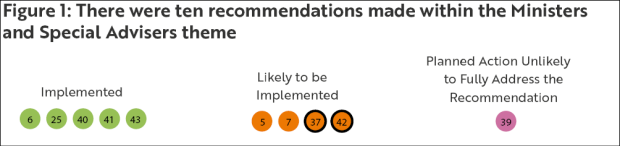
2.8 Ten of the RHI Inquiry’s recommendations have been grouped under the theme of Ministers and Special Advisers. Our assessment of the progress made around their implementation is summarised in Figure 1 (with more detail contained in Appendix 4).
2.9 We considered the extent to which these 10 recommendations have been implemented in respect of the recently formed Executive, and concluded that action has been taken to implement 5 of the 10 recommendations. Although the number of implemented recommendations has been maintained at the 2022 level, two further recommendations are now assessed as likely to be implemented (Recommendations 37 and 42) and only one recommendation (39) is deemed unlikely to be fully addressed based on planned actions. The implemented recommendations cover various codes of practice; guidelines; protocols; inductions and briefings; and legislation which were in place and underpinned our 2022 assessments and continue to apply. However, we do not concur with the assessment published by DoF in March 2024 for Recommendations 7 and 39.
2.10 The Code of Conduct for Special Advisers (August 2021) remains current. It clarifies that Special Advisers serve the Executive as a whole, and not just their Minister, and it clarifies their role in, amongst other things, considering submissions and associated background documents submitted by civil servants to Ministers. The Code also strengthens record keeping requirements to ensure that all records are maintained within official systems, with further detailed guidance provided in NICS Guidance on Record Keeping for Special Advisers.
2.11 In addition, the Code also requires Special Advisers to ensure that no conflict arises, or could be perceived to arise, between their public duties and their private interests, financial or otherwise. They have a statutory duty to disclose details of interests that could give cause to conflict, and the Department is required to prepare and publish a Register of Interests in respect of Special Advisers (completed most recently in September 2024). Also, if a Special Adviser is lobbied, then they must provide the Department with a written record of the lobbying, within a reasonable period. Special Advisers are subject to the NICS disciplinary process, where applicable, under the terms and conditions of their Letter of Appointment, and the NICS Code of Ethics forms part of their contract of employment.
2.12The Ministerial Code of Conduct and the accompanying Guidance for Ministers on their roles and responsibilities, published in March 2020, remains current. Amongst other things, these place a responsibility on Ministers for the management and conduct of their Special Advisers, and require Ministers to make declarations of interest as they emerge and change on an ongoing basis, as well as ensuring there is no conflict of interest or perception of a conflict of interest. Ministers’ Private Offices, staffed by a small team of civil servants, continue to be resourced to provide support to Ministers.
2.13 In relation to Recommendation 7, induction and guidance was made available to Ministers and Special Advisers soon after their appointments. In preparation for the return of Ministers, Departmental Private Secretaries met with DoF and The Executive Office officials to determine the key documents that should be included in briefing packs to accompany the departmental induction of Ministers. It is also envisaged that one-to-one briefings or training on selected aspects of a Minister’s role will be provided internally. Special Advisers have also been provided with key documents, such as the Code of Conduct for Special Advisers and Letter of Appointment, and offered places on induction seminars presented by a senior DoF official (9 out of 13 appointed Special Advisers had attended by mid-2024). The nature and effectiveness of such support and training to Ministers and Special Advisers will need to be kept under review, as well as being in place for new incoming Ministers and Special Advisers. We note that there is no requirement for Special Advisers to attend induction training and 4 from 13 Special Advisers had not attended at the point this report was being produced. We do not concur with the DoF assessment that this recommendation is implemented, rather we have concluded that it is not yet fully implemented.
2.14 The Department’s own assessment of two of these Recommendations (37 and 42), which relate to reducing organisational silos and strengthening the Ministerial Code of Conduct (specifically to include a requirement on Ministers to take an active role in questioning and challenging advice they receive), was that they were not yet fully implemented. We welcome the promotion of joint working and improved collaboration through revisions to various Ministerial, Special Adviser and NICS codes, and the establishment of the Shared Leadership Board. The outcome of the proposals on the role of Ministers in relation to official advice is one element within a range of matters to be referred to the Executive for consideration.
2.15 We have assessed that the planned action associated with Recommendation 39 is currently unlikely to address it fully (see Appendices 3 and 4 for further details). This refers to the need for Ministers to sufficiently read and familiarise themselves with any legislation they are presenting for approval - DoF considers that this has now been implemented. However, the basis for our assessment in 2022, that the planned action was unlikely to fully address the recommendation remains unchanged. Nothing new has been added to the arrangements in place as reported in 2022. We are currently unable to conclude that this recommendation is likely to be implemented in the absence of a specific action or change which addresses the original issue. DoF told us that it believes that it has taken as much action as possible in this area, and it is unclear about what further actions can be taken to demonstrate that the Inquiry’s recommendation has been fully addressed. In addition, we note that the NIA response to Recommendation 38, that consideration is given to improved Assembly scrutiny, also has a bearing on this assessment, as an element of this is likely to include greater scrutiny of Ministers and the evidence base for policy/legislation being brought forward.
2.16 As a result of our 2022 assessment within the Ministers and Special Advisers theme, we raised NIAO Recommendation One, that the Group Internal Audit and Fraud Investigation Service (GIAFIS) within the NICS should monitor compliance with requirements for the DoF to maintain and publish registers of declared interests, lobbying and meetings as appropriate. Our recommendation has not been implemented.
2.17 In our March 2022 report, we also raised NIAO Recommendation Two, that attendance at departmental inductions and developmental training for Ministers and Special Advisers should be regarded as compulsory within a reasonable timeframe of assuming their position, as circumstances permit. We went on to recommend that attendance at both inductions and briefings for Special Advisers should form part of their contract of employment, and suggested that full engagement by Ministers should be a necessity, with a particular role to be fulfilled by each Minister’s Department in this area. DoF maintains the view that attendance at such provision should not be compulsory, but rather departments can commit to encouraging attendance. We consider that the recommendation in our 2022 report remains valid and should be implemented.
Professional Skills
Some progress has been made in the implementation of Professional Skills-related recommendations
2.18 Among the failings identified by the RHI Inquiry were the failures by the Northern Ireland Departments and the NICS in not appreciating the unique risks of the RHI scheme; failing to incorporate budget control mechanisms when developing the policy, and inadequate project management throughout the life of the RHI scheme. The Inquiry made ten recommendations relating to Professional Skills, and our assessment of the progress made on their implementation is summarised in Figure 2 (with more detail set out in Appendix 4).
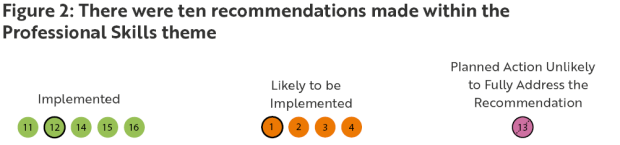
2.19 Five of the ten recommendations within this theme are now implemented, an improvement on the 2022 position, where four recommendations were in this category. In four cases we have assessed that, although the recommendations are likely to be implemented over time, they have not yet reached the required threshold. For Recommendations 1, 2 and 4, DoF has told us that it will take steps to fully address the Inquiry’s recommendations in these areas, and it will commission advice on how the status of the Making a Difference policy making guidance might be formalised - this has now commenced. Further to this, work is also to be undertaken which will scope out how a control mechanism for the delivery of the policy function, reflecting Making a Difference, might be implemented, in appropriate cases, akin to the Gateway process for projects or the business case processes for expenditure – the Department has confirmed that, as yet, no timescale has been set out.
2.20 Based on the Department’s latest responses, there is now one case where our latest assessment of the planned action has concluded that it is unlikely to fully address the recommendation (13) (see Appendices 3 and 4 for further details). This relates to the implementation of DAO(DoF) 02/20 and, in particular, the provision of skills and expertise to a project team from external sources and the role of an appointed Senior Responsible Owner (SRO) in this process (paragraphs 2.21-2.23). DoF has told us that SROs are accountable for the composition of their Project or Programme Board, which will include consideration of whether the Board would benefit from external members. It also holds the view that it would appear disproportionate for the Department to monitor the operational implementation of the guidance in DAO (DoF) 02/20, as adherence to good practice is maintained through existing governance structures within departments. DoF has therefore concluded that the Inquiry recommendation has been fulfilled (although it remains the focus of the Department to improve delivery of the best outcomes through project and programme delivery). In respect of the Professional Skills theme as a whole, we do not concur with the DoF assessment for five of the ten recommendations - the Department’s assessment deemed all five to be implemented, whereas our assessment is that four (Recommendations 1, 2, 3 and 4) are likely to be implemented over time given planned actions, and for the final case (Recommendation 13), that the planned actions will not fully address the Inquiry recommendation.
2.21 Since we reported in 2022, there has been much work done to put guidance and arrangements in place that emphasise the importance of having people (NICS staff or external professional or specialist external resources) with the right skills and/or experience to take forward policy implementation and project delivery. Progress on ensuring the NICS has the right resources and specialist expertise has been considered under the Resourcing and People theme (paragraphs 2.26–2.36).
2.22 The Making a Difference: the NICS Guide to Making Policy that Works, published in February 2023, makes clear that the level of resourcing should be assessed from the beginning, and policy development should not proceed unless adequate skills and resources are available; that risks are assessed and realistically stated, with appropriate mitigations in place; and that it is advisable to model a number of policy solutions to demonstrate how they stand up to different circumstances. The Guide also emphasises the importance of assessing the potential of partnership working, considering whether a policy should be developed and/or delivered in partnership with another authority, including neighbouring administration (the Policy Profession issued a guide entitled Partnership Engagement with Neighbouring Administrations, in September 2023).
2.23 While the Accounting Officer (AO) is responsible for projects in his/her department, a Senior Responsible Owner (SRO) is formally appointed to oversee a project and is tasked with, among other things, ensuring the project team have appropriate skills and expertise, which may include expertise from the Strategic Investment Board (SIB) or other external sources, to deliver the project. The AO and SRO are supported by recently established Departmental Portfolio, Programme and Project Offices (P3Os) that are intended to ensure visibility, and provide support for governance, oversight and reporting on programme/project delivery and assurance. A P3O Forum was established in February 2021, to assist departments in sharing best practice; to develop learning, to support the project delivery function; and to strengthen reporting – it meets formally on a bi-annual basis.
2.24Other recently-introduced processes aimed at maximising expert advice in planning and managing projects include the introduction, in November 2021, of the Five Case Model for Business Cases, along with Better Business Cases NI guidance - one of the core drivers behind the introduction of the new approach was to ensure that the correct expertise was used throughout the business case process; and the establishment of Commercial Case Peer Reviews, aimed at providing confidence that a project is on the correct course for its next stage Gateway Review, utilising experts from a list of Commercial Case Peer Reviewers in construction; infrastructure; project delivery; commercial; and procurement.
2.25 We consider that rigorous assessments of the implementation of the Making a Difference policy guidance (February 2023); the outworking of the Policy for our People strategy (September 2023); and the application of Five Case Model for Business Cases (2021) are required to assess whether these are being implemented in full and having the required effect on the capacity and capability to design and deliver policy.
Resourcing and People
Whilst some progress has been made on the recommendations relating to Resourcing and People, our overall assessment remains unchanged from that in 2022
2.26 Four of the Inquiry’s recommendations have been grouped under the theme of Resourcing and People. Our assessment of progress in relation to their implementation is summarised in Figure 3 (with more detail found within Appendix 4).
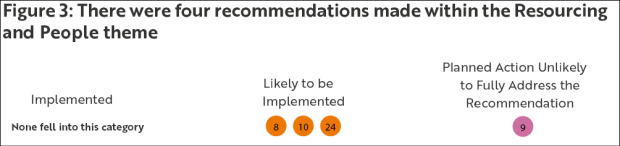
2.27 We considered the extent to which each recommendation had been implemented since our previous assessment process in 2022. While evidence of further progress is apparent, our review around this theme concludes that the categorisation of each recommendation remains unchanged - three recommendations are likely to be implemented in full (8, 10, 24) along with one further recommendation where the planned action remains unlikely to fully address it. Our assessment in respect of Recommendations 8, 10 and 24 is in alignment with the Department’s most recent assessment. However, we do not concur with the DoF assessment for Recommendation 9.
2.28 DoF has told us that a People & Organisational Development Group was established in November 2022, and that the NICS Human Resources (NICSHR) function is now separated from key functional delivery areas linked to recruiting, developing and managing NICS careers. Next steps, include the mapping of key deliverables required and associated investment needed to deliver wider planned changes remain under development, with a view to the finalisation of a three-year plan (2024-25 to 2026-27).
2.29 We understand that a Recruitment and Selection Development Group is now in place to progress a collaborative approach to the review of NICS recruitment policy and processes between the Civil Service Commissioners and the NICS - supporting documentation was made available which set out the outcomes achieved to date, and other action being progressed.
2.30 While development of an overarching policy framework around NICS recruitment has taken place to support external recruitment as the default method with job role recruitment approach, we understand that the policy framework for recruitment will not be finalised until the Central Trade Union Side (CTUS) consultation process, to be progressed during 2024, has been concluded – an indicative timescale for policy implementation is 2024-25 and while, in the context of Recommendation 24, our current assessment of likely to be implemented remains until this policy can be reviewed and its impact on securing continuity of business assessed.
2.31 We also note that: current secondment arrangements are now contained within a revised policy document (July 2022 – Version 5) with this, and related guidance (October 2023 – Version 2) having been issued to NICS staff; the adoption of a draft NICS apprenticeship policy and related guidance remains subject to NICS Board oversight, approval by the Finance Minister and formal consultation with CTUS; and a series of new NICS entry routes in support of a skills and leadership talent pipeline have been developed.
2.32 In relation to the Senior Civil Service (SCS), the Department has told us that a revised approach to setting SCS personal performance objectives/development needs is in place, while work has also been undertaken on SCS talent management, to include a fair and transparent approach to career development moves and talent biographies to support talent management discussions. The effective date for the revised approach was May 2022 for Permanent Secretaries, and April 2024 for all SCS post-holders, with mandatory participation across the SCS.
2.33 One aspect of Recommendation 9 relates to the handling of commercially sensitive information by policy officials in roles related to the Northern Ireland economy (see Appendix 3 for further details). In our 2022 assessment, we concluded that guidance around this should be communicated directly to all staff who may receive such information, and that it was not sufficient to rely on line management to identify appropriate staff – rather that it was for the leadership of the Northern Ireland Civil Service (which we deem to mean senior civil service officials) to play a direct role in determining the appropriate staff who should receive direct communications in this area, in line with the recommendation wording. DoF has told us that this is viewed as a line management responsibility by the NI Departments. However, our current assessment is that allowing such decisions to be taken by line managers runs the risk that those making them might be at a level such that they are not fully sighted in all cases on the associated commercial sensitivities. We would therefore continue to highlight the importance of the oversight roles and responsibilities of SCS post-holders as set out in the Inquiry recommendation.
2.34 The Department told us that a refresh of the guidance on the use of external consultants was to be completed by August 2024, but that slippage has occurred due to competing priorities and capacity issues. As a result, our current assessment of Recommendation 10 as a whole is that it is likely to be implemented in full, based on the planned action, if the guidance developed is sufficient and appropriate. We also note the publication of Making a Difference: the NICS Guide to Making Policy that Works in February 2023.
2.35 There has been progress made in respect of the management of consultants by Civil Service teams since our last assessment. In response to actions taken around developing the role of the SRO, DoF told us that an NICS-wide SRO appointments process is in operation, with those overseeing High Risk Major Programmes and Projects (MPPs) receiving an SRO Appointment Letter advising the holder of their roles and responsibilities; support and guidance available to them and the mandatory training requirement to fulfil this role – this is a 2-day SRO Masterclass with externally-sourced experts, using a collaborative framework arrangement with Great Britain, and mandatory completion of Cabinet Office SRO training. We understand that, during September 2024, that all current SROs overseeing High Risk MPPs should have been offered the SRO Masterclass training – at present some 27 per cent (12) of SROs are yet to complete this. The Department also told us that the NICS Board is now updated twice-yearly on the status of Major Programmes and Projects.
2.36 In acknowledging that some additional progress has been achieved, our assessment is that overall progress is at the same level as we reported in 2022 and further work remains to be completed in order to fully address the RHI Inquiry’s recommendations.
Collaboration and Communication
Both of the Collaboration and Communication-related recommendations have been implemented
2.37 There were two Inquiry recommendations assigned to the theme of Collaboration and Communication. The results of our assessment process summarised in Figure 4 indicate that both have now been implemented (more detail is contained within Appendix 4). This is an improvement on the position reported in 2022, when neither of the recommendations had been fully implemented. The NIAO and DoF assessments are in alignment for both recommendations.
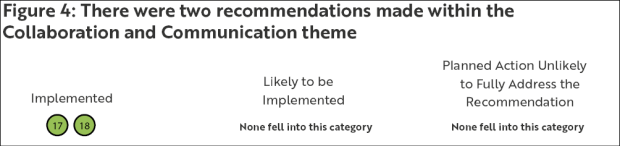
2.38 The focus of Recommendation 17 has been around applying best practice from other jurisdictions to provide more support for professions within the NICS, in respect of Project Delivery, Finance and Economics. We acknowledge the demonstrable progress that has been achieved in relation to the NICS workforce model for the Project Delivery profession in respect of job roles and resourcing mix, although we understand that career pathways/frameworks have not, as yet, been put in place, pending resourcing, an agreed approach and CTUS consultation.
2.39 The NICS Workforce Model is also being applied to the Finance and Economist (and other) professions. This involves mapping job roles to career pathways, in order to clearly defining the competencies, functional skills and qualifications required for individuals within the NICS workforce to progress in their current role, or other roles, and remains ongoing. The development of a proposal for a new Trainee Accountant Scheme, incorporating a scheme framework document was concluded and resulted in a recruitment exercise launch in June 2024. As regards the Economist profession, mandatory bespoke induction training in place for new staff forms one aspect of the Learning and Development pathway in place, while economists working on business cases are now required to attain Five Case Model accreditation.
2.40 The Inquiry had identified a need for a government-wide framework for information exchange and, where appropriate, co-operation, both cross-departmentally and with other jurisdictions, with both elements falling within Recommendation 18. The Department told us that both of these aspects are being progressed in several different ways – for example, Inter-Governmental Relations (IGR) has provided a tiered structure for regular and co-ordinated engagement around sectoral issues (at Inter-Ministerial Group level); strategic issues (at Inter-Ministerial Standing Committee level) and at Head of Government level. The main benefits are considered to be around improved sharing of information, including access to UK Government information on devolved matters, (such as in relation to the Sewel Convention, where circumstances may lead to an issue of concern arising), as well as being able to influence thinking. While DoF told us that, as yet, there has been no joint qualitative evaluation work undertaken around the benefits of these arrangements, with anticipated difficulties cited around differing expectations/aspirations of the participants, we note the April 2024 publication of the Intergovernmental Relations – Annual Report 2023.
Governance and Financial Controls
Significant progress has been made in the implementation of the recommendations relating to Governance and Financial Controls
2.41 Ten of the Inquiry’s recommendations have been grouped under the theme of Governance and Financial Controls. Our assessment of progress is that nine of these are now implemented. This is a significant improvement on the 2022 position, where only six were implemented. We concurred with the assessment published by DoF in all but one case (Recommendation 32a). The results are summarised in Figure 5 (with more detail set out in Appendix 4).
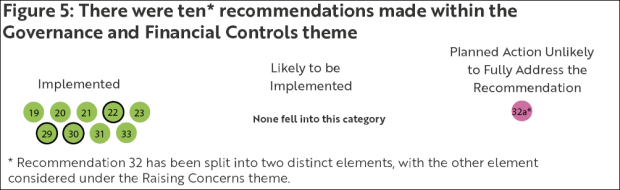
2.42 In line with our methodology (see Appendix 1), for each recommendation which we had reported as implemented based on our 2022 assessment (19, 20, 21, 23, 31 and 33), we followed these up with the Department, both to ensure that the basis for those assessments had not changed, and also to identify any further developments which had occurred – this was confirmed.
2.43 Recommendations 29 and 30 had previously been assessed as likely to be implemented in full, and the details of further progress made provided by DoF means that these recommendations are now assessed as implemented. Developments include the publication of a revised version of Managing Public Money Northern Ireland (MPMNI) in November 2023 and strengthening the Finance profession within the NICS, to include the provision of financial training for budget holders (both formal and on-the-job).
2.44 Following our 2022 assessment work, we had concluded that more work was required to develop a proactive role for DoF in the monitoring of financial progress of policy initiatives on an ongoing basis, in line with the Inquiry recommendation (22). The Department told us that it had since written to departments regarding the conditions of DoF approval, stating that, while it would continue to routinely apply standard conditions of approval to projects, these conditions, in terms of implementation timeframes and tolerance levels, could vary depending on the nature of the project - furthermore, DoF might also apply ‘non-standard’ conditions of approval in certain circumstances, in order to provide further assurance around a proposal. DoF considers that these measures collectively help to ensure that it can tailor the level of monitoring of a project, post-approval, to the degree of complexity, risk, scale of spend, and so on, involved. We have concluded that this demonstrates a level of proactivity by the Department and we have now assessed this recommendation as implemented.
2.45 The Inquiry made a recommendation around the provision of departmental checks and balances to provide early warning of problems, with particular reference to systems of risk management and governance (Recommendation 32a) (see Appendices 3 and 4 for further details). While we recognise the previous changes regarding approaches to risk management, and DoF’s more recent references to the various (higher-level) information and other sources which feed into the discharge of an AO’s responsibilities, as set out within the Governance Statement, the Inquiry recommendation focussed on the need for departments to review how their governance systems work in practice, as a means of ensuring that they are both widely understood and actively used by staff. As there is no evidence available to support and confirm that the necessary approaches to achieve this have been put in place, this aspect of the recommendation continues to be assessed as unlikely to be fully addressed.
2.46 Significant progress has been made in this area, although we consider that there is an outstanding area of work to be completed by departments in reviewing both the use and understanding of governance systems by their staff.
Record Keeping
Overall progress has regressed slightly in relation to the recommendations around Record Keeping
2.47 Three of the Inquiry’s recommendations have been grouped under the theme of Record Keeping. Our assessment of overall progress is that the position has regressed slightly from that reported in 2022. We concur with the assessment published by DoF in all but one of the recommendations (Recommendation 28). Progress on implementation is summarised in Figure 6 (with more detail contained in Appendix 4).
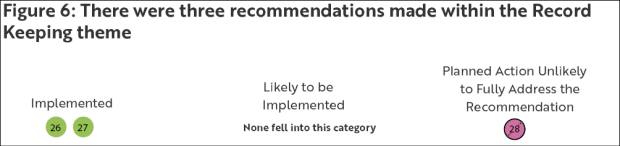
2.48 As we had reported on two of these recommendations (26 and 27) as implemented in our 2022 assessment, we followed these up with the Department to ensure that the basis for those assessments had not changed, and to identify any further developments – this was confirmed.
2.49 The Inquiry had recommended that “regular audits of record keeping should be undertaken so as to ensure that important information is recorded, is easily identifiable, is readily accessible and remains so for as long as is necessary in respect of any policy or initiative”. In our 2022 assessment, we concluded that Recommendation 28, as a whole, was likely to be implemented in full, although we had also recommended (NIAO Recommendation Three) that the NICS Group Internal Audit and Fraud Investigation Service (GIAFIS) should monitor compliance with standards and processes for record keeping across all departments on an ongoing basis, particularly where matters should be documented for complex or major decisions.
2.50 While DoF’s most recent assessment acknowledges that more work is to be done in this area, in response to our recommendation, the Department has now told us that:
- ongoing monitoring of compliance within departments is a management role, assisted by the Records Management Governance Framework;
- the option of GIAFIS conducting a thematic review of compliance with that Governance Framework should [instead] be considered in the context of the wider work in respect of records management; and
- it believes that the arrangements in place across NI Departments are sufficient to meet the Inquiry’s intentions around Recommendation 28 and, at this point, there is no firm commitment to undertake an audit of record keeping.
We continue to conclude that this is required in order to fully address the Inquiry’s recommendation in this area.
2.51 We understand that a thematic audit of compliance with records management policies is to be scheduled for consideration at a future date and, more widely, that any form of review requires NICS Board approval, and is subject to its prioritisation. The Department has told us that the timescale for completion of this work has not yet been confirmed.
2.52 In respect of records management systems, we are aware that there has been further progress made, including migration to Microsoft Office 365 (MS365), and some initial exploration by a Digital Workplace Team into how departments’ obligations around future retention, accessibility, utilisation and disposal of NICS information records will be met - DoF’s most recent assessment is that work in this area is not yet fully implemented, and this is in alignment with NIAO’s current assessment. However, the Department’s overall assessment is that sufficient progress will be made for this recommendation to merit an implemented categorisation in due course - we are not in agreement with this assessment and have concluded that the planned action remains unlikely to fully address it.
2.53 Of particular relevance to the Record Keeping theme (and the Ministers and Special Advisers theme - Recommendation 41), we note that the May 2024 coverage of Module 1 of the UK Public Inquiry into the handling of the Covid-19 pandemic, as it pertained to Northern Ireland, identified some significant issues around the use of certain communication channels by public officials.
2.54 In keeping with the Records Management theme, I note that my Audit Team encountered difficulty in securing timely access to adequate records in support of the assessment of progress in implementing the Inquiry’s recommendations published by DoF in March 2024. This caused a delay in my Team’s ability to progress the fieldwork phase for this second RHI follow-up report, as this information forms the basis for NIAO’s current assessment of progress. Despite DoF having placed its report on its latest assessment outcomes - Implementation of the Recommendations of the RHI Inquiry - in the public domain during March 2024, we found that a complete and readily accessible audit trail of the relevant documentation was largely absent when we requested this in April 2024. This led to delays in obtaining the supporting evidence required, as a result of which, it was not possible for me to report to the NI Assembly ahead of it going into summer recess at the beginning of July 2024, as had been planned. DoF told us that it is important to note that teams would not as a rule have a readily available body of evidence to support the assessment of the March update and that the assessment was based upon the collation of business areas’ own responses rather than an audit.
2.55 We acknowledge that some further progress has been made in this area, and that aspects of further planned action are underway. However, we are disappointed that DoF is effectively maintaining its view that the NICS Group Internal Audit and Fraud Investigation Service (GIAFIS) should play a lesser role in the cross-departmental context - we continue to recommend (in line with our previous NIAO Recommendation Three) that, given GIAFIS’ strategic placement, it monitors compliance with standards and processes for record keeping across all departments on an ongoing basis, particularly where matters should be documented for complex or major decisions.
Recommendation Four
It is acknowledged that the evidence in support of the DoF assessment of progress in implementing the Inquiry’s recommendations is sourced from a number of NI Departments. However, given NIAO’s recent experience of issues around timely access to records while undertaking our latest assessment, we recommend that measures are put in place by DoF to ensure that appropriate documentation and records in support of future published assessments are held centrally by DoF, and are made available on a timely basis for audit inspection.
Raising Concerns
All of the recommendations related to Raising Concerns have been Implemented
2.56 Four of the Inquiry’s recommendations have been grouped under the theme of Raising Concerns. We concur with the DoF assessment of progress that all four recommendations have been implemented. This is a significant improvement on the 2022 position, where only one recommendation was deemed to be fully implemented. The results are summarised in Figure 7 (with more detail found within Appendix 4).
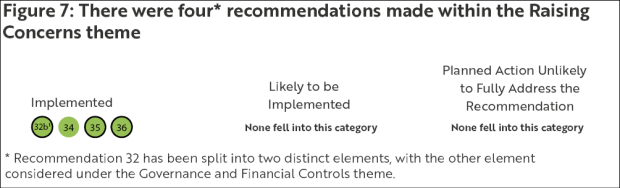
2.57 Following our 2022 assessment, we reported on Recommendation 34 as implemented and, in line with our methodology (see Appendix 1) followed up with the Department to ensure that the basis for our assessment remained accurate, and to identify any further developments which had occurred – this was confirmed.
2.58 Recommendations 32b and 36 had previously been assessed as likely to be implemented in full, and the details of further progress made provided by DoF means that these recommendations are now assessed as implemented.
2.59 Following our previous assessment on the implementation of Recommendation 32b, as we had indicated an intention to continue to monitor and assess progress and improvement going forward in dealing with concerns raised by civil servants, evidence of this over the intervening period was sought. DoF told us that the arrangements now in place within the Raising a Concern (RaC) Policy Framework (RaCPF) launched in January 2023 are wide-ranging, with applicability both across the NICS and externally, and provided supporting documentation. A further significant output progressed to date has involved GIAFIS in the preparation of an initial departmental-wide insight assurance report into the implementation of the RaCPF for 2023-24, which was submitted to the NICS Board in July 2024. We would also highlight that, while a more detailed consideration around the implementation of the RaCPF arrangements at a departmental level was limited to evidence in respect of the Department of Finance for our current assessment, we are also aware from other NIAO work of similar arrangements operating within other NI departments.
2.60 Recommendation 36 addressed the need to have a more robust process in place to learn lessons than had previously been used, and highlighted the need for Senior Civil Service Leaders to be more systematic, persistent and proactive in their communications with staff around the need for identified change, and in setting out what is required and how it can be achieved through a supported workplace. The Inquiry also identified the need for more external scrutiny, such as from Non-Executive Board members, as well as from strengthened Assembly Committees, in ensuring that all necessary changes happen systematically and are sustained. DoF told us that a key aspect of the RaCPF now in place addresses the scrutiny role of Boards – for example, the NICS Board’s commissioning of the departmental-wide report for consideration around the effectiveness of RaC arrangements already referenced within this theme. The Department also told us that the NICS Board leads on the effectiveness of the Civil Service, having a responsibility to “address issues of strategic significance facing the NICS as a whole or constituent parts of it” – including the corporate response to NICS-wide risks and failures.
2.61 Our previous assessment of Recommendation 35 had concluded that the planned action at that time would have been unlikely to address it in full, however, our latest review of evidence provided by the Department led to an assessment of implemented. We considered that work was required to ensure that, where appropriate, officials would investigate the implementation and operation of schemes in place. DoF told us that the introduction of the RaC Policy Framework facilitates early warning notifications to be made and for concerns to be raised by the public and businesses around known or potential issues with any initiative (as set out within the Inquiry recommendation). Other aspects involve training for nominated Designated Officers and their operational teams, and reporting to Boards (including the NICS Board), as referenced in a related recommendation under the Raising Concerns theme. The Department has also told us that the handling of concerns will always include appropriate fact-finding and/or investigation.
Appendix 1: Report Methodology
- We assessed DoF’s March 2024 progress report on the implementation of the recommendations of the RHI Inquiry for the sufficiency of detail and evidence provided in support of its conclusion on the implementation of each recommendation.
- We liaised with the named Senior Responsible Owner (SRO) to obtain any additional detail and evidence judged not to be evident from DoF’s progress report to support its assessment.
- We considered the adequacy of controls across the Northern Ireland Civil Service to measure the extent of improvement or impact of the response to the Inquiry’s recommendations.
The nature and extent of audit work varied across the recommendations:
- where it was considered that the recommendations had been Implemented in NIAO’s previous report, if the information relied upon previously could be confirmed with DoF as remaining extant, then the previous assessment reached was maintained;
- where DoF considered that the recommendations had been Implemented since NIAO had last reported, the supporting evidence made available was assessed and follow-up enquiries undertaken as required; and
- where DoF considered the recommendations as Not Yet Fully Implemented, the supporting evidence was examined for assessment, to include necessary follow-up enquiries.
We will report, for information purposes, any update on the Assembly’s actions in response to Recommendation (38) which falls to it.
The actions taken in response to the NIAO recommendations made in our 2022 report were examined and the adequacy of the responses determined.
A high-level update on the RHI scheme was carried out, but this did not include either an overall review or assessment of the scheme.
Appendix 2: RHI Inquiry recommendations grouped by theme
The RHI Inquiry’s report contained 44 recommendations.
The Executive Sub-Committee accepted responsibility for implementing 42 of the recommendations.
Of the two recommendations remaining, Recommendation 38 related to the NI Assembly, while Recommendation 44 related to the Northern Ireland Audit Office.
To assist its response to the Inquiry’s recommendations, the Executive Sub-Committee, supported by the Department of Finance, grouped recommendations addressing similar areas into seven thematic groupings (we note that Recommendation 32 spans two themes).
The summary table below shows the thematic groupings to which each recommendation was assigned.
| Theme | Inquiry Team Recommendation Number |
|---|---|
| Ministers and Special Advisers | 5, 6, 7, 25, 37, 39, 40, 41, 42, 43 |
| Professional Skills | 1, 2, 3, 4, 11, 12, 13, 14, 15, 16 |
| Resourcing and People | 8, 9, 10, 24 |
| Collaboration and Communication | 17, 18 |
| Governance and Financial Controls | 19, 20, 21, 22, 23, 29, 30, 31, 32a, 33 |
| Record Keeping | 26, 27, 28 |
| Raising Concerns | 32b, 34, 35, 36 |
| Other | 38, 44 |
Appendix 3: RHI Inquiry recommendations where the planned action has been assessed as being unlikely to fully address them
Theme 1: Ministers and Special Advisers
| RHI Inquiry Team Recommendation | |
|---|---|
| 39 | Any Minister presenting the Assembly with legislation for approval should sufficiently read and familiarise themselves with that legislation and ensure an adequate evidence base is publicly available to demonstrate that the benefits justify any attendant costs. |
Theme 2: Professional Skills
| RHI Inquiry Team Recommendation | |
| 13 | Project boards are an essential element of project management oversight and must include individuals who can challenge and who are not directly responsible for the day-to-day delivery of the project. Such boards, in appropriate circumstances, can benefit greatly from the inclusion of individuals external to the Northern Ireland Civil Service, preferably with experience/expertise in the project subject matter. |
Theme 3: Resourcing and People
| RHI Inquiry Team Recommendation | |
| 9(1) | Commercial and business awareness amongst policy officials, particularly those working in roles relating to the economy of Northern Ireland, must be improved. |
| 9(2) | It is important that the leadership of the Northern Ireland Civil Service also devise and provide clear guidance and training to relevant staff about the identification and handling of commercially sensitive information, including when engaging with third parties. This should include a clear process for escalating queries in relation to, and seeking clearance in respect of, what can be shared by officials, where necessary. |
| 9(3) | In addition, a wider range of opportunities and encouragement for policy civil servants to gain front-line business/commercial and operational experience would be of benefit. |
Planned actions for element 9(2) above are assessed as unlikely to fully address the Inquiry’s recommendation.
Theme 5: Governance and Financial Controls
| RHI Inquiry Team Recommendation | |
| 32a | The checks and balances within a department designed to catch problems early failed over many years in DETI to identify certain of the risks of the RHI or their materialisation. All departments would benefit from reviewing how their governance systems work in practice in order to ensure that they are widely understood and actively used by staff. Leaders should set the tone and expectation for strong governance and risk management. |
Theme 6: Record Keeping
| RHI Inquiry Team Recommendation | |
| 28(1) | The culture and practice of record keeping and access to records within the Northern Ireland Civil Service needs to change so that staff responsible for a given area of work have easy access to the analysis and decisions underpinning the policy or initiative on which they are engaged. |
| 28(2) | Regular audits of record keeping should be undertaken so as to ensure that important information is recorded, is easily identifiable, is readily accessible and remains so for as long as is necessary in respect of any policy or initiative. |
| 28(3) | In addressing this recommendation, there should be a review of the NICS electronic information management system and how it is used by civil servants. Steps should be taken to ensure that the systems which civil servants are expected to use are fit for purpose and facilitate the easy saving, storage and subsequent location and use of relevant material. |
Planned actions for element 28(2) above are assessed as unlikely to fully address the Inquiry’s recommendation.
Appendix 4: Annex illustrating progress against individual RHI Inquiry Report recommendations
Theme 1: Ministers and Special Advisers NOTE – the 3 columns on the right refer to the current review
| RHI Inquiry Team Recommendation | DoF’s status of recommendation by September 2021 Action taken to implement recommendation by September 2021 Further planned action to implement recommendation | 2022 NIAO Assessment of the extent to which the recommendation has been implemented, or will be implemented by the planned action | DoF’s status of recommendation by March 2024 Action taken to implement recommendation by March 2024 Further planned action to implement recommendation | Supporting evidence Auditor’s assessment of evidence | 2024 NIAO Assessment of the extent to which the recommendation has been implemented, or will be implemented by the planned action |
|---|---|---|---|---|---|---|
5(1) | One role of Ministers in a democratic system is to decide on policies and they can only do so effectively if they are prepared, in appropriate cases, to question and challenge material put to them in submissions and regulatory impact assessments. | Not yet fully implemented. | Recommendation as a whole: The recommendation is likely to be fully implemented based on the planned action. See each sub-recommendation assessment below. Full implementation of all elements of this recommendation should equip Ministers with the necessary skills to fulfil their public role. | Not yet fully implemented. |
| The recommendation as a whole is likely to be fully implemented based on the planned action. Full implementation of all elements of this recommendation should equip Ministers with the necessary skills to fulfil their public role. |
5(2) | Ministers should be given training on their role in relation to policy, legislation and on the working of public expenditure and value for money. | Partially implemented. Executive Ministers attended a number of away-day events (with Permanent Secretaries) shortly after taking up office following the restoration of devolution in January 2020. Topics included working as an Executive and briefing on key issues facing the Executive, including presentations on the budget. Subsequent formal training courses provided by the Institute for Government (IfG) were developed for Executive Ministers but planned sessions were postponed because of the Covid crisis. The Department has subsequently offered training to all Executive Ministers, but while all signalled an interest a suitable date could not be found. As an alternative, one-to-one sessions with the IfG were offered to all Ministers. One Minister and their Special Adviser availed of this. Further planned action: Plans are being developed to deliver induction programmes to Ministers and Special Advisers to be delivered by the IfG. Discussions with the IfG are continuing and a further date will be offered to Executive Ministers in the near future. Arrangements will be made for induction of new Ministers at the beginning of the new mandate in 2022. | The recommendation is likely to be fully implemented based on the planned action. Further work will need to be done on an ongoing basis to train and induct incoming Ministers on these critical matters, and we believe that attendance at appropriate training and inductions should be regarded as compulsory for Ministers within a reasonable timeframe of taking office. Departments should take all possible steps to encourage attendance by their Minister. | At a meeting of Departmental Private Secretaries with the Department of Finance (DoF) and The Executive Office (TEO) officials prior to the return of Ministers, guidance was provided on the key documents that should be included in Ministerial briefing packs. Each department also provided their Minister with a First Day Brief document specific to the department in question and provided face to face briefings to their Minister. Ministers are expected to engage with all relevant guidance and officials stand ready to provide additional briefing should Ministers require it. The Department informed us of further planned action: In addition to the documentation and verbal briefings received by Ministers upon taking up office, proposals on revisions to guidance documents on the operation of the Executive and on the role and duties of Ministers are likely to be presented to the First Minister and deputy First Minister (FM and dFM) in September 2024. The guidance will reference Ministers’ accountability to the Assembly and Ministers’ relationship with civil servants, including the role of the Accounting Officer. It is envisaged the offer of one-to-one briefings or training on selected aspects of a Minister’s role will be provided internally. | The Department told us that, by 28 October 2022, one Minister and their Special Adviser had availed of one-to-one sessions with the IfG. Currently, it is envisaged that the offer of one-to-one briefings or training on selected aspects of a Minister’s role will be provided internall.
Auditor’s assessment of the supporting evidence provided: We continue to assess that Ministers’ engagement with all relevant guidance and the offers of one-to-one briefings or training that is being envisaged remains a necessity. | We consider that if Ministers engage with all relevant guidance and the offers of one-to-one briefings or training that is being envisaged then, based on the planned action, the recommendation is likely to be fully implemented. |
| More should also be done to provide: (a) comprehensive departmental induction and information, which should include frank disclosure of any specific difficulties and problems involved in a particular scheme or policy area; and | Implemented. Departmental induction and briefing for Ministers were provided to Ministers on the return of the Northern Ireland Executive (the Executive) and on Executive away days. | Implemented. | The Department informed us that Departmental induction and briefing for Ministers was provided to Ministers on the return of the Northern Ireland Executive in February 2024. At a meeting of Departmental Private Secretaries with DoF and TEO officials prior to the return of Ministers, guidance was provided on the key documents that should be included in Ministerial briefing packs. Each department also provided their Minister with a First Day Brief document specific to the department in question and provided face-to-face briefings to their Minister. | Auditor’s assessment of the supporting evidence provided: The actions taken in respect of the current Executive are broadly in line with the actions taken, by September 2021, by the previous Executive – this allows the previous Implemented assessment to be maintained. | Implemented. |
| RHI Inquiry Team Recommendation | DoF’s status of recommendation by September 2021 Action taken to implement recommendation by September 2021 Further planned action to implement recommendation | 2022 NIAO Assessment of the extent to which the recommendation has been implemented, or will be implemented by the planned action | DoF’s status of recommendation by March 2024 Action taken to implement recommendation by March 2024 Further planned action to implement recommendation | Supporting evidence Auditor’s assessment of evidence | 2024 NIAO Assessment of the extent to which the recommendation has been implemented, or will be implemented by the planned action |
|---|---|---|---|---|---|---|
| (b) greater support in the form of a properly resourced Private Office. | Implemented. In July 2019, revised guidance was issued for Minister’s Private Offices. Resourcing issues were addressed by regrading and redefining of the Private Secretary and Assistant Private Secretary posts. | Implemented. | Implemented. | Auditor’s assessment of the supporting evidence provided: DoF informed us that the Private Office guidance was updated in 2021 to include references to the requirements of the Functioning of Government Act 2021 and that these are not believed to have impacted on the workload of the Private Offices. Private Secretaries continue to be appointed at Grade 7. Given the above, this allows the previous Implemented assessment to be maintained. | Implemented. |
6(1) | Under existing arrangements, Northern Ireland Ministers should be responsible for their Special Advisers. | Implemented. The revised Ministerial Code of Conduct (published 16 March 2020) requires that Ministers must, at all times: “ensure that the rules on the management and conduct of special advisers, including discipline, are adhered to”. This was reinforced to Ministers by also being included in the accompanying Guidance for Ministers issued in March 2020 and the Code of Conduct for Special Advisers issued January 2020. The changes to the Ministerial Code of Conduct were legislated for with the passage of the Northern Ireland (Ministers, Elections and Petitions of Concern) Act by the United Kingdom (UK) Parliament in February 2022. Special Advisers are also subject to the NICS disciplinary process, where applicable, under the terms and conditions of their Letter of Appointment, the Code of Conduct for Special Advisers, and the Functioning of Government (Miscellaneous Provisions) Act which received Royal Assent in March 2021. | Implemented. | Implemented. | DoF told us that: The Ministerial Code of Conduct has not been revised since March 2020, it places responsibility for Special Advisers with their Minister. In addition, the letter of appointment for Special Advisers and the Special Adviser Code of Conduct also details Ministers’ responsibility for their Special Advisers: Special Adviser Arrangements | Department of Finance (finance-ni.gov.uk) The Functioning of Government Act 2021 remains unchanged: | Implemented. |
6(2) | New or returning Ministers should be invited to convey to the relevant Permanent Secretary, and make transparent to the department, how the Minister expects his or her Special Adviser to fulfil their role in relation to considering submissions and associated background documents. There should be clarity with regard to the Minister’s and the Special Adviser’s respective roles in terms of reading, advising and commenting upon submissions, technical reports and other documentation advanced as a basis for ministerial decisions. | The revised Code of Conduct for Special Advisers (issued January 2020) clarifies that Special Advisers can (among other things): · give assistance and advice; · contribute to policy planning within the Department; · review and comment on – but not change, suppress or supplant – advice submitted to Ministers by civil servants. The Department has noted that these expectations will be specific to the relevant departments and Ministers/Special Advisers and are expected to be covered in the development training offered to Ministers and Special Advisers. | Implemented. | Implemented. Further planned action:
Proposals on revisions to guidance documents on the operation of the Executive and on the role and duties of Ministers are likely to be presented to the FM and dFM in September 2024. The guidance will reference Ministers’ accountability to the Assembly and Ministers’ relationship with civil servants, including the role of the Accounting Officer. | The Code of Conduct for Special Advisers retains the details cited at September 2021: Special Adviser Arrangements |see Department of Finance (finance-ni.gov.uk) Changes to the Code were made to reflect the Functioning of Government Act; however, these do not impact upon the statements of September 2021. Auditor’s assessment of the supporting evidence provided: The information above on the Code of Conduct for Special Advisers (issued in January 2020 and revised in August 2021) is consistent with the statements of September 2021 – this allows the previous Implemented assessment to be maintained. | Implemented. |
6(3) | The advisory role of the Special Adviser in relation to ministerial decision-making, including the sequencing of consideration by the Special Adviser and the Minister, should be clearly set out for officials to understand. This should include provision for exceptional circumstances in which, and the means by which, the usual procedures may need to be adapted, for example in cases of particular urgency or when a Minister is abroad on official business or on leave. | The Department advised that this is set out in departmental Private Office guidance and not mandated centrally. Departmental processes are however supported by a new group to ensure service wide liaison across Private Offices has been established, led by The Executive Office. All Private Offices attend, and several sessions have been held to discuss the operation and delivery of the Private Office guidance. | Implemented. | Implemented. | Private Office guidance remains current. Auditor’s assessment of the supporting evidence provided: While confirmation that the Private Office guidance remains current, of itself, may be sufficient to maintain our Implemented assessment, the existence of a group to ensure service-wide liaison across Private Offices could provide a further level of assurance that Private Office guidance might be discussed. We sought further confirmations around the nature of service-wide liaison - DoF told us that: Cross-departmental discussion of issues relating to Private Offices is now taking place among the Senior Civil Service (SCS) Managers with responsibility for Private Offices, through the quarterly meetings of the Corporate Services Directors’ Forum, and that this group is satisfied that communications among the Private Secretaries themselves effectively occurs on a day-to-day basis. The readiness of Private Offices for the return to the Executive was considered at meetings of this Forum prior to February 2024, and Private Office matters have been addressed in the meetings subsequently – meetings have taken place on 8 September and 16 November 2023; and 23 February; 24 May and 4 July 2024. | Implemented. |
7 | There should be a clearly defined induction process for new Special Advisers, shared by the appointing Minister and the relevant Permanent Secretary, in the course of which the structure and work of the relevant department, the terms of the Special Advisers Model Contract, the Code Governing Appointment of Special Advisers, the relevant NICS Codes of Conduct and the role, responsibilities, accountability and obligations of advisers should be carefully explained. Such a process should involve practical preparation and training and not be limited to the provision of documents. | Partially implemented. DoF told us that immediately on their appointment all Ministers (and Special Advisers where they have been appointed) meet with the Permanent Secretary and key Private Office staff and that all Special Advisers have been provided with copies of all of these documents and the revised codes of appointment and conduct (including job description). The process for salary determination has also been shared with Special Advisers. These details were then provided to each departmental Minister and Permanent Secretary, who were tasked with ensuring the provisions, particularly in relation to conflicts of interest and declaration of interests, were clearly understood. The Department told us that training has been offered to all and provided to those who asked for it. Whilst we acknowledge the efforts taken here, we believe the practical focus the recommendation suggested requires further work. Further planned action: As noted above [Recommendation 5], plans are being developed to deliver induction programmes to Ministers and Special Advisers, to be delivered by the IfG. Ministers and Special Advisers have indicated their interest. The date is to be confirmed. | The recommendation is likely to be fully implemented based on the planned action. | Implemented. Induction of Special Advisers has been offered on appointment, February 2024; and induction sessions were delivered on 1, 15 and 29 March (the involvement of IfG was not considered necessary, and the induction was delivered in-house). The induction presentation has also been forwarded to all Private Offices for reference. | A copy of the presentation made at the induction sessions was provided: We were told that, by mid-June 2024, the induction sessions had been delivered to nine Special Advisers, which included the four Special Advisers appointed for the first time in February 2024. A total of 13 Special Advisers have been appointed (according to DoF’s website). We sought confirmation as to the requirements on Special Advisers to attend induction training, given that there is no reference to training in their letter of appointment or the Code of Conduct. DoF told us that Special Advisers are invited to take up the offer of induction, and Private Offices are encouraged to support Special Advisers’ attendance; there is also recognition that some Special Advisers have extensive prior experience. No preparatory work was required for the induction sessions, but all those attending would have received the core documents and their departmental induction sessions. The induction covers the full range of topics deemed appropriate and relevant for corporate induction. It is in line with the scope envisaged for IfG induction. The Letter of Appointment, Code of Conduct and NICS Code of Ethics are provided on appointment. As the slides in the link set out, the principles and some specific details are drawn out in the presentation, and these are then discussed in the context of the induction session. We were also informed that the induction material was provided to the Private Offices and arrangements are being made with the Chief Executives’ Forum to run a session on Accountability and Governance in Autumn 2024. Auditor’s assessment of the supporting evidence provided: In keeping with the Inquiry’s recommendation “[the induction] process should involve practical preparation and training and not be limited to the provision of documents” and, to date, nine of 13 Special Advisers have attended the training, our current assessment is that - the recommendation is likely to be fully implemented based on the planned action - whilst still stressing the need for all Special Advisers to attend induction training. | The recommendation is likely to be fully implemented based on the planned action. However, there is also a need to reference and stress the need for departments and Ministers to [encourage/mandate] all Special Advisers to attend induction training. Encouraging-vs-mandating training for Special Advisers - given that the Inquiry recommendation emphasised that induction should be more than just the provision of documents would provide grounds to consider proposing that training should be a mandatory requirement. |
25 | In light of their legal responsibility to direct and control the department for which they are responsible, and their democratic accountability to the Northern Ireland Assembly, ministerial decisions should be taken by Ministers (in conjunction with other ministerial colleagues, where appropriate) and by no one else. | Implemented. The Pledge of Office requires Ministers “to accept no authority, direction or control on my political activities other than my democratic mandate alongside my own personal and party judgment”. This message was reinforced to Ministers in the Guidance for Ministers issued in March 2020, which underlined that Ministers must act in accordance with the Pledge of Office. | Implemented. | Implemented. Further planned action: Proposals on revisions to guidance documents on the operation of the Executive and on the role and duties of Ministers are likely to be presented to the FM and dFM in September 2024. The guidance will reference Ministers’ accountability to the Assembly and Ministers’ relationship with civil servants, including the role of the Accounting Officer. | DoF informed us that the Pledge of Office and Guidance for Ministers remains current. Revisions to the guidance are likely to be presented to the Executive in September 2024, although these should not impact on the fundamental principle that Ministerial decisions should be taken by Ministers. | Implemented. |
37 | In keeping with the spirit of the Ministerial Pledge of Office, the Northern Ireland political parties, supported by the Northern Ireland Civil Service, should together agree a set of actions to reduce organisational silos arising between the government departments and their linked public bodies and to promote behaviours of collaboration and joined-up departmental working in the interests of the whole Northern Ireland community. | Partially implemented. We note that the revised Ministerial, Special Advisers’ codes and revised NICS Code of Ethics all now include the obligation to work towards the objectives of the Executive as a whole. For example, the revised Special Adviser Code of Conduct, issued in January 2020, clarifies that: “Special advisers stand outside the departmental hierarchy but work collaboratively with civil service colleagues supporting the Ministers who have appointed them and the Executive as a whole”. We accept that the draft Programme for Government (PfG) is designed to ensure, support and require collaborative working across government (within the context that individual departments have distinct legal remits). The use of Outcome-Based Accountability (OBA) as the universal methodology for developing, delivering and monitoring implementation of the PfG corroborates the collaborative nature of the development and delivery of the PfG. Whilst the changes to the codes referred to above are welcome, no agreed set of actions to reduce organisational silos arising between government departments separate from the work of those departments, has been agreed or published. We therefore cannot currently consider the recommendation as likely to be addressed by the planned actions. Further planned action: The revision of the NICS Code of Ethics (issued in February 2022) emphasises collaborative working and it also extends the definition of integrity to require that civil servants “always act in a way that is … collaborative”. The NICS Board will be setting up appropriate governance arrangements for the PfG to facilitate collaborative design and delivery. | The recommendation is not currently likely to be fully implemented based on the planned action. While the revision of the NICS Code of Ethics to require more collaborative working and the changes to the Special Adviser Code of Conduct are welcome, in our opinion they do not specifically address the recommendation made by the Inquiry. | Not yet fully implemented. Any Programme for Government (PfG) will be developed and delivered with the support and participation of all Ministers and their departments, and Ministers have affirmed that they will operate within the framework of an agreed programme, in order to support its delivery, and regardless of the department responsible for delivering any policies or programmes within it. The NICS Code and Special Adviser Code remain current, and these include the obligation to work towards the objectives of the Executive as a whole. | DoF informed us that, during the period following the May 2022 Northern Ireland Assembly Election, frequent meetings between the NICS and political parties aided a collective understanding of challenges that an incoming Executive would face. Whilst this work has not resulted in any new processes, its outworking might instead be evidenced in the form of the joint working undertaken and the shared policy positions since an Executive was formed (examples being in the approach to budget negotiations with the UK Government; draft PfG themes; and the establishment of a cross-departmental working group on childcare issues). Further work to establish more formal processes to ensure joint working remains ongoing as a result of these discussions. DoF also told us that TEO, along with the Public Sector Chairs’ Forum, the Chief Executives’ Forum and the wider Northern Ireland Civil Service have established a Shared Leadership Board to promote and improve collaboration and leadership between Departments and Arm’s Length Bodies (ALBs). | The recommendation is likely to be fully implemented based on the planned action. We welcome the promotion of joint working and improved collaboration through revisions to various Ministerial, Special Adviser and NICS codes, along with the establishment of the Shared Leadership Board. |
39 | Any Minister presenting the Assembly with legislation for approval should sufficiently read and familiarise themselves with that legislation and ensure an adequate evidence base is publicly available to demonstrate that the benefits justify any attendant costs. | Not implemented. The Department told us that the revised Guidance for Ministers issued in March 2020 notes Ministers are expected to give accurate, timely and truthful information to the Assembly to support the Assembly’s scrutiny function, and that all Ministers are aware of their responsibilities in bringing forward legislation to the Assembly. Further planned action: No evidence has been provided of further actions planned to implement this recommendation. | The recommendation is not currently likely to be fully implemented based on the planned action. We note the Department’s response, however, in our view, a Minister presenting legislation to the Assembly in an accurate, timely and truthful manner does not equate to familiarity with the presented information. We appreciate the practical difficulties of demonstrating the sections of this recommendation concerning Ministers being familiar with legislation, however we believe making the evidence base for any legislation public and readily available should be addressed. | Implemented. The Department informed us that: The introduction of legislation into the Assembly is the culmination of a process which involves evidence-based policy development and decision-making. The policy development stage involves public consultation and engagement with stakeholders, along with the carrying out of screening or impact assessments, all of which is published. The Minister bringing forward the legislation will be required to take decisions at key points in that process. Once legislation is introduced into the Assembly, the Assembly’s processes provide ample opportunity to scrutinise and explore the evidence base for legislation. The Committee and (in the case of bills) Consideration stages of the process, in particular, require a Minister to articulate clearly the policy behind, and purpose of, the legislation. Key stages of the Assembly processes are recorded either in written or video format (or both) and are readily accessible to the public. | We enquired of the Department if there had been any new or further developments, additional to the processes as set out at March 2024 and which could, in particular, satisfy the following element of the Inquiry recommendation “...ensure an adequate evidence base is publicly available to demonstrate that the benefits justify any attendant costs”. The Department told us that the principles set out in the March 2024 position are long-standing - it has been standard practice on the part of both Departments (including the Minister) and the Assembly to provide and scrutinise the relevant evidential basis for policy decisions. Auditor’s assessment of the supporting evidence provided: The Department’s response does not add anything new to the position stated in September 2021, other than setting out in more detail how the information base underpinning a policy is made available through the policy development stage of consultation, and that the Assembly’s processes provide ample opportunities to scrutinise and explore the evidence base for legislation. In our 2022 assessment, we acknowledged the practical difficulties of demonstrating the section of this recommendation concerning the Minister being familiar with legislation. However, we also recognise that the Inquiry deemed issues around the rigour of the process, as it had been applied to the introduction of the RHI Scheme legislation, also necessitated an explicit recommendation to remedy this going forward. | Our current assessment remains that the recommendation is not currently likely to be fully implemented based on the planned action. It is not the role of NIAO to specify how the recommendation should be addressed, however, we are currently unable to confirm that this recommendation is likely to be implemented in the absence of a specific action or change that addresses the original issue. DoF has told us that it is unsure what arrangements could be put in place to adequately evidence that the Inquiry’s recommendation has been addressed in full going forward. Additionally, the NI Assembly response to Recommendation 38, that consideration is given to improved Assembly scrutiny, also has a bearing on this assessment, in that the Assembly is to improve its scrutiny function – an element of this is likely to include greater scrutiny on Ministers and the evidence base for policy/legislation being brought forward. |
40(1) | Ministers, Special Advisers and officials in Northern Ireland government departments should declare their interests annually in writing. | Implemented. Ministers are required (by virtue of being Member of the Legislative Assembly) to maintain a register of interests with the Northern Ireland Assembly and update this register within four weeks of any change in registrable interest occurring. The Guidance for Ministers published in March 2020 sets out the requirements for the declaration of interests and provides a template form to be completed. The Guidance also outlines that a statement covering relevant Ministers’ interests will be published twice yearly. NICS departments publish a register of gifts and hospitality for Senior Civil Servants (above Grade 5) on their websites, although when checked in January 2022 we noted not all departments were up to date. At the Permanent Secretary level, gifts and hospitality are collated by the Department of Finance (DoF) and published on the Open Data NI portal. The Code of Conduct for Special Advisers (issued in January 2020) sets out the requirements for the declaration of interests and provides a template form for completion. The first register was published in July 2020, and a revised version issued in March 2021. The Special Adviser Code of Conduct also sets out that departments will issue a quarterly report of gifts and hospitality received by special advisers together with details of special advisers’ meetings with external parties. These are also collated by DoF and issued on the Open Data NI portal. The Functioning of Government (Miscellaneous Provisions) Act (which received Royal Assent on 22 March 2021) requires DoF to set out a scheme defining the categories of financial and other interests that are registrable, including gifts and hospitality; and to create, maintain and make publicly available a register of Ministerial and Special Adviser interests, including gifts and hospitality. It also requires Ministers and Special Advisers to inform the Permanent Secretary of DoF of their registrable interests, including those of their spouse, partner or close family members; and within 28 days of any change to those registrable interests, inform the Permanent Secretary of that change. The Scheme and Register under the 2021 Act were published in March 2021. | Implemented. We would recommend that the NICS Group Internal Audit and Fraud Investigation Service (GIAFIS) monitor on an ongoing basis compliance by all departments with appropriately disclosing declarations of interest. [NIAO Recommendation One (paragraph 3.7)] | Implemented. Ongoing monitoring of compliance with the relevant processes is a matter for departments. The option of a one-off audit by NICS Internal Audit of the declarations of interest process implemented by departments will be raised within 24 months of the next Executive being formed. | The scheme mandated under the Functioning of Government Act 2021 remains in place: The last Register was published in March 2022. Register of Ministers’ and Special Advisers’ Interests (finance-ni.gov.uk) We note that the latest Registers were published in September 2024. The Department also told us that: The Guidance for Ministers (March 2020) and Code of Conduct for Special Advisers (January 2020), referred to in September 2021, remain current. DoF publishes the registers of Ministers and Special Advisers interests. Departments have a role in ensuring that declarations are completed and passed to DoF, although the responsibility lies with the individuals. Registers for other officials are collated and maintained by departments, and DoF collates the entries for Permanent Secretaries for publication. The preparation of the registers following the formation of the 2024 Executive required Ministers and Special Advisers to complete the necessary processes. Departments’ compliance with the requirements for the declarations by officials is overseen by each respective Department’s governance structures; the preparation of the 2024 Registers was completed and published on DoF’s website in September 2024. An audit of the declarations of interest process across departments will need to be considered alongside other priorities. Auditor’s assessment of the supporting evidence provided: There is a comprehensive process for registering of interests, though it is noted that responsibility to comply rests with the individual. The response to our 2022 Recommendation One, that it will be considered alongside other priorities, provides no certainty that it will be seen as a priority, and included in NICS Internal Audit work programme. | Implemented. Whilst acknowledging what the Department has told us, that an audit of the declarations of interest process across departments will need to be considered alongside other priorities, we would again emphasise the importance of our recommendation, that a one-off audit by NICS Internal Audit of the declarations of interest process would provide some confidence that the system is working as envisaged. |
40(2) | When any conflict of interest arises during the course of government business, each individual should understand that he/she has an obligation formally to declare that conflict and ensure that it has been recorded. | Implemented. The Guidance for Ministers requires Ministers to update the Ministerial Declaration of Interest Framework document as interests emerge and change on an ongoing basis. The revised Code of Conduct for Special Advisers notes that where a conflict arises, or could be perceived to arise, concerning Special Advisers, they are required to comply with NICS rules and departmental procedures. Special Advisers are therefore required to declare their interest in line with the general principles contained in section 6.01 of the Standards of Conduct in the NICS Staff Handbook. This requirement also applies to senior officials in departments. On the completion of the Register of Interests and subsequent updates, the Permanent Secretary of DoF seeks an assurance from Permanent Secretaries that they have arrangements to ensure that any real or potential conflicts of interest are being effectively managed. | Implemented. | Implemented. The Department provided the following updates: All Ministers have completed a declaration of interests. The Register of Ministers’ Interests has been prepared in draft and is being processed to complete the text for publication. All Special Advisers have completed a declaration of interests. The Register of Special Advisers’ Interests has been prepared in draft and is being processed to complete the text for publication. As part of the preparation for the publication of the registers, the DoF Permanent Secretary has written to all Permanent Secretaries asking for their confirmation that appropriate arrangements have been put in place to manage any real or potential conflicts of interest. The Guidance for Ministers and the Code of Conduct for Special Advisers, referred to in September 2021, remain current. | Auditor’s assessment of the supporting evidence provided: The guidance and Code of Conduct position on conflicts of interest at September 2021 has not changed, and continues to operate as described. We also note that declarations of interests have been made by all Ministers and Special Advisers, and that preparation of the 2024 Registers was completed and published on DoF’s website in September 2024. | Implemented. In respect of previous actions undertaken which resulted in an NIAO assessment of Implemented by 2022, DoF has now confirmed that, in 2024: these arrangements remain in place and are still operating as described; and in terms of further developments in this area, Declarations of Interests made by all Ministers and Special Advisers, are in place. |
40(3) | Departments, for their part, must have and implement clear policies and procedures so that all those concerned know what they have to do and when. | Implemented. The Ministerial Code, Guidance for Ministers and Code of Conduct for Special Advisers are issued to relevant staff and available on the DoF website. | Implemented. | Implemented. | The Department confirmed that the summary of actions taken by September 2021 has also been taken with the new Executive (established in February 2024). The Codes and guidance are available on the DoF website. | Implemented. In respect of previous actions undertaken which resulted in an NIAO assessment of Implemented by 2022, DoF has now confirmed that, in 2024: these arrangements remain in place and are still operating as described. |
40(4) | The relevant existing policies and practices should be tightened up and rigorously implemented to ensure they are consistent with best practice. Conflicts of Interest guidance published by the Northern Ireland Audit Office in 2015 is a good baseline. We further recommend that the registers of interests be made public. | Implemented. Revised guidance was issued in 2020 – see sections above. Furthermore, the Functioning of Government (Miscellaneous Provisions) Act places a statutory duty on Ministers and Special Advisers to register interests, with DoF to maintain the register. | Implemented. | Implemented. | The Department confirmed the relevant guidance, Codes and legislation remains current. The Functioning of Government (Miscellaneous Provisions) Act 2021 remains extant. | Implemented. In respect of previous actions undertaken which resulted in an NIAO assessment of Implemented by 2022, DoF has now confirmed that, in 2024: these arrangements remain in place and are still operating as described. |
41 | The Special Adviser Code of Conduct should be revised. How these changes are achieved will need to be a matter for the political representatives concerned in the construction of a system in which the public can have confidence. The Inquiry’s findings suggest the following ought to be considered for inclusion in a revised code: | Implemented. The revised Special Adviser Code of Conduct was issued in January 2020. | Implemented. | Implemented. | The Code of Conduct for Special Advisers was further revised following publication of the RHI Inquiry Report and the Functioning of Government (Miscellaneous Provisions) Act 2021, and published August 2021. The Code addresses the sub-sections of the recommendation. Code of Conduct for Special Advisers (finance-ni.gov.uk) The relevant guidance, Codes, Letter of Appointment, and legislation remain current. | Implemented. |
41(1) | the accountability of a SpAd to his/her appointing Minister and clarity as to the responsibilities of each; | Implemented. The revised Special Adviser Code of Conduct clarifies that the appointing Minister is responsible for the management and conduct of Special Advisers. The revised Code also offers clarity on the role and responsibilities of a Special Adviser and what they can do on behalf of their Minister. | Implemented. | Implemented. | The Code of Conduct for Special Advisers (August 2021) remains current and addresses the recommendation’s specific point. | Implemented. In respect of previous actions undertaken which resulted in an NIAO assessment of Implemented by 2022, DoF has now confirmed that, in 2024: these arrangements remain in place and are still operating as described. |
41(2) | clarity about the working relationship between SpAds based in departments and SpAds in the Executive Office; | Implemented. The Department noted that the Code of Conduct clarifies that a Minister appoints a Special Adviser and is responsible for their management and conduct. Under the Functioning of Government (Miscellaneous Provisions) Act, a Special Adviser can only be directed and supervised by their appointing Minister and can only report to that Minister. A Special Adviser may also be directed by and report to a junior Minister in that department, as directed by the appointing Minister. The Functioning of Government (Miscellaneous Provisions) Act clarifies that the power of a Special Adviser to manage another special adviser applies only to the Special Advisers within The Executive Office. | Implemented. | Implemented. | The Code of Conduct for Special Advisers (August 2021) and the 2021 Act remains current and addresses the recommendation’s specific point. | Implemented. In respect of previous actions undertaken which resulted in an NIAO assessment of Implemented by 2022, DoF has now confirmed that, in 2024: these arrangements remain in place and are still operating as described. |
41(3) | responsibilities of SpAds to the Executive as a whole; | Implemented. The revised Code of Conduct for Special Advisers clarifies that Special Advisers have a responsibility to support the Executive as a whole and liaise with other Special Advisers in support of the Executive’s work. | Implemented. | Implemented. | The Code of Conduct for Special Advisers (August 2021) remains current and addresses the recommendation’s specific point. | Implemented. In respect of previous actions undertaken which resulted in an NIAO assessment of Implemented by 2022, DoF has now confirmed that, in 2024: these arrangements remain in place and are still operating as described. |
41(4) | with whom and how SpAds should register their interests; | Implemented. Special Advisers are required to complete a template Declaration of Interest form attached to the Code of Conduct. The revised Code also requires special advisers to declare gifts and hospitality and details of meetings with external organisations and individuals. Under the Functioning of Government (Miscellaneous Provisions) Act, currently, Special Advisers (and Ministers) are required to tell the relevant department when they have been lobbied and the department is required to retain a record of this. | Implemented. | Implemented. | The Code of Conduct for Special Advisers (August 2021) remains current and addresses the recommendation’s specific point. | Implemented. In respect of previous actions undertaken which resulted in an NIAO assessment of Implemented by 2022, DoF has now confirmed that, in 2024: these arrangements remain in place and are still operating as described. |
41(5) | how SpAds should act when conflicts of interests arise, cross-referencing to departmental requirements on how such conflicts should be identified, reported and managed; | Implemented. The revised Code of Conduct for Special Advisers issued in January 2020 notes that where a conflict arises, or could be perceived to arise, concerning Special Advisers then they are required to comply with “NICS rules and departmental procedures”. Special Advisers are therefore required to declare their interests in line with the general principles contained in section 6.01 of the Standards of Conduct in the NICS Staff Handbook. | Implemented. | Implemented. | The Code of Conduct for Special Advisers (August 2021) remains current and addresses the recommendation’s specific point. | Implemented. In respect of previous actions undertaken which resulted in an NIAO assessment of Implemented by 2022, DoF has now confirmed that, in 2024: these arrangements remain in place and are still operating as described. |
41(6) | SpAds’ duty of confidentiality, cross-referencing to their employment terms under the Civil Service code; | Implemented. Whilst not included in the Code of Conduct for Special Advisers, the accompanying Letter of Appointment template for newly appointed Special Advisers was updated in January 2020 to include appropriate notice of their requirements for confidentiality. | Implemented. | Implemented. | The Letter of Appointment as Special Adviser remains current. | Implemented. In respect of previous actions undertaken which resulted in an NIAO assessment of Implemented by 2022, DoF has now confirmed that, in 2024: these arrangements remain in place and are still operating as described. |
41(7) | expectations and rules for SpAds when handling and emailing official information; | Implemented. The revised Code of Conduct for Special Advisers explicitly states that Special Advisers should not disclose official information, and any breach of this will be subject to a disciplinary process that may include dismissal. The revised Code also includes requirements for Special Advisers to keep accurate official records and use official email systems for communications relating to official business. The terms of the Code of Conduct have been further expanded in a Records Management Protocol for Special Advisers. The Functioning of Government (Miscellaneous Provisions) Act has made it a specific criminal offence for Special Advisers (and Ministers) to disclose “official information” with third parties for improper benefit, with exempting clauses for public interest or reasonable behaviour. A serious offence carries a jail term of up to two years. | Implemented. | Implemented. | The Code of Conduct for Special Advisers (August 2021) remains current and addresses the recommendation’s specific point. | Implemented. In respect of previous actions undertaken which resulted in an NIAO assessment of Implemented by 2022, DoF has now confirmed that, in 2024: these arrangements remain in place and are still operating as described. |
41(8) | guidance about use of personal email addresses and personal mobiles for official business; | Implemented. The revised Code of Conduct for Special Advisers includes a requirement that where use of an official email system was not possible (and this is only expected in exceptional circumstances), any messages must be copied to their official email account. Furthermore, the Code of Conduct also includes a requirement that information generated in the course of government business must be handled in accordance with the law, regardless of how it was communicated. The terms of the Code of Conduct have been further expanded in a Records Management Protocol for Special Advisers. | Implemented. | Implemented. | The Code of Conduct for Special Advisers remains current and addresses the recommendation’s specific point. Guidance is also set out in the NICS Key Records Management Responsibilities for Special Advisers.
| Implemented. In respect of previous actions undertaken which resulted in an NIAO assessment of Implemented by 2022, DoF has now confirmed that, in 2024: these arrangements remain in place and are still operating as described. However, we also note from May 2024 coverage of Module 1 of the UK Public Inquiry into the handling of the Covid-19 pandemic as it pertained to Northern Ireland, that some significant issues were identified around the use of certain communication channels by public officials which are relevant to this aspect of the Recommendation. |
41(9) | protocol for handling disputes between a Minister and a SpAd; | Implemented. Whilst not included in the Code of Conduct for Special Advisers, the accompanying Letter of Appointment template for newly appointed Special Advisers was updated in January 2020 to include guidance that, in the event of any grievances relating to their employment, these must be brought to the attention of the department’s Permanent Secretary in writing (or the appointing Minister). | Implemented. | Implemented. | The Letter of Appointment as Special Adviser remains current and addresses the recommendation’s specific point. | Implemented. In respect of previous actions undertaken which resulted in an NIAO assessment of Implemented by 2022, DoF has now confirmed that, in 2024: these arrangements remain in place and are still operating as described. |
41(10) | clarity on the routes for handling grievances and disciplinary matters; | Implemented. The revised Code of Conduct for Special Advisers issued in January 2020 includes clarification that the appointing Minister is responsible for the conduct and discipline of Special Advisers. The further revision, in October 2021, has included reference to the statutory requirement under the Functioning of Government Act that the disciplinary code applicable in the NICS is to be applied to Special Advisers, consistent with the role and responsibility of the appointing Minister. The text of the NICS Handbook has been amended to the same effect. The Letter of Appointment for Special Advisers specifies that the Letter, together with the Code of Conduct for Special Advisers, the NICS Code of Ethics and any contractual parts of the NICS Handbook constitutes their contract of employment. This includes the section dealing with grievances. In addition, the Letter of Appointment template for newly appointed Special Advisers includes guidance that, in the event of any grievances relating to their employment, these must be brought to the attention of the department’s Permanent Secretary in writing (or the appointing Minister). Further planned action: It is planned that work on reviewing the NICS Handbook will include elements beyond Discipline (including grievances). Amendment of chapter 6.04 (Grievance) will follow in line with the amendment to chapter 6.03 (Discipline). | Implemented. | Implemented. | The Code of Conduct and Letter of Appointment as Special Adviser remains current and addresses the recommendation’s specific point. | Implemented. In respect of previous actions undertaken which resulted in an NIAO assessment of Implemented by 2022, DoF has now confirmed that, in 2024: these arrangements remain in place and are still operating as described. |
41(11) | guidance on dealing with party political matters, and on interacting with party officials; and | Implemented. The revised Code of Conduct for Special Advisers issued in January 2020 contains an annex providing guidance on Special Advisers’ involvement in party political matters. The Code of Conduct also advises that Special Advisers may liaise and brief their party (including representatives who are not Assembly members). The revised Code also contains a blanket requirement that Special Advisers “should avoid anything which might reasonably lead to the criticism that people paid from public funds are being used for party political purposes”. | Implemented. | Implemented. | The Code of Conduct and Letter of Appointment as Special Adviser remains current and addresses the recommendation’s specific point. | Implemented. In respect of previous actions undertaken which resulted in an NIAO assessment of Implemented by 2022, DoF has now confirmed that, in 2024: these arrangements remain in place and are still operating as described. |
41(12) | the need for an office to be responsible for periodic updating of the SpAd Code of Conduct. | Implemented. We understand that the Strategic Policy and Reform Directorate of DoF has taken responsibility for the updating of the Special Advisers Code of Conduct. In our view, this should be explicitly stated in the Code of Conduct for Special Advisers. | Implemented. | Implemented. | The Code of Conduct for Special Advisers sets out a named owner, a Grade 5. Following a reorganisation within DoF, the named owner is now the Director of People and Organisational Development. | Implemented. In respect of previous actions undertaken which resulted in an NIAO assessment of Implemented by 2022, DoF has now confirmed that, in 2024: these arrangements remain in place and are still operating as described. |
41(13) | Any revised SpAd code should be published. | Implemented. The revised Code of Conduct for Special Advisers was published in January 2020. We expect any further revisions to the Code will be similarly publicly available. | Implemented. | Implemented. | The Code is published on the Department of Finance website. It was first published in January 2020, and last updated in August 2021. | Implemented. In respect of previous actions undertaken which resulted in an NIAO assessment of Implemented by 2022, DoF has now confirmed that, in 2024: these arrangements remain in place and are still operating as described. |
41(14) | In the meantime, should SpAds come to be appointed before a revised code takes effect, the Inquiry recommends that there should be robust compliance with both the letter and spirit of the Civil Service (Special Advisers) Act (Northern Ireland) 2013 and the codes emanating therefrom approved by the Assembly. | Implemented. There was a small gap between the restoration of the Executive (11 January 2020) and the publication of the revised Code of Conduct for Special Advisers (20 January 2020) where the revised code was not in effect. The revised Code of Conduct for Special Advisers now applies to all currently employed Special Advisers and will be applied to all Special Advisers employed in the future. | Implemented. | Implemented. | DoF informed us that all Special Advisers currently in post were appointed in February 2024 in accordance with the current Code. | Implemented. In respect of previous actions undertaken which resulted in an NIAO assessment of Implemented by 2022, DoF has now confirmed that, in 2024: these arrangements remain in place and are still operating as described. |
42 | The Code of Conduct issued to Northern Ireland Ministers in 2007 (contained within the Northern Ireland Ministerial Code 2006) should be revised and brought up to date reflecting the findings of the RHI Inquiry and drawing on relevant best practice standards from ministerial codes of conduct used elsewhere in the UK and indeed from Northern Ireland’s earlier Ministerial Code of 2000. This should be a priority for the Northern Ireland Executive. From the experience of this Inquiry, a revised code would among other things: | Partially implemented – whilst the majority of the sub-recommendations are considered implemented, the sub-recommendations to revise the ministerial Code of Conduct so that ministers take an active role in challenging and questioning advice they receive is considered not likely to be implemented. A revised Ministerial Code of Conduct was issued in March 2020, shortly after the publication of the RHI Inquiry’s report. The revised Ministerial Code of Conduct was brought into law the passage of the Northern Ireland (Ministers, Elections and Petitions of Concern) Act by the UK Parliament in February 2022 and the revised Ministerial Code of Conduct applies retrospectively to current Ministers. We consider each of the recommendations points on the revised Ministerial Code of Conduct individually below. | The recommendation is not currently likely to be fully implemented based on the planned action. While most points have been addressed there are no plans to update the ministerial code to include the active role expected of ministers in questioning and challenging the advice they receive. | Not yet fully implemented. DoF told us that, while it had been assessed by the Department to have been implemented, this may be revisited on the return of the Executive, in light of NIAO comments. Further planned action: The role of Ministers in relation to official advice will be one element in a range of matters to be referred to the Executive for consideration. | The revised Code of Conduct and Guidance for Ministers remain current. The Code of Conduct does not include a clause that Ministers take an active role in challenging and questioning advice they receive: Ministerial Code | Department of Finance (finance-ni.gov.uk) Auditor’s assessment of the supporting evidence provided: It may be possible to re-visit our current assessment of Not implemented once FM and dFM have signed-off on the guidance which DoF has referred to, and we are able to consider what obligations this guidance then places on Ministers in terms of challenging and questioning the advice that they receive. | The recommendation as a whole is likely to be fully implemented based on the planned action. |
42(1) | explain how Ministers are expected to fulfil their responsibilities when leading a department and determining a department’s policies; | Implemented. The revised Ministerial Code of Conduct requires that Ministers “be accountable to the Assembly and the public for the decisions and actions of their departments and agencies, including the stewardship of public funds and the extent to which key performance targets and objectives have been met”. Whilst not included in the Ministerial Code of Conduct, the accompanying Guidance for Ministers also states that Ministers have full executive authority of the department of which they are in charge as part of a broader Executive programme and with the Assembly’s approval. Further planned action: An update to the relevant section of the Guidance for Ministers, to draw out the Minister’s responsibilities with their department, is awaiting NI Executive approval. | Implemented. | Further planned action: An update to the relevant section of the Guidance for Ministers, to draw out the Minister’s responsibilities with their department, is part of the proposals on revisions to guidance documents on the operation of the Executive and on the role and duties of Ministers are likely to be presented to the FM and dFM in September 2024. The guidance will reference Ministers’ accountability to the Assembly and Ministers’ relationship with civil servants, including the role of the Accounting Officer. | Auditor’s assessment of the supporting evidence provided: It may be possible to re-visit our current assessment of Not implemented once we are able to assess the effect of any elements of the guidance which DoF has referred to and Ministers accept and, in particular, what obligations this then places on Ministers, in terms of challenging and questioning the advice that they receive. | Not yet implemented. |
42(2) | make clear that Ministers have an active role in questioning and challenging the advice they receive; | Not implemented. No clarification of the role of Ministers to actively question and challenge advice is included in the revised Ministerial Code of Conduct. Whilst not included in the Ministerial Code of Conduct, the accompanying Guidance for Ministers requires Ministers to give fair consideration to advice they receive in reaching policy decisions. Further planned action: Issues such as this are expected to be addressed in planned ministerial development sessions. | The recommendation is not currently likely to be fully implemented based on the planned action. We believe that the “active role” suggested by the recommendation was required to be in the Ministerial Code of Conduct and anticipated more from a minister than the “fair consideration” to be given to advice from civil servants included within the Guidance for Ministers. | Not implemented. Further planned action: The role of Ministers in relation to official advice will be one element in a range of matters to be referred to the Executive for consideration (part of the proposals on revisions to guidance documents on the operation of the Executive and on the role and duties of Ministers. These proposals are likely to be presented to the FM and dFM in September 2024). | Auditor’s assessment of the supporting evidence provided: No supporting evidence has been provided which would suggest that any change to the current position is proposed – on this basis, our current assessment is Not implemented. It may be possible to re-visit this when FM and dFM have signed-off on the guidance which DoF has referred to. | Not yet implemented. |
42(3) | cross-reference to Ministers’ duties under “Managing Public Money Northern Ireland”; | Implemented. Although not specific to Managing Public Money Northern Ireland (MPMNI), an appropriate cross-reference to comply with “rules relating to the use of public funds” is included in the revised Ministerial Code of Conduct. | Implemented. | Implemented. | DoF told us that the Ministerial Code of Conduct is extant - the cross-reference to comply with ‘rules relating to the use of public funds’ is included in the Ministerial Code of Conduct. | Implemented. |
42(4) | be clear that, unless and until the legislation is changed, each Minister is individually responsible for the recruitment, management and discipline of his/her SpAd, including for observing the Northern Ireland laws and guidance in force in relation to SpAds; | Implemented. The revised Ministerial Code of Conduct assigns ministers responsibility for making NICS and public appointments in accordance with legislation and also for the management, conduct and disciplining of their special advisers. This is further set out in Guidance for Ministers and the Code of Conduct for Special Advisers issued in early 2020. The responsibility of the appointing Minister for the management, conduct and adherence to code of conduct for their Special Advisers is given statutory effect by the Functioning of Government (Miscellaneous Provisions) Act. | Implemented. | Implemented. | DoF told us that the Ministerial Code; Guidance for Ministers; and the Code of Conduct for Special Advisers remain extant and is clear as to a Minister’s responsibility for his/her Special Advisers. | Implemented. |
42(5) | clarify expectations about collaboration and joint working between Ministers of different departments as well as an individual Minister’s responsibility to support the Government in Northern Ireland as a whole; | Implemented. The Pledge of Office places obligations upon Ministers amongst other things: · to participate fully in the Executive Committee, the North-South Ministerial Council and the British-Irish Council; · to participate with colleagues in the preparation of a programme for government; · to operate within the framework of that programme when agreed within the Executive Committee and endorsed by the Assembly; · to support, and to act in accordance with, all decisions of the Executive Committee and Assembly. The requirements for working as part of the Executive and for attending North South and East West meetings are in the Ministerial Code and referenced in the Code of Conduct. We note that the accompanying Guidance for Ministers requires them to support agreed Executive positions in the Assembly and this is also included in the Pledge of Office. We accept that the requirements are understood by Ministers and that compliance is outside the control of the NICS. Further planned action: Revisions to the Guidance for Ministers to reflect this recommendation are ongoing. | Implemented. | Implemented. Further planned action: DoF informed us that proposals on revisions to guidance documents on the operation of the Executive and on the role and duties of Ministers are likely to be presented to the FM and dFM in September 2024. | DoF told us that the Pledge of Office, and the obligations placed upon Ministers, remains extant. | Implemented. |
42(6) | consideration should also include whether recent changes to the Westminster, Scottish Executive and Welsh Government Ministerial Codes of Conduct could be relevant to the Northern Ireland context. For example, the Westminster Ministerial Code of August 2019 published by the Cabinet Office specifically provides at paragraph 3.3 that: “The responsibility for the management and conduct of Special Advisers, including discipline, rests with the Minister who made the appointment. Individual Ministers will be accountable to the Prime Minister, Parliament and the public for their actions and decisions in respect of their Special Advisers.” | Implemented. We are content that appropriate consideration of relevant changes in other jurisdictions has been incorporated into the Ministerial Code of Conduct. | Implemented. | Implemented. | We asked DoF whether any further consideration had been given to relevant changes in other jurisdictions – it told us that no subsequent consideration had been undertaken. | Implemented. |
43 | In addition, the Northern Ireland Executive and Assembly ought, in the Inquiry’s view, to give due consideration to an independent mechanism to assess compliance with codes of conduct in public life as they apply to Ministers and Special Advisers. Whatever route is chosen, there must in future also be a focus on keeping standards of conduct clear, consistent, up-to-date and reflective of good practice. How this is done will be a matter for debate, but the principles of independence, transparency and periodic reporting to the people of Northern Ireland must be at the core. | Implemented. For assessing compliance with the revised Ministerial Code of Conduct, the Panel for Ministerial Standards (the Panel) was proposed in March 2020 by the Northern Ireland Executive. The Panel would be responsible for investigating and reporting findings following complaints that a minister has breached the Ministerial Code. Sanctioning of ministers would not be a responsibility of the Panel. Commissioners to the Panel are yet to be appointed, except for the implied appointment to the standing position on the Panel for the Assembly Commissioner for Standards acting ex officio. Under the Functioning of Government (Miscellaneous Provisions) Act, the Northern Ireland Assembly Commissioner for Standards is now required to investigate genuine complaints that Ministers have breached the Ministerial Code. The Functioning of Government (Miscellaneous Provisions) Act also makes it a statutory requirement that Special Advisers are subject to the disciplinary processes and procedures of the NICS, free from ministerial interference. DoF noted in the Executive Response to the RHI Inquiry and Action Plan that the arrangements for enforcement (i.e. the ministerial panel) will be considered further in light of the decision of the Assembly to extend the remit of the Assembly Commissioner for Standards in the Functioning of Government (Miscellaneous Provisions) Act. | Implemented. | Implemented. | We asked DoF whether the Panel for Ministerial Conduct has been established. It told us that the Assembly decided to extend the remit of the Assembly Commissioner for Standards in the Functioning of Government (Miscellaneous Provisions) Act 2021, as referenced previously in September 2021 – this remains the current position. Auditor’s assessment of the supporting evidence provided: In terms of the previous actions undertaken which resulted in an NIAO assessment of Implemented by 2022, DoF has now confirmed that alternative considerations outlined at that time have been actioned since then – our current assessment is that an Implemented outcome remains appropriate. | Implemented. |
Theme 2: Professional Skills NOTE – the 3 columns on the right refer to the current review
| RHI Inquiry Team Recommendation | DoF’s status of recommendation by September 2021 Action taken to implement recommendation by September 2021 Further planned action to implement recommendation | 2022 NIAO Assessment of the extent to which the recommendation has been implemented, or will be implemented by planned action | DoF’s status of recommendation by March 2024 Action taken to implement recommendation by March 2024 Further planned action to implement recommendation | Supporting evidence Auditor’s assessment of evidence | 2024 NIAO Assessment of the extent to which the recommendation has been implemented, or will be implemented by the planned action |
|---|---|---|---|---|---|---|
1(1) | A new policy at its earliest stage should be subject to a rigorous process to determine whether the Northern Ireland devolved administration has (or is prepared to assign) the necessary skills and resources to deliver the policy safely and competently. | Status sub recommendation 1 – Partially implemented Existing recruitment and selection policies and practices were reviewed and revised as part of the development of the NICS People Strategy (approved by the NICS Board in May 2018). We note that the issue of the Dear Accounting Officer (DAO) (DoF) 02/20 letter, which updates best practice in project delivery, includes a requirement for the Senior Responsible Owner (SRO) of each program to ensure a programme or project is sufficiently resourced. The issue of DAO (DoF) 06/21 (an update to the guidance of DAO (DoF) 02/20) adds to the SRO’s responsibilities on resourcing, including the best use of external experts. Better Business Cases NI, introduced by the Department in November 2020, requires SROs and Accounting Officers to undertake an initial assessment of the specialist advice necessary to develop and sign off on the business case for expenditure decisions. The ethos of the new Guidance is to ensure specialists with the necessary skills are involved at an early stage in the business case process. Should these skills not be sufficiently available in-house then Accounting Officers (AO) and Senior Responsible Owners (SRO) will be expected to source externally. However, in November 2020, our report on Capacity and Capability in the Northern Ireland Civil Service identified that, despite the NICS introducing a new workforce planning template for all departments covering 2019-2020, three departments had produced only a draft template. Further, we noted that these templates considered only headcount and not functional skills. Early work has started on the key building blocks of workforce planning. This includes review and development of the NICS workforce model, identifying the professional, technical and functional skills and, where required, formal qualifications needed to deliver the various job roles across the service. DoF has established a senior stakeholder group to focus on recruitment priorities and a rolling recruitment planning process to fill departmental vacancies, giving due regard to the skills needed. A fundamental review of Civil Service recruitment policy is underway. Terms of Reference have been agreed by the Minister for Finance, and an advisory panel of external HR experts has been formed to support the review work. The review will identify and agree a set of principles and a policy framework to ensure that the NICS is staffed with people who have the necessary skills and expertise for the job. A new NICS Learning and Development Plan has been agreed by the NICS Board which prioritises development of the key functional skills identified by the RHI Inquiry and NIAO report on Capacity and Capability. The NIAO’s recommendations on Capacity and Capability were further endorsed by the NI Assembly’s Public Accounts Committee (PAC) in its May 2021 Report on Capacity and Capability in the Northern Ireland Civil Service. Commercial skills and accredited project and programme management training has been developed, as well as Senior Civil Service practitioners delivering a range of policy workshops to enhance the capability of NICS policy makers. Further planned action: This, and following recommendations, will be addressed through the revision of the Guide to Policy Making. The revision process will also be the context within which the issues highlighted in the RHI Inquiry are discussed within the wider policy community. An NICS learning needs analysis will be conducted by the end of March 2022 to ensure appropriate development support is available to assist with any capability issues identified within departments.
| Recommendation 1 as a whole: The recommendation is not currently likely to be fully implemented. This sub-recommendation within Recommendation 1: the recommendation is likely to be fully implemented based on the planned action. The revision of the Guide to Policy Making, and the changes and developments in recruitment, training and expenditure appraisal processes are welcome and contribute to strengthening the NICS. These are continuing to be developed. In our view, in order for this recommendation to be regarded as implemented, it is essential that the NICS can demonstrate that a rigorous assessment of whether there are sufficient skills and resources to deliver the policy safely and competently has been carried out. This will be something we will continue to monitor in any future review of the NICS’ progress in addressing the RHI Inquiry’s recommendations. | Implemented. Making a Difference (the new, short guide to the policy function) was published 1 February 2023. RHI recommendations were referenced in the launch presentation to 900+ policy officials. The approach to policy development set out in Making a Difference makes it clear that the level of resourcing should be assessed from the beginning. It also makes clear that policy development should not move forward unless adequate resources are available. Furthermore, the approach in the guide was developed to be in line the principles of good practice in programme and project management (this applies whether or not a formal programme or project approach is being adopted). Project or programme management provides for an assessment of the resource required from the beginning through the conduct of an independent GatewayTM assessment. Otherwise, the need for sufficient resource to develop and deliver a policy is a matter for assessment within the business area, and for assurance to the Minister and, as appropriate, to the Assembly Committee. | DoF told us that in a relatively concise and accessible guide, Making a Difference (February 2023, the NICS guide to making policy) the importance of assessing the Department’s ability to deliver, in terms of human and financial resources, is given prominence. The role of the business case, completing which is itself a rigorous process, is emphasised, and the use of GatewayTM reviews is given prominence. DoF highlighted that the guide addresses the issues of capacity and skills to deliver new policies: The second factor of the ‘Analysis of Options’ is: Capacity - as a relatively small administration, it is important that an objective assessment is made of whether we are able to develop and deliver each new policy by ourselves. The first generic risk identified is “the risk that there are insufficient resources (money, staff, expertise) available to implement the policy in full or on time”. A checklist of questions to consider ensuring proper preparation includes: · “Has an effective process been undertaken to determine whether the necessary skills and resources are in place to deliver the policy safely and competently?” · “Do we have the necessary specialist skills, or can we access them; for example, commercial skills?” and · “Are the necessary approvals and supporting documents in place before expenditure is incurred on the development and implementation of the policy?”. The same point specifically about policy initiatives that are being run as projects or programmes includes: · “Have you subjected the programme or project to independent scrutiny in the form of a GatewayTM Review?”. The checklist accompanying Making a Difference also includes these elements early on: · “Do you have what you need to get started?” and · “Are the necessary skills and resources, including specialist skills, in place to develop the policy safely and competently? Have you engaged with professional colleagues? Do you have the necessary approvals before expenditure is incurred? Do you have appropriate structures in place to develop the policy, including a Project or Programme Board?”. Auditor’s assessment of the supporting evidence provided: The development and promotion of new guidance on policy-making is welcomed, but the implementation of the Inquiry’s recommendation will come about, not only by having the guidance in place, but through the rigour with which the guidance is applied. | The recommendation as a whole is likely to be fully implemented based on the planned action. This sub-recommendation within Recommendation 1: the recommendation is likely to be fully implemented based on the implementation of the guidance to making policy (Making a Difference). In order for this recommendation to be regarded as Implemented, it is essential that the NICS can demonstrate that a rigorous assessment of whether there are sufficient skills and resources to deliver the policy safely and competently has been carried out. Our conclusion is that the Department should obtain assurances from an independent review of the rigour of such assessments when considering new policies. In response, DoF has told us that it will take steps to fully address the Inquiry’s recommendation in this area, and it will commission advice on how the status of Making a Difference policy making guidance might be formalised – this has now commenced. Further to this, work is also to be undertaken which will scope out how a control mechanism for the delivery of the policy function, reflecting Making a Difference, might be implemented, in appropriate cases, akin to the Gateway process for projects or business case processes for expenditure – the Department has confirmed that, as yet no timescale has been set out. |
1(2) | The scope for economies of scale through working in partnership with another administration (for example a Westminster department, another of the devolved administrations or city-regions within the UK or, in appropriate circumstances, the Republic of Ireland) should be thoroughly examined and the assessment of joint working options made visible to Ministers and the relevant Assembly Committee. | Status sub recommendation 2 – Partially implemented. Better Business Case guidance and guidance in the DAO (DoF) 6/21 and DAO (DoF) 2/20 reinforced this message, with guidance recommending that “SROs scan across departments, other devolved administrations and the Whitehall Departments when embarking on novel, innovative of (sic) complex change initiatives”. DoF told us that there are many examples where this joint working across devolved administrations and with Westminster is being taken forward, for example: · The work to develop Common Frameworks after leaving the EU. · Development of Executive green growth policies in line with UK wide Net Zero requirements. · The Climate Change Committee. Within DoF the Head of the NICS Economist Profession has developed links with both the UK Government Economic Service (GES) and the Irish Government Economic and Evaluation Service (IGEES) in order to share best practice and learning. Further planned action: Work to establish a framework between neighbouring administrations is being developed (refer to Recommendation 18 under the Collaboration and Communication theme). The opportunity for joint delivery is expected to be included in this framework. The place of partnership between jurisdictions will be referenced and developed in the context of the revision of the Policy Guidance. | This sub-recommendation within Recommendation 1: The recommendation is not currently likely to be fully implemented. The recommendation in business case guidance to “scan” across other administrations does not sufficiently address this recommendation. We believe that a thorough examination of the potentials for partnership working with other administrations should be built into the development of all new policies and evidenced for visibility as suggested. | Implemented. Making a Difference (published 1 February 2023) emphasises using what works in other places (p.13). The RHI recommendations were referenced in the launch presentation to 900+ policy officials. Making a Difference makes it clear that there may be times when a Minister will choose to ensure that their policy aligns with that in a neighbouring jurisdiction, including for the purposes of implementation. The expectation that this must be considered as an option will inform the nature of the advice given by officials. The form in which policies are articulated, evidenced and explained will depend upon the nature of the policy and the scrutiny given by the Assembly; it is not prescriptive. Guidance to policy teams on collaboration with neighbouring jurisdictions, in the form of extension material from Making a Difference, was launched in September 2023. | DoF told us that an in-person launch event for Policy Engagement with Neighbouring Administrations took place in Belfast for NICS and HCS colleagues on 25 September 2023 as part of the Policy Festival. It also told us that the importance of assessing the potential for partnership working is given prominence in Making a Difference (sub-recommendation 1 above refers). For example, in the ‘Analysis of Options’, the second factor of consideration is Capacity – proper consideration must be made of whether a policy should be developed and/or delivered in partnership with another authority, including a neighbouring administration. There are times when the best solution is to follow the pattern of an existing policy. In addition, it noted that the Policy engagement document supports the practical application of this approach by encouraging engagement generally, supporting cross-administration communication and collaboration. Knowledge of policy approaches in neighbouring jurisdictions also enables policy teams here to know early on whether there are options for collaboration. (Visibility to Ministers and Committees is addressed in DoF in the context of Recommendation 39 under the Ministers and Special Advisers theme). | This sub-recommendation within Recommendation 1: the recommendation is likely to be fully implemented based on the implementation of the guidance Policy Engagement with Neighbouring Administrations. In order for this recommendation to be regarded as Implemented, it is essential that the NICS can demonstrate that there is a rigorous/comprehensive assessment of the potential for joint working options with other administrations, to achieve economies of scale. Our conclusion is that the Department should obtain assurances from an independent review of the rigour of the assessments of the potential for joint working with other administrations when considering new policies. In response, DoF has told us that it will take steps to fully address the Inquiry’s recommendation in this area, and it will commission advice on how the status of Making a Difference policy making guidance might be formalised – this has now commenced. Further to this, work is also to be undertaken which will scope out how a control mechanism for the delivery of the policy function, reflecting Making a Difference, might be implemented, in appropriate cases, akin to the Gateway process for projects or business case processes for expenditure – the Department has confirmed that, as yet no timescale has been set out. |
2(1) | Novel, potentially volatile and untested initiatives should in future be scrutinised thoroughly, well ahead of ministerial and business case approval. The Inquiry commends processes such as a ‘starting point Gateway assessment’ and, at a suitable point, a ‘feasibility signoff’ completed by the department’s Accounting Officer. | Recommendation 2 as a whole: Partially implemented. This sub-recommendation within Recommendation 2: Implemented. The Department told us that all current guidance requires full assessment, and that this has always been the case, but it was not effectively applied in the RHI situation. MPMNI, Construction and Procurement Delivery (CPD) project management and procurement, expenditure approval and business guidance, and risk management have all been updated as demonstrated in the departmental response to the RHI report. The Starting Gateway Review process is an early intervention assurance review, the use of which has been re-emphasised in DAO (DoF) 02/20. Further planned actions include: The importance of testing policy interventions will be drawn out in the process of revising the Guide to Policy Making. Implement the Infrastructure and Project Authority’s (IPA) ‘Get to Green’ refresh of GatewayTM and wider Assurance Reviews. Consideration will be given to including a link to the Starting Gate process to increase awareness as part of the review of the Guide to Practical Policy Making. | Recommendation 2 as a whole: Likely to be fully implemented based on the planned action. This sub-recommendation within Recommendation 2: Implemented. | Recommendation 2 as a whole: Implemented. This sub-recommendation within Recommendation 2: Implemented. | DoF told us, in respect of this sub-recommendation within Recommendation 2, that: Updates to the policies listed remain in place. Dear Accounting Officer (DAO) (DoF) 02/20 letter has been replaced by DAO (DoF) 05/23 (this revised the financial thresholds for engaging with the GatewayTM review process). Making a Difference policy guidance advises modelling a small number of policy solutions to demonstrate how they would stand up to different circumstances, including extreme circumstances; and ‘future-proofing’ modelling tests against different future scenarios, based upon the greatest external risk factors. The policy guidance lists a number of key questions that should be addressed from the outset, including: · “Is the policy new and untested, and has it therefore been scrutinised appropriately (well ahead of ministerial and business case approval)?” and · “Has an independent starting point review (typically termed a GatewayTM) been undertaken and an assessment of feasibility been signed off and completed by the Department’s Accounting Officer?”. The IPA’s Get to Green was implemented in 2021, with three stage gate assessments (Red, Amber, Green) and a move to a more risk-based approach, with GatewayTM report recommendations focusing more on risks. Project Assessment Reviews have been replaced by health checks or deep-dive reviews (carried out between GatewayTM reviews). We also note that the Making a Difference policy guidance includes, amongst the list of areas to consider from the outset, a question which asks: “Has an independent starting point review (GatewayTM) been undertaken, and feasibility been assessed?”. Auditor’s assessment of the supporting evidence provided: DoF has confirmed that updates to the policies listed remain in place; the policy guidance (February 2023) addresses the issues raised in the Inquiry’s recommendation and the planned actions at September 2021 have been Implemented - our current assessment is that an Implemented outcome remains appropriate. | The recommendation as a whole is likely to be fully implemented based on the planned action. This sub-recommendation within Recommendation 2: Implemented. |
2(2) | With regard to particular policies driven by unpredictable demand, consideration should always be given, before the policy is implemented, to the inclusion of a clearly drafted statutory power to enable swift action to be taken to suspend and/or close the scheme in order to bring it under control. | Partially implemented. The Department stated that existing guidance on project management, alongside post project review and evaluation if applied correctly, can give early warning of emerging issues. The Department also noted there are many examples where this recommendation has been actioned during the Covid period (for example the Regulations put in place to deliver the Localised Restrictions Support Scheme or for the assistance provided to airports). New schemes applied to specific time periods and were subject to review. Further planned action: The importance of being able to suspend or stop an ongoing scheme will be drawn out as part of the revision of the Guide to Policy Making. | Likely to be fully implemented based on the planned action. The revisions to the Guide to Policy Making may be sufficient to address this recommendation however we will only be able to conclude accordingly when the revised Guide is issued and available to review. | This sub-recommendation within Recommendation 2: Implemented. Making a Difference (published on 1 February 2023) highlights modelling extreme circumstances (p.17); unexpected negative consequences (p.19); and communicating risks clearly and realistically to senior management (p.21). The RHI recommendations were referenced in the launch presentation to 900+ policy officials. | Auditor’s assessment of the supporting evidence provided: The policy guide Making a Difference (February 2023), as stated by the Department, sets out a number of areas that should be considered that are of relevance to the Inquiry recommendation. The guide specifically refers to considering having mitigations in place to prevent budgets being exceeded - its list of questions which should be considered from the outset when developing policy, asks of the policy maker, “Have risks been mitigated or can they be mitigated before moving ahead? (for example, could demand for services exceed supply and can this be controlled to ensure that budgets are not exceeded?”). The example used, ensuring budgets are not exceeded, relates to the Inquiry recommendation but, unlike the recommendation, the guide is not prescriptive about what the mitigations might be. | This sub-recommendation within Recommendation 2: the recommendation is likely to be fully implemented based on the planned action. In order for this recommendation to be regarded as Implemented, our assessment is that it is essential that the NICS is able to demonstrate that there is a rigorous and comprehensive implementation of the Making a Difference (February 2023) policy guide, specifically in relation to this sub-recommendation and, with regard to particular policies driven by unpredictable demand, that consideration should always be given, before the policy is implemented, to the inclusion of a clearly drafted statutory power to enable swift action to be taken to suspend and/or close the scheme in order to bring it under control. In response, DoF has told us that it will take steps to fully address the Inquiry’s recommendation in this area, and it will commission advice on how the status of Making a Difference policy making guidance might be formalised – this has now commenced. Further to this, work is also to be undertaken which will scope out how a control mechanism for the delivery of the policy function, reflecting Making a Difference, might be implemented, in appropriate cases, akin to the Gateway process for projects or business case processes for expenditure – the Department has confirmed that, as yet no timescale has been set out. |
3 | As far as practicable, Northern Ireland Civil Service teams working on policies, particularly new and untested initiatives, should be trained and supported so that they have the skills to do the job, not least the ability to model the policy, the skills to test it in advance under different conditions and scenarios, and the self-awareness to seek and use external challenge. | Partially implemented. The Department noted a number of generalist grade staff or teams working on policies have availed of developed or revised training opportunities. Senior Civil Service policy practitioners have also delivered a range of policy workshops to enhance the capability of NICS policy makers. Further planned action: DoF plans to address the knowledge and skills of those in policy roles by: · providing training with an emphasis on modelling and testing; · conducting a fundamental review of the Practical Guide to Policy Making; and following through to the Policy Skills Guide (which sets out the skills required for professional development in policy roles) and policy-skills training to improve consistency in best practice. | Likely to be fully implemented based on the planned action. | Implemented. Policy teams are encouraged to engage closely with, or where possible include professional colleagues from NISRA and the Economist profession throughout the process and from the earliest point. Those professional colleagues will seek to work closely together with each other and with policy teams. Training in analysis of policy options is available to generalist civil servants in policy teams through a range of accredited courses at degree or Masters level. A range of internal training opportunities also exist, including courses that directly address the policy development process, as well as key supporting courses. (such as in options appraisal and evaluation). Making a Difference was published in February 2023. RHI recommendations were referenced in the launch presentation to 900+ policy officials. The review of the Policy Skills Guide was commissioned by the Policy Steering Group in November 2023, within the context of wider development of the policy function. | The Department told us that it has progressed its three areas of planned action (as stated at September 2021) as follows: NICSHR Learning & Development offers a course on Evidence and Analysis, led by members of the Statistician and Economist professions. This has been delivered online following the Covid-19 pandemic and is currently being reviewed with a view to returning to in-person events and increasing its frequency. The NICS continues to collaborate with Ulster University on the delivery of graduate-level modules. The Practical Guide to Policy Making was replaced with Making a Difference policy making guide in early 2023. The review of the Policy Skills Guide was initiated in November 2023, as part of the wider strategy to develop the Learning and Development provision to policy teams, as set out in the People at the Heart of Policy document: DoF also told us that teams working on policy should have the ‘self-awareness to seek and use external challenge ‘ and, while external challenge is not a requirement for every kind of policy development exercise (given the very broad scope of policy development), it will be expected where a business case is developed with economist colleagues. A key aspect of external challenge comes when policies are subject to public consultation; separate focussed engagement exercises with stakeholders; and/or scrutiny in the Assembly. Auditor’s assessment of the supporting evidence provided: The Department has set out details of how the skills of NICS teams working on policy are being enhanced and the framework for practitioners provided by Making a Difference policy guide. However, the outworking of the Policy for our People strategy (September 2023) will need to take place to demonstrate that policy teams have sufficient capacity and capability around policy design/delivery. | The recommendation is likely to be fully implemented based on the planned action. |
4 | A lesson from the RHI experience is that action is needed to raise and sustain the quality of advice to Ministers and the clarity with which it is expressed. Options must be properly evaluated and, at the point of formal decisions, advice must be clear, comprehensive and impartial. Risks should be clearly and realistically stated, with an account of the implementation challenges and how the policy will work on the ground. In particular, when relevant because of the nature of the policy, Ministers should be informed at the outset of how the initiative may be suspended or closed if it gets into difficulty. Ministers should in future expect, and departments should put in place systems to ensure, that officials provide regular and accurate information about how implementation is working in practice, especially when a third party is involved in implementing and/or administering a scheme or policy. | Not implemented. The Department noted that this is a very high level recommendation and that actions in relation to the NICS Code of Ethics, professional skills, resourcing and people, project management and expenditure approval processes are all relevant to ensure that Ministers receive the best possible advice. Further planned action: Ensure financial and non-financial performance target reporting to the Minister, including outside the budget period. Improve the reporting of risks to Ministers. The revision of Policy Guidance is expected to include general points on the quality and nature of advice and reporting to Ministers and this will also be featured in the leadership development programme. DoF told us that the guide is expected to provide specific standards for the provision of advice to Ministers. In addition to highlighting the need for advice to always comply with the NICS values, it will set out clear principles in terms of clarity and comprehensiveness. It will reinforce what can go wrong using the RHI findings and will illustrate how these risks can be addressed. This will include specific guidance about the systems that need to be in place to provide regular and accurate information to Ministers. DoF told us it is their intention to have a first draft of the policy guide completed in March 2022. | Likely to be fully implemented based on the planned action. | Implemented. Making a Difference was published in February 2023. RHI recommendations were referenced in the launch presentation to 900+ policy officials. | DoF told us that: Making a Difference sets out, in respect of policy teams that, “in advising Ministers, you must ensure that you adhere to the NICS values of Honesty, Integrity, Objectivity and Impartiality”. There are some key points to remember about policy advice: · “It must be an honest account of your analysis of the evidence, and must not hide or misrepresent inconvenient data or material” · “It should be candid about the risks associated with the options” and · “It should set out what arrangements will be in place so that the Minister has the assurance that the policy is proving effective and that risks are being managed”. The guide also includes a clear warning, a learning from RHI, that when things go wrong, you must stop - “Do not proceed if you have concerns that your policy is set up to fail”, going on to list a series of potential concerns, which includes: · “Do you have the necessary people in place?” · “Do you have the necessary skills and experience?” · “Do you have the support you need?” · “Are Ministers aware of the risks of proceeding?” and · “Has the proposed approach been independently scrutinised?”. The Department also told us that: when problems occur in a project there can be a lot of pressure to proceed and indeed to accelerate the approach taken to date. When things are going wrong this is the wrong thing to do. The guide also sets out the importance of monitoring delivery and accounting for performance. It states that, “in the same way that it is important to use objective evidence to develop policy actions, it is also essential to use appropriate data in order to ensure that the policy is having the intended effect”. We sought additional confirmations from DoF in relation to specific elements of the planned action first noted in September 2021, which set out the following intended outcomes: (1) to ensure financial and non-financial performance target reporting to the Minister, including outside the budget period; and (2) to improve the reporting of risks to Ministers (and with general points around quality/nature of advice and reporting to feature in the leadership development programme). In response, the Department told us that no specific actions have been taken to change the systems or processes around target or risk reporting to Ministers. The Department’s view is that performance delivery and the management of risk is fundamental to governance across Departments, and that reporting to Ministers is an inherent part of providing advice, informed by good practice guidance, such as Making a Difference. Auditor’s assessment of the supporting evidence provided: The Making a Difference policy guidance addresses the concerns raised in the recommendation However, as it remains as a guidance document in relation to policy development (and implementation), it will only be through a review of the application of the principles and practices set out in the guide in the process of developing and delivering policy that we would be in a position to determine whether the recommendation has been implemented. Also, in terms of the specific elements of planned action highlighted above, a formalised review process would also provide a means to identify whether these aspects, which the Department regards as already inherent within the process have, in fact, been incorporated as intended. | The recommendation is likely to be fully implemented based on the planned action. In order for this recommendation to be regarded as Implemented, our assessment is that it is essential that the NICS is able to demonstrate that rigorous and comprehensive implementation of the Making a Difference policy guide has become the standard approach in use, for example, through a formally reported review process. In response, DoF has told us that it will take steps to fully address the Inquiry’s recommendation in this area, and it will commission advice on how the status of Making a Difference policy making guidance might be formalised – this has now commenced. Further to this, work is also to be undertaken which will scope out how a control mechanism for the delivery of the policy function, reflecting Making a Difference, might be implemented, in appropriate cases, akin to the Gateway process for projects or business case processes for expenditure – the Department has confirmed that, as yet no timescale has been set out. |
11 | Best practice project and risk management disciplines should be the default practice within the Northern Ireland Civil Service when developing novel and complex policies and managing their implementation. These disciplines can be widely applied and should not be confined only to major or capital projects. They can be tailored to the specific circumstances of an initiative and are especially important when implementing policies designed to change behaviour or to make incentive payments to individuals or businesses. If there is insufficient resource to implement adequate project management then projects should not proceed. | Implemented. NICS Human Resources (NICSHR) has rolled out an accredited practitioner-level training in the Management of Risk methodology, targeted at senior staff involved in programme or project delivery. To date, two cohorts have completed this five day programme designed to provide guidelines on identifying, assessing and controlling risks within an organisation. The NICS Board endorsed the establishment of an NICS Project Delivery Profession in March 2019, mirroring work undertaken by departments in GB. The new NICS Project Delivery Profession business unit was formed in March 2021. By working closely with IPA colleagues, the foundations of the profession have been established and work is well underway to implement the profession across NICS departments on a phased basis. These efforts were supported by the issue of revised guidance on best practice in project delivery through DAO (DoF) 02/20 (with further updates provided by the issue of DAO (DoF) 06/21). Key aspects of the new guidance included a more formal appointment process for the Senior Responsible Owners of programmes and projects and recommending the establishment of Portfolio, Programme or Project Offices (P3Os) in each department. Amendment has been made to the HM Treasury Orange Book (Risk Management), with key highlights of practical guidance to assist risk management including five main principles on risk management (which bodies are required to comply with or explain departures from in their governance statements) and the introduction of the “three lines of defence” model for delegating risk management roles and responsibilities. In July 2019, DoF’s Strategic Policy Division produced A Review of the Expenditure Approval and Business Case Processes which recommended that the NICS adopt the Five Case Model approach to developing business cases (in line with the approach taken by Departments in GB). This has been supported by the launch of a Better Business Cases NI hub on the DoF website (https://www.finance-ni.gov.uk/articles/better-business-cases-ni) which provides supporting guidance and pro-forma templates for staff. Further planned action: Ongoing implementation/embedding of the NICS Project Delivery Profession endorsed by the NICS Board in March 2019. Ensure that all departments have in place a P3O to ensure visibility and provide support for governance, oversight and reporting on programme/project delivery and assurance, as set out in DAO (DoF) 02/20. Bring forward proposals for the implementation of Portfolio Management. It is expected that the establishment of the P3Os within each department will enable Portfolio Management within each department and at an NICS level. Local implementation of the IPA’s ‘Get to Green’ refresh of GatewayTM and wider Assurance Reviews. Reform behaviours and culture to ensure a greater focus on risk management. | Implemented. | Implemented. | The Department told us that the implementation/embedding of the NICS Project Delivery Profession has included the following: Project teams have been advised of available Project Leadership training (Major Projects Leadership Authority) and Project Leadership Programme) through their Portfolio, Programme or Project Offices (P3Os) - these formally meet bi-annually and also on an ad hoc basis to answer queries. To support project delivery, a number of networks have been established including a Senior Responsible Owner (SRO) Network which has met 3 times since November 2023, with 3 further events also planned. Forums for Contract Managers and Project Managers were established in 2023 and are held bi-annually. Project staff are encouraged to register on the Cabinet Office Government Online Skills Tool (GOST) system to allow their skills and continuous professional development to be tracked. Auditor’s assessment of the supporting evidence provided: Supporting evidence from DoF demonstrates the ways in which ‘Further planned action’ set out at September 2021 has been progressed - on this basis, our current assessment is that an Implemented outcome remains appropriate. In addition, we know through our work on the Major Capital Projects – Follow-up Report that revised policy and guidance on best practice in project delivery has included the establishment of Departmental Portfolio, Programme or Project Offices (P3Os), which are intended to ensure visibility and provide support for governance, oversight and reporting on programme/project delivery and assurance. A P3O Forum was established in February 2021 to assist departments to share best practice; develop learning; support the project delivery function and strengthen reporting. The P3O Forum meets twice a year, with all departments in attendance. The Major Capital Projects - Follow-up Report also references the findings of an initial review of implementation of the Five Case Model for business cases, highlighting where input on business cases from experts had not been provided, or where there was a lack of explanation as to why such expert advice had not been sought. | Implemented. |
12 | The leaders of the Northern Ireland Civil Service should work with Invest Northern Ireland and the Strategic Investment Board to consider how both organisations can better contribute their expertise to the work of mainstream departments, particularly in relation to good practice on implementation of programmes and project management. This could for example include providing advice at the early stages of policy development; ‘tyrekicking’ and challenge; and joint training and job exchange schemes. | Partially implemented. Principles and procedures for the use of the Strategic Investment Board (SIB) were agreed by the NICS Board in July 2019. These recognised the value of early engagement at the outset of a project and are being developed into guidance for departments. The Department told us that the role of SIB is widely known and the requirements for GatewayTM have been significantly strengthened in the DAO (DoF) 6/21 and in the Better Business Case guidance, and that the Department considers that the recommendation goes beyond the two organisations mentioned. Whilst we acknowledge the benefits of engagement with expertise in the wider NICS beyond Invest NI and SIB, we still believe wider consideration of the practical expertise SIB and Invest NI can provide is necessary to consider the requirements of this recommendation fully addressed. Further planned action: Improve the way in which departments work with Invest NI and SIB, ensuring that that partnership dovetails with GatewayTM and existing guidance on the obligations of the SRO. DoF told us that they are seeking to introduce a system of Commercial Case Peer Reviews across NICS to utilise existing expertise within the system; with the aim to provide a more robust line of defence model for SIB and Accounting Officers, and that there is an intention to develop a medium to long-term Capability Delivery Plan, with measurable milestones, by May 2022. | The recommendation is not currently likely to be fully implemented. However, DoF have told us that they want to use experience across the NICS to conduct commercial case peer reviews. This has the potential to address the spirit of the recommendation made by the Inquiry but is at too early a stage for us to consider. | Implemented. The use of Commercial Case Peer Reviews has been established. A list of Commercial Case Peer Reviewers has been drawn up with expertise from the following areas - Construction, Infrastructure, Project Delivery, Commercial and Procurement. Over the last six months, Commercial Case Peer Reviews have been carried out on two Major Projects. Expertise for these Peer Reviews was drawn from CPD, the Cabinet Office, DfI, DfC and SIB. Reviewers were selected from participants who had completed the Cabinet Office Assessment and Development Centre and also had appropriate project delivery experience. DAO (DoF) 02/20 makes clear that if external professional or other specialist external resources are required, then SIB should be engaged at an early stage of the project or programme to identify the availability of appropriate resources. [This DAO (DoF) 02/20 was subsequently replaced by DAO (DoF) 6/21 and most recently by DAO (DoF) 05/23, which placing responsibility on the SRO to ensure that the programme/project team has appropriate skills and expertise, which may include sourcing expertise from SIB or other external sources]. | DoF told us that, since the Commercial Case Peer Reviews were established in 2022, two reviews have been carried out to date - guidance on the use of Commercial Case Peer Reviews is on the Commercial Delivery Group (CDG) website: Commercial RED Team Reviews | Department of Finance (finance-ni.gov.uk) The Department also provided the 2024 Progress Report on the Commercial Capability Plan: We note the updates of DAO (DoF) 02/20, and most recently the publication of DAO (DoF) 05/23 (Revised Guidance on Engagement with the GatewayTM Assurance Review Process and the Appointment of a Senior Responsible Owner), advising that project teams should have appropriate skills and expertise, which may come from a variety of external sources. DoF also provided several examples of Invest NI and SIB contributions to the work of mainstream departments.
Auditor’s assessment of the supporting evidence provided: The Commercial Case Peer Review process is now in place and operational, as an additional process between routine GatewayTM assessments, and undertaken at the request of the SRO. The use of SIB personnel in project management roles has been demonstrated, with examples of Invest NI and SIB personnel working with departments to aid policy development, providing a challenge function and enabling knowledge transfer through their work in departmental teams, and also through the provision of training courses and seminars. | Implemented. |
13 | Project boards are an essential element of project management oversight and must include individuals who can challenge and who are not directly responsible for the day-to-day delivery of the project. Such boards, in appropriate circumstances, can benefit greatly from the inclusion of individuals external to the Northern Ireland Civil Service, preferably with experience / expertise in the project subject matter. | Partially implemented. The Department noted that there is nothing to preclude external membership of project boards and that it is not uncommon to find external members on NICS programme or project boards (particularly at phases of the project when their expert input adds the greatest value). The benefits of external appointments need to be balanced against issues of commercial sensitivity and potential conflicts of interest. DoF also told us that SROs are responsible for ensuring that they have the expertise they need to ensure successful project delivery, as reinforced in DAO (DoF) 02/20 and DAO (DoF) 06/21. Access to this can come in a variety of ways, such as formal consultation, consultancy, GatewayTM and through overarching boards such as the Procurement Board or ALB Boards. Further planned action: The formal appointment process for programme and project SROs will be amended to ensure that SROs are aware of the benefits of external input to project boards, as appropriate, during the project lifecycle. The departmental Portfolio, Programme or Project offices can also record nomination of external members when the project board members are being appointed. | The recommendation is likely to be fully implemented based on the planned action. | Implemented. DAO (DoF) 02/20 (Revised Policy and Guidance on Best Practice in Project Delivery and Engagement with GatewayTM Assurance Review Process) was published on 16 September 2021. The revised DAO advises SROs of “…the need to ensure that wider programme and project resourcing requirements are addressed…” while stating that “…SROs must secure the necessary staff with the appropriate skills and experience…”. Where external professional or other specialist external resources may be required, SIB should be engaged at an early stage of the project or programme to identify the availability of appropriate resources. A revised SRO Appointment template is attached to the revised DAO (DoF) 02/20. The SRO appointment letter reminds the appointee to take account of the guidance on programme and project resourcing, including the acquisition of external expertise, as set out in DAO (DoF) 02/20. In addition, SROs are advised that a senior representative of the suppliers or delivery agents can be invited to the Project Board to provide their perspective and expertise. | The Department told us that: DAO (DoF) 02/20 was updated by the publication of 05/23 (Revised Guidance on Engagement with the GatewayTM Assurance Review Process and the Appointment of a Senior Responsible Owner). This revised DAO advises SROs that project teams should have appropriate skills and expertise which may include expertise from SIB or other external sources. The current SRO Appointment template for use is attached to the DAO (DoF) 05/23. In addition, it recommends that the Programme/Project Board has external representation (for example, an official from another jurisdiction with experience in this area) who can share lessons learned and provide a challenge function. DoF also told us that the data around the composition of project boards is not collected by its Commercial Delivery Group. However, it did confirm that the one High Risk Programme in DoF (Integr8) does have an external member on the Programme Board, who works in the public sector in another jurisdiction and is involved in the implementation of a HR/Finance system and therefore well-placed to provide advice and pass on lessons learned. Auditor’s assessment of the supporting evidence provided: The planned action at September 2021 in respect to the provision of advice to SROs that project teams should have appropriate skills and expertise (which may include external input) is evident in DAO 05/23. Detail on the extent to which acquisition of external expertise is being held by departmental P3Os has not been ascertained. Given the nature of our current review of progress on the implementation of the Inquiry’s recommendations, we had restricted our enquiries to identifying whether or not DoF held this data centrally - it confirmed that this does not happen. | The recommendation is not likely to be fully implemented based on the planned action DoF has now told us that they have completed what they believed was necessary to fulfil the Inquiry recommendation, and they do not plan to carry out any assessment of the operational implementation of the new guidance. |
14 | The risks involved in implementation of an initiative must be tracked, re-considered regularly and used to manage, improve and adjust the project in real time. How the risks are being acted upon should be reported to the Project Board and to the relevant Minister. | Implemented. The publication of DAO (DoF) 02/20 re-emphasised the need to continue to effectively apply the existing risk management processes embedded in programme and project best practice. For major programmes and projects, the application of existing independent assurance reviews, including GatewayTM, incorporate an assessment of the effectiveness of risk management at key milestones. Poor performance in this area will result in report recommendations being made and Departmental Accounting Officers now have sight of every GatewayTM report produced for their department’s projects. These reports can be made available to Ministers. Risk Management processes have been updated and reissued. The Orange Book has been revised and re-issued to all departments. Further planned action: Improve the reporting of risks to Ministers. | Implemented. | Implemented. | Auditor’s assessment of the supporting evidence provided: Alongside confirming that the basis of an Implemented recommendation at September 2021 continued to remain accurate in 2024, DoF told us that the operational arrangements continue to provide for GatewayTM reviews incorporating an assessment of the effectiveness of risk management at key milestones, with Departmental Accounting Officers being copied into each GatewayTM report produced for their projects. However, given that ‘Further planned action’ to implement this recommendation, as reported through DoF in September 2021 had included reference to an intention to: ‘improve the reporting of risks to Ministers’ (which cross-refers to an element of planned action within Recommendation 4), we enquired further in order to establish the action taken to progress this, and also to gain an understanding of the means by which assurance is gained that risk reporting has subsequently improved. In response, the Department told us that no specific actions have been taken to change the systems or processes around risk reporting to Ministers. The Department’s view is that performance delivery and the management of risk is fundamental to governance across Departments, and that reporting to Ministers is an inherent part of providing advice, informed by good practice guidance, such as Making a Difference.
| Implemented. |
15 | Co-ordination of groups of projects aiming to achieve change in a particular sector – e.g. renewable energy projects – would be stronger through use of high level Programme Boards. Such boards should meet regularly and receive reports of relevant experience as to how the projects are working ‘on the ground’. Had such a board existed, taken such reports and met regularly in relation to the NI non-domestic RHI scheme, it could have provided a forum for the exchange of knowledge and communication between the concerned departments and agencies (DETI/DfE, Invest NI, DFP/DoF, DARD/DAERA and CAFRE). | Implemented. The Department noted that a significant number of projects are currently overseen by interdepartmental project boards when it is appropriate to do so. Significant examples include EU future relations and Brexit, Covid recovery, PfG development, The Green Growth, Energy, Sustainable Development Strategies. The creation of departmental P3Os will provide visibility and enable a more co-ordinated approach to groups of sector-specific projects across the departments. In February 2021, CPD facilitated the initial meeting of the group of departmental P3O staff with the view of creating an NICS P3O Community of Interest for information and knowledge exchange going forward. Further planned action: Develop cross-departmental collaboration and coordination through the PfG outcomes-based approach and the promotion of collaborative behaviours. The CPD-hosted meetings will continue as a means of supporting the establishment of departmental P3Os. | Implemented. | Implemented. | DoF told us that: Departmental P3Os meet together formally on a bi-annual basis. CDG meets with P3Os on an ad hoc basis to answer queries (weekly). Interdepartmental Forums include: · SRO Forum – (quarterly); · Contract Manager Forum (bi-annually); · Project Manager Forum (bi-annually); · Construction Industry Group (quarterly) these are cross public sector and include private sector representative bodies. The department also informed us that, while there is no central register of Interdepartmental Programme Boards, DoF enquiries of departments provided the following examples: Energy Strategy cross-departmental Oversight Group; the 14-19 Framework Implementation Programme (DE and DfE); the Children and Young People’s Strategy (all departments have collective responsibility, with individual departments having responsibility for respective departmental and policy areas) Monitoring and Reporting Board; and the Special Education and Inclusion Joint Health and Education Oversight Group. Auditor’s assessment of the supporting evidence provided: Our enquiries in this area have confirmed that CPD/P3O co-ordination opportunities and Interdepartmental Forums remain current/active and established a number of examples of Interdepartmental Programme Boards in place, which could co-ordinate groups of projects aimed at achieving change within a particular sector. | Implemented. |
16 | Where other government bodies, such as Ofgem, or contractors or other third parties are involved in the implementation of a project, the ‘home’ Department must retain overall control and overall project management. The governance arrangement between the Northern Ireland department and the third party must be owned and led at a senior level in the department. | Implemented. DAO (DoF) 2/20 has been issued and revised by DAO (DoF) 6/21 which makes it clear that this is the responsibility of the SRO within a department. The Department noted also that MPMNI requires that all such relationships are governed by appropriate contractual or Memorandum of Understanding (MoU) arrangements. Further planned action: Ensure senior ownership of governance arrangements with third parties. | Implemented. | Implemented. | DoF told us that: Departmental Accounting Officers have responsibility for projects within their departments (based on the guidance within MPMNI) and receive GatewayTM Review reports. SROs are formally appointed to oversee projects; are responsible for the governance of projects and resources; and have responsibility for the appointment of contract managers. Contracts are normally put in place for external providers, with Memorandum of Understanding arrangements generally used between departments. SROs also have responsibility for the governance aspects of projects – [currently based on the arrangements detailed in DAO (DoF) 05/23 (which replaced DAO (DoF) 06/21 and, prior to that, DAO (DoF)02/20)]. Within the Department of Finance, project information provided to its Departmental Board includes: project status based on RAG (Red/Amber/Green) designations, along with SRO and other relevant progress updates. Project information provided to the NICS Board incorporates the same project RAG status; SRO and related updates on progress. Auditor’s assessment of the supporting evidence provided: We note that, both the current DAO (DoF) 05/23 and other related guidance in place continue to make it clear that fulfilment of the requirements and duties in place around project governance sit with each appointed Senior Responsible Owner. | Implemented. |
Theme 3: Resourcing and People NOTE – the 3 columns on the right refer to the current review
| RHI Inquiry Team Recommendation | DoF’s status of recommendation by September 2021 Action taken to implement recommendation by September 2021 Further planned action to implement recommendation | 2022 NIAO Assessment of the extent to which the recommendation has been implemented, or will be implemented by the planned action | DoF’s status of recommendation by March 2024 Action taken to implement recommendation by March 2024 Further planned action to implement recommendation | Supporting evidence Auditor’s assessment of evidence | 2024 NIAO Assessment of the extent to which the recommendation has been implemented, or will be implemented by the planned action |
|---|---|---|---|---|---|---|
8 | A fundamental shift is needed in the approach used within the Northern Ireland Civil Service with regard to recruitment and selection for government jobs. This must involve an up-front assessment of the skills that are required to fulfil the specific role in question, rather than matching a person to a role according to an individual’s grade and level of pay. In time the Inquiry believes this should lead towards more job-specific recruitment and selection which must, of course, be fair, transparent and consistent with relevant employment legislation. | Partially implemented. Our report on Capacity and Capability in the Northern Ireland Civil Service acknowledged that the majority of specialist, professional, technical and Senior Civil Service posts are recruited to specific roles. However, for general service appointments, we identified that recruitment arrangements do not always assess the skills and experience of prospective candidates nor consider these when matching successful candidates with vacancies. The PAC also recommended a fundamental review of recruitment and selection procedures in the NICS in its May 2021 Report on Capacity and Capability in the Northern Ireland Civil Service. A fundamental review of NICS recruitment policy is underway. Terms of Reference have been agreed by the Minister for Finance, and an advisory panel of external HR experts has been formed to support the review work. The review will identify and agree a set of principles and a policy framework to ensure that the NICS is staffed with people who have the necessary skills and expertise for the job. DoF told us that this review is expected to support the NICS ambition to open up recruitment more widely, to attract the best possible candidates, and to expand the resourcing mix, that is, the mechanisms used to bring people, skills and expertise into the Civil Service. Examples of an expanded resourcing mix include greater use of apprenticeships, broadening secondment opportunities and introducing initiatives to support the employment of people furthest from employment (e.g. disabled people, young care leavers). Principles and guidance have been published to support the expansion of apprenticeships within the NICS, and two new apprenticeships developed within the areas of Procurement and Operational Delivery. Further alignment of NICSHR resources and operations to deliver on NICS corporate HR priorities including resourcing activities for critical posts. Job-specific appointments were made within the NICS generalist grades, for example the recruitment of policy experts at Grade 7 and SO level to work on EU matters, and the majority of SCS vacancies filled via individual, job specific, competitions. As at the end of Sept 2021, 925 staff were appointed from an open recruitment competition for SO/DP grades, matching candidates to roles based on their skills and experience. Early work has also started on improving workforce planning. This includes review and development of the NICS workforce model, identifying the professional, technical and, where required, formal qualifications needed to deliver the various job roles across the service. DoF told us that a key building block is determining the approach to supporting, mentoring and developing the various occupational groups/professions across the NICS and Terms of Reference for the review of NICS approach to professions have been developed, incorporating recommendations arising from NIAO and PAC reports. DoF has established a senior stakeholder group to: inform the review of recruitment and selection; inform the review and development of the NICS workforce model; and also to focus on recruitment priorities through delivery of a rolling recruitment planning process to fill departmental vacancies giving due regard to the skills needed. Further planned action: Reform the role and sponsorship of the Civil Service Commissioners for NI. We note that this will require engagement with the Northern Ireland Office as Commissioners are appointed by the Secretary of State. Increase investment, resources and focus to support the continued work in relation to the key building blocks of workforce planning. Give specific focus to the review and development of the workforce model in terms of job roles, review of professions and resourcing mix. In developing the workforce model, ensure that the key functional skills important across the job role structure (e.g. policy and commercial skills) are incorporated into the model design with L&D delivery plans prioritised and aligned. Continue the review of the NICS approach to professions, based on the agreed Terms of Reference and aligning to the workforce model delivery plan. | The recommendation is likely to be fully implemented based on the planned action. We will, however, continue to monitor the effectiveness of actions taken to implement this recommendation in future reviews. | Not yet fully implemented. DoF told us that a People & Organisational Development Group, was established in November 2022 - the NICS Human Resources (NICS HR) function is now separated from key functional delivery areas linked to recruiting, developing and managing NICS careers. Work is underway to map out the key deliverables required and to establish the investment needed to deliver the necessary changes. DoF has told us that a Recruitment and Selection Development Group was formed to progress a collaborative approach to the review of NICS recruitment policy and processes between the Civil Service Commissioners and the NICS. DoF has also reported delivery of the following: Development of an overarching policy framework around NICS recruitment (to support external recruitment as the default method with job role recruitment approach) - subject to ongoing Central Trade Union Side (CTUS) consultation. A revised secondment policy and development of an apprenticeship policy; and development of new NICS entry routes to support the development of a skills and leadership talent pipeline, for example, the Graduate Management Programme; a new NICS Skills Academy; new apprenticeship schemes and the JobStart Scheme (aimed at young, unemployed, disabled persons). Further work underway includes the development of an employee mobility policy to support the movement of staff at grade to best utilise existing skills or support career development. Work has been undertaken on Senior Civil Service (SCS) talent management, with a fair and transparent approach to career development moves; talent biographies to support talent management discussions. A revised approach to setting SCS personal performance objectives/development needs has also been introduced. | Auditor’s assessment of the supporting evidence provided: Both written and verbal (NIA Finance Committee HR Reform briefing in April 2024) evidence reflects the structural changes being implemented as a result of the HR Review. However, we note that next steps, including the mapping of key deliverables required and associated investment required to deliver wider planned changes remain under development, with a view to the finalisation of a three-year plan (2024-25 to 2026-27). A Recruitment and Selection Development Group’s Terms of Reference were drawn up in April 2023 – there is collaboration between NICS and Civil Service Commissioners on a series of aspects around recruitment and selection and an intention to meet quarterly. Meeting minutes were not made available, but instead a document setting out outcomes achieved to date and others being progressed, by work area, was provided, supplemented with detailed documentary evidence. The policy framework for recruitment will not be finalised until the CTUS consultation process, to be progressed during Summer 2024, has been concluded – an indicative timescale for policy implementation is 2024-25. Current secondment arrangements are contained within a revised policy document (July 2022 – Version 5) and related guidance (October 2023 – Version 2) issued to NICS staff. At May 2024, adoption of a draft NICS apprenticeship policy and related guidance remained subject to NICS Board oversight, approval by the Finance Minister and formal consultation with CTUS (to be progressed during Summer 2024). New NICS entry routes in support of a skills and leadership talent pipeline include: (1) a four-year Graduate Management Programme underway (Staff Officer recruitment process completed in 2022, underpinned by policy and guidance); (2) the Jobstart Scheme introduced in 2021, with Phase 1 completed in early 2023 and an evaluation assessment provided to the Civil Service Commissioners (CSC)) in late 2023. Phase 2 of the Scheme, under development in late 2023 and formally approved to proceed, was launched in mid-June 2024; and (3) NICS Skills Academy recruitment took place at Staff officer and Deputy Principal Grades in 2022 – update to the NICS Board due in mid-2024. Terms of Reference for the development of an employee mobility policy and related guidance were drawn up in November 2023, with a planned review completion date of September 2024. Clarifications were obtained from DoF around the outworking of this process and any outcomes arising to date – these are set out within Recommendation 24. The effective date for the introduction of this revised approach was May 2022 for Permanent Secretaries, and April 2024 for all SCS post-holders, with mandatory participation across SCS being confirmed. | The recommendation is likely to be fully implemented based on the planned action. We will, however, continue to monitor the effectiveness of actions taken to implement this recommendation in future reviews. |
9(1) | Commercial and business awareness amongst policy officials, particularly those working in roles relating to the economy of Northern Ireland, must be improved. | Partially implemented. Training is now available on commercial awareness and on the related skills of project and programme management. Courses include: · Commercial Skills; · Project Management; · Programme Management: · Managing Successful Programmes Practitioner; · Project and Project Assurance; and · Programme and Project Risk. A learning and development framework has been introduced for economists which includes commercial awareness. The NICS has piloted the Cabinet Office’s “Commercial Skills Assessment and Development Centre” to evaluate its potential as a mechanism to improve commercial skills across NI departments. | Recommendation 9 as a whole: The recommendation is not currently likely to be fully implemented. This specific sub-recommendation concerning commercial and business awareness: Implemented. | Implemented. |
| The recommendation as a whole is not currently likely to be fully implemented. This specific sub-recommendation concerning commercial and business awareness: Implemented. |
9(2) | It is important that the leadership of the Northern Ireland Civil Service also devise and provide clear guidance and training to relevant staff about the identification and handling of commercially sensitive information, including when engaging with third parties. This should include a clear process for escalating queries in relation to, and seeking clearance in respect of, what can be shared by officials, where necessary. | Partially implemented. The Department told us that in addition to the specific training and guidance on the handling of commercially sensitive information for those working in procurement (as set out above), the identification and handling of commercially sensitive information in general is an aspect of the existing guidance in respect of handling official information. This is to be found in the Guide to Physical, Document and IT Security, April 2014. The handling of official information is addressed in the ‘Responsible for Information’ e-learning package. The renewed focus upon records management, including the security of information, has corroborated the importance of this aspect of the work of officials generally. Line managers are required to ensure that staff are sufficiently skilled to fulfil their role. | The recommendation is not currently likely to be fully implemented. Whilst we note the Department’s response, we believe the guidance on handling commercially sensitive information should be directly communicated to all staff who may receive such information and that it is not sufficient to meet the recommendation to just rely on line management to identify appropriate staff to receive it. A more proactive approach coming from the leadership of the NICS is required. | Implemented. DoF has told us that the identification of staff who may receive commercially sensitive information is a line management responsibility. |
| The recommendation as a whole is not currently likely to be fully implemented. This specific sub-recommendation highlighting the importance of the oversight role as fulfilled by the leadership of the NICS: Not currently likely to be fully implemented. In noting the Department’s response, we would again highlight that it is for the leadership of the Northern Ireland Civil Service (which we deem to mean senior civil service officials) to play a direct role in determining the appropriate staff who should receive direct communications in this area. Our assessment is that allowing decisions in this area to be taken by line managers runs the risk that those making them might be at a level such that they are not fully sighted in all cases on the associated commercial sensitivities. We would therefore continue to highlight the importance of the oversight roles and responsibilities of SCS post-holders as set out in the Inquiry recommendation. |
9(3) | In addition, a wider range of opportunities and encouragement for policy civil servants to gain front-line business/commercial and operational experience would be of benefit. | Partially implemented. Additional talent management guidance has been developed for line managers and staff on development conversations and the full range of development opportunities available. These opportunities include trawls/transfers and opportunities via secondment and interchange. | The recommendation is not currently likely to be fully implemented. We note that the NICS Board has placed a temporary embargo on outward secondments due to critical resourcing pressures across the NICS and as such cannot currently consider this recommendation fully addressed. | Implemented. DoF provided confirmation that the NICS Board had agreed, at its June 2022 meeting, to lift the embargo on outward secondments, effective from 26 July 2022 – a new secondment policy had been finalised, and this was launched to coincide with the July date. | Auditor’s assessment of the supporting evidence provided: Since the embargo was lifted on outward secondments, a detailed DoF breakdown, by Department shows that, as of April 2024, 122 had been put in place (the equivalent figure for inward secondments is 60). | The recommendation as a whole is not currently likely to be fully implemented. This specific sub-recommendation concerning more opportunities being available to gain commercial/business and operational experience: Implemented. |
10 | The Northern Ireland Civil Service should consider what changes are needed to its guidance and practices on the use of external consultants arising from the experience of RHI. Specific recommendations include: | Not implemented. Refer to parts a and b below of Recommendation 10. | The recommendation is likely to be fully implemented based on the planned action. | Not yet fully implemented. Our understanding was that a refresh of the guidance would be complete by August 2024. The refresh project was also to take into account a Cabinet Office decision to discontinue spend control on consultancy and professional services, as of February 2023. Making a Difference: the NICS Guide to Making Policy that Works was published in February 2023. | Auditor’s assessment of the supporting evidence provided: Early enquiries of the Department sought further details of the elements of the existing guidance to be revisited and refreshed, given the stated completion date. However, in response, it told us that it would be possible to provide an update following the next piece of work in respect of this recommendation, in line with the timetable already set out. As a result of follow-up enquiries, DoF told us that, due to competing priorities and capacity issues, the review and revision of this guidance had proved to be challenging. As a result, it noted the possibility that there might be some slippage in the original August 2024 target date, but that the initial focus would be placed on undertaking to complete this project as soon as possible. Once sufficient progress had been made, the Department indicated that it would then be in a position to provide NIAO with the updates requested. | The recommendation is likely to be fully implemented, based on the planned action, if the guidance developed in response to the planned actions is sufficient and appropriate. |
10(1) | (a) that better assessments are needed at the outset of a given policy or project pre- procurement, as to what type of specialist support is to be sought from amongst the different types of available consultancies – for example, contracted-in specialist skills or stand-alone advisory reports or some appropriate combination of both; and | Not implemented. The responsibility for Senior Responsible Owners to assess the blend of resources required to deliver their programmes and projects (including the use of specialists) has been re-emphasised by the issue of DAO (DoF) 02/20 on the best practice in project delivery. We agree with the Department that actions taken in relation to recruitment and ensuring expertise needed are relevant, along with actions taken in relation to training and development in specific areas. However, we believe further work is still required for evaluating the nature of specialist support. Further planned action: Develop the Guidance on the Use of Professional Services including Consultants, including issues of the ‘intelligent customer’ role and the knowledge transfer needed. Develop the guidance on assessing the need for specialist support within project management/assurance methodologies, in the The Executive Office (TEO) Guide to Policy Making. | The recommendation is likely to be fully implemented based on the planned action. | Not yet fully implemented. Work on the planned actions remains ongoing, as referenced above. |
| The recommendation is likely to be fully implemented based on the planned action, assuming that the guidance developed in response to the planned actions is sufficient and appropriate. |
10(2) | (b) that far greater emphasis should be placed upon the resources and capabilities of the relevant Civil Service teams to manage the consultants and to make effective use of their input, including knowledge transfer and retention after any consultancy contract has ended. | Not implemented. No evidence has been provided of actions taken to date to implement this recommendation. Further planned action: Develop the Guidance on the Use of Professional Services including Consultants, including issues of the ‘intelligent customer’ role and the knowledge transfer needed. Develop the guidance on assessing the need for specialist support within project management/assurance methodologies, in the TEO Guide to Policy Making. Develop the role of the SRO in ensuring they have the right skills available to them to deliver the policy, including externally-sourced expertise. | The recommendation is likely to be fully implemented based on the planned action if the guidance developed under the planned actions is sufficient and appropriate. However, with no evidence of actions taken to date the lack of progress is disappointing. | Not yet fully implemented. In response to actions taken around developing the role of the SRO, DoF has told us that there is an NICS-wide SRO appointments process in place, an SRO Appointment Letter advises the holder of their roles and responsibilities, the support and guidance available to them and the mandatory requirement to undertake specific training as part of the fulfilment of this role. Training, delivered through DoF’s Commercial Delivery Group (CDG), takes the form of a 2-day SRO Masterclass with externally-sourced experts, using a collaborative framework arrangement with GB. Mandatory completion of Cabinet Office SRO training is also required. A September 2023 event launched an SRO network. CDG reports twice-yearly to the NICS Board on the status of Major Programmes and Projects (MPPs). With 105 MPPs at March 2024, 98 SRO formal appointment letters had been issued, with the remaining 7 in train [with departmental P3Os]. Work on other planned actions remains ongoing, as already referenced. | Auditor’s assessment of the supporting evidence provided: DoF told us that for the 105 MPPs in place at March 2024, 98 SROs had been formally appointed, and a further 7 were in the pipeline. Of these, 70 had completed the CDG SRO Masterclass training by this time. We understand that the remainder will have been offered training at the next SRO Masterclass, anticipated to take place in September 2024. However, given the mandatory nature of this training requirement, this means that at least 40 per cent (28) of SROs had at least a 6-month wait for this (anticipated) training, and assuming availability to attend, whilst expected to fulfil (in full) the requirements of the appointed SRO for an MPP. We sought further confirmations from DoF that all SROs currently overseeing projects had attended the specified training. It referred us to the issue of a Dear Accounting Officer letter in November 2023 (DAO (DoF) 05/23), setting out a change in the arrangements for the formal appointment process for SROs, which was introduced in 2020. At that time, Departmental Accounting Officers were required to issue appointment letters for High and Medium Risk MPP. However, following a review process, the DAO notes that a revised practice is now operating, with a requirement to issue appointment letters in relation to High Risk MPPs only. Under this arrangement there are currently 36 SROs in place over 45 MPPs, with some overseeing more than one MPP. However, we also understand that some 27 per cent (12) of the SROs role-holders appointed to High Risk MPPs have yet to complete the CDG SRO Masterclass training, due to be offered in September 2024, once a new training contract has been awarded and becomes operational. Whilst this training has been mandated (as per the DAO) for newly-appointed SROs and is available to existing SROs to refresh their understanding of the role, re-attendance intervals are not specified. Our enquiries around the availability of an up-to-date SRO Register have established that CDG has been in receipt of SRO appointment letter copies since October 2020, and maintains an SRO Appointment Letter Tracker, which records the appointment date and SRO Masterclass attendance for each SRO. | The recommendation is likely to be fully implemented based on the planned actions, if the guidance developed in response to the planned actions is sufficient and appropriate. |
24(1) | Senior managers in the Civil Service must take responsibility for guiding and, where necessary, sequencing the timing of staff moves so that continuity of business is secured. This includes allowing sufficient time for transferring staff to hand over, and discuss in person, responsibilities with their successors. | Partially implemented. We note the development of guidance and a template for knowledge transfer to support knowledge retention following personnel movements, issued to departments for implementation. The review of NICS recruitment policy incorporates the sequencing and flexibility of handling staff moves to secure business (alongside the ongoing work on talent management and skills development). Further planned action: Complete the review of recruitment policy. | The recommendation is likely to be fully implemented based on the planned action, pending completion of the review of recruitment policy and assessing its impact on securing continuity of business. | Not yet fully implemented. DoF told us that the review of recruitment policy, including the development of policy and processes to support employee mobility, is underway.
Work undertaken on Senior Civil Service (SCS) talent management includes the introduction of a fair and transparent approach to SCS career development moves, with biographies contributing to talent management discussions. In addition, the sequencing of SCS moves is being managed in a way which allows sufficient time for transferring staff to hand over responsibilities to their successors.
A knowledge transfer process has been in place since October 2019, as a means of support to line management to better manage the impact of staff moves through more effective knowledge transfer, assisting with succession planning and the maintenance of corporate memory. | Auditor’s assessment of the supporting evidence provided: A draft recruitment and selection policy framework is currently awaiting a CTUS consultation process. A circular was issued in March 2022 to the NICS Board by the Head of the Civil Service, following on from one of the recommendations contained within the NIAO report on Capacity and Capability in the Northern Ireland Civil Service (Nov 2020) – this document outlined a series of planned intentions for the development of SCS talent management arrangements, seeking views on the suitability of the way forward, as set out. DoF was able to provide details of the subsequent arrangements put in place to manage SCS talent from May 2022, with agreement to implement these arrangements on a phased basis from May 2022, beginning with Permanent Secretaries, then to include Grade 3 post-holders and further to Grade 5 post-holders. The operational arrangements include: (1) an SCS Performance Planning and Objective Setting template [as noted within Recommendation 8] - this (mandatory at all levels) approach applied to Permanent Secretaries initially, followed by all other SCS post-holders by April 2024; (2) NICS Performance Management Arrangements (Grade 2); (3) Guidance on Holding Development Discussions Toolkit; (4) a Framework for Key Talent Management Actions (Grade 3); (5) a Talent Biography Template; and (6) regular 3600 Assessment Arrangements for Permanent Secretaries underway since mid-2022. DoF also confirmed that an evaluation of this approach is to be incorporated as part of the review of performance management and processes going forward. In response to our enquiry as to how the knowledge transfer template information, once captured, was being applied, DoF told us that the responsibility sat with departments/business areas to ensure that there were processes in place to effectively use information exchange, through both an appropriate handover from an exiting member of staff and the induction of a new staff member. It also confirmed that this process applies to every internal staff movement. | The recommendation is likely to be fully implemented based on the planned actions, pending completion of the review of recruitment policy and assessing its impact on securing continuity of business. |
24(2) | The Northern Ireland Civil Service should consider allowing those managers more flexibility in handling the timing of staff moves (e.g. in terms of retention, allowances and promotion in role) to help secure business continuity on complex projects. | Partially implemented. The Department noted the current policy and practice that business areas are normally expected to release staff within four weeks of an offer but have the scope to negotiate shorter or longer release dates as necessary. The review and development of managing internal staff moves is included in the Terms of Reference agreed by the Minister for the review of recruitment policy. Further planned action: Progress implementation of new processes and procedures that enable line managers’ capability and confidence in their people- management roles. Complete the review of recruitment policy. | The recommendation is likely to be fully implemented based on the planned action, pending completion of the review of recruitment policy and assessing its impact on securing continuity of business. | Not yet fully implemented. The review of recruitment policy, noted already, is underway. Since October 2019, a knowledge transfer process has been available to provide assistance to line managers to better manage the impact of staff moves | This remains a work in progress at May 2024. We also enquired whether the results of any high-level assessment work in this area were available to demonstrate its effectiveness over the period from 2019 to date - DoF told us that none was available, as the process is managed by individual departments. In noting that consideration was to be given on undertaking an evaluation/survey of staff across the NICS to establish its effectiveness, there was no indicative timescale provided. | The recommendation is likely to be fully implemented based on the planned action, pending completion of the review of recruitment policy and assessing its impact on securing continuity of business. |
Theme 4: Collaboration and Communication NOTE – the 3 columns on the right refer to the current review
| RHI Inquiry Team Recommendation | DoF’s status of recommendation by September 2021 Action taken to implement recommendation by September 2021 Further planned action to implement recommendation | 2022 NIAO Assessment of the extent to which the recommendation has been implemented, or will be implemented by the planned action | DoF’s status of recommendation by March 2024 Action taken to implement recommendation by March 2024 Further planned action to implement recommendation | Supporting evidence Auditor’s assessment of evidence | 2024 NIAO Assessment of the extent to which the recommendation has been implemented, or will be implemented by the planned action |
|---|---|---|---|---|---|---|
17 | The Northern Ireland Civil Service should take steps to draw on best practice from other jurisdictions to provide more support for professions within the civil service. The Inquiry specifically recommends: | Partially implemented. Regarding the Economist profession, the Head of the NICS Economist Profession has developed links with both GES and IGEES in order to share best practice and learning. Further planned action: No evidence of any further planned action was provided to the NIAO. | The recommendation is likely to be fully implemented based on the planned action, pending assessment of the improved professional opportunities for finance professionals within the NICS. | Implemented. |
| Implemented. |
17(1)
| (a) the establishment of a project management profession with a named senior leader and a comprehensive programme of professional development; and | Partially implemented. The NICS Board endorsed the establishment of an NICS Project Delivery Profession in March 2019, mirroring work undertaken by departments in GB. The new NICS Project Delivery Profession business unit was formed in March 2021. As part of the implementation process, a pilot of the GB Infrastructure and Projects Authority’s (IPA) capability assessment tool - ‘Government On-line skills tool’ (GOST) was successfully concluded in July 2021. GOST is currently being rolled out across the NICS for project professionals to evaluate their current project delivery capability and identify areas for development. The tool also signposts recommended development approaches. The Chief Executive of CPD is Head of Profession for Project Delivery. Further planned action: Ongoing implementation/embedding of the Project Delivery profession. A programme of development will be co- ordinated through departmental P30s. The review and development of the workforce model in terms of job roles, review of professions and resourcing mix will include completion of the work necessary to establish the Project Delivery profession, its job roles and career framework, including the appointment of a Head of Profession. | The recommendation is likely to be fully implemented based on the planned action. | Implemented. DoF told us that a series of development opportunities have been promoted through the Departmental P30 network (P30 is a Portfolio, Programme, and Project Office, providing a decision enabling and support function for organisational business change): Major Projects Leadership Programmes (IPA); · Contract Management training (Cabinet Office) – 1,078 staff enrolled with the UK Government Commercial College (GCC), with 852 having completed Contract Management Foundation training; · SRO training (Cabinet Office); · SRO Masterclasses (DoF CDG) – 105 individual SROs attended in 2022-23, with an additional 65 to July 2023; · Government Online Skills Tool (GOST) - 339 NICS Project Delivery (PD) Professionals have registered. Access to Corporate membership of the Association for Project Management is also promoted, as is the availability of DoF advice and guidance. A Head of Profession for Project Management was appointed in 2021. | Auditor’s assessment of the supporting evidence provided: Within the Project Delivery profession · Project specific roles have been created, encouraging more staff to make application for them and · Discussion remains ongoing with NICS HR around the development of a clearly defined career frameworks for the profession. We acknowledge that demonstrable progress has been achieved in relation to the NICS workforce model for the Project Delivery profession in respect of job roles and resourcing mix, DoF confirmed to us that career pathways/frameworks have not, as yet, been put in place – given the dependency on resourcing; agreed approach and CTUS consultation, the Department was unable to provide a definitive date around completion at this point. | Implemented.
This specific sub-recommendation concerning the Project Delivery profession: Implemented. |
17(2)
| (b) the development of improved professional opportunities for finance professionals and for economists within the Northern Ireland Civil Service | Partially implemented. Finance Professionals DoF has been engaging with the Finance Directors’ group across the NICS on how it will build capacity and capability in the finance profession. Discussions are ongoing around a strategic approach drawing on the work of One Finance, the finance function in the UK Civil Service. Plans have commenced on streamlining recruitment processes for departments and preparation has begun for a bespoke induction programme for newly appointed finance professionals. Economists A rotation protocol was put in place and published in December 2018, setting out the guiding principles for career management and development of staff within the NICS Economist Profession. A Learning & Development (L&D) Framework has been developed and put in place for NICS Economist Profession staff. The framework provides a structured learning and development pathway for NICS Economists throughout their career. Course topics include economic/analytical subjects, policy, leadership, management and communication. Between October 2019 and January 2020, the vast majority of Economist staff received training on, and became accredited in, the Five Case Model. Remaining staff will receive training in due course but the Department was unable to indicate when this was expected. Commercial awareness is now identified as a mandatory skillset which economists are required to develop and maintain. Further planned action: Deliver the strategy under development for the NICS finance profession, aligning delivery plans with the review and development of the NICS workforce model. | The recommendation is likely to be fully implemented based on the planned action. | Implemented. DoF told us that the Finance Directors’ Forum has established a key stakeholder sub-group to address both short and long-term actions. This group has been working in partnership with NICS HR on their new approach to the professions - work on the finance profession is taking the form of a ‘pathfinder’ project. Progress is also reported around staff rotation opportunities for development purposes and induction training for newly promoted members of the finance profession. | Auditor’s assessment of the supporting evidence provided: The NICS Workforce Model is also being applied to the Finance and Economist and other professions - the process of documenting the ‘as is’ workforce model, which includes mapping job roles to career pathways, remains ongoing. We understand that preliminary work has been undertaken around the development of these career frameworks/pathways, with a view to clearly defining the competencies, functional skills and qualifications required for individuals within the NICS workforce to progress in their current role, or other roles. This, in turn, is intended to enable an individual self-assessment process to be undertaken against role expectations and routes, with a view to progressing depth of expertise or breadth of experience, going forward. On completion (subject to resource availability), it is envisaged that these career pathways/frameworks will form a strategic centerpiece to transparent career progression, being clearly linked to the competency framework and supporting performance management and employee development plans. Within the Finance profession The development of a proposal for a new Trainee Accountant Scheme, incorporating a scheme framework document was carried out, and its launch was advertised in late June 2024 in the form of a recruitment exercise. Within Economist profession DoF has told us that: · The economist rotation protocol continues to be implemented across the profession. · Mandatory bespoke induction training is in place for new staff into the profession and is one element of the Learning and Development pathway in place. Other elements include professional development seminars and opportunities to share learning and best practice through relevant corporate activities. · Economists working on business cases are now required to attain Five Case Model accreditation. · An e-learning course - Commercial and Financial Awareness - has been made available. · Meeting continuous professional development requirements forms part of individual personal development plans. | Implemented.
This specific sub-recommendation concerning the Finance profession: Implemented.
This specific sub-recommendation concerning the Economist profession: Implemented. |
18 | More generally, we recommend a Northern Ireland government-wide framework for information exchange and, where appropriate, co-operation between the Northern Ireland Civil Service, Whitehall departments and (where relevant) departments of other devolved Governments and of the Government of the Republic of Ireland. | Partially implemented. A survey of the extensive existing forums for intergovernmental liaison was carried out in the context of the UK Government’s intergovernmental review. Initial work to address this recommendation, recognising that any framework had to be established with the cooperation of the other administrations, concluded that further work will be taken forward in the context of the UK Government’s Intergovernmental Review, to ensure that any arrangements are consistent with, and take proper account of, new UK-wide frameworks. Further planned action: Pending the development of revised structural frameworks following the intergovernmental review, arrangements will be made for peer learning event(s) to support existing and proposed working-level activity between administrations. | The recommendation is not currently likely to be fully implemented. We consider that evidence of the positive impact on information exchange and co-operation from the framework and structures established under the intergovernmental review are required before we can conclude that this recommendation is addressed. | Implemented. DoF has told us that interjurisdictional collaboration forms part of the work for the Policy Community, following completion of the guidance Making a Difference; the NICS Guide to Making Policy that Works. We also understand that this will also be taken forward more widely in the development of collaborative practices within the NICS and with ALBs, as well as with partner organisations in the private and community and voluntary sectors. Guidance in relation to Policy Engagement with Neighbouring Administrations was issued in September 2023 to policy teams, extending the material covered within the Making a Difference document. Drawing largely on colleagues’ experience, circulation has included Policy Profession members across all departments and Departmental representatives on the Policy Profession Steering Group, with references included on the NICS intranet and in Policy Profession Unit newsletters (distributed to the UK Government departments and the Scottish and Welsh Governments). DoF also told us that extensive information exchange and co-operation between policy teams in NI departments and their counterparts in other administrations takes place, with many examples of good practice. | Auditor’s assessment of the supporting evidence provided: Inter-Governmental Relations (IGR) has provided a tiered structure for regular and co-ordinated engagement around sectoral issues (Inter-Ministerial Group level); strategic issues (Inter-Ministerial Standing Committee level) and Head of Government level. The main benefits are considered to be around improved sharing of information, including access to UK Government information on devolved matters, (such as in relation to the Sewel Convention, where circumstances may lead to an issue of concern arising), as well as being able to influence thinking. No joint qualitative evaluation work has been undertaken, to date, around the benefits of these arrangements, with anticipated difficulties cited around differing expectations/aspirations of the participants. DoF told us that the results of a recent departmental survey conducted by TEO around participation in British-Irish Council workstreams had highlighted benefits around information and access – DoF takes the view that, were a similar exercise undertaken on the lower portfolio tier of the IGR structures, similar outcomes would be expected. We also note the April 2024 publication of the Intergovernmental Relations - Annual Report 2023 (publishing.service.gov.uk) | Implemented. |
Theme 5: Governance and Financial Controls NOTE – the 3 columns on the right refer to the current review
| RHI Inquiry Team Recommendation | DoF’s status of recommendation by September 2021 Action taken to implement recommendation by September 2021 Further planned action to implement recommendation | 2022 NIAO Assessment of the extent to which the recommendation has been implemented, or will be implemented by the planned action | DoF’s status of recommendation by March 2024 Action taken to implement recommendation by March 2024 Further planned action to implement recommendation | Supporting evidence Auditor’s assessment of evidence | 2024 NIAO Assessment of the extent to which the recommendation has been implemented, or will be implemented by the planned action |
|---|---|---|---|---|---|---|
19 | The processes within a department for approving new expenditure and business cases including, where it forms part of that process, the role of Casework Committees, should be thoroughly re-designed to be more rigorous, testing and independent. Such processes should be less bureaucratic and pay greater attention to examining the unique features of the project proposed. | Partially implemented. In July 2019, DoF’s Strategic Policy Division produced A Review of the Expenditure Approval and Business Case Processes which recommended that the NICS adopt the Five Case Model approach to developing business cases (in line with the approach taken by departments in GB). This has been supported by the launch of a Better Business Cases NI hub on the DoF website which provides supporting guidance and pro-forma templates for staff. The Review of Expenditure Approval and Business Case Processes considered the role of Casework Committees in the approval process and recommended that they be rolled out across all departments, as a means of providing added assurance to the decision-maker in relation to significant or complex cases. As part of the Review, all departments were consulted, and their views informed this recommendation. This was reinforced by the Best Practice in Business Cases guidance issued in August 2021. Five Case Model Business Case e-Learning and webinar-based training courses have been developed by NICS Economists and are available on the NICS learning platform for completion by all non-economist NICS staff. Work is ongoing to explore how these training products can be made available to staff in ALBs/NDPBs. The DfE Casework Committee was reviewed by DfE’s Internal Audit and following their report, issued in July 2018, several changes have been made. The role of the Committee has been clarified and its aim is to “deliver better value for money for the taxpayer by challenging expenditure proposals on the grounds of deliverability, affordability and value for money”. An explicit requirement has been included for the senior Grade 3 official submitting the expenditure proposal to highlight complexities within the proposal which may require the Casework Committee to engage specialist skills or expertise to support their assessment. Economists are now prohibited from being involved in both the spend proposal and providing advice to the Casework Committee. The DfE Finance Division are also now required to make a formal assessment of affordability. Several other minor improvements were also introduced following a further DfE review of the Casework Committee in April 2019. Further planned action: Give consideration to the role of Casework Committees to ensure that they are rigorous and deliver the necessary scrutiny and independence, in line with the existing role of GatewayTM reviews. | Implemented. | Implemented. |
| Implemented. In respect of previous actions undertaken which resulted in an NIAO assessment of Implemented by 2022, DoF has provided the following confirmations in 2024: these arrangements remain in place and are largely operating as described, with Better Business Cases NI guidance continuing to evolve, based on best practice and updated HMT guidance; DoF continues to encourage the use of Casework Committees (or a comparable layer of scrutiny) when proportionate to the decision made and reflecting risk, complexity and value. As requested, DoF officials sit as Casework Committee observers and provide feedback around proposals to help in expediting approvals processes; and the delivery of associated training continues across the NICS, with training demand described as ‘healthy’. An alternative ‘voiceover’ version has also been made available by DoF to departments for dissemination among their ALBs/Non-Departmental Public Bodies (NDPBs) as required. |
20 | Public expenditure rules should be sufficiently flexible so that false economies can be avoided. In order to deliver a policy objective, departments should not be required to choose a more expensive option in overall terms because they cannot use the available funding in a flexible cost-effective way. The Department of Finance should engage with HMT to determine how such false economies, impacting as they must on the value for money taxpayers receive for the funds they provide, can be identified and avoided in the future in respect of government initiatives in Northern Ireland. | Implemented. Public expenditure in NI is governed by the UK Budgeting rules set by HM Treasury (HMT). These rules mean that there is limited flexibility available to the Executive in some areas. During the latest iteration of the Statement of Funding Policy (published November 2020) which governs the rules by which HMT implements flexibility from one year to the next, agreement was reached to increase the Resource DEL carry forward from 0.6% of the Budget to 0.75% of the Budget. This additional flexibility will take effect from 2021-22. DoF has engaged with HMT on this issue and HMT has confirmed that the budgeting rules are set by HMT with the macro-economic picture in mind and NI is expected to abide by such rules. In future should similar arrangements occur for another scheme, HMT is content that DoF discuss the position with it and explore what could be done within the budgeting rules that exist at the time. | Implemented. | Implemented. |
| Implemented. In respect of previous actions undertaken which resulted in an NIAO assessment of Implemented by 2022, DoF has provided the following confirmations in 2024: further to the Statement of Funding Policy issued in 2020, a further iteration was published by HMT in November 2023 alongside the UK Government’s 2023 Autumn Statement; and there have been no changes to flexibility around carry forward funding under the Budget Exchange Scheme. |
21 | The Department of Finances distinctive role in scrutinising business cases should be searching and sceptical, guarding against over-reliance on the assurances offered by the applicant department. | Implemented. The previously mentioned Review of the Expenditure Approval and Business Case processes that was completed by DoF in 2019 made a number of recommendations aimed at improving the decision-making process around expenditure decisions within the NICS. As well as the move to the Five Case Model for preparing business cases, the Review made a number of other recommendations aimed at removing an over-reliance on assurance from others. This included that DoF should introduce a best practice guide setting out the roles and responsibilities of all parties involved in the expenditure approval process. This Guide was issued in October 2020 and is aimed at clarifying who is responsible for making expenditure decisions and who should provide advice. The application of the Five Case Model and associated best practice guidance is aimed at making decision-making more transparent and robust. A revised covering pro forma has been issued to departments which must be used when business cases are being submitted to DoF Supply for approval. This asks departments to indicate what professional advice their Accounting Officer has received around each of the Five Cases when reaching their final approval decision. DoF Supply receives advice from economists in DoF’s Strategic Policy Division when departments seek expenditure approval. A Learning and Development Framework has been put in place for the Economist profession as well, to ensure that staff gain experience working in a range of departments. This gives them the experience and knowledge to scrutinise business cases without relying on assurances from departments seeking approval. Economists in DoF who review business cases have undertaken appropriate training including HMT’s accredited training programme. A range of training products has also been developed and made available to non-economist staff to share experience and knowledge. All of this, coupled with HMT’s specific guidance on how to review a business case, ensures that staff, and in particular those in Strategic Policy Division and DoF Supply, have the necessary knowledge and skills to interrogate a business case and the information supplied by departments when seeking approval. A further recommendation was that the advice provided by economists and others should be shared between parties when business cases are being submitted for approval, to improve transparency around decision-making processes prior to DoF approval being sought. | Implemented. However, we intend to evaluate the impact of the actions taken by DoF at a later date. | Implemented. |
| Implemented. In respect of previous actions undertaken which resulted in an NIAO assessment of Implemented by 2022, DoF has provided the following confirmations in 2024: to date, evaluative work has taken the form of an interim evaluation (after 18 months) of the rollout of the Five Case Model produced in November 2022 – this provided an assessment against the 16 recommendations which had resulted from the 2019 review. In DoF’s view, the review outcomes were largely positive, both in relation to the use of the Five Case Model and the quality of Business Cases drafted using the ‘new’ guidance. We understand that a full evaluation (after 36 months) is to be undertaken by the end of 2024; and issue of a Best Practice Guide by DoF in October 2020 took place in response to a recommendation arising from the November 2022 interim Five Case Model evaluation. DoF has told us that this is regularly reviewed and updated as required, and most recently in August 2021 (including an updated list of Frequently Asked Questions to aid understanding of the business case process under the current guidance). |
22 | Particularly where a policy initiative is demand-led, novel, complex and/or likely to be lengthy, consideration should be given to increasing Department of Finance involvement from an early stage and on an ongoing basis, including a more proactive role in monitoring the financial progress of the relevant initiative, rather than merely reactively dealing with periodic requests for additional expenditure or approval. | Partially implemented. DoF Supply has consistently promoted the early engagement of DoF in the development of business cases prior to Supply approval being sought, particularly for those cases that are likely to be novel, complex or contentious. This early engagement occurs regularly and includes attending departmental Casework Committee meetings relating to such projects. The Better Business Case NI guidance encourages the development of business cases in three stages for large or complex projects – Strategic Outline Case (SOC), Outline Business Case (OBC) and finally Full Business Case (FBC). These reflect the development of the proposal from its initial inception right through to final procurement. For those projects costing over £50 million or which are considered novel or contentious, the SOC must be submitted to DoF Supply for approval. Such projects cannot proceed to OBC stage without DoF approval which provides DoF Supply with an opportunity to comment and give advice around the most expensive, complex and otherwise novel cases, prior to departments committing significant resources in business case development. Further planned action: Consideration by DoF of the introduction of an Approval Panel for the highest cost and most complex proposals. | The recommendation is not currently likely to be fully implemented. We believe that more work is needed to develop a proactive role for DoF to monitor financial progress of an initiative on an ongoing basis, as recommended by the Inquiry. | Implemented. DoF told us that it wrote to departments in May 2022 regarding the conditions of DoF approval, stating that, whilst it would continue to routinely apply standard conditions of approval to projects, these conditions, in terms of implementation timeframes and tolerance levels, could vary depending on the nature of the project. The letter stated that DoF might also apply ‘non-standard’ conditions of approval in certain circumstances, to provide further assurance around the proposal. In DoF’s view, these measures will collectively help to ensure that it can tailor the level of monitoring of a project, post-approval, to the degree of complexity, risk, scale of spend, and so on, involved. |
| Implemented. |
23 | Ministers should always be advised of any conditions attached to the approval of a policy or project by the Department of Finance. The Department of Finance should also require, and be kept informed of, regular reviews to ensure compliance with such conditions by the spending department. | Implemented. DAO (DoF) 8/21 included guidance to departments which stated that DoF Supply will include a line in approval letters to say that any non-standard conditions of approval should be brought to the attention of Ministers; and that it will be for departments to determine the most suitable method for advising their Ministers. Further planned action: On an ongoing basis, as part of the Annual Assurance Statement, departments will be asked to confirm: that the appropriate approvals process has been followed for all expenditure; that Ministers have been made aware of conditions that apply to all expenditure approvals as standard and specifically have been made aware of any non-standard conditions that have been applied to expenditure; and that they are content that all expenditure activity has adhered to the conditions of its approval. | Implemented. | Implemented. |
| Implemented. In respect of previous actions undertaken which resulted in an NIAO assessment of Implemented by 2022, DoF has now confirmed that, in 2024: these arrangements remain in place and are still operating as described; and there are no further developments to note in the area. |
29 | The finance function within a department should exert the necessary authority and capability to fulfil the requirements of ‘Managing Public Money Northern Ireland’, namely to retain a firm grasp of the organisation’s financial position and performance. The Inquiry recommends that the Department of Finance take action to review and, if necessary, strengthen the leadership of and support for the finance functions within departments of the Northern Ireland Government. | Partially implemented. We understand DoF has recently led Finance Director Forum meetings to co-ordinate complementary induction processes for newly recruited members of the Finance Profession. DoF-led Finance Director meetings have been re-established to share knowledge and experience and to improve understanding across departments. Further planned action: Progress and finalise the review of MPMNI. Deliver the strategy currently under development for the NICS finance profession. | The recommendation is likely to be fully implemented based on the planned action. | Implemented. A revised version of MPMNI was published in November 2023. |
| Implemented. |
30 | Civil servants who are responsible for holding and monitoring a budget should have to demonstrate core requirements in financial literacy and an understanding of how public spending operates, including what is expected of them according to the core guidance contained in ‘Managing Public Money Northern Ireland’. The Inquiry recommends that the financial training requirements for budget holders be reviewed and updated. | Partially implemented. Available training includes an online package on public expenditure. This training is for budget holders and general service grades and explains the NI Public Expenditure process and the local Budget Setting Process. Further planned action: At a later stage consider the demand for a further classroom-based training course. As part of that process DoF will engage with Finance Directors on departmental requirements. Should there be demand for such a course DoF will develop this in conjunction with the Centre for Applied Learning. There are no current plans for further classroom-based training courses due to the Covid pandemic. | The recommendation is likely to be fully implemented based on the planned action. | Implemented. DoF told us that feedback from the finance profession is that the online course provides a good initial overview of Public Expenditure, with on-the-job training providing much of the further learning. DoF has also noted that any further training beyond the online course will be dependent on cost and capacity of the responsible business area. |
| Implemented. |
31 | Any imperative to spend a budget within a given timeframe should not be allowed to take precedence over how that budget is used and the longer term benefits and overall value of such expenditure. Ministers, Special Advisers and the Northern Ireland Civil Service all share responsibility for ensuring best practice in the use of taxpayers’ money. | Implemented. Under the previously mentioned Five Case Model for assessing expenditure decisions, the financial and commercial cases will be addressed separately. This will improve the opportunities for a specialist to examine the expenditure proposal and improve the advice provided to the decision-maker, compared to the process under the previous approach. The move to the Five Case Model is expected to improve the quality of decision making through ensuring that the decision-maker has all the necessary advice from the relevant specialists, including financial advice. This leads to more transparent and effective decision making around expenditure approval decisions. | Implemented. | Implemented. |
| Implemented. In respect of previous actions undertaken which resulted in an NIAO assessment of Implemented by 2022, we sought assurances from DoF in relation to the operational arrangements which are currently in place and any further developments over the intervening period. DoF has told us that the arrangements operate as previously described. As part of the business case submission process to DoF (that is, for projects where departments do not have delegated authority to approve), there is a requirement in place for departments to complete the DoF Supply pro forma – this indicates if specialist advice has been provided for each of the five cases or provide reasons as to why this has not taken place. We understand that, at the Interim Five Case Evaluation (November 2022), the use of these pro formas was tested and, in the majority of projects, the process in place had been used. It is intended that further testing will be carried out as part of the Final Evaluation. Whilst we understand that there have been no further developments over the intervening period, DoF has also told us guidance dictates that value for money considerations take precedence over budgetary time constraints, and that the use of the Five Case Model requires the relevant specialists (financial; commercial; economic; policy and project management) to quality-assure the aspects of the business case relevant to them. |
32a | The checks and balances within a department designed to catch problems early failed over many years in DETI to identify certain of the risks of the RHI or their materialisation. All departments would benefit from reviewing how their governance systems work in practice in order to ensure that they are widely understood and actively used by staff. Leaders should set the tone and expectation for strong governance and risk management. | Partially implemented. As previously mentioned, DoF issued guidance to Accounting Officers in May 2020 to apply the updated HMT Orange Book setting out the latest approach to Risk Management. The revised Orange Book guidance moves to a more practical guide by providing a non-technical, clear and concise guide to the concept of risk management. Further planned action: No evidence of any further planned actions was provided to the NIAO. | The recommendation is not currently likely to be fully implemented. Whilst the changes in risk management are welcome, we do not believe these address the Inquiry’s recommendation in isolation as the recommendation has a practical focus, asking all departments to review the use and understanding of governance systems. We note that DoF has identified and brought to our attention issues that it has identified in departments, such as irregular expenditure, in the years since RHI. This is to be welcomed but reflects that departments have failed to adequately improve their own governance structures to prevent such issues prior to the launch of an initiative or detect such issues at a sufficiently early stage. | Implemented. DoF has referred to the Governance Statement, a key feature of the organisation’s annual report and accounts, as setting out how Departmental Accounting Officer duties have been carried out in the course of the year, and which should incorporate both corporate governance and risk management matters. In addition, it noted that MPMNI does not specify a fixed format for the Governance Statement, but reflects that, with the Board’s support, AO responsibilities in this area include: decision-making around the structure of the Governance Statement; taking account of input from the Board, its Committees and internally; and, where relevant, integrating information about related ALBs. |
| The recommendation is not currently likely to be fully implemented. Whilst we recognise the previous changes in risk management and DoF’s more recent references to the various (higher-level) information and other sources which feed into the discharge of the AO’s responsibilities, as set out within the Governance Statement, we continue to conclude that the nature of the Inquiry’s recommendation remains focussed around departments reviewing the use and active understanding of governance systems by their staff. There is no evidence available to support and confirm that the necessary approaches to achieve this have been put in place. |
33 | The protocol for relations with HMT, namely that the Northern Ireland Department of Finance must be the sole conduit of formal communication, should be reinforced and widely understood across the Northern Ireland Civil Service. The Department of Finance, for its part, must recognise that its unique relationship with HMT places on its officials a responsibility to be alert to, and act expeditiously upon, the requirements of all other departments in matters relating to HMT; and to communicate clearly and effectively with those departments as to HMT’s position in respect of the spending Department’s financial envelope. | Implemented. A protocol clarifying how the NICS should engage with HMT in GB was issued through DAO (DoF) 04/19. The protocol reinforced that communication with HMT should primarily be through the Public Spending Directorate in the Department of Finance. Where departments are discussing policy with respective GB departments (including devolved administrations) they are required to keep the Public Spending Directorate informed of discussions relating to HMT funding. Further planned action: Keep the information sharing and knowledge transfer protocols under review, engaging with HMT and departments on their effectiveness and revising where necessary. Assess position with both HMT and departments and review any breaches for lessons learned as part of its first review. | Implemented. | Implemented. | Auditor’s assessment of the supporting evidence provided: Alongside confirming that the basis of an Implemented recommendation at September 2021 continued to remain accurate in 2024, DoF told us that the protocol for relations with HMT appeared to be working effectively at present, and that the position would continue to be kept under review. However, given that ‘Further planned action’ to implement this recommendation, as reported through DoF in September 2021 had included reference to an intention to: ‘assess the position with both HMT and departments and review any breaches for lessons learned as part of its first review’, we enquired further in order to establish whether any such review been undertaken and, if so, what the reported outcomes had shown; and also, if the first review referred to had not yet been undertaken, whether this was included in a future work programme and with a reporting timescale in place. DoF told us that the operation of the protocol was kept under review through regular stocktakes with HMT and departments, and that no issues had come to light which would necessitate a formal review. | Implemented. In respect of previous actions undertaken which resulted in an NIAO assessment of Implemented by 2022, DoF has now confirmed that, in 2024: these arrangements remain in place and are still operating as described; and there are no further developments to note in the area. |
Theme 6: Record Keeping NOTE – the 3 columns on the right refer to the current review
| RHI Inquiry Team Recommendation | DoFs status of recommendation by September 2021 Action taken to implement recommendation by September 2021 Further planned action to implement recommendation | 2022 NIAO Assessment of the extent to which the recommendation has been implemented, or will be implemented by the planned action | DoF’s status of recommendation by March 2024 Action taken to implement recommendation by March 2024 Further planned action to implement recommendation | Supporting evidence Auditor’s assessment of evidence | 2024 NIAO Assessment of the extent to which the recommendation has been implemented, or will be implemented by the planned action |
|---|---|---|---|---|---|---|
26 | Notes of significant meetings between officials and ministers, particularly those affecting decision-making and spending, must be taken and retained. The responsibility for ensuring this is done should be clearly identified and compliance should be ensured in practice. | Implemented. The requirement to keep accurate official records has been reinforced through a revision to the NICS Code of Ethics (referred to above under Ministers and Special Advisers), which is anticipated to be published in the near future. The Code of Ethics also applies to Special Advisers (except for requirements to be appointed on merit and behave with political impartiality). The revised Code of Ethics includes an explicit requirement that staff must “keep accurate official records, including minutes of ministerial meetings, and handle information as openly and transparently as possible within the legal framework”. The existing record keeping culture in the NICS has been reinforced through the support available through the Records Management Hub, and through the changes to private offices in respect of ministerial meetings. The Functioning of Government (Miscellaneous Provisions) Act 2021 requires that relevant arrangements are in place to create and retain a written record of relevant meetings to conduct official business between Ministers, Special Advisers, civil servants or third parties. Ministers and Special Advisers are also required to take reasonable steps to ensure a civil servant attends meetings with third parties about official business. Further planned action: Establish formal project under Senior Civil Servant SRO to examine what the NICS requires in a records management system in 2020 and beyond. Carry out a reporting exercise to ensure that products designed to address these recommendations have been appropriately embedded within all departments. | Implemented. | Implemented. |
| Implemented. In respect of previous actions undertaken which resulted in an NIAO assessment of Implemented by 2022, DoF has now confirmed that, in 2024: these arrangements remain in place and are still operating as described; and there are no further developments to note in the area. |
27 | Ministers responses to submissions should be formally and timeously recorded and disseminated to officials by the Minister’s Private Office. That responsibility should not be left to policy teams. One clear corollary is the need for a better system to carry out these essential administrative tasks and the Inquiry recommends a much stronger role for ministerial Private Offices which should be staffed by officials capable of supporting Ministers in this and other tasks to a high standard. | Implemented. In July 2019, the Civil Service improved the workings of Minister’s Private Offices with revised guidance and the regrading and redefining of the Private Secretary and the Assistant Private Secretary roles. The guidance was further revised in January 2020 to require the Private Secretary to create and manage records of discussions Ministers have had with third parties where a Minister commits to an action, reaches a decision or makes an agreement. Private Office Guidance was revised and re-issued in March 2021 in light of recent experience and requirements of the Functioning of Government Act. | Implemented. | Implemented. |
| Implemented. In respect of previous actions undertaken which resulted in an NIAO assessment of Implemented by 2022, DoF has now confirmed that, in 2024: these arrangements remain in place and have been operating, and as previously described, since the return of Ministers in February 2024; there are no further developments to note in the area; and no further revisions have been made to the Private Office Guidance since this was issued in 2021. |
28(1) | The culture and practice of record keeping and access to records within the Northern Ireland Civil Service needs to change so that staff responsible for a given area of work have easy access to the analysis and decisions underpinning the policy or initiative on which they are engaged. | Further planned action: Further address the culture and behaviours surrounding record keeping in the NICS. Further work by the NICS Information Management Council is planned to follow up on the progress of implementing the changes from the Records Management and HPRM reviews. | Implemented. However, it will take time to fully address the culture and behaviours surrounding record keeping which were identified by the RHI Inquiry. Since failings over RHI emerged we have identified some similar issues of a lack of transparency during the course of our financial audit and public reporting work. It is important that work continues to change the culture generally to one of more openness and transparency. We will continue to monitor for cultural improvements in openness and transparency across the NICS in future reports. | Implemented. |
| The recommendation as a whole is not likely to be fully implemented based on the planned action. This specific aspect of the recommendation: Implemented. |
28(2) | Regular audits of record keeping should be undertaken so as to ensure that important information is recorded, is easily identifiable, is readily accessible and remains so for as long as is necessary in respect of any policy or initiative. | Not implemented. As part of the previously mentioned Review of Records Management project, a new NICS Records Management Governance Framework has been developed. The Governance Framework was endorsed by the NICS Information Governance Board in December 2020 and is being considered for implementation by departments. The Governance Framework details the process for carrying out regular records management health checks to assess compliance for storing official records with Records Management policies and procedures. Further planned action: In June 2021 all departments were asked to confirm if they fully, partially or did not accept the recommendations from the NICS RM and HPRM optimisation reviews. All departments accepted all recommendations. In December 2021 departments were asked for an update on implementation. NICS Information Management Council has developed a work programme to implement the necessary recommendations. Each individual work task will have its own timeframe. | The recommendation is likely to be fully implemented based on the planned action. We would recommend that GIAFIS monitor compliance with standards and processes for record keeping across all departments on an ongoing basis, particularly where matters should be documented for complex or major decisions. | Not yet fully implemented. DoF told us that it regards ongoing monitoring of compliance within departments in general as a management responsibility, and that this constitutes what the Records Management Governance Framework is intended to achieve. It told us that using NICS Internal Audit Services (GIAFIS or Group Internal Audit and Fraud Investigation Service) to conduct a thematic review of compliance with the Records Management Governance Framework might be better considered in the context of a wider exercise to address records management as a cultural and ethical matter, whilst noting that a thematic audit of compliance with records management policies is to be scheduled for consideration at a future date. DoF also told us that, whatever its form, this type of cross-departmental review (whether thematic or synthesising separate departmental reviews) would first require NICS Board approval and be subject to its prioritisation – however, we understand that a timescale for completion has not, as yet, been put in place. | Auditor’s assessment of supporting evidence: As referenced in respect of an aspect of Recommendation 41 within Theme 1 - Ministers and Special Advisers, we note that the May 2024 coverage of Module 1 of the UK Public Inquiry into the handling of the Covid-19 pandemic, as it pertained to Northern Ireland, identified some significant issues around the use of certain communication channels by public officials, which have relevance to this aspect of the current recommendation. In addition, in the process of undertaking the fieldwork phase for this second RHI follow-up report, as a basis for informing NIAO’s further assessment of progress in the implementation of the Public Inquiry recommendations, we encountered difficulties around accessing records on a timely basis. Despite DoF having placed its latest ‘assessment of progress’ report - Implementation of the Recommendations of the RHI Inquiry - in the public domain during March 2024, we found that a readily accessible audit trail of the relevant documentation was largely absent when we requested this, in order to commence fieldwork in April 2024.
| The recommendation as a whole is not likely to be fully implemented based on the planned action. This specific aspect of the recommendation: Not likely to be fully implemented. DoF has now confirmed that that it believes the arrangements in place across NI Departments are sufficient to meet the Inquiry’s recommendation and, at this point, there is no firm commitment to undertake an audit of record keeping. Nevertheless, we continue to conclude that this is required in order to fully address the Inquiry’s recommendation in this area. |
28(3) | In addressing this recommendation, there should be a review of the NICS electronic information management system and how it is used by civil servants. Steps should be taken to ensure that the systems which civil servants are expected to use are fit for purpose and facilitate the easy saving, storage and subsequent location and use of relevant material. | Partially implemented. An extensive programme of work has been undertaken by the records management community across the NICS, led by the Information Governance Board. A data protection and information management hub has been launched on the NICS intranet with links to NICS Record Management Policy, Record Management Governance Framework, Email Management policy and guidance. A records management training strategy has been developed and a new e-learning package and guidance has been created. Projects were initiated in July 2019 to review the NICS’ Records Management policies and practices and also to review the current electronic document records management system Hewlett Packard Records Management (HPRM, but also commonly known by the acronym of its predecessor system TRiM). Recommendations from these two reviews are in the process of being fully implemented by departments individually. In January 2020, the IT Assist Records NI Team reviewed the HPRM 8.3 upgrade options and recommended Content Manager (CM) 9.4 for approval. The project to upgrade to Content Manager was initiated in February 2020 and in November 2020 the NICS environment was upgraded to Content Manager 9.4, providing additional functionality, with the Department of Justice expected to follow. The following products have emerged from these two projects to date (with many being added to the NICS Managing Information intranet site): · Creation of the NICS Managing Information website; · NICS Record Management Policy; · NICS Record Management Governance framework; · NICS Record Management Training Strategy; · Processes and procedures document for Retention and Disposal of electronic records; · Review process of laying departmental Retention and Disposal schedules; · NICS Content Manager Governance Framework; · NICS Email management policy; · Email management guidance; · HPRM eLearning developed; · NICS naming conventions best practice guidance; · Retention and Disposal (R&D) policy statement; · Retention and Disposal (R&D) policy; · Public Record Office of Northern Ireland selection policy statement; · NICS Records Management Desk Aid; · “Records Matter” guidance document; · Standard NICS Retention and Disposal schedule templates; and · Review of current departmental Retention and Disposal schedules. Further planned action: Establish formal project under Senior Civil Servant SRO to examine what the NICS requires in a records management system in 2020 and beyond. The programme board for this project met for the first time in March 2021. An initial scoping exercise under this review was due to be completed in June 2021 however has been delayed. The NICS are currently considering migrating to Microsoft Office 365 (MS365) and how this would align with obligations for future retention, accessibility, utilisation and disposal of NICS information records. A Proof of Concept for records management in MS365 is currently being considered with a number of pilot users. The results from this concept will inform the future direction for a records management system. | The recommendation as a whole is likely to be fully implemented based on the planned action. | Not yet fully implemented. DoF told us that the NICS has now migrated to Microsoft Office 365 (MS365) and a Digital Workplace (DW) Team (within Digital Operations) has begun to explore how it meets NI departments’ obligations for future retention, accessibility, utilisation and disposal of NICS information records. We understand that the DW Team will be working closely with the NICS Information Management community on a programme of work, in order to enhance the performance of the current electronic document and records management system (EDRMS). DoF told us that completion of one element of this work has introduced changes to retention periods which apply to OneNote and One Drive. The DW Team’s aim is to have produced and shared business-focussed guidance and support for MS365 products including MS Teams; OneDrive; OneNote; MS Outlook; and MS Word, by March 2025. In relation to enhancing the performance of the current EDRMS, the programme of work undertaken to date by IT Assist has: · Increased the memory capacity and processors to servers. · Increased the size of the temporary database where all processing occurs. · Updated indexes. However, DoF has told us that adding on additional infrastructure no longer represents a viable option and the CM supplier has instead recommended a split of the database. A paper presented to the Information Governance Board (IGB) [now the ‘SIRO Forum’*] in May 2024 followed on from a February 2024 paper on this subject [Content Manager (CM) - Database Project Mandate, which outlined the issues; workarounds put in place to address performance; and potential solutions]. The May 2024 paper set out details of three potential options, with departmental Senior Information Risk Officers (SIROs) initially being asked to consider and identify a preferred departmental option, in writing. Once agreement has been reached, the intention is to establish a formal project and begin work on the database split (the results of testing by IT Assist have, to date, we understand, been reported as positive). No indicative timescale for this has been set, although DoF has indicated an aim to have the required number of databases operational by March 2025. In addition, membership of the IGB* was replaced by the introduction of a ‘SIRO Forum’, fulfilling the same role, but with the establishment of an updated Terms of Reference (ToR) in May 2024. In line with the ToR, meetings are to take place at least quarterly; an agreed annual programme of work will be set; and the SIRO Forum will formally report to the NICS Board, on an annual basis, on matters considered. |
| The recommendation as a whole is not likely to be fully implemented based on the planned action. This specific aspect of the recommendation: Not yet fully implemented. |
Theme 7: Raising a Concern NOTE – the 3 columns on the right refer to the current review
| RHI Inquiry Team Recommendation | DoF’s status of recommendation by September 2021 Action taken to implement recommendation by September 2021 Further planned action to implement recommendation | 2022 NIAO Assessment of the extent to which the recommendation has been implemented, or will be implemented by the planned action | DoF’s status of recommendation by March 2024 Action taken to implement recommendation by March 2024 Further planned action to implement recommendation | Supporting evidence Auditor’s assessment of evidence | 2024 NIAO Assessment of the extent to which the recommendation has been implemented, or will be implemented by the planned action |
|---|---|---|---|---|---|---|
32b | Civil servants should be encouraged not to feel in any way inhibited about disclosing possible or emerging problems, raising concerns, negative aspects or adverse criticisms of a project as necessary to ensure that decisions are properly informed. | Partially implemented. The revised NICS Code of Ethics clarifies the options available to civil servants should they believe they are being required to act in a way which conflicts with the Code of Ethics. New arrangements detail how concerns with a Minister's instruction can be escalated if they are not addressed. There is also an explicit requirement for civil servants to give appropriate consideration to concerns raised from outside the NICS. A Whistleblowing Across the NICS review was published by NICS GIAFIS in September 2019. The review was not satisfied with the whistleblowing arrangements in three departments and recommended the adoption of an NICS-wide whistleblowing policy rather than each individual department developing their own policy. The review also recommended that all departments consider creating a dedicated whistleblowing team and that an NICS-wide training package on whistleblowing be developed. We understand that all departments have now created a dedicated whistleblowing team. Work has progressed on an overarching Raising a Concern policy to address when things go wrong (in a wider context than whistleblowing alone), informed by the NIAO’s Raising Concerns: A Good Practice Guide for the Northern Ireland Public Sector, and putting whistleblowing alongside other forms of concerns and complaints. Of the three departments identified with deficiencies, a departmental level review of whistleblowing in one department is due to commence in January 2022. For the other two departments, follow-up reviews are due to take place once the Raising a Concern policy has been implemented. Further planned action: Implement the remaining recommendations of the GIAFIS review. Launch and promote the revised NICS Code of Ethics (note the revised Code of Ethics was issued February 2022). Finalise and launch the encompassing ‘Raising Concerns’ policy informed by the NIAO Good Practice Guide. Provide appropriate guidance to managers, staff and the public about addressing concerns in the NICS. Appoint Speak-Up Champions. | The recommendation is likely to be fully implemented based on the planned action. NIAO intends to perform further work on assessing how well improvements to recording and responding to concerns raised have embedded across the public sector. | Implemented. DoF told us that the launch of the Raising a Concern (RaC) Policy Framework took place in January 2023, including nomination of designated officers as Speak Up Champions; and the reporting to Boards (including the NICS Board). We understand that initial training for Designated Officers and their operational teams has been provided since May 2023, and that the Designated Officers’ Forum is a venue for continuous professional development. The RaC Policy Framework remains current, with some minor updates made within six months of its original publication Raising a Concern Policy Framework | Department of Finance (finance-ni.gov.uk) All of the relevant documentation, including minutes of Forum meetings, are located on the same online page. As a result of the GIAFIS review, recommendations were made in relation to deficiencies at September 2021, in three departments, as regards whistleblowing. In the intervening period to March 2024, DoF has told us that a departmental-level review of whistleblowing in one department was completed in May 2022 and resulted in a previously ‘Limited’ opinion being raised to ‘Satisfactory’, with follow-up reviews in two other departments planned to take place once the RaC Policy had been implemented. The policy framework was issued in January 2023, with the two follow-up reviews subsequently being completed and both resulting in a ‘Satisfactory’ opinion. DoF told us that finalisation of the audits across all nine departments had been planned to allow for the preparation of an ‘insight report’ covering themes, trends and common issues in relation to the implementation of the Policy Framework and its presentation to the NICS Board meeting in July 2024, for assurance purposes. This aligns with the NICS Board’s approach as set out within the RaC Policy Framework (RaCPF), with the commissioning of an annual report, the first being the GIAFIS insight report into the implementation of the RaCPF. Cases of concern raised are to be collectively reported by the following categories – by civil servants and others within NI departments; by individuals outside the NICS and also by anonymous individuals. Going forward, the NICS Board also agreed, in August 2023, that the presentation of subsequent reports will focus on setting out key areas of learning for NI departments from the investigation of concerns raised during that year, and that these will be prepared by the Designated Officers’ Forum. It will be up to the Forum members to identify cases which inform lessons for general application; broad areas for improvement and issues relevant across departments - no individual case details will be shared. Although commissioned to prepare reports on the Board’s behalf, the arrangements in place permit the Designated Officers’ Forum, by exception, to recommend an action be applied across the NI departments to the NICS Board - where this relates to the effective implementation of existing policy, it will be an NICS Board decision to agree and implement (or not). Where a recommendation includes a corporate policy change which would affect all NI departments, it may be submitted to the relevant Minister (the Minister of Finance or another) by the Permanent Secretary, on the recommendation of the NICS Board. DoF has also confirmed that the RaC Policy Framework applies equally to internally and externally-raised concerns, and that this aligns with departmental policy and process arrangements, given the need to promote consistency of approach. We also note that, to date, no issues specific to externally-raised concerns have been raised within the Designated Officers’ Forum, although the Forum’s Terms of Reference make provision for such discussions to take place, as necessary. | Auditor’s assessment of the supporting evidence provided: In line with the stated intention at the time of our previous assessment in 2022 to continue to monitor and assess progress and improvement going forward in dealing with concerns raised, follow-up questions with a focus on implementation over the intervening period were raised through DoF. The arrangements now in place within the RaCPF are wide-ranging (as set out under heading ‘Action taken to implement recommendation by March 2024’), with applicability both across the NICS and externally. Within the Department of Finance, the above evidence demonstrates progress and improvement, over time, in relation to concerns raised. From NIAO’s other work, we are also aware of similar arrangements operating within other Government Departments. | Implemented. |
34 | The Northern Ireland Civil Service should have regard to best practice elsewhere about how to respond effectively when serious problems emerge, such as those that did so with the non-domestic NI RHI in the summer of 2015, by, for example, establishing a parallel investigatory team and/or developing a specialist capacity within the internal audit service that can be rapidly deployed to assess the situation. | Implemented. Following the centralisation of internal audit services in October 2017, GIAFIS developed its investigation capacity to support the delivery of fraud (and other) investigations. This included training staff across GIAFIS in investigative techniques and establishing a whistleblowing investigation team for the Department of Education and Department for Communities (although other departments have utilised the resource in this team). GIAFIS currently has 17 trained investigators spread across all internal audit teams and smaller scale investigations are regularly undertaken within individual departments. For larger scale and/or more complex investigations, an investigation team is drawn from staff across GIAFIS. An example of this in practice was the Investigation of Vehicle Lift Faults in NI MOT Centres which was undertaken for the Department for Infrastructure by a cross departmental investigation team of GIAFIS staff. | Implemented. | Implemented. |
| Implemented. In respect of previous actions undertaken which resulted in an NIAO assessment of Implemented by 2022, DoF has now confirmed that, in 2024: these arrangements remain in place and are still operating as described [all Heads of Internal Audit are trained investigators]; and there are no further developments to note in the area. |
35(1) | Better systems are needed for spotting early warnings and concerns from the public and businesses that something unexpected could be happening or going wrong with an initiative. Simply updating existing complaints and whistle-blowing policies, although helpful, will not be sufficient, since relevant intelligence often does not come through these routes. The default response amongst officials should be one of curiosity rather than assuming the concern is misplaced. | Partially implemented. Included within the revised draft of the NICS Code of Ethics (which was launched in February 2022) is a requirement for civil servants to give consideration to concerns raised by those outside the NICS and ensure that such concerns are properly addressed. Further planned action: The NICS aims to endorse a culture of curiosity and challenge. The development and rollout of the single overarching Raising a Concern policy is being used as a vehicle for encouraging a change in culture, as well as ensuring that all concerns are given attention, no matter how they have been raised. The launch and promotion of the revised policy is intended to address the use of language around concerns, and staff and management attitudes. The policy will address how Departmental management (including Boards) are apprised of the number and nature of concerns being raised and are provided with analysis of trends. The policy will be accompanied by explanatory guidance for managers, staff, members of the public, and responsible teams. This development of the new policy will be accompanied by the identification of champions within the NICS who will provide the necessary leadership to support changes to practice and culture. | The recommendation is not currently likely to be fully implemented. The revision to the Code of Ethics and the plans to develop a system with a responsible team for raising concerns in all departments are welcome, however we will need to assess the impact of this new system for collating concerns raised and how they are considered by departments. Work is still needed to address the recommendation that, where appropriate, officials investigate the implementation and operation of schemes in practice. | Implemented. DoF told us that the launch of the Raising a Concern (RaC) policy framework took place in January 2023, including nomination of designated officers as Speak Up Champions and the reporting to Boards (including the NICS Board). We understand that initial training for Designated Officers and their operational teams has been provided since May 2023, and that the Designated Officers’ Forum is a venue for continuous professional development. Handling of concerns will always include appropriate fact-finding and/or investigation. The NICS Internal Audit Service has conducted a thematic review of the implementation of the policy framework, and DoF has confirmed that the report was presented to the NICS Board’s August 2024 meeting. | From NIAO’s other work, we are aware of these arrangements operating within individual Government Departments. | Implemented. |
35(2) | We recommend that all Northern Ireland departments review their processes for obtaining, handling and responding to information from multiple routes, to ensure that they have robust systems to pick up early warnings and repeated signals, as well as evidence that a policy is working as intended. | Not implemented. No evidence has been provided of actions taken to implement this recommendation. Further planned action: The single, overarching Raising a Concern policy being developed will give the responsible team within each department the task of collating records of concerns being raised, and of briefing the Departmental Board. The roll-out of the policy will be the basis for all departments to review internal processes. | The recommendation is likely to be fully implemented based on the planned action. | Implemented. DoF told us that the launch of the Raising a Concern (RaC) policy framework had taken place in January 2023 and included the nomination of designated officers as Speak Up Champions and the reporting to Boards (including the NICS Board). We understand that provision of initial training for Designated Officers and their operational teams began in May 2023 and that the Designated Officers’ Forum provides a venue for continuous professional development. |
| Implemented. |
35(3) | Consideration should be given, in appropriate cases, to encouraging relevant officials to investigate the implementation and operation of a scheme in practice. | Not implemented. No evidence has been provided of actions taken to implement this recommendation. Whilst the review of the implementation and operation of schemes is a standard practice in the assurance process, we believe more can be done to encourage practical investigation. Further planned action: No evidence of any further planned action was provided to the NIAO. | The recommendation is not currently likely to be fully implemented. | Implemented. DoF told us that the monitoring and evaluation of policy interventions is included in the practice of the policy function, as set out in the Making a Difference document. |
| Implemented. |
36 | The Northern Ireland Civil Service should develop a better process to learn from past failures, one that goes beyond the traditional method of revising and circulating internal guidance. Leaders within the Senior Civil Service must be more systematic, persistent and proactive in explaining to staff what changes are needed and supporting staff to adapt their working practices. A tougher level of external scrutiny, such as from the non-executives on the boards of departments and from strengthened Assembly Committees, while no guarantee of success, would increase scrutiny and help ensure that systematic changes are made and sustained. | Not implemented. No evidence has been provided of actions taken to implement this recommendation. The Department told us that it considers this to be a statement and not a separate recommendation. Further planned action: Enhance the role of Departmental Boards, including the role of Non-Executive Directors and Ministers, and review the remit and agenda of Boards. | The recommendation is likely to be fully implemented based on the planned action. | Implemented. DoF told us that the role of Boards in monitoring the receipt and handling of concerns is a key aspect of the RaC Policy Framework now in place. The Non-Executive Directors’ Forum received a briefing in June 2023. The Policy Framework includes a role for the NICS Board to commission and consider report findings in relation to the effectiveness of RaC arrangements across the NICS, with the first of these issued for the Board’s scrutiny in August 2024. Leadership on the effectiveness of the NICS sits with the NICS Board, including a responsibility to ‘address issues of strategic significance facing the NICS as a whole or constituent parts of it’. This includes the corporate response to NICS-wide risks and failures. |
| Implemented. |